






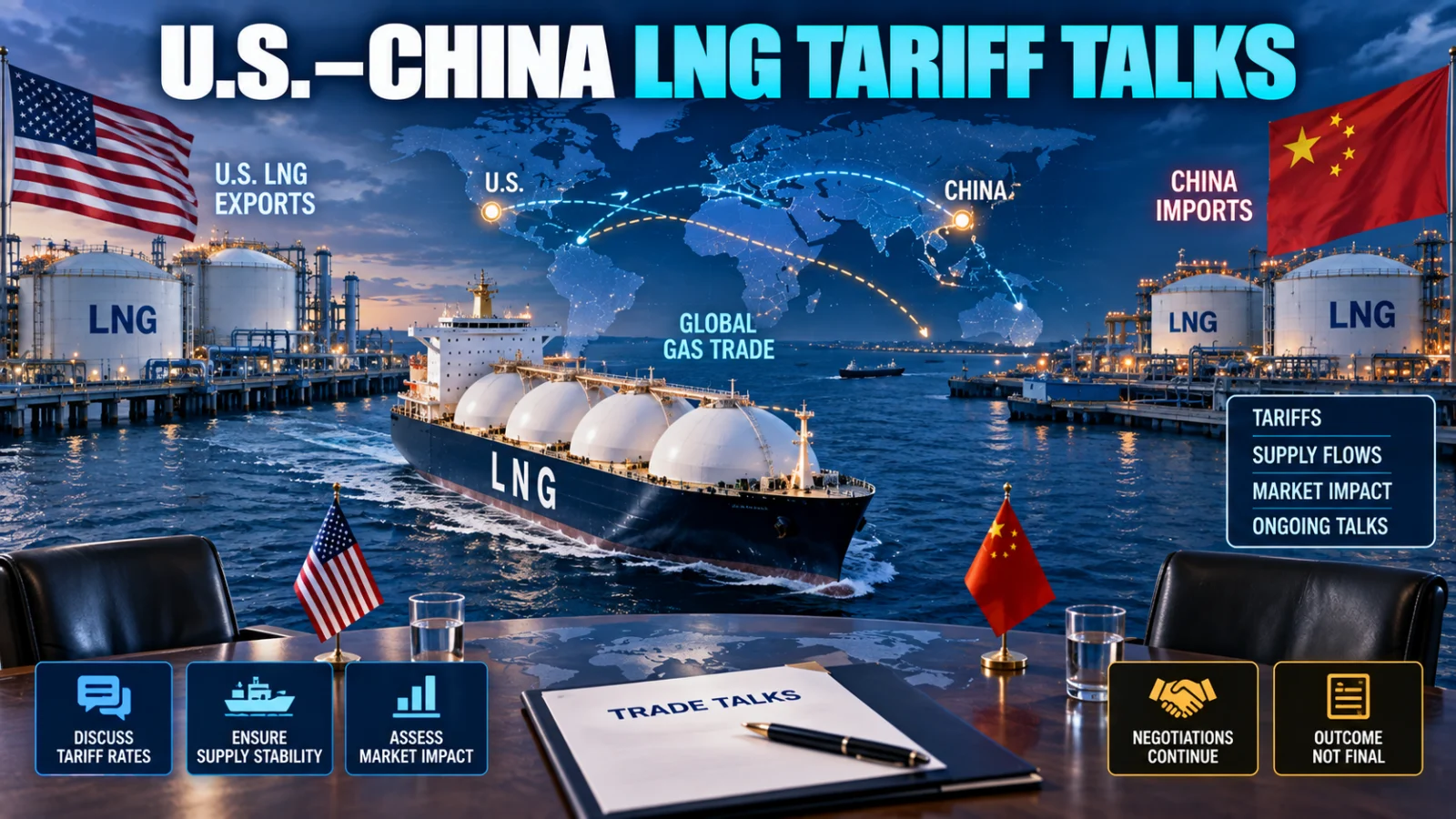
U.S.–China LNG tariff talks have moved into a new negotiation phase, but China has not announced that its 15% tariff on U.S. liquefied natural gas has been removed.
Direct answer: Reuters reports that U.S. and Chinese negotiators are discussing reducing or eliminating China’s 15% tariff on American LNG ahead of high-level trade talks. The proposal is not final. Until a controlling tariff or customs action says otherwise, the 15% tariff remains the current baseline.
Has China removed its 15% tariff on U.S. LNG?
No final removal has been announced in the evidence reviewed. The material change is that LNG tariff relief is now credibly reported as an active subject of U.S.–China negotiations.
That distinction matters because a negotiation can change market expectations without changing the tariff that applies to an actual cargo. A reported proposal, political discussion or commercial LNG contract does not by itself change customs treatment.
What are the U.S. and China discussing?
Reuters reported on September 18 that negotiators are considering reducing or eliminating China’s 15% tariff on U.S. LNG. The LNG issue is being discussed alongside a wider possible package of reciprocal tariff reductions before the next senior U.S.–China meeting.
The exact LNG tariff outcome remains unresolved. Public reporting does not establish whether negotiators are considering complete removal, a lower rate, a temporary exemption, a broader trade package or another mechanism.
Why does the 15% tariff matter?
The tariff materially changes the economics of sending U.S. LNG directly to Chinese buyers. Reuters reported that direct U.S.–China LNG trade fell sharply after the tariff was imposed, making U.S. cargoes less competitive for Chinese importers relative to alternatives.
For exporters, traders and buyers, the relevant question is therefore not simply whether diplomatic talks are taking place. It is whether the tariff applied to commercial cargoes actually changes.
What would prove that the tariff has really changed?
The strongest confirmation would be a controlling U.S. or Chinese government announcement, tariff schedule, customs notice or other implementing measure establishing the new treatment of U.S. LNG.
A credible political statement could strengthen the evidence, but readers making commercial decisions should still distinguish an announced negotiating agreement from the legal or customs step that determines what importers actually pay.
Do recent U.S. LNG cargoes to China prove the tariff is gone?
No. Reuters reported that some U.S. LNG cargoes have recently arrived in or headed toward China despite the existing tariff. Cargo movement can occur while a tariff remains in force.
The existence of trade therefore does not by itself prove normal tariff access has been restored. The more useful test is the applicable tariff treatment and whether official implementation has changed.
Does the China Gas–Venture Global deal mean tariff relief is already agreed?
No. China Gas announced a long-term LNG supply agreement with U.S.-based Venture Global while the tariff issue remained unresolved. Reuters reported that the agreement covers a 20-year supply period beginning in 2030.
A long-term contract can reflect expectations about future supply, pricing and market access without proving that today’s tariff has already been removed. The contract and the tariff negotiations are related to the broader U.S.–China LNG relationship, but they are not the same event.
What changed compared with the previous trade state?
The key change is that reducing or eliminating the LNG tariff is now reported as an active negotiation topic. Before that report, the practical answer was simply that the 15% tariff remained a significant barrier to normal direct U.S.–China LNG trade.
The new state is more nuanced: the tariff remains the current baseline, but negotiators are discussing a possible change that could materially alter U.S. LNG access to the Chinese market.
What has not changed?
- No final LNG tariff agreement has been publicly established in the evidence reviewed.
- No verified new tariff rate has been announced.
- No implementation date has been established.
- No confirmed LNG purchase commitment tied to tariff relief has been established.
- Commercial contracts or individual cargo movements do not independently prove tariff removal.
Who could be affected if the tariff is reduced?
A material tariff reduction could affect U.S. LNG producers and export projects, Chinese gas buyers, commodity traders, shipowners and other participants exposed to global LNG flows.
Lower tariff friction could make direct U.S. supply more commercially attractive to Chinese buyers. The eventual effect on prices, contract economics and shipping flows would still depend on the final tariff terms, global LNG prices, freight costs, contract structures and Chinese demand.
Could tariff relief immediately restore earlier U.S.–China LNG trade volumes?
That cannot be assumed. Removing or reducing a tariff can improve trade economics, but actual flows depend on buyer demand, available cargoes, long-term contracts, spot-market pricing, shipping economics and wider bilateral trade conditions.
Tariff relief would therefore be an important market-access change, not a guarantee of any specific volume of future LNG purchases.
What is the next important checkpoint?
The next major scheduled political checkpoint is the planned September 24 U.S.–China leaders’ meeting referenced in current reporting. Senior trade consultations ahead of that meeting may also clarify whether LNG tariff relief remains part of the negotiating package.
The strongest same-day update trigger for this page would be a formal tariff announcement, customs implementation notice or authoritative government statement giving specific LNG terms.
What should readers watch for?
- a confirmed new tariff rate for U.S. LNG entering China;
- whether relief is complete, partial or temporary;
- an effective date or customs implementation notice;
- any conditions tied to LNG purchases or broader reciprocal tariff concessions;
- evidence that direct U.S.–China LNG cargo flows increase materially after implementation.
What remains unknown?
The exact tariff rate under consideration, the legal mechanism for any relief, an effective date, the duration of any change, possible purchase commitments and the final outcome of the wider U.S.–China negotiations all remain unresolved.
Those unknowns are important because a reported negotiating position can change before an agreement is reached.
Verification note
ThePulseSignal reviewed Reuters reporting on the LNG tariff discussions, the wider U.S.–China trade consultations, commodity issues ahead of the planned September meeting and the separate China Gas–Venture Global LNG agreement. The evidence supports reporting that tariff relief is under discussion, but it does not support stating that China has already removed the tariff.
Bottom line
U.S.–China LNG tariff talks are active, but China’s 15% tariff on U.S. LNG has not been officially removed in the evidence reviewed. The current reader-safe position is that tariff relief is being discussed. A controlling government or customs action is still needed before TPS can describe a new tariff rate as implemented.