






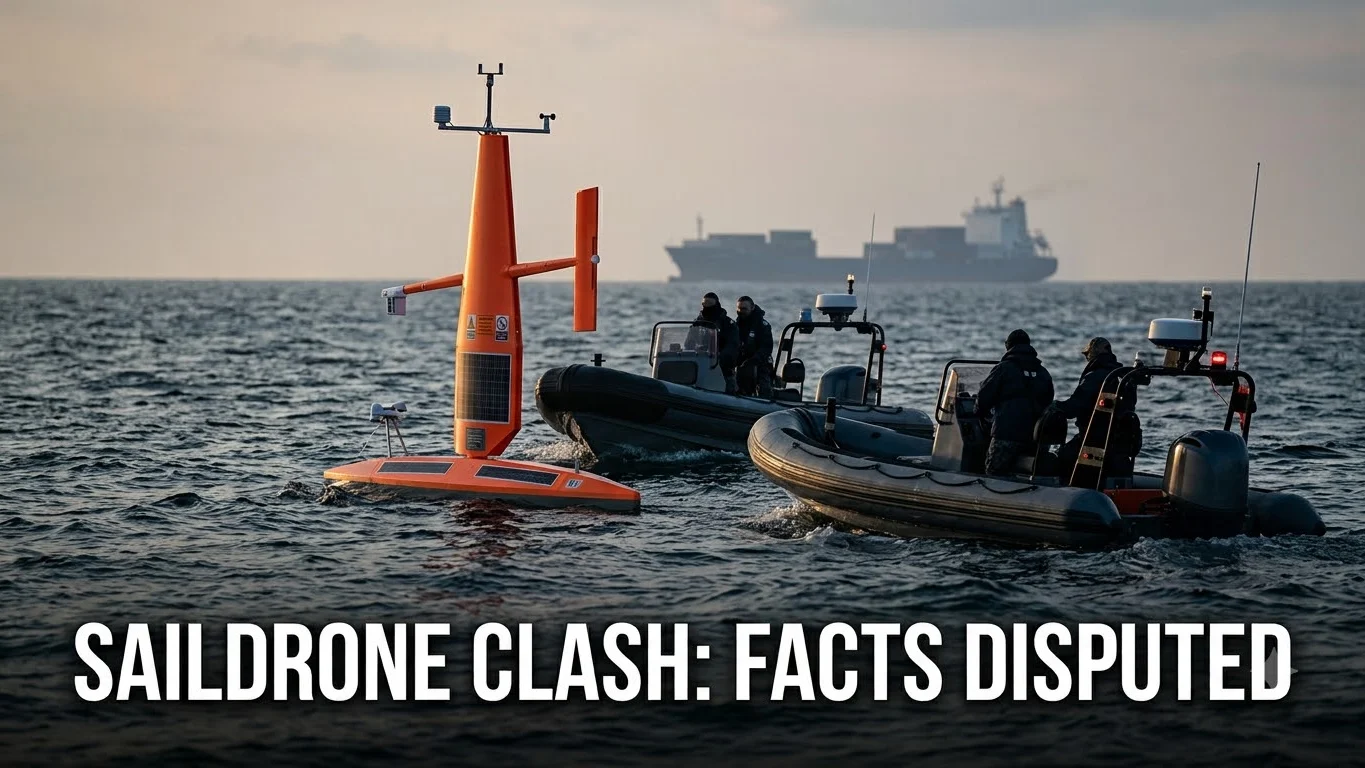
The US Iran Saildrone incident is confirmed as a real maritime confrontation, but the central reason for the U.S. strike remains disputed. U.S. Central Command says Iranian small boats tried to take possession of a U.S. unmanned surface vessel and that American forces responded. Iranian authorities describe the struck vessels as fishing boats and report missing fishermen.
Those accounts cannot currently be reconciled into one verified version. TPS did not find independent evidence establishing whether the two boats were military craft attempting to seize the Saildrone or civilian fishing vessels caught in the confrontation. The safest current reading is therefore to separate what both sides acknowledge from what each side claims.
What is confirmed about the US Iran Saildrone incident?
A U.S. Saildrone was involved in an encounter with two Iranian boats in waters near Hormozgan and the Strait of Hormuz. CENTCOM spokesman Capt. Tim Hawkins publicly acknowledged a confrontation and said U.S. forces responded forcefully. Iranian officials separately acknowledged that two boats were struck.
The shared factual core is narrower than some headlines suggest: there was a U.S.–Iran maritime encounter involving an unmanned U.S. surface vessel, two boats were struck, and the two sides disagree about who those boats were and what they were doing immediately beforehand.
What does CENTCOM say happened?
Associated Press reported Capt. Tim Hawkins, a U.S. Central Command spokesman, as saying Iranian small boats attempted to take possession of a U.S. unmanned surface vessel. According to that account, CENTCOM responded and the attempted seizure failed.
Hawkins also said the Saildrone remained under U.S. operational control and that CENTCOM’s surface drones were accounted for. TPS did not identify contrary evidence showing that Iran captured the Saildrone.
However, the attempted-seizure description remains a U.S. official claim. A standalone CENTCOM incident release, imagery or video independently demonstrating the boats’ actions immediately before the strike was not recovered in the completed R&D.
What does Iran say happened?
Iranian reporting cited Hormozgan deputy governor Ahmad Nafisi as describing the struck vessels as fishing boats near the Kargan and Larak Island area. Iranian authorities also reported that several fishermen were missing.
That account materially conflicts with the U.S. description of boats attempting to take control of the Saildrone. TPS cannot independently establish from the reviewed evidence whether the crews were civilian, military or mixed.
Were the boats IRGC vessels or civilian fishing boats?
That is not yet independently established. U.S.-official reporting describes the boats as Iranian vessels involved in an attempted seizure. Iranian authorities describe them as fishing craft.
Until stronger primary or independently verified evidence appears, TPS will not promote either description to an independently verified fact.
Were both boats destroyed?
Axios reported, citing U.S. officials, that an American drone fired two missiles and destroyed the boats. Other reports repeated the U.S. account of two boats being destroyed.
CENTCOM has acknowledged a forceful response, but TPS did not recover a standalone CENTCOM incident statement specifying the exact strike platform, weapons used or complete engagement sequence. Those mechanics should therefore remain attributed rather than presented as independently verified.
What is known about casualties or missing people?
Iranian authorities reported missing fishermen. Axios separately reported U.S. officials as saying most people aboard the boats were killed.
The exact number, identities and civilian or military status of the people aboard remain unresolved in the evidence reviewed. TPS is therefore not using a definitive casualty total.
Was the Saildrone captured?
CENTCOM says no. Hawkins said the unmanned surface vessel remained under U.S. control and that the command’s surface drones were accounted for.
No reviewed source established that Iran successfully took possession of the Saildrone.
Did this incident close or further restrict the Strait of Hormuz?
No incident-specific evidence reviewed by TPS establishes a new Strait of Hormuz closure or commercial-shipping restriction caused by this confrontation.
The wider Gulf already has significant military and commercial-shipping disruption, but that broader operating picture should not be attributed to this Saildrone encounter without separate evidence.
Why the conflicting accounts matter
The difference is not a minor wording dispute. If the U.S. account is correct, the episode involved an attempted seizure of an American unmanned military asset followed by a U.S. defensive response. If the Iranian account is correct, the strike hit civilian fishing vessels.
Those versions imply very different legal, military and escalation consequences. That is why the unresolved vessel identity and pre-strike activity are the most important facts still missing.
What evidence could resolve the dispute?
- A formal CENTCOM incident release with imagery, video or a detailed timeline.
- An Iranian military or IRGC statement identifying the vessels and their mission.
- Names or identities of the crews and a verified casualty or rescue record.
- Independently geolocated footage showing the boats and Saildrone immediately before the strike.
- Satellite, maritime-tracking or other independently verified evidence establishing the location and sequence.
Bottom line
A U.S.–Iran confrontation involving a Saildrone and two Iranian boats did occur, but the central explanation for the strike is still disputed. CENTCOM says the boats tried to take control of the U.S. unmanned vessel. Iranian authorities say fishing boats were attacked and fishermen went missing.
TPS cannot currently determine which account accurately describes the vessels or their actions immediately before the strike. Until stronger evidence appears, definitive claims that Iran tried to seize the Saildrone or that the U.S. knowingly struck civilian fishing boats should remain attributed claims rather than settled fact.
Verification note
TPS compared the directly attributed CENTCOM spokesman account carried by Associated Press with Axios reporting based on U.S. officials and Iranian-side reporting citing the Hormozgan deputy governor, then checked whether the available evidence independently resolved vessel identity, capture status, casualties or commercial-shipping impact.
Limitations and unresolved facts
No standalone CENTCOM incident release or independently verified imagery resolving the pre-strike conduct was recovered in the completed R&D. Boat ownership, crew status, exact strike mechanics, casualty totals and the actions immediately before the engagement remain unresolved. No new commercial-shipping closure or restriction was established as a consequence of this incident alone.