







Vite CVE-2026-39364 is now an active exploitation issue, not only an older vulnerability disclosure. Singapore’s Cyber Security Agency says the flaw is being actively exploited, while F5 Labs has reported mass scanning of exposed Vite development servers for sensitive files including environment configuration, cloud credentials and infrastructure-as-code state.
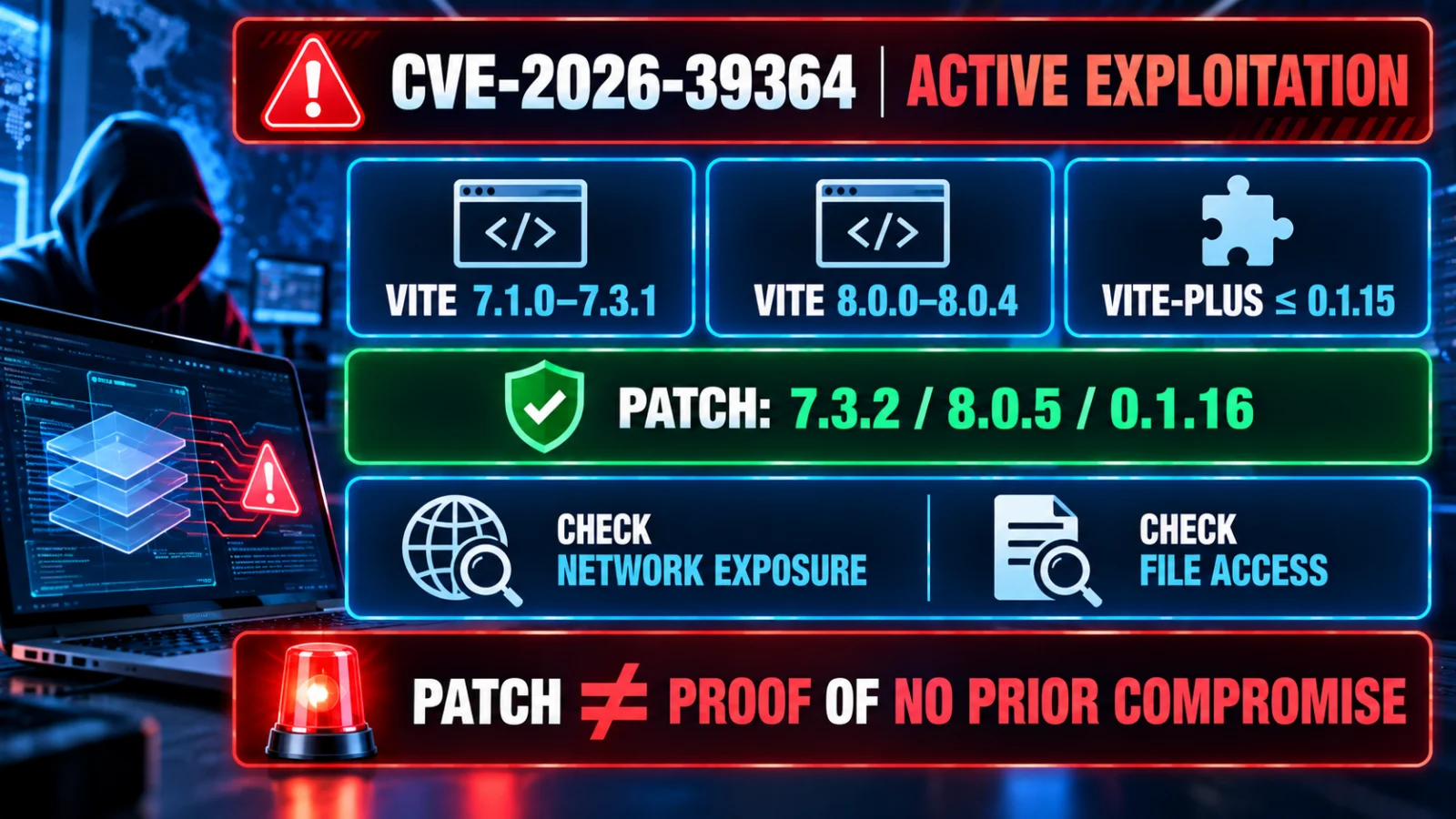
Direct answer: If you run Vite 7.1.0 through 7.3.1, Vite 8.0.0 through 8.0.4, or Vite-plus 0.1.15 or earlier, update immediately. The Vite advisory lists Vite 7.3.2, Vite 8.0.5 and Vite-plus 0.1.16 as patched. A vulnerable version alone does not prove compromise: the development server must also meet the advisory’s exposure conditions, and a successful attack must be established separately from vulnerability or scanning evidence.
Which Vite versions are affected by CVE-2026-39364?
The vendor advisory identifies the following affected version ranges:
- Vite 7.1.0 through 7.3.1
- Vite 8.0.0 through 8.0.4
- Vite-plus 0.1.15 and earlier
The corresponding patched releases identified in the advisory are Vite 7.3.2, Vite 8.0.5 and Vite-plus 0.1.16. Administrators should prefer the latest supported release in their applicable branch rather than treating the first patched release as a permanent target.
When is a Vite development server actually exposed?
CVE-2026-39364 does not mean every Vite installation is remotely exploitable. The Vite advisory describes conditions that must exist for remote exploitation of the file-access bypass.
The development server must be deliberately reachable beyond the default local-only context, such as through the --host option or server.host configuration. The requested file must also fall within the relevant server.fs.allow and server.fs.deny conditions described by the advisory.
This distinction matters because an administrator should not jump directly from an affected package version to a conclusion that an internet attacker could reach that specific deployment.
What does CVE-2026-39364 allow an attacker to do?
The vulnerability is an access-control bypass affecting Vite’s development-server file restrictions. Under the affected configuration, a remote unauthenticated requester can retrieve files that should have been blocked by server.fs.deny.
The security consequence depends on which files are present and readable in the affected environment. Development systems frequently contain configuration data, environment variables, cloud credentials or infrastructure information that may have much greater impact than ordinary source files.
What attackers are scanning for
F5 Labs reported mass scanning of exposed Vite endpoints and attempts to retrieve sensitive files. Observed targets included .env files, AWS and Azure credential-related material, Terraform state and other configuration or environment data.
Those observations establish attacker interest and active probing. They do not establish that every request succeeded or that every exposed Vite deployment lost credentials.
Vulnerable does not mean confirmed compromised
There are three separate states that should not be collapsed into one:
Your Vite or Vite-plus release falls inside the vulnerable version range. This establishes patch applicability, not attacker access.
The development server was reachable over the network and the advisory’s file-access conditions were present. This creates a credible remote-exploitation path.
Logs, requests, cloud events or other forensic evidence indicate that a sensitive file or credential may actually have been retrieved or used. This moves the problem beyond patching into incident response.
This is why patching and compromise assessment are related but separate tasks. Installing a fixed release removes the known vulnerable behavior going forward; it does not prove that an exposed server was untouched before the update.
What affected administrators should do now
First, identify the Vite or Vite-plus version in use and update affected deployments to a patched or newer supported release. CSA advises affected users to update immediately because exploitation is active.
Second, determine whether the development server was exposed beyond a trusted local environment. Review whether --host, server.host, a reverse proxy, container ingress, cloud security rule, development tunnel or another networking path made the service reachable to untrusted clients.
Third, if the server was exposed while vulnerable, treat patching as the start of the investigation rather than proof that the issue is closed. Review available access logs, reverse-proxy records, cloud telemetry and other evidence for suspicious file requests or downstream credential use.
Should every Vite user rotate cloud credentials?
The reviewed evidence does not support a universal rule that every user of an affected Vite version must rotate every credential. F5’s telemetry shows that attackers are actively searching for credential-bearing files, but vulnerability or exposure alone does not prove those files were successfully retrieved.
If investigation shows that a sensitive file may have been exposed, or if relevant logs are unavailable and the potential impact is high, the situation should be escalated according to the organization’s incident-response and secret-management procedures rather than treated as a simple software-update task.
What if the Vite server only listened locally?
The Vite advisory’s remote exploitation conditions matter. A development server that was not made reachable to untrusted network clients is in a materially different exposure state from an internet-facing development server. Administrators should still update an affected version, but they should not describe a local-only deployment as remotely compromised without supporting evidence.
Why exposed development servers are valuable targets
Development servers can contain information that would rarely be intentionally exposed by a production application: environment files, deployment configuration, cloud access material, infrastructure state and service credentials. A file-read vulnerability therefore has the potential to become a broader cloud or infrastructure incident if useful secrets are successfully obtained.
That downstream consequence must still be verified deployment by deployment. TPS found evidence of active probing for those materials, not evidence that every scanned organization suffered a cloud takeover.
What TPS verified
TPS reviewed the Vite security advisory for the vulnerability conditions and exact patched releases, Singapore CSA’s current exploitation alert, and F5 Labs telemetry describing mass scanning and targeted file types. The evidence supports an active-exploitation warning and immediate patching, while preserving the distinction between vulnerable, exposed and proven compromised states.
What could change next
The current answer should be updated if CISA adds CVE-2026-39364 to the Known Exploited Vulnerabilities catalog, Vite revises the affected or fixed versions, CSA or F5 publishes new exploitation findings, reliable indicators of compromise become available, or confirmed downstream credential abuse materially changes the incident-response boundary.