






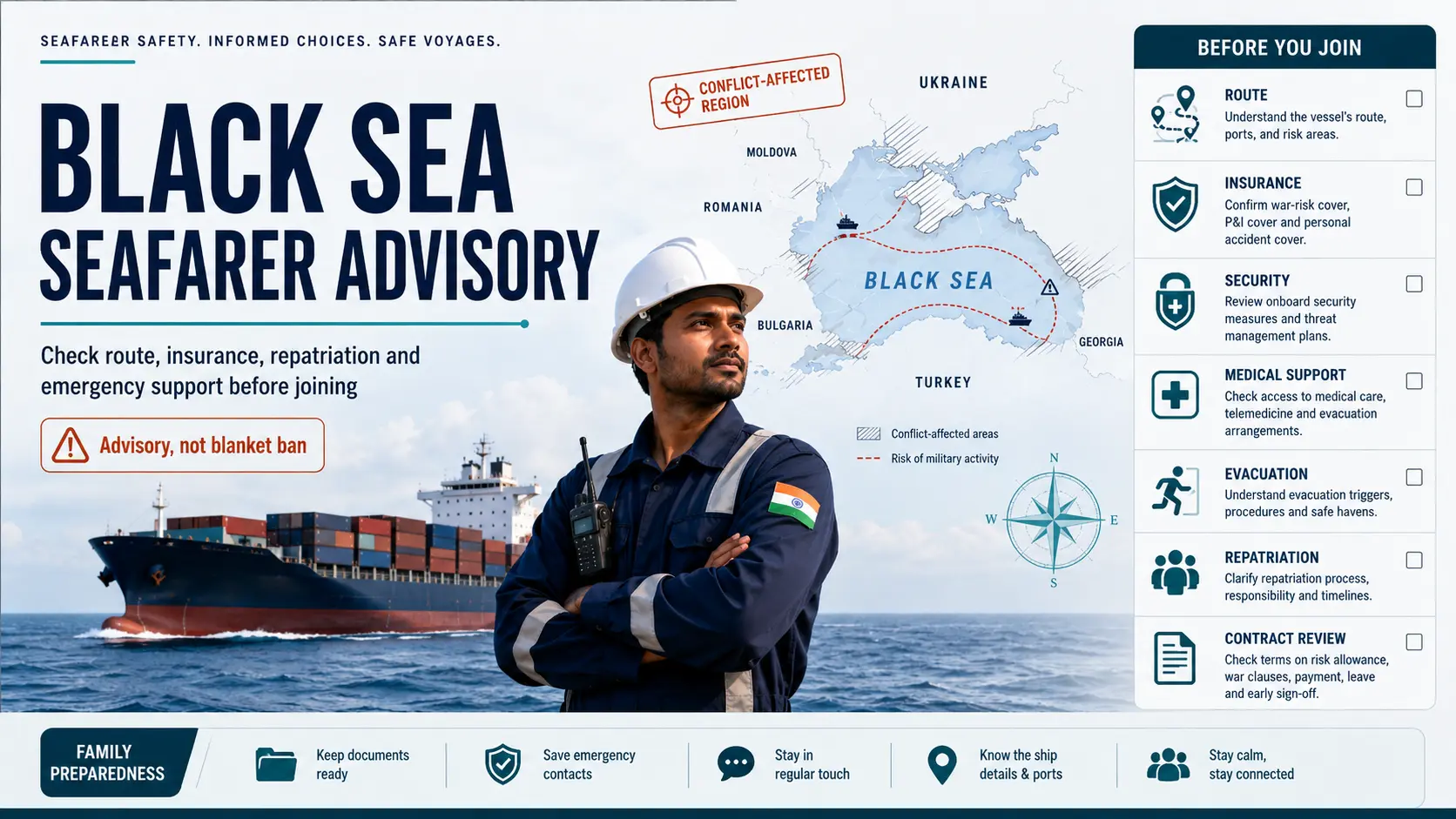
Indian seafarer Black Sea advisory guidance now requires far more careful pre-joining checks than a normal overseas ship assignment.
The Ministry of External Affairs and DG Shipping have warned Indian nationals and shipping stakeholders about the increased security risk to commercial vessels operating in or transiting the Black Sea and adjoining conflict-affected waters.
The direct answer
The official advisories do not establish a blanket ban on Indian seafarers joining every vessel connected with the Black Sea.
They place a higher verification burden on the worker, recruiter, shipowner and family. Before accepting or continuing an assignment, the seafarer should obtain written information about the vessel’s route, ports of call, security arrangements, insurance, medical support, evacuation, repatriation and compensation terms.
DGMA also launched a Seafarer Tracking Module on the e-NAVIK portal on September 4, 2026 for enhanced monitoring of Indian seafarers serving on Indian-flagged and foreign-flagged vessels operating in high-risk areas. The module is intended to strengthen coordination and prompt response during maritime-security incidents or emergencies.
Risk can vary by port, route, vessel, flag, cargo, current conflict conditions and the contractual framework covering the crew. A job offer should be assessed against the actual voyage—not only the region name.
In this guide
- What the two advisories establish
- Is Black Sea employment banned?
- Pre-joining safety checklist
- How to verify the recruiter
- What to check in the contract
- Insurance and compensation
- War-risk pay and refusal rights
- What families should keep ready
- e-NAVIK Seafarer Tracking Module
- Emergency and grievance routes
- What to do if contact is lost
- Frequently asked questions
What do the July 23 and July 26 advisories establish?
| Official body | Date | What the notice establishes | What the seafarer should do |
|---|---|---|---|
| Directorate General of Shipping | July 23, 2026 | Maritime-security advisory for Indian ships and foreign-flagged vessels carrying Indian seafarers operating in or transiting the Black Sea | Check the vessel, company, recruiter, route, onboard safety framework and grievance routes |
| Ministry of External Affairs | July 26, 2026 | Employment and safety advisory for Indian nationals considering commercial-vessel work in the Black Sea region | Assess risk before accepting employment and keep family and consular-support arrangements ready |
The MEA advisory states that attacks on commercial shipping had increased since April 2026 and had resulted in the deaths of five Indian nationals.
The public material reviewed does not identify the victims, employers, vessels or exact attack circumstances. Those details should not be inferred.
Is employment on a Black Sea vessel prohibited?
No blanket deployment prohibition was identified in the official material reviewed.
The correct interpretation is:
- the risk level is materially higher than an ordinary commercial route;
- the seafarer should not accept a vague or incomplete offer;
- the company and recruiter should disclose the expected route and safety arrangements;
- the contract and applicable collective agreement must be reviewed before joining;
- the risk should be reassessed if the route changes after joining.
The advisory raises the standard of due diligence. It does not transform every Black Sea-linked voyage into the same legal or operational category.
Black Sea pre-joining safety checklist
| Before accepting or continuing the job | Evidence to obtain | Why it matters |
|---|---|---|
| Vessel route | Written expected itinerary and intended ports of call | The actual route determines the practical exposure |
| Conflict-zone exposure | Written confirmation whether the vessel enters a current warlike or high-risk area | Contractual benefits and refusal rights may depend on the designated area |
| Recruiter legitimacy | Current RPSL licence details and direct company contact | Reduces dependence on informal or unverified intermediaries |
| Employment framework | Seafarer Employment Agreement, CBA and company policies | Actual pay, insurance and repatriation rights usually sit in these documents |
| Security arrangements | Company and shipboard security procedures | Shows how threats, route changes and emergencies are managed |
| Insurance | Written injury, disability, death, P&I and applicable war-risk coverage | Verbal assurances are difficult to enforce after an incident |
| Medical support | Onboard care, telemedical support and medical-transfer procedure | Conflict conditions may delay access to shore treatment |
| Evacuation | Trigger, authority, safe haven and transport procedure | Clarifies what happens when the voyage cannot continue safely |
| Repatriation | Who pays, when it applies and the destination | Prevents later disputes over cost and responsibility |
| Compensation | Exact death, disability and injury benefits and nominated beneficiary details | Families need written terms, not only a general insurance statement |
| Emergency escalation | Master, company, recruiter, e-Navik, MADAD and Indian mission routes | Families need a sequence for escalating a crisis |
How can a seafarer verify the recruitment agency?
Recruitment and placement of seafarers in India should be handled through a valid Recruitment and Placement Services Licence holder.
Before paying, signing or travelling:
- Ask for the agency’s full legal name and RPSL number.
- Check the current DG Shipping/DGMA valid, invalid and temporarily suspended RPSL list.
- Match the licence-holder name with the company issuing the offer.
- Contact the licensed company directly if an informal sub-agent or WhatsApp contact is involved.
- Keep receipts and written communication.
- Do not surrender original documents to an unverified intermediary.
The legal entity appearing on the offer, employment contract and licence record should be checked against the current official list.
What should the employment contract disclose?
The contract should not use vague phrases such as “worldwide trading” as the only response to a known conflict-zone assignment.
Ask for clarity on:
- expected trading area and ports;
- right to notify crew of route changes;
- applicable CBA or union agreement;
- risk allowance or bonus, where applicable;
- leave or early-sign-off terms;
- medical treatment and shore transfer;
- evacuation and safe-haven arrangements;
- repatriation responsibility;
- death, injury and disability compensation;
- nominated beneficiary details;
- grievance and dispute-escalation process.
What insurance should be checked?
The official advisory tells seafarers to examine insurance and compensation arrangements before joining.
That should be converted into written questions:
Personal accident cover
What injury, permanent disability and death benefits apply to the seafarer?
P&I or employer liability
Which insurer or club responds to crew injury, illness, death and repatriation claims?
War-risk extension
Does the coverage remain valid for the intended route and current conflict conditions?
Beneficiary details
Who is recorded to receive death compensation, and are the details current?
Do not assume that “the ship is insured” automatically proves that every crew risk, exclusion and family benefit is covered.
Are double wages or refusal rights guaranteed?
Not universally.
Some seafarers working under an applicable IBF, ITF or other collective agreement may receive additional war-risk pay, enhanced death or disability compensation, refusal rights or company-paid repatriation when the vessel enters a currently designated area.
These benefits depend on:
- the vessel’s agreement;
- the exact designated area;
- the dates for which the designation applies;
- the route actually followed;
- the wording of the Seafarer Employment Agreement and CBA.
Ask the employer to identify the exact clause and agreement that applies to the vessel.
What should the family keep ready?
Before the seafarer travels, the family should securely keep:
- passport copy;
- CDC and seafarer identity details;
- employment contract and CBA;
- RPSL agency details;
- ship name, IMO number and flag;
- shipowner and manager details;
- expected joining port and itinerary;
- insurance and compensation documents;
- beneficiary and nominee records;
- company emergency contact;
- e-Navik grievance reference details;
- MADAD login or grievance details if a case is filed.
Families should agree on a realistic contact routine. A temporary communication gap at sea does not automatically prove an emergency, but an unexplained gap combined with a route incident should be escalated promptly.
What changed with the e-NAVIK Seafarer Tracking Module?
DGMA Circular 56 of 2026, issued on September 4, 2026, launched a Seafarer Tracking Module on the e-NAVIK portal for enhanced monitoring of Indian seafarers serving aboard Indian-flagged and foreign-flagged vessels operating in high-risk areas.
DGMA says the module is intended to strengthen coordination and prompt response if a maritime-security incident or emergency occurs. For a Black Sea assignment, this makes accurate vessel, voyage, recruiter and crew information more important rather than less important.
Before joining, make sure the employer and licensed recruiter have the seafarer’s correct identity, vessel, voyage and current contact information in the systems and records they are required to maintain. The tracking module supports official coordination; it does not replace the seafarer’s contract, family contact plan, e-Navik grievance route or MADAD consular route.
Which official emergency and grievance routes should be used?
| Situation | Primary route | What to prepare |
|---|---|---|
| Seafarer grievance, abandonment, missing crew, wages, welfare or maritime crisis | DG Shipping/DGMA e-Navik 24×7 grievance redressal system | Seafarer details, CDC, vessel, company, RPSL, contract and incident chronology |
| Consular assistance or overseas grievance | MEA MADAD portal | Passport, location, vessel, employer, mission jurisdiction and supporting records |
| Immediate incident on board | Master, ship security officer and company’s emergency contact | Location, incident type, persons affected and urgent need |
| Family cannot locate the seafarer | Company and RPSL first, followed by e-Navik and the relevant Indian mission/MADAD | Last contact, vessel, route, IMO number and employment documents |
| Suspected recruitment fraud | DG Shipping/DGMA grievance route and relevant law-enforcement channel | Offer letter, payment proof, phone numbers, messages and licence claims |
Emergency phone numbers should be taken from the current official advisory or mission page at the time of use. Do not rely on a copied social-media directory or an older screenshot.
What should families do if contact with the vessel is lost?
- Record the exact date, time and method of the last contact.
- Contact the ship-management company and licensed RPSL agency.
- Ask for the vessel’s current operational status and next expected contact point.
- Keep the ship name, IMO number, flag and expected route ready.
- Register an e-Navik grievance if the company response is inadequate or the case is urgent.
- Register the consular grievance on MADAD and contact the relevant Indian mission where appropriate.
- Preserve the grievance IDs and every follow-up response.
- Do not publicly disclose operational security details that could increase risk to the ship or crew.
What the advisory does not confirm
- It does not identify the five deceased Indian nationals.
- It does not identify every affected vessel or employer.
- It does not establish that every Black Sea port has the same risk.
- It does not create one universal war-risk wage rate.
- It does not create a universal 30-day refusal right.
- It does not prove that every financial sponsor or recruiter statement is contractually enforceable.
- It does not replace the vessel’s contract, CBA, flag-state rules or current security notices.
Indian seafarer Black Sea advisory: frequently asked questions
Has India banned seafarers from joining Black Sea vessels?
No blanket ban was identified in the official material reviewed. The advisories require a much stronger risk, route, contract and support assessment.
Does the advisory apply to foreign-flagged ships?
Yes. The DG Shipping advisory explicitly covers foreign-flagged vessels carrying Indian seafarers as well as relevant Indian ships.
Must the employer disclose the intended route?
The official advisory tells seafarers to obtain information on the intended route and ports of call before accepting employment. Ask for it in writing.
Is double wage guaranteed?
No universal entitlement was established. Additional pay may depend on the current designated risk area and the vessel’s applicable CBA or collective agreement.
Can a seafarer refuse conflict-zone transit?
That depends on the applicable contract, CBA and current designated-area framework. Ask for the exact clause before joining.
How can the family verify the recruiter?
Check the agency’s exact legal name and RPSL number against the current DG Shipping/DGMA valid, invalid and suspended list.
Where should a family register a missing-seafarer grievance?
Use the company and RPSL route immediately, then e-Navik for maritime grievance escalation and MADAD or the relevant Indian mission for consular support.
Should emergency numbers be copied from WhatsApp?
No. Verify the current number on the official MEA, DG Shipping, e-Navik or Indian mission page at the time of use.
Official sources and verification routes
- MEA advisory for Indian nationals undertaking employment on commercial vessels operating in the Black Sea region
- DG Shipping Black Sea maritime-security advisory listing
- Official RPSL validity and suspension list
- e-Navik 24×7 seafarer grievance mechanism
- e-Navik grievance portal
- MEA MADAD consular grievance portal
- DGMA maritime-security page listing Circular 56 of 2026 on the e-NAVIK Seafarer Tracking Module
Verification and editorial limitation
Confirmed: MEA’s Black Sea employment advisory is dated July 26, 2026.
Confirmed: DG Shipping issued a related maritime-security advisory dated July 23, 2026 for Indian ships and foreign-flagged vessels carrying Indian seafarers.
Confirmed: The advisories require serious attention to route, security, insurance, medical care, evacuation, repatriation and compensation arrangements.
Confirmed: e-Navik provides a 24×7 maritime grievance mechanism, and MADAD provides consular grievance filing and tracking.
Confirmed: DGMA Circular 56 of 2026 launched a Seafarer Tracking Module on e-NAVIK on September 4, 2026 for Indian seafarers serving on Indian-flagged and foreign-flagged vessels in high-risk areas.
Conditional: Extra war-risk pay, refusal rights and enhanced compensation may apply where a current collective agreement or designated-risk framework covers the vessel and route.
Not confirmed: A blanket Indian government deployment ban, a universal double-wage entitlement, a 30-day refusal right or one fixed emergency-number directory valid for every route.
Last verified: September 15, 2026.
Limitation: Conflict conditions, route plans, insurance terms, collective agreements, vessel status and mission contacts can change rapidly. This article is a public-service checklist, not a personalised maritime or legal determination.