






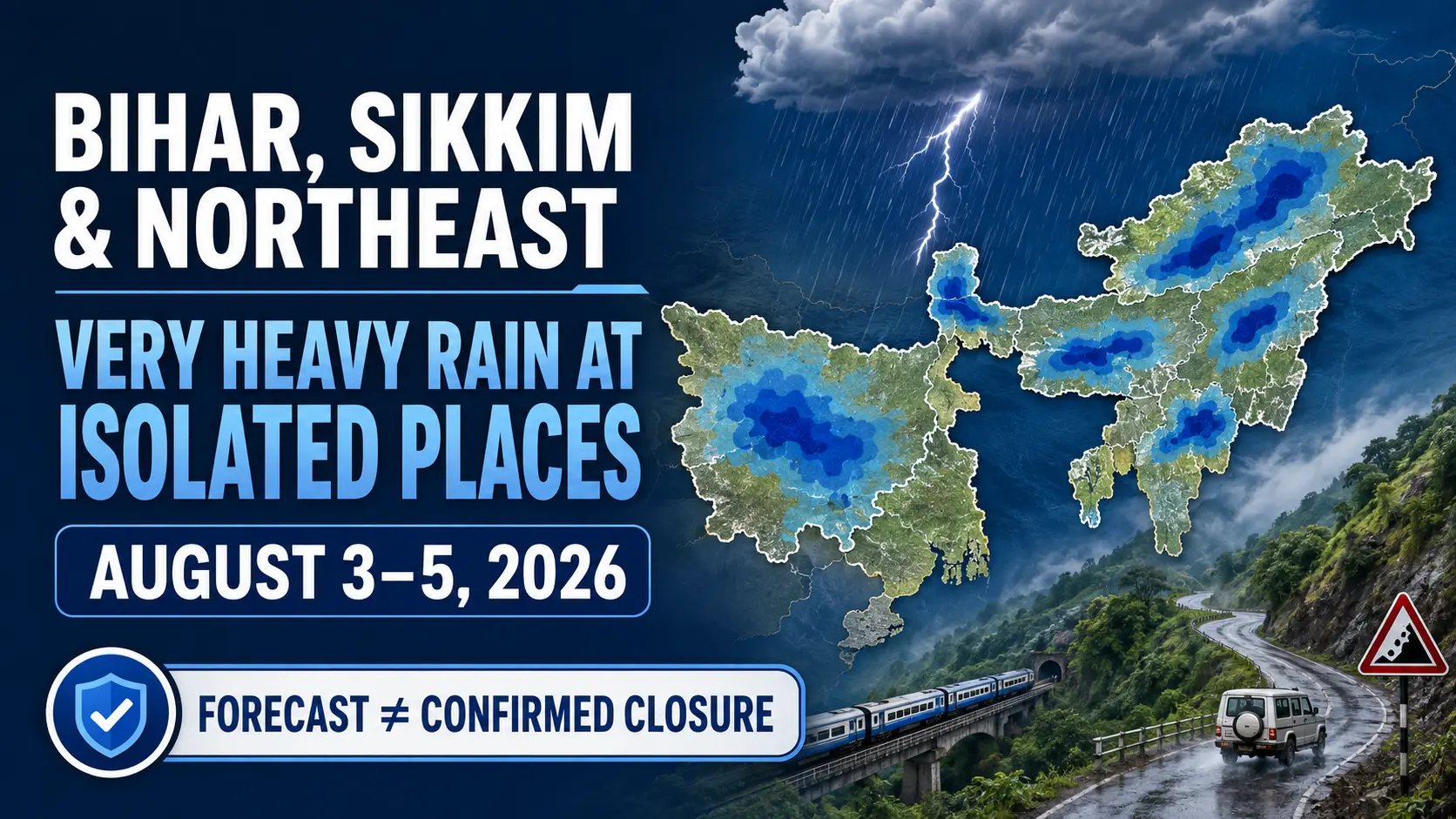
The latest Bihar Sikkim Northeast rain warning places different regions under higher rainfall risk on different dates between August 3 and August 5, 2026. The India Meteorological Department forecasts very heavy rainfall at isolated places, but that does not mean every district will receive the same intensity or that transport services are already disrupted.
Direct answer: Bihar faces isolated very heavy rain on August 3. Arunachal Pradesh faces a higher-risk period on August 3 and 4. Assam, Meghalaya, Nagaland, Manipur, Mizoram and Tripura face isolated very heavy rain on August 4. Sub-Himalayan West Bengal and Sikkim remain under isolated heavy-to-very-heavy rainfall risk through August 5.
People travelling through the affected regions should check their exact district, road, railway, airport and destination status before departure. A national forecast describes weather risk; it does not confirm that a specific highway, train, flight, school or tourist site is closed.
Where is very heavy rain forecast from August 3 to 5?
IMD’s national press release issued at 1:50 PM IST on August 2 says rainfall activity is expected to increase along the foothills of the central and eastern Himalayas during the following four to five days. The same forecast identifies a separate increase over Northeast India.
Very heavy rain at isolated places over Bihar, Sub-Himalayan West Bengal and Sikkim, and Arunachal Pradesh.
Very heavy rain at isolated places over Arunachal Pradesh, Assam and Meghalaya, Nagaland, Manipur, Mizoram and Tripura, and Sub-Himalayan West Bengal and Sikkim.
Heavy to very heavy rain remains possible at isolated places over Sub-Himalayan West Bengal and Sikkim, with continuing heavy-rain risk elsewhere in parts of east and Northeast India.
Heavy rainfall also remains possible over Uttarakhand, Himachal Pradesh and parts of Uttar Pradesh and northwest India during portions of the forecast period. However, these areas should not be described as facing exactly the same rainfall intensity or peak date as Bihar, Sikkim or the Northeast states.
What does “very heavy rain at isolated places” mean?
“At isolated places” is an important qualification. It means the forecast intensity is expected at a limited number of locations within the named meteorological region, not across the entire state.
The forecast does not mean:
- every district will receive very heavy rain;
- rain will remain equally intense throughout the day;
- all roads in the state will face landslides or flooding;
- every train or flight will be cancelled;
- every school or government office will close; or
- all tourist destinations must shut.
Do not remove the words “at isolated places” when sharing the forecast. Saying that an entire state will receive very heavy rain materially changes the meaning of IMD’s warning.
Bihar rain warning for August 3
IMD forecasts isolated very heavy rainfall over Bihar on August 3. Widespread rainfall is expected over the state during the broader forecast period, and thunderstorms or lightning may also occur in parts of the region.
Residents and travellers should verify:
- the latest district-level warning;
- urban waterlogging advisories;
- local river and embankment information;
- train delays or diversions issued by the railway;
- district administration notices; and
- school or office orders issued locally.
A statewide IMD forecast does not establish that a particular river is above warning level or that a particular district has ordered a closure.
Sikkim and north Bengal rain warning through August 5
Sub-Himalayan West Bengal and Sikkim remain one of the more persistent risk areas in the forecast. Isolated heavy-to-very-heavy rainfall is expected through August 5.
This matters for travellers because repeated rainfall can affect:
- hill roads and landslide-prone slopes;
- routes between Siliguri and Sikkim;
- local bridges and low-lying stretches;
- tourist access roads;
- airport transfers; and
- return journeys after the heaviest rainfall has passed.
These are forecast risks, not confirmed closures. A road should be described as closed only after the relevant district administration, police, road authority or another official source confirms its operating status.
When does Northeast India face the higher rainfall risk?
Arunachal Pradesh
Arunachal Pradesh faces isolated very heavy rainfall on August 3 and August 4. Travellers should verify local road and district conditions because a statewide forecast cannot identify whether a particular route is safe or operational.
Assam and Meghalaya
Assam and Meghalaya face isolated very heavy rainfall on August 4. Heavy rainfall may occur on surrounding dates, but August 4 is the more clearly identified very-heavy-rain day in the national forecast reviewed for this article.
Nagaland, Manipur, Mizoram and Tripura
These four states face isolated very heavy rainfall on August 4. Readers should check district warnings and confirmed road or transport advisories rather than treating the entire four-state region as uniformly affected.
Date distinction: The Northeast warning does not peak everywhere on August 3. The national forecast places the clearer very-heavy-rain signal for Assam, Meghalaya, Nagaland, Manipur, Mizoram and Tripura on August 4.
Does an orange or red colour mean travel is banned?
No. IMD warning colours communicate the level of weather preparedness or action required. They do not automatically create a legal road closure, school closure, tourist ban or transport cancellation.
IMD also states on its warning bulletin that red colouring means “Take Action” and does not by itself mean that authorities have formally declared a “red alert.”
Administrative action must be checked separately through:
- district administration orders;
- state disaster-management authorities;
- traffic police or highway authorities;
- railway service notices;
- airport or airline notifications;
- tourism department advisories; and
- school or education department orders.
Are highways, trains or flights already disrupted?
The national forecast itself does not confirm a specific highway closure, railway cancellation, airport shutdown or tourist restriction across the article’s full geographic area.
IMD identifies possible impacts such as localised landslides, mudslides, waterlogging, low-lying flooding and disruption to road, rail or helicopter services. These are expected hazards that may occur where intense rain develops. They are not proof that every listed disruption has already happened.
Verification rule: Treat a named road, train, flight, school or tourist-site disruption as confirmed only when the responsible authority or operator publishes a current notice.
How should travellers verify conditions before leaving?
- Check the district forecast. State-level wording may be too broad for a route decision.
- Check the exact road. Look for a current police, district, highway or public works notice.
- Check the transport operator. Use the railway, airline, airport or bus operator’s own status notice.
- Contact the destination. Confirm whether the hotel, institution, tourist site or event remains operational.
- Verify the return route. Repeated rain can cause delayed landslides or water-level rises after the outward journey.
- Recheck shortly before departure. Hill-road and local flood conditions can change faster than the national forecast cycle.
When should a traveller reconsider the journey?
A state-level rain warning alone does not automatically require cancellation. Reconsider or postpone the journey when one or more of the following is confirmed:
- the district administration advises against non-essential travel;
- the exact road is closed or movement is restricted;
- the railway, airline or airport cancels or suspends the service;
- the destination confirms closure;
- a river or local flood warning affects the route;
- the return route is uncertain; or
- night travel would pass through an active landslide-prone corridor during heavy rain.
Lightning and local flooding precautions
IMD also warns of moderate-to-intense lightning over parts of Bihar, Jharkhand and Sub-Himalayan West Bengal and Sikkim during the opening phase of the forecast period.
During thunderstorms:
- move indoors when thunder is heard;
- avoid sheltering under isolated trees;
- stay away from exposed hilltops and open fields;
- do not cross flooded or overtopped roads;
- avoid standing near damaged electrical infrastructure; and
- follow local evacuation or traffic instructions immediately.
Why older search results can be misleading
Search results for August rainfall warnings can include reports from earlier years with similar state names and weather language. An older article may mention a red alert, road closure or extreme-rain episode that does not apply to August 2026.
Before relying on a result, check:
- the publication year;
- the bulletin issue time;
- the forecast-validity period;
- the named state and district; and
- whether the page reports a forecast or an actual disruption.
Frequently asked questions
Will all of Bihar receive very heavy rain on August 3?
No. IMD forecasts very heavy rain at isolated places over Bihar. Rainfall intensity can differ significantly among districts and locations.
Which Northeast states face very heavy rain on August 4?
IMD identifies Arunachal Pradesh, Assam, Meghalaya, Nagaland, Manipur, Mizoram and Tripura for isolated very heavy rainfall on August 4.
Is Sikkim under a rain warning until August 5?
Yes. The national forecast supports isolated heavy-to-very-heavy rainfall over Sub-Himalayan West Bengal and Sikkim through August 5. District and route conditions should still be checked separately.
Does an orange warning mean roads are closed?
No. It indicates a higher weather-risk and preparedness level. A road closure requires a separate notice from the responsible district, police, highway or road authority.
Should travellers cancel all trips to Sikkim or Northeast India?
Not solely because of the national forecast. Check the district warning, exact route, transport service, destination and return-route status. Postpone when authorities advise against travel or the actual route is disrupted.
Does red colouring on an IMD map always mean a red alert?
No. IMD states that red colouring means “Take Action” and does not automatically mean authorities have formally used the phrase “red alert.”
Are trains and flights already cancelled?
The IMD forecast does not itself confirm a cancellation. Check current notices from Indian Railways, the airline, the airport or another responsible operator.
Verification notes to readers
The rainfall dates and intensity descriptions in this article come from the India Meteorological Department’s August 2, 2026 national press release and all-India forecast bulletin.
The terms “heavy,” “very heavy” and “at isolated places” have been preserved because removing those qualifications would change the meaning of the forecast.
Possible landslides, flooding and transport disruption are presented as forecast impacts, not as confirmed events. A named closure, cancellation or restriction should be treated as confirmed only when the relevant district authority, road authority, railway, airport, airline, police or another responsible body issues a current notice.
Weather warnings can change with later IMD bulletins. Readers should check the latest district-level forecast before making a time-sensitive travel decision.
How this article was verified
We reviewed IMD’s national press release issued at 1:50 PM IST on August 2, 2026 and the corresponding all-India weather forecast bulletin. We compared the forecast dates for Bihar, Sub-Himalayan West Bengal and Sikkim, Arunachal Pradesh, Assam, Meghalaya, Nagaland, Manipur, Mizoram and Tripura.
We separately checked whether the national forecast established any specific highway closure, train cancellation, airport shutdown, school closure or tourist restriction. No such broad disruption claim was treated as confirmed without a separate authority or operator notice.
We also reviewed current search and publisher coverage to identify common points of confusion, including the tendency to describe isolated rainfall as statewide, merge different forecast dates and treat possible disruption as an existing closure.
Limitations and unresolved facts
This article uses a national-level forecast and does not replace district-level nowcasts, local administration orders or operator service notices. The exact locations receiving very heavy rain cannot be known in advance from the national wording alone.
At the time of preparation, no single verified source established a comprehensive list of road, railway, airport, school or tourism disruptions across all the states discussed. River-warning and danger-level conditions must also be checked through current Central Water Commission and state flood bulletins.
The forecast may be revised after publication. Readers should rely on the newest IMD, district and transport-authority update for immediate decisions.