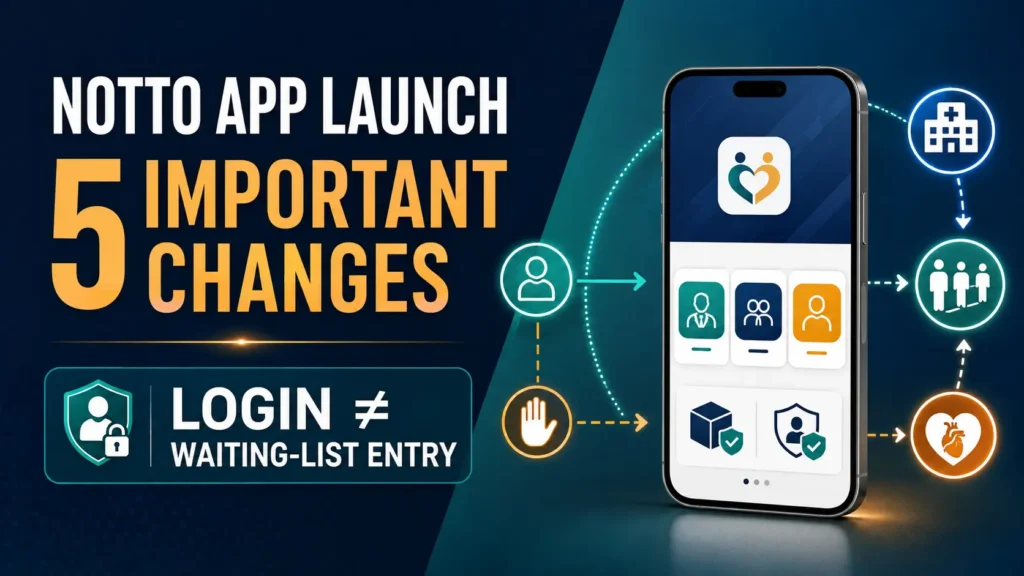





The official NOTTO app is the Android application using package com.notto and linked through the Government of India’s NOTTO portal. Patients, donors and families should not assume that every app carrying the word “notto” is connected with India’s transplant system.
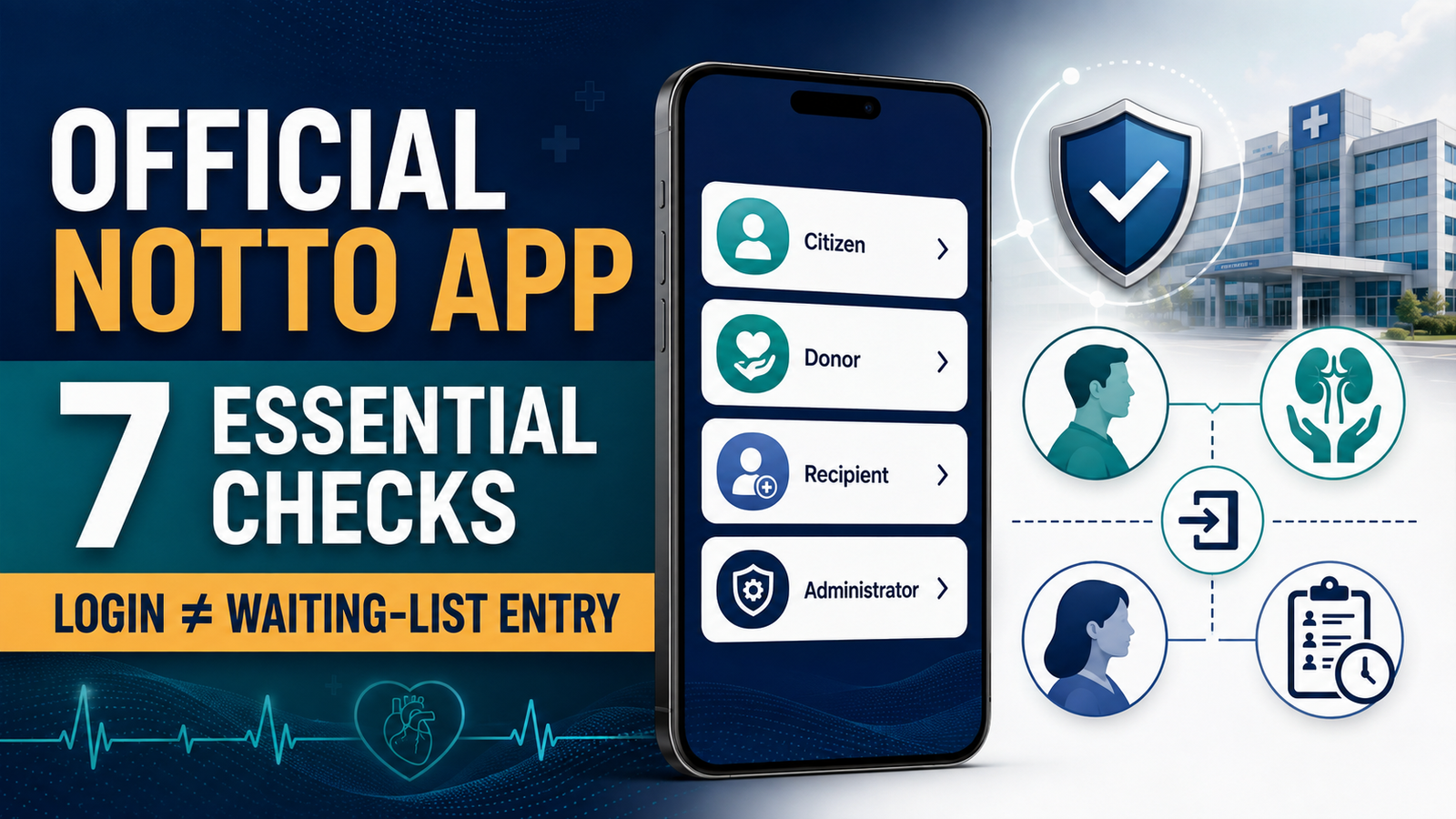
The app includes separate Citizen, Donor, Recipient and Administrator routes. However, creating an account, receiving an OTP or making an organ-donation pledge does not automatically place a patient on a transplant waiting list or guarantee organ allocation.
Direct answer
Use the official NOTTO portal to reach the Android listing and verify package com.notto, the government-linked developer identity and official contact details.
Recipients should continue through an authorised transplant hospital. NOTTO’s public portal describes recipient registration as a hospital-linked process rather than a simple self-registration completed by installing the app.
Seven checks before using the official NOTTO app
- Verify package
com.notto. - Confirm the listing is connected with
notto.mohfw.gov.in. - Do not confuse the unrelated package
com.jktdeveloper.nottowith the transplant app. - Understand whether you are entering as a Citizen, Donor, Recipient or Administrator.
- Do not treat an organ pledge as recipient registration.
- Do not treat recipient login as proof of waiting-list inclusion or allocation.
- Review the privacy and Google Play Data Safety information before submitting documents.
Contents
How to identify the official NOTTO app
The safest method is to open the Google Play listing through the official NOTTO government portal rather than relying only on a store or Google search.
Official Android package
com.notto
Official government portal
notto.mohfw.gov.in
Official organisation
National Organ and Tissue Transplant Organisation under the Directorate General of Health Services, Ministry of Health and Family Welfare.
Public helpline
1800-11-4770
The official portal also publishes recipient guidance, donor-pledge material, hospital information and links to transplant-network resources. It says recipient registration should be completed through an authorised transplant hospital.
Wrong-app warning: The package com.jktdeveloper.notto belongs to an unrelated note-taking application. It is not the official Indian organ-transplant app.
The reviewed evidence does not establish that the unrelated app is fraudulent or malicious. The problem is that a similar name can confuse users searching for the government application.
Why might the official NOTTO app not appear in search?
App-store and Google results can vary by device, location, language, account and indexing status. During the verification process, a search for “NOTTO” surfaced the unrelated note-taking application while the official package was easier to reach using its direct URL.
This means users should not verify an app only by title or icon. Check:
- the complete package name;
- the developer identity;
- the linked government website;
- the support address;
- whether the listing is reached from the official NOTTO portal.
Searching by the exact package com.notto or opening the official portal is safer than searching only for the word “NOTTO.”
What do Citizen, Donor, Recipient and Administrator login mean?
The app screenshots reviewed by ThePulseSignal show three main entry categories on the first login screen.
Citizen
The Citizen route displays separate options for Indian and foreign citizens and asks for a mobile number before generating an OTP.
A Citizen login should not be treated as formal transplant-recipient registration.
Donor
The Donor route is associated with donor access and pledge-related functions.
A deceased-donation pledge and a living-donor transplant approval are legally and operationally different processes.
Recipient
The Recipient route asks for a mobile number and OTP.
The visible screen does not prove that any person can independently create a valid transplant waiting-list record without an authorised hospital.
Administrator
The Administrator route includes NOTTO, ROTTO, SOTTO and Hospital access.
This is intended for authorised institutional users rather than the general public.
The visible hospital dashboard includes modules for waiting lists, super-urgent patients, recipient details, donor details, PM-JAY patient requests, alerts, grievances, staff details and operational analytics.
That institutional structure is important: the app is not only a public pledge tool. It is also an operational interface for hospitals and transplant authorities.
Donor pledge, living donation and recipient registration are different
NOTTO’s official forms separate these activities.
- Form 7 is used for organ or tissue pledging.
- Other forms apply to living near-relative, spousal or non-near-relative donation.
- Medical-fitness and relationship-certification forms are separate.
- Applications for living-donor transplantation and hospital registration are also separate.
A pledge records a person’s intention to donate organs or tissues after death. It does not:
- register that person as a transplant recipient;
- place anyone on a waiting list;
- approve a living-donor transplant;
- guarantee organ retrieval after death;
- guarantee that an organ will be suitable for transplantation.
Family involvement remains important. NOTTO’s public FAQ explains that a donor pledge records the person’s wishes, while the family or person lawfully in possession of the body is still involved when deceased donation is considered.
Does a recipient login mean the patient is registered?
Not necessarily.
A recipient login may provide access for a patient whose details have already been entered through the transplant system. The public login screen alone does not establish that a new patient can complete clinical evaluation, hospital registration and waiting-list placement independently.
The official portal currently tells prospective recipients to register through an authorised transplant hospital.
A transplant hospital may need to:
- assess the patient clinically;
- confirm transplant eligibility;
- collect and verify documents;
- enter the patient into the applicable registry;
- coordinate with NOTTO, ROTTO or SOTTO systems;
- update urgency, compatibility and treatment information.
Patients should therefore ask their hospital for confirmation of the exact registration stage rather than relying only on whether an OTP login works.
Waiting-list inclusion is not the same as organ allocation
These are separate stages.
Waiting-list inclusion
- Requires formal recipient registration.
- Depends on clinical and administrative eligibility.
- Connects the patient with the applicable allocation system.
- Does not guarantee an organ or a particular date.
Organ allocation
- Depends on organ availability.
- Uses medical, compatibility and urgency criteria.
- May involve geographic and allocation rules.
- Requires final clinical acceptance by the transplant team.
Even where a waiting-list record exists, that does not mean the patient is first in a simple chronological queue. Organ allocation can depend on multiple medical and operational factors.
Can patients see their exact waiting-list position?
The reviewed public login screens and portal material did not establish that every recipient can see a fixed national queue number.
Patients should ask the authorised transplant hospital:
- whether their registration is active;
- which organ and programme they are registered for;
- which state or national registry applies;
- whether any document or medical update is pending;
- whether the app displays status, rank, priority or only account information;
- how urgency or compatibility changes are communicated.
Do not pay an unofficial person to “increase” a waiting-list rank. Use the authorised transplant hospital and official NOTTO, ROTTO or SOTTO channels.
Should existing patients register again?
No reviewed official source established that all patients must create a second registration because the new app and e-प्रत्यारोपण platform have launched.
Existing patients should:
- contact their transplant coordinator;
- confirm whether their current registration remains active;
- ask whether the record has migrated or been linked to the new platform;
- avoid cancelling an existing registration without written guidance;
- avoid creating duplicate records unless the hospital instructs them to do so.
A duplicate or incomplete record could create additional confusion rather than improving access.
Is the official NOTTO app available on iPhone?
During the reviewed check, the official NOTTO portal displayed the Android download route and marked the App Store version as “Coming Soon.”
iPhone users should rely on the official web portal until NOTTO publishes a verifiable App Store listing.
What data may the official NOTTO app collect?
The Google Play Data Safety panel reviewed for the official app listed categories including:
- name;
- email address;
- address;
- phone number;
- emails, SMS or MMS and other in-app messages;
- photos;
- files and documents;
- device or other identifiers.
The Play listing also said the app did not share data with third parties.
Google Play displayed the developer-submitted statement that data was not encrypted during the reviewed check.
This disclosure requires clarification. It does not prove that every OTP, transplant record or medical document is sent openly over an unsecured internet connection.
The statement could refer to a particular flow, storage practice, developer declaration or an inaccurate submission. Only NOTTO, C-DAC or a technical security assessment can establish the exact scope.
Until this is clarified, users should:
- verify the official app before entering information;
- avoid uploading documents that are not required;
- use a trusted network;
- confirm document requests with the transplant hospital;
- avoid sending Aadhaar, medical records or OTPs through unofficial email, messaging or social-media accounts.
What if the portal or app does not load?
The official NOTTO portal briefly remained on a welcome screen during one test and loaded normally during a later check.
If the app or site stalls:
- wait and reload once;
- try a private or incognito browser window;
- switch between Wi-Fi and mobile data;
- open the official portal directly;
- avoid downloading a similarly named app as a substitute;
- contact the hospital transplant coordinator for urgent recipient matters;
- use NOTTO’s public helpline for official guidance.
A temporary loading problem in one browser should not automatically be described as a nationwide outage.
Frequently asked questions
Which is the official NOTTO Android app?
The official Android package is com.notto. Verify it through the official NOTTO government portal.
Is com.jktdeveloper.notto the official NOTTO transplant app?
No. It is an unrelated note-taking application.
Does a donor pledge place someone on the transplant waiting list?
No. A donor pledge records a person’s wish to donate organs or tissues. Recipient registration is a separate hospital-linked process.
Can a patient register independently through the app?
The reviewed public material did not establish a complete independent self-registration workflow. The official portal says recipients should register through an authorised transplant hospital.
Does recipient login confirm waiting-list inclusion?
Not by itself. Patients should obtain confirmation from their transplant hospital that their registration is active in the applicable system.
Does waiting-list registration guarantee an organ?
No. Allocation depends on availability, compatibility, urgency and applicable medical and administrative rules.
Does a donor card override the family’s role?
No. The pledge records the person’s wishes, but family and lawful consent procedures remain relevant when deceased donation is considered.
Should existing patients register again?
Do not create a duplicate registration without guidance. Ask the authorised transplant hospital whether the existing record remains active or has migrated.
Is the NOTTO app available on iPhone?
The official portal showed the App Store version as “Coming Soon” during the reviewed check.
Is data in the NOTTO app encrypted?
Google Play displayed a developer-submitted statement that data was not encrypted. The exact technical scope was not established and requires official clarification.
Official resources
- Official NOTTO portal
- Official NOTTO registration page
- Official NOTTO forms
- Official NOTTO FAQs
- Official NOTTO Android listing
Verification notes to readers
ThePulseSignal reviewed the official NOTTO portal, public registration pages, downloadable forms, official FAQs, the direct Google Play listing for package com.notto, the unrelated package com.jktdeveloper.notto and supplied screenshots of Citizen, Donor, Recipient, Administrator and hospital-dashboard screens.
The official portal explicitly directs recipients to register through an authorised transplant hospital. The official forms separately identify organ pledging, living donation, transplant approval and hospital registration.
Article last verified: August 4, 2026.
Limitations and unresolved facts
- A complete real-patient recipient-registration workflow was not tested.
- No Aadhaar, medical record or hospital credential was entered during verification.
- Automatic migration of existing hospital and state records was not confirmed.
- Exact recipient waiting-list visibility inside the app was not confirmed.
- Account-deletion and data-retention controls were not independently verified.
- The technical scope of the Google Play encryption disclosure remains unresolved.
- App-store search ranking can vary between users and devices.