






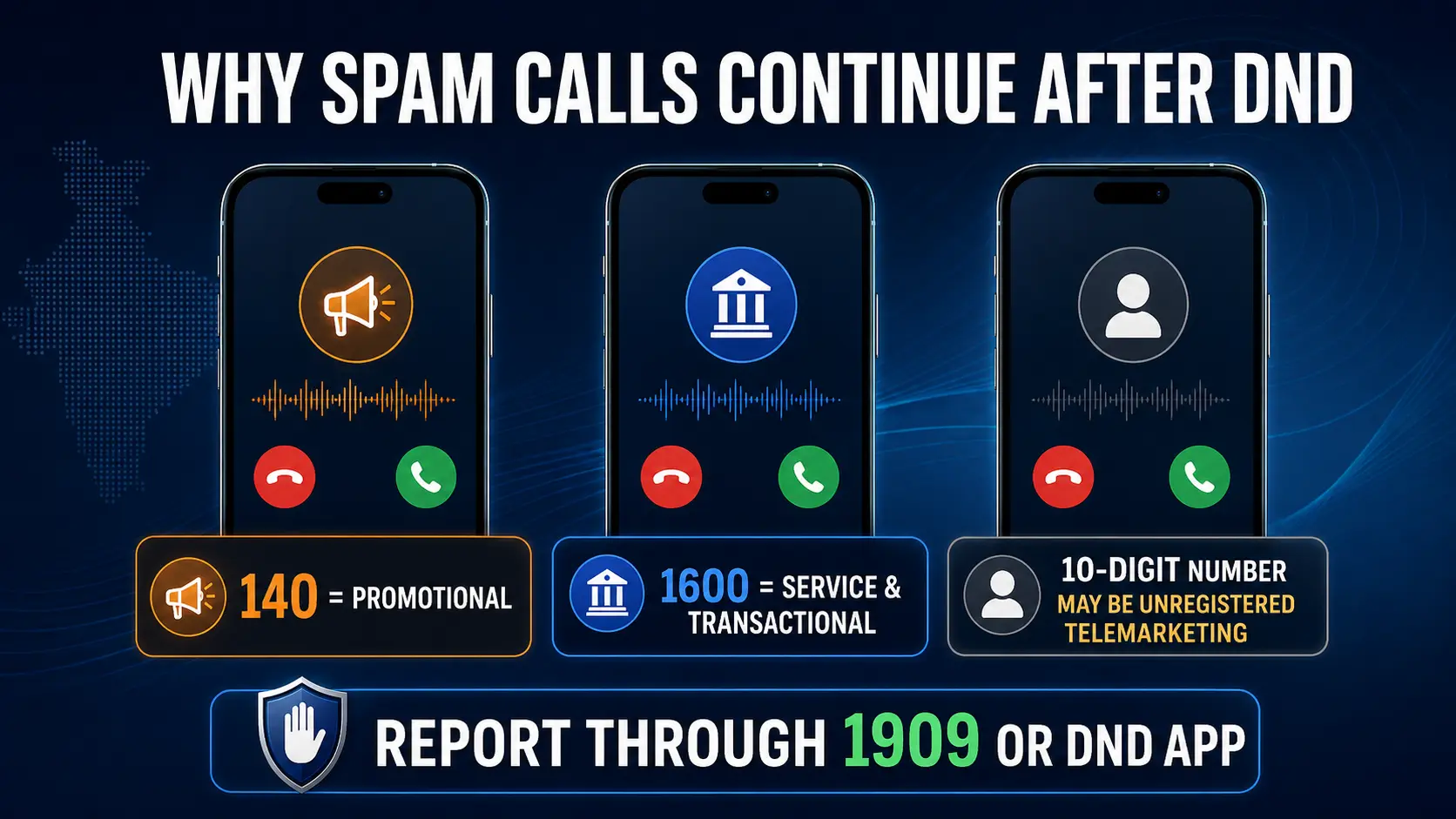
Why spam calls continue after DND is mainly explained by the limits of what DND can control. TRAI’s system manages commercial-communication preferences, designated number series, complaints and enforcement. It does not make every illegal or unregistered caller technically incapable of contacting you.
That is why a person can register for DND and still receive sales calls from an ordinary 10-digit mobile number, suspicious service calls, impersonation attempts or communication that falls outside the recipient’s selected preferences.
Direct answer
Why spam calls continue after DND: DND controls regulated commercial communication and provides an enforcement route when senders violate your preferences.
It is not a network-level guarantee that every scammer, unregistered telemarketer or misused mobile connection will be blocked before calling.
Current operational rule
DND activation: Allow seven days after preference registration.
Formal complaint: TRAI’s current FAQ says complain within three days of receiving UCC.
Routes: 1909, DND app and other authorised channels.
Best practice: Report immediately and preserve the call or message evidence.
What DND can do
- record full or category-based preferences;
- control delivery of registered promotional communication;
- support complaints against preference violations;
- help identify registered senders and designated series;
- trigger investigation and regulatory action.
What DND cannot guarantee
- that every illegal caller is blocked in advance;
- that every displayed number is genuine;
- that a 1600 call is automatically trustworthy;
- that one complaint causes instant disconnection;
- that financial fraud is resolved through DND alone.
In this evergreen guide
- What DND actually controls
- Why calls continue after DND
- 140, 1600 and 10-digit numbers
- What 140 means
- What 1600 means
- Ordinary-number telemarketing
- Current TRAI evidence
- How to register DND
- Full versus selective preferences
- How to complain
- Three-day versus seven-day conflict
- Complaint versus report
- Evidence to preserve
- What the DND app does
- Spam versus suspected fraud
- Why action may not be immediate
- Related public-service guides
- Verification method
- Limitations
- FAQs
What does DND registration actually control?
DND, also known through TRAI’s National Customer Preference Register framework, records a subscriber’s choices about receiving promotional commercial communications.
A user may block promotional communications broadly or manage selected commercial categories. Registered senders and telecom providers are expected to respect those preferences when promotional calls and messages are processed through the regulated system.
Preference registration
The subscriber chooses whether promotional communication should be blocked fully or by selected sector.
Delivery checks
Registered promotional calls can be checked against the subscriber’s recorded preference before delivery.
Complaint enforcement
When communication violates the framework, the recipient can submit evidence for investigation by the access provider.
DND does not mean “block every unknown caller.” A personal call, service communication, transactional call, fraud attempt and promotional call are not treated identically under the telecom commercial-communication framework.
Why spam calls continue after DND registration
Why spam calls continue after DND can usually be traced to one or more gaps between the regulated commercial-communication system and the behaviour of an unregistered or fraudulent caller.
- the call came from an unregistered telemarketer using an ordinary mobile number;
- the DND preference was registered less than seven days earlier;
- the subscriber blocked only selected promotional categories;
- the sender claims to have valid consent;
- the call was classified as service or transactional rather than promotional;
- the number or sender identity was misused;
- the communication was illegal or fraudulent and occurred outside the compliant sender framework;
- the earlier complaint did not contain enough information to be processed formally.
Most important distinction: DND can regulate senders that use the commercial-communication system. An offender operating outside that system may still attempt the call and face action only after detection or complaint.
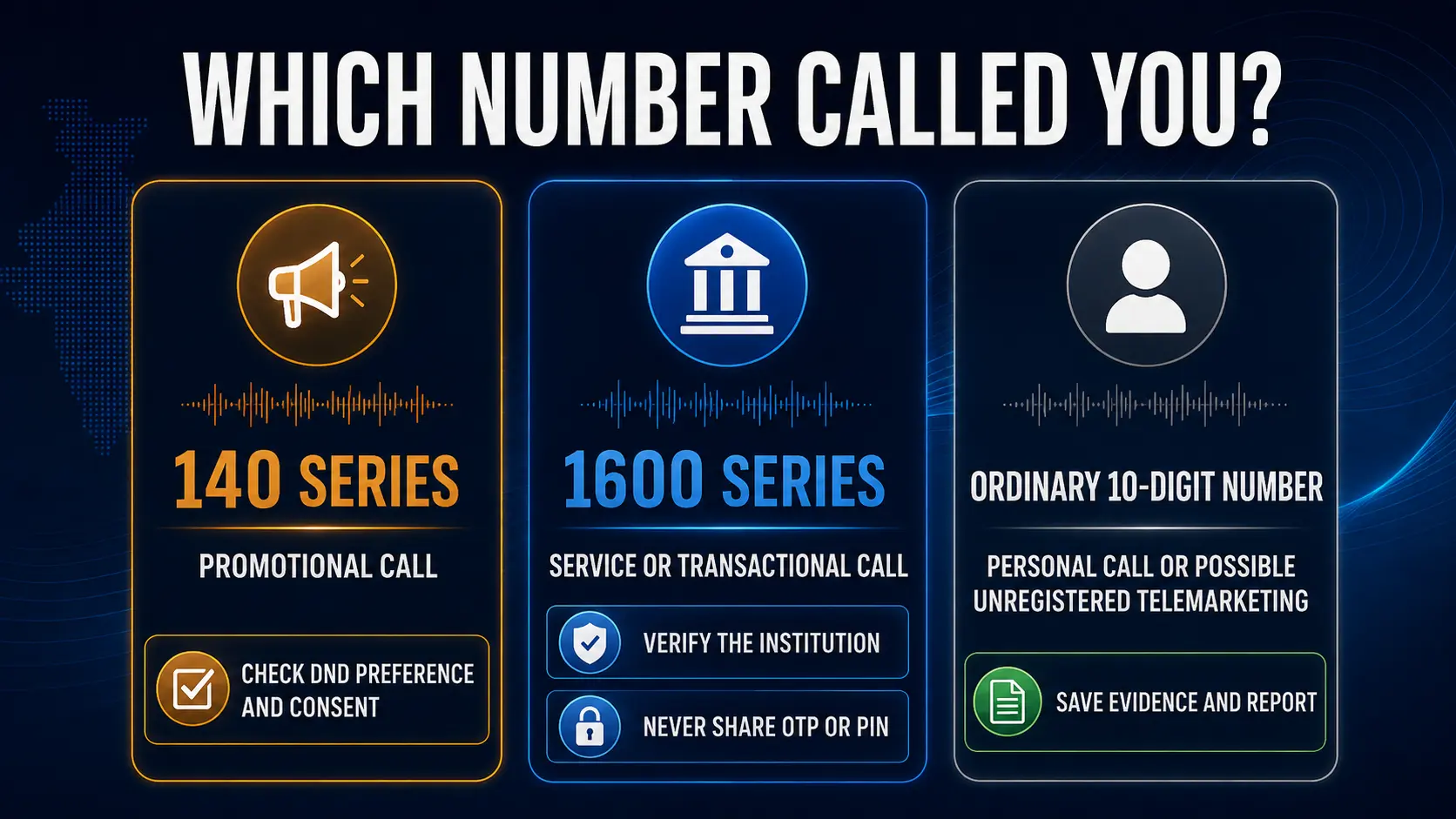
140, 1600 and ordinary 10-digit numbers: what is the difference?
140 series
Intended use: Promotional calls.
Delivery should depend on DND preferences and valid consent. A 140 call is not automatically a scam, but it may violate your registered preference.
1600 series
Intended use: Designated service and transactional calls from regulated entities and government communication.
The number format is not permission to share sensitive credentials.
Ordinary 10-digit number
Intended use: Normal telephone communication.
It may also be misused by an unregistered telemarketer. Commercial misuse can be reported through the UCC framework.
| Incoming communication | Likely regulatory category | Can DND preference matter? | Recommended reader action |
|---|---|---|---|
| 140-series sales call | Registered promotional call | Yes | Check preference and consent; complain if the call violates them. |
| 1600-series account or service call | Service or transactional communication | Not treated like an ordinary promotional call | Verify the organisation independently; do not share credentials. |
| Sales call from ordinary mobile number | Possible unregistered telemarketing | DND complaint or report can support enforcement | Save the call log and report promptly. |
| OTP, PIN or payment request | Potential fraud or impersonation | DND alone is not sufficient | End the call and contact the institution through an official channel. |
| Personal or expected call | Non-commercial communication | Usually no | Handle normally unless suspicious behaviour occurs. |
What does a 140-series phone number mean?
The 140 series is designated for promotional calls under TRAI’s commercial-communication system.
These may include marketing for:
- banking and financial products;
- insurance;
- real estate;
- education;
- health-related services;
- consumer goods;
- tourism, entertainment or other promotional sectors.
A 140-series call is not automatically unlawful. Whether the call should reach a subscriber depends on the recorded preference, valid consent and compliance with the applicable rules.
Do not describe every 140 call as “fraud” or “spam.” It is a promotional number series. The violation question depends on preference, consent and sender conduct.
What does a 1600-series phone number mean?
The 1600 series is intended for designated service and transactional calls from regulated banking, financial-services and insurance entities and for government-to-citizen communication.
Examples can include:
- account servicing;
- transaction-related communication;
- insurance servicing;
- pension-related communication;
- government-service notifications.
The purpose of the designated series is to make such calls easier to recognise separately from promotional calls.
A 1600 prefix is not a substitute for verification. Never share an OTP, PIN, CVV, password, remote-access code or screen-sharing access merely because the caller uses or claims to use a designated series.
Why are ordinary 10-digit mobile numbers used for telemarketing?
An ordinary mobile connection is not supposed to be used for promotional telemarketing.
Unregistered telemarketers may nevertheless use regular mobile numbers because they are easier to obtain and can make the call appear personal or local.
This misuse is another major reason why spam calls continue after DND. The caller may be avoiding the registered 140-series route instead of successfully passing a legitimate DND preference check.
Under TRAI’s consumer guidance, commercial misuse of a normal telephone connection can lead to regulatory action, including disconnection and blacklisting after complaints and investigation.
DND has not necessarily failed. The caller may be operating outside the route that DND preferences are designed to control.
What do the latest TRAI figures show?
The August 4, 2026 government release provides a dated snapshot for April–June 2026.
1.085 million
UCC complaints received through all routes
89%
Share of complaints received through the TRAI DND app
224 million
Subscribers with registered DND preferences
1.48 billion
140-series calls blocked after preference checks
The same official release said more than 1.12 billion subscribers had not registered a preference and that telecom operators’ systems flagged a very large volume of calls and messages as suspected spam.
These are dated statistics, not permanent system rules. The article’s explanation remains evergreen, but the evidence panel should be updated when TRAI publishes newer data.
How to register or change DND preferences
TRAI lists several official routes for registering or modifying preferences:
1
Choose the official route
Use 1909, the TRAI DND app or the telecom provider’s authorised app or website.
2
Select full or category blocking
Choose whether to block all promotional communication or selected sectors.
3
Save the confirmation
Preserve the preference-registration message, date and reference.
4
Allow processing time
TRAI’s current FAQ says complaints based on preference violation apply after seven days from registration.
Do not use an unofficial app or agent to “activate DND.” Preference registration should be completed through TRAI or the subscriber’s telecom provider.
What is the difference between full and selective DND?
Full promotional blocking
The subscriber indicates that promotional communication across the available commercial categories should be blocked, subject to consent and regulatory exceptions.
Selective preference
The subscriber allows or blocks particular sectors rather than applying one broad preference to every promotional category.
Service and transactional communication is not treated identically to promotional marketing. That is why full promotional DND does not necessarily stop expected account, transaction or government-service calls.
How to complain about a spam call or message
TRAI lists these authorised complaint or reporting routes:
- SMS to 1909;
- voice call to 1909;
- interactive voice response;
- the TRAI DND app or another approved app;
- an authenticated web portal;
- another method notified by TRAI.
For a voice call
Preserve the caller number, call date, time, duration, claimed organisation, purpose and any complaint reference generated.
For an SMS
Preserve the full message content, sender header or number, date, time, links and screenshots.
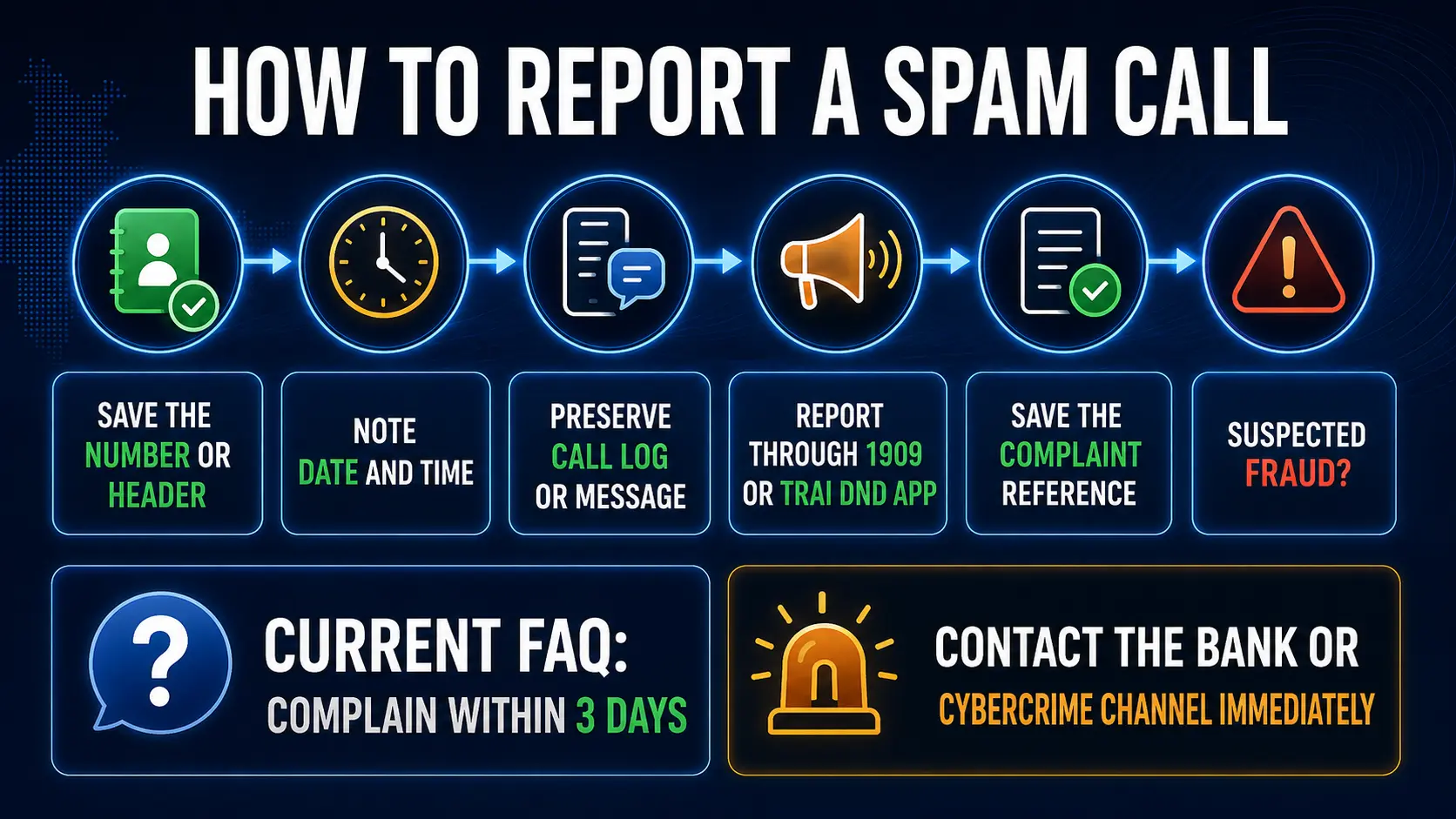
A useful complaint should identify the communication clearly enough for the access provider to trace and classify it.
For the complete submission workflow, use ThePulseSignal’s step-by-step guide to complaining about spam calls through 1909 and the TRAI DND app, including the SMS format, evidence checklist and complaint tracking steps.
Is the complaint window three days or seven days?
Official wording has conflicted. TRAI’s current consumer FAQ says a subscriber should complain within three days of receiving UCC. An earlier government response referred to complaints within seven days.
The safer operational rule is:
Submit the complaint immediately—preferably on the same day and no later than three days after receiving the communication.
This avoids relying on the longer wording and preserves the best chance of formal complaint classification.
What is the difference between a complaint and a report?
| Submission type | Purpose | Timing importance | Possible outcome |
|---|---|---|---|
| Formal UCC complaint | Alleges a specific violation of commercial-communication rules or subscriber preference. | Must satisfy the prescribed complaint conditions and current deadline. | Investigation and action under the access-provider process. |
| Spam report | Provides intelligence about suspected spam or misuse. | May still be useful when formal complaint conditions are not satisfied. | Can contribute to detection, analysis or later enforcement. |
| Fraud report | Reports impersonation, account compromise, financial loss or cybercrime. | Should be made immediately. | Bank, telecom, cybercrime or law-enforcement response. |
Do not assume that a spam report and a formal UCC complaint are legally or operationally identical. The app or telecom provider may classify the submission based on timing, completeness and the type of communication.
What evidence should you preserve?
-
Caller number or sender header.
Record exactly what appeared on the phone. -
Date and time.
Formal complaint windows are short. -
Call log or message screenshot.
Preserve the original device record where possible. -
Communication content.
Note the product, organisation, offer or request made. -
Consent context.
Record whether you had requested the call, used the service or given marketing consent. -
DND registration evidence.
Save the preference date and confirmation. -
Complaint reference.
Keep the acknowledgement and status updates.
What can the TRAI DND app do?
TRAI’s current app materials describe functions including:
- registering and managing DND preferences;
- submitting spam complaints;
- tracking complaints using a reference ID;
- checking information about registered senders and designated 1600-series numbers;
- dual-SIM support;
- viewing complaint-action updates.
The app helps explain why spam calls continue after DND by separating preference management from later reporting and enforcement. It is not presented as a universal real-time call blocker.
The app is not a promise that every call will be blocked in real time. Its main roles include preference management, sender information, reporting and complaint tracking.
When is the problem spam, and when is it suspected fraud?
Unwanted promotion
The caller markets a product or service without matching your preference or consent.
Primary route: DND or 1909 complaint.
Suspicious impersonation
The caller claims to represent a bank, regulator, courier, police authority or government office and asks for sensitive information.
Primary action: End the call and verify independently.
Financial or cyber fraud
Money was transferred, credentials were disclosed, an account was accessed or malware was installed.
Primary action: Contact the bank or affected institution and use the appropriate cybercrime or telecom-fraud reporting channel immediately.
A communication can be both unsolicited and fraudulent. Filing a DND complaint does not replace urgent steps to protect an account or report financial loss.
Users who are unsure whether an app, portal or message is genuinely official can also read ThePulseSignal’s official NOTTO app registration and verification guide, which explains how to distinguish an official public-service workflow from misleading links and unofficial apps.
Why might a spam complaint not lead to immediate action?
Possible reasons include:
- the complaint was submitted outside the formal window;
- the number, sender header or message details were incomplete;
- the DND preference had not completed its activation period;
- the communication was treated as service or transactional;
- the sender produced a consent record;
- the number could not be conclusively connected to the alleged sender;
- the submission was processed as a report rather than a formal complaint;
- the telecom provider’s investigation remained pending.
Do not interpret every closed complaint as proof that the call was lawful. Read the provider’s stated reason and preserve the reference before deciding whether further escalation is justified.
Related ThePulseSignal spam-call and public-service guides
How this “Why spam calls continue after DND” guide was verified
Verification method
ThePulseSignal reviewed TRAI’s current UCC FAQ, preference-registration pages, UCC complaint and reporting page, official DND app information, the February 2026 DND app revamp announcement and the August 4, 2026 government release containing current complaint, preference and designated-number statistics.
TRAI’s current FAQ was treated as the operational source for the seven-day DND activation boundary, the three-day complaint window, 1909 complaint routes and action against ordinary mobile connections used for telemarketing.
The August 4 government release was used only for the dated April–June 2026 statistics and current description of 140-series preference checking.
TRAI’s app materials were used to verify complaint tracking, preference management, sender-information and dual-SIM functions.
The explanation of why spam calls continue after DND is based on the distinction between registered commercial communication, designated number series and ordinary mobile connections that may be misused outside the regulated telemarketing route.
No claim was made that every 140 call is unlawful, every 1600 call is genuine or every ordinary-number caller is a telemarketer.
Official sources reviewed
Limitations and unresolved facts
The framework is verified, but caller identity, consent and complaint outcomes are case-specific.
- The April–June 2026 complaint and blocking figures are dated and will change.
- Earlier official material referred to a seven-day complaint window, while TRAI’s current FAQ says three days.
- The article cannot determine whether a specific caller possessed valid consent.
- A displayed caller ID does not independently prove the caller’s identity.
- A 1600-series number should not be treated as permission to disclose credentials.
- An ordinary 10-digit number is not automatically an unregistered telemarketer.
- The article does not confirm the investigation result of any individual complaint.
- Telecom-provider app screens and complaint categories may differ.
- DND complaints do not replace banking, cybercrime or law-enforcement reporting when fraud occurs.
- The exact escalation route can depend on the telecom provider and nature of the communication.
Why spam calls continue after DND: frequently asked questions
Why spam calls continue after DND registration?
Spam calls can continue because an unregistered telemarketer may use an ordinary mobile number, the preference may still be within its activation period, the subscriber may have selected only certain categories, or the call may be classified as service or transactional.
Does DND block every unknown phone number?
No. DND manages commercial-communication preferences and complaints; it is not a universal unknown-number blocker.
What does a 140-series number mean?
It is designated for promotional calls. Delivery should depend on the recipient’s preference and valid consent.
What does a 1600-series number mean?
It is intended for designated service and transactional calls from regulated entities and government communication.
Is every 1600-series call safe?
No number format should be treated as permission to share an OTP, PIN, password, CVV or account access.
Can a telemarketer call from a normal mobile number?
Ordinary mobile connections are not permitted for telemarketing, but unregistered callers may misuse them and can face regulatory action after complaints.
How do I activate DND?
Use 1909, the TRAI DND app or an authorised telecom-provider channel to register full or category-based preferences.
How long does DND take to become effective?
TRAI’s current FAQ refers to seven days from preference registration before a subscriber can complain about UCC received after registration.
How quickly must I complain about a spam call?
TRAI’s current consumer FAQ says within three days of receiving the communication. Submit it as soon as possible.
Can I complain through 1909?
Yes. TRAI lists SMS, voice call and IVRS through 1909, along with approved apps and authenticated web portals.
What details should I preserve?
Keep the caller number or sender header, date, time, call log, message content, screenshots, claimed company and complaint reference.
What does the TRAI DND app do?
It supports preference management, spam complaints, complaint tracking, sender information and dual-SIM handling.
Should financial fraud be reported only through DND?
No. Contact the bank or affected institution and use the appropriate cybercrime or telecom-fraud reporting route immediately.
Will one complaint disconnect the number immediately?
Not necessarily. The telecom provider must classify and investigate the communication under the applicable process.
Last verified: August 5, 2026. This guide reflects the official TRAI rules and guidance available on that date.