






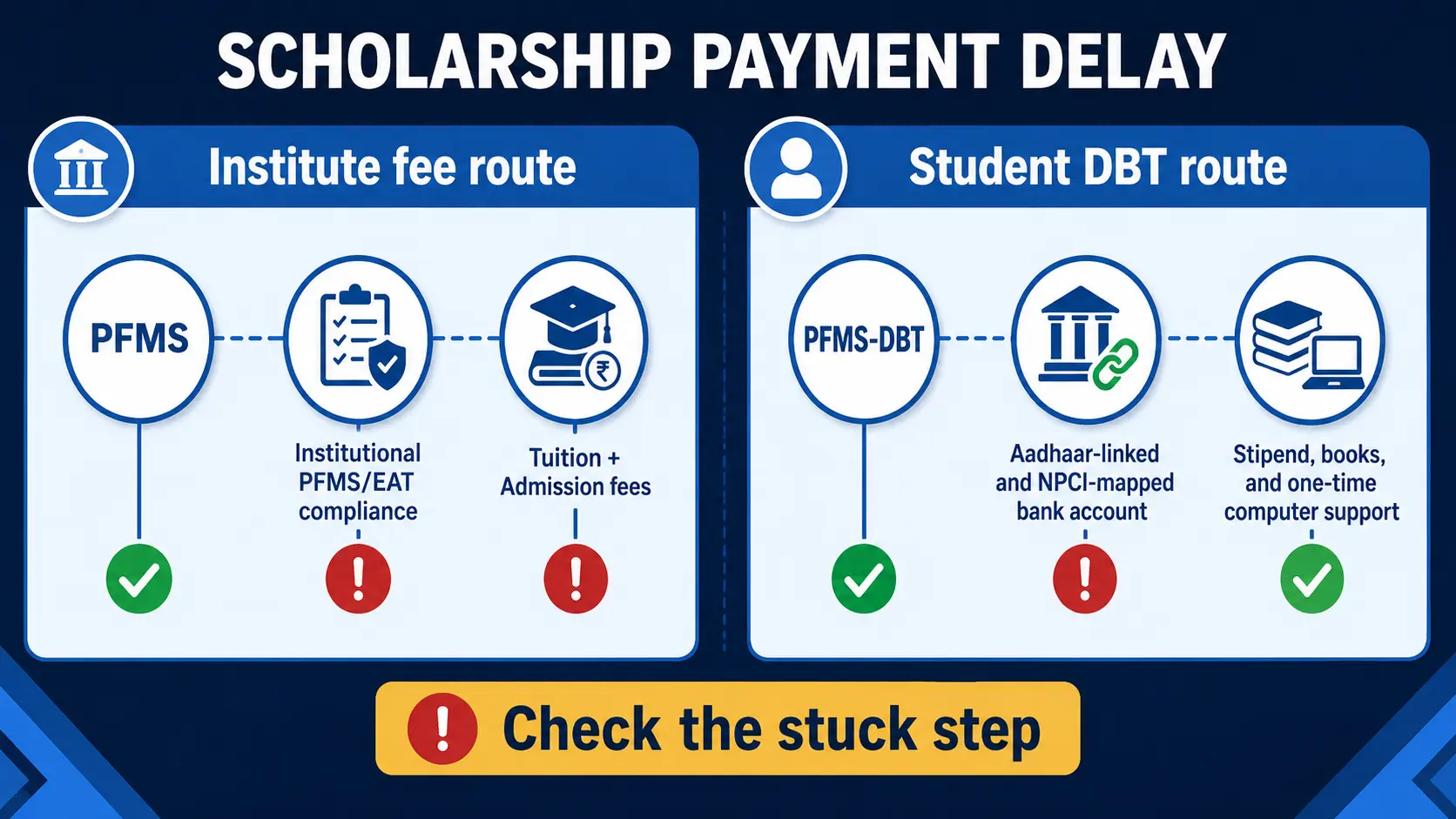
An ST Top Class Scholarship payment can be delayed in two very different places: the institution-fee route or the student’s direct-benefit-transfer route. The correct next step depends on which component is stuck, who controls that stage and what the official portal or institution can actually verify.
The August 5 parliamentary disclosure makes that distinction important. Institutional tuition and admission-fee dues linked to 2,527 students were reported as pending because concerned institutions had not completed required PFMS/EAT compliance. Separate student-level allowance failures were linked to Aadhaar seeding or bank-account issues.
Direct answer
Why an ST Top Class Scholarship payment may be pending
If tuition or admission fees are pending, the problem may sit with the institution’s PFMS/EAT compliance. If stipend, books or computer support did not reach the student, the issue may involve the student’s Aadhaar-linked and NPCI-mapped bank account or a failed DBT transaction.
Current evidence benchmark
What the Ministry disclosed on August 5
The Ministry reported approximately ₹20.22 crore in 2024–25 institutional-fee payments pending for 2,527 students. It separately reported 28 student-level allowance delays for 2024–25 linked to Aadhaar seeding or bank-account linking.
Confirmed
- Institutional tuition and admission-fee payments follow a different route from student allowances.
- PFMS/EAT compliance is an institution-level responsibility.
- Student stipend, books and computer support are paid through PFMS-DBT.
- The student’s bank account must remain active and correctly linked for DBT.
- Selection does not itself prove that payment has been credited.
Not confirmed
- The affected institutions were not publicly identified in the reviewed disclosure.
- No universal date for clearing all pending dues was announced.
- The evidence does not prove every selected 2025–26 student can already see a sanctioned payment.
- The disclosure does not establish that every college may demand payment directly from students.
Table of contents
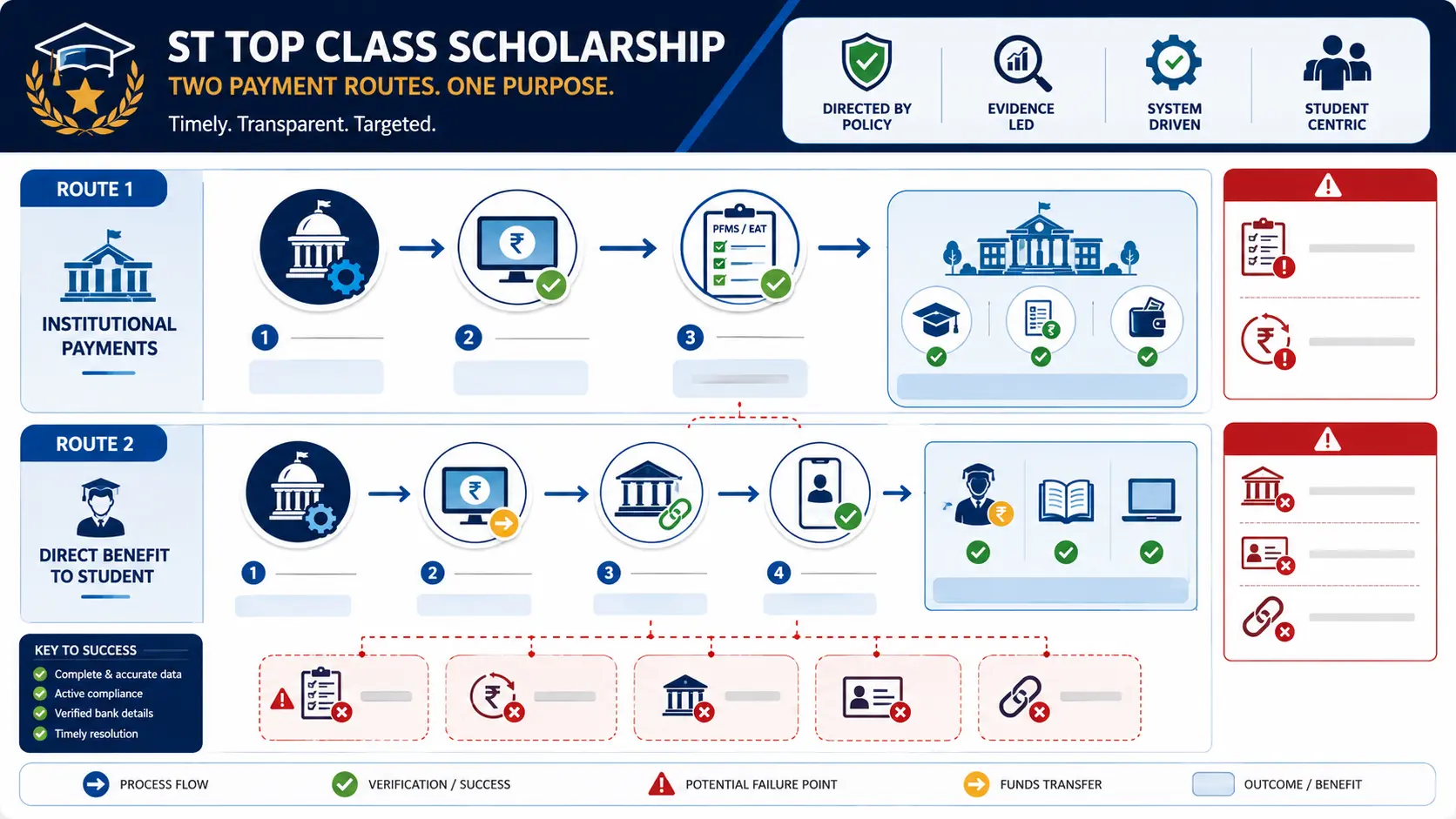
ST Top Class Scholarship payment: the two routes
The scheme does not send every component to the same recipient. Understanding the payment route is the first step in diagnosing a delay.
| Payment component | Who receives it | Official route | Typical failure point |
|---|---|---|---|
| Tuition, admission and eligible non-refundable fees | Institution | PFMS | PFMS/EAT compliance, unspent-balance or verification issue |
| Stipend | Student | PFMS-DBT | Aadhaar seeding, NPCI mapping, inactive account or payment failure |
| Books and stationery | Student | PFMS-DBT | Student-bank or DBT failure route |
| One-time computer support | Student | PFMS-DBT | Component not sanctioned, already used once or DBT failure |
Warning
Correcting the student’s bank account will not resolve an institutional PFMS/EAT block. Asking the college to update PFMS will not fix a student-level Aadhaar or NPCI mapping problem.
What is currently pending under the scheme?
The August 5 Rajya Sabha answer reported that 2024–25 tuition and admission-fee payments linked to 2,527 students remained pending across fresh and renewal categories.
Fresh students
1,439 students were linked to approximately ₹15.996 crore in pending institutional payments.
Renewal students
1,088 students were linked to approximately ₹4.226 crore in pending institutional payments.
Combined position
Approximately ₹20.22 crore remained pending across institutional-fee categories connected to 2,527 students.
The Ministry attributed the institutional delay to incomplete PFMS/EAT requirements, including clearance or updating of unspent balances. Separate student-level failures were also reported: four students in 2022–23, 15 in 2023–24 and 28 in 2024–25 had allowance delays linked to Aadhaar seeding or bank-account issues.
Editorial interpretation
A headline saying “2,527 students did not receive scholarship money” would be too broad. The ₹20.22 crore concerns institutional tuition and admission-fee payments. Student-level DBT failures were reported separately.
What if the institution-fee route is stuck?
An institution-level delay usually requires action from the college or university rather than a change to the student’s personal bank account.
The official FAQ says the institution receives tuition, admission and non-refundable fees through PFMS. It must record expenditure through the PFMS EAT 02 module, and the relevant unspent balance should show nil after complete expenditure.
What the student should ask the institution
- Has the Institute Nodal Officer verified and forwarded the application correctly?
- Has the institution completed the required PFMS/EAT process?
- Does the PFMS EAT report still show an unspent balance?
- Has the institution submitted any pending utilisation or expenditure record?
- Is the payment request awaiting Ministry action, or is institutional compliance incomplete?
- Can the institution provide a written status rather than a verbal assurance?
A student generally cannot clear the institution’s PFMS/EAT compliance personally. The practical role of the student is to obtain a precise written status, preserve fee receipts and ask the Institute Nodal Officer to identify the pending institutional action.
Common mistake
Do not repeatedly edit personal bank details when the unpaid component is tuition or admission fees due to the institution. First confirm which payment component is pending.
What if the student DBT route is stuck?
The student component includes stipend, books and stationery, and one-time computer support. These amounts are paid through PFMS-DBT into the student’s Aadhaar-linked and NPCI-mapped bank account.
Check the account
Confirm that the account is in the student’s name, active and able to receive credits.
Check Aadhaar seeding
Ask the bank whether Aadhaar is seeded for DBT purposes, not merely recorded in the customer profile.
Check NPCI mapping
Verify which bank is currently mapped to Aadhaar in the NPCI mapper.
Check NSP status
Use the application ID and date of birth to review the visible application status.
Preserve failure evidence
Save screenshots, payment-status text, bank responses and any rejection or failure code.
Escalate with specifics
State the component, year, application ID, visible status and bank-verification result.
The official student FAQ advises students to keep the account active and functional throughout the course and to comply with bank conditions such as Aadhaar seeding and any receiving limit that could block the scholarship credit.
Selected for 2025–26 but payment not credited?
The Ministry said red-flag and eligibility checks had concluded, the final selection list had been published and release processing had started. It did not announce one universal credit date for all selected students.
| Status | What it establishes | What it does not establish |
|---|---|---|
| Appears on final selection list | The student has been selected under the published list | It does not prove that payment has been sanctioned, sent or credited |
| Payment under process | A payment workflow may have started | It does not prove that PFMS completed the transaction |
| PFMS processed | The payment system processed a transaction | It does not always prove successful bank credit without final status |
| Credited | The amount reached the receiving account | It does not prove that every scholarship component has been released |
What does the ST Top Class Scholarship cover?
Tuition and admission fees
Government-institution fees are covered at actuals under scheme conditions. Private-institution tuition and admission fees are capped at ₹2.5 lakh per year per student.
Stipend and books
The student component includes a stipend of ₹3,000 per month and ₹5,000 per year for books and stationery.
Computer support
One-time computer and accessories support of ₹45,000 is available during the course tenure. It is not payable every year.
The FAQ also states that where an eligible student has already paid tuition or admission fees, the institution should reimburse the student after receiving the government amount and receiving valid receipts or vouchers.
What should a student do now?
Identify the missing component
Separate institution fees from stipend, books and computer support.
Record the visible status
Save the NSP status, academic year, application ID and date of the latest update.
Contact the right party
Use the Institute Nodal Officer for institutional compliance and the bank or helpdesk for student DBT issues.
Preserve receipts and correspondence
Keep fee receipts, bank records, portal screenshots, emails and grievance acknowledgements.
Evidence to include in a grievance
- student name and application ID;
- academic year and fresh or renewal category;
- institution name and course;
- the exact unpaid component;
- visible NSP or PFMS status;
- fee receipt where relevant;
- bank confirmation of Aadhaar seeding and NPCI mapping where relevant;
- Institute Nodal Officer’s written response;
- screenshots and previous grievance numbers.
Where can students escalate the delay?
The Ministry’s scholarship pages provide a dedicated grievance route for Top Class Scholarship students and universities.
- Ministry of Tribal Affairs grievance portal
- National Scholarship Portal
- Ministry scholarship and result page
The 2025–26 student FAQ lists the Scholarship Division number as 011-23345179. It also lists the NSP technical helpdesk at 0120-6619540, available from 8 AM to 8 PM except government holidays, and the email helpdesk@nsp.gov.in.
The Ministry’s current contact directory separately displays a Top Class Scholarship contact number. Because official pages may show different contact details, students should verify the latest listing before calling and preserve the page or screenshot used.
Related ThePulseSignal guides
Delhi Lakshmi Yojana application guide
A separate government-scheme guide explaining eligibility, documents and application-status checks.
PM Surya Ghar application stuck
A step-by-step guide to identifying which party controls a delayed government-scheme workflow.
How this was verified
ThePulseSignal reviewed the Ministry of Tribal Affairs and Press Information Bureau disclosure on pending scholarship dues, the official 2025–26 student FAQ for the National Fellowship and Scholarship for Higher Education of ST Students, the National Scholarship Portal, and the Ministry’s scholarship, grievance and contact pages.
The parliamentary answer was treated as the controlling source for the 2,527-student institutional pendency, the approximate ₹20.22 crore amount, the PFMS/EAT explanation and the separately reported Aadhaar or bank-linked student failures.
The official FAQ was used to verify the two payment components, Aadhaar and NPCI requirements, financial-assistance amounts, the student status-check route, grievance steps and helpdesk details. Secondary pages were used only to assess search and competitor coverage.
Last verified: August 5, 2026, approximately 9:15 PM IST.
Limitations and unresolved facts
- The affected institutions and institution-wise pending amounts were not publicly identified.
- No universal date for clearing the 2024–25 pendency was announced.
- The article cannot determine whether an individual application has been sanctioned, processed or credited.
- The evidence does not establish whether every affected institution is demanding fees directly from students.
- The article does not determine whether an institution may restrict admission, examinations, hostel access or academic services in an individual case.
- Current official pages display different phone numbers for the scheme, so readers should verify the latest listing.
- Aadhaar appearing in bank records does not itself prove that the correct bank is active in the NPCI mapper.
Frequently asked questions
Why is my ST Top Class Scholarship payment pending?
First identify whether the unpaid component is due to the institution or directly to you. Institution fees may be held up by PFMS/EAT compliance, while student allowances may fail because of Aadhaar, NPCI mapping, account or DBT issues.
Does selection mean the scholarship money has been approved?
No. Selection, sanction, PFMS processing and bank credit are separate stages.
Who must fix incomplete PFMS/EAT compliance?
The institution must complete its PFMS/EAT responsibilities. Students should ask the Institute Nodal Officer for the exact pending action and written status.
How can I check whether Aadhaar is linked for scholarship DBT?
Ask the bank whether Aadhaar is seeded for DBT and verify which bank is active in the NPCI mapper using the official UIDAI or bank route.
Can I change my bank account after selection?
The reviewed FAQ does not provide a universal post-selection bank-change procedure. First confirm the existing correction route through NSP, the institution and the Ministry helpdesk.
Is the ₹45,000 computer amount paid every year?
No. It is one-time assistance during the course tenure.
What if I already paid the college fees?
The official FAQ says the institution should reimburse eligible fees after receiving the government payment and valid receipts or vouchers from the student.
When will 2025–26 payments be credited?
The Ministry said release processing had started, but the reviewed official material did not provide one universal credit date.