






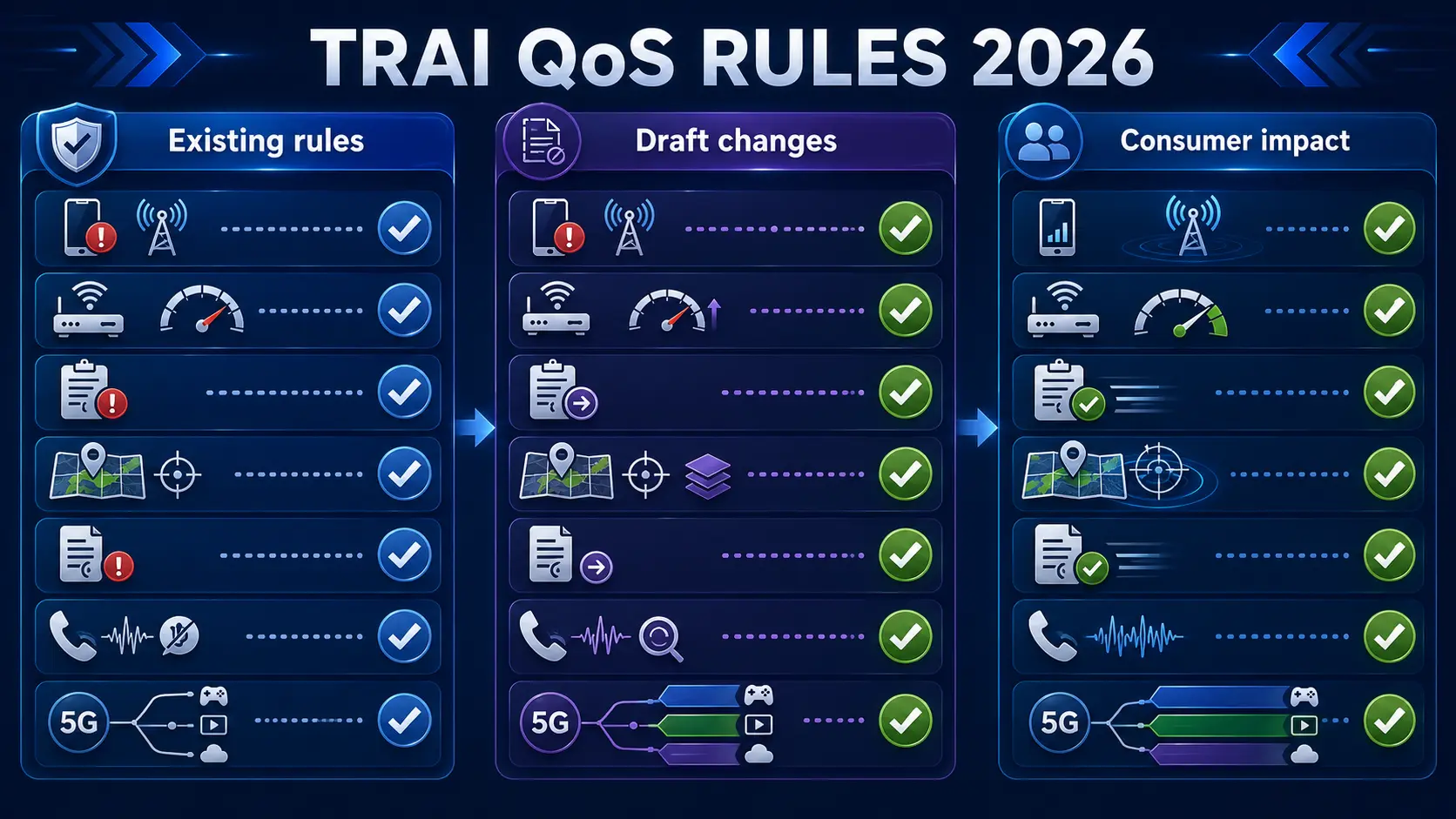
TRAI’s 2026 Quality of Service consultation is now closed, but the proposed amendments are still not enforceable telecom rules. TRAI’s current consultation listing marks the August 5 consultation on draft mobile and broadband QoS amendments as Closed after the September 15, 2026 counter-comments deadline.
The enforceable baseline remains TRAI’s 2024 Standards of Quality of Service of Access and Broadband Regulations unless and until TRAI formally notifies an amendment.
Direct answer: the comments deadline closed on September 2, the counter-comments deadline passed on September 15, and TRAI now lists the consultation as Closed. The proposed wider mobile-outage test, fixed-broadband significant-outage framework, 98% coverage-map accuracy target, one-week billing-complaint deadline, silence-call benchmark, 5G slicing controls and Quality of Experience provisions remain proposals rather than enforceable requirements.
What is the current TRAI QoS consultation status?
TRAI’s current consultation listing marks the Quality of Service consultation released on August 5, 2026 as Closed.
The submission period has therefore ended. Comments closed on September 2 and the extended counter-comments deadline was September 15.
Important: closure of the consultation does not mean the draft amendments automatically became law on September 15.
Have final TRAI QoS Rules 2026 been notified?
No final 2026 amendment replacing the current 2024 access and broadband QoS framework is listed on TRAI’s current regulations surface.
The August 5 document remains a consultation paper containing draft amendments. TRAI can retain, change or remove proposed thresholds, definitions, formulas, consumer protections and commencement provisions before issuing any final amendment.
What is already enforceable under TRAI’s 2024 rules?
- mobile significant-outage reporting for qualifying outages;
- postpaid rent rebates and prepaid validity extensions for qualifying prolonged mobile outages;
- mobile and fixed-broadband speed measurement requirements;
- technology-wise mobile coverage maps;
- wireline repair benchmarks;
- billing and charging complaint requirements; and
- graded financial disincentives for specified QoS non-compliance.
What remains only proposed in 2026?
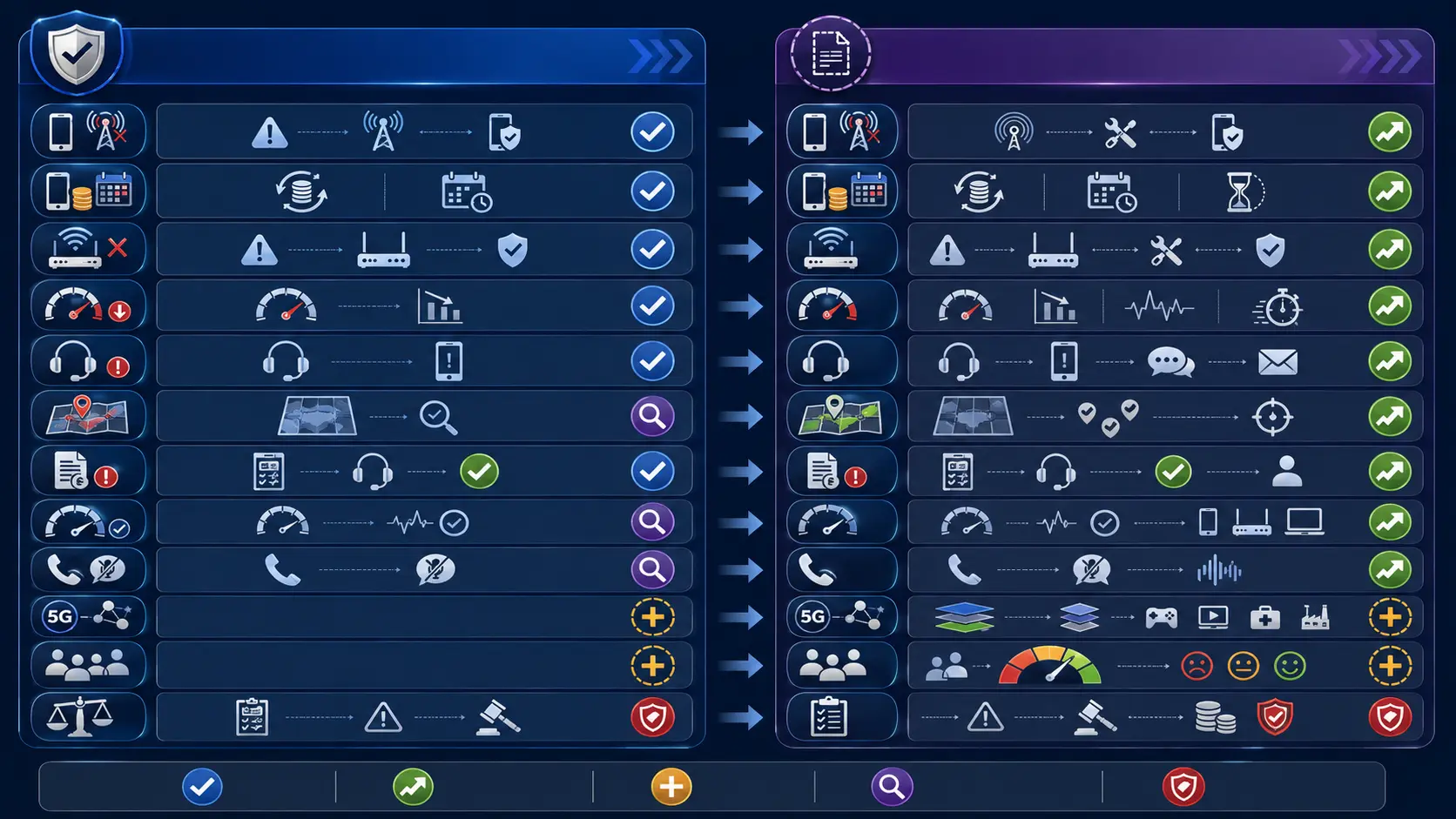
| Area | 2026 proposed change | Current legal state |
|---|---|---|
| Mobile significant outage | Add an LSA-level subscriber-impact test for complete loss affecting more than 10% of subscribers for more than four continuous hours | Draft only |
| Fixed broadband outage | Create a formal significant-outage framework | Draft only |
| Broadband degradation | Include sufficiently widespread and sustained degradation of at least 20% against declared typical speed, subject to other conditions | Draft only |
| Complaint access | Keep complaint registration available during outages or automatically map affected subscribers to fault tickets | Draft only |
| Coverage maps | Require at least 98% accuracy against measured evidence | Draft only |
| Billing complaints | Reduce the resolution period from four weeks to one week | Draft only |
| Silence calls | Introduce a benchmark of no more than 1% | Draft only |
| 5G network slicing | Add slice-specific capacity and advance-information requirements | Draft only |
| Quality of Experience | Create a possible service-wise QoE score | Draft only |
What happened after the September 15 counter-comments deadline?
The counter-comments submission window has ended and TRAI now marks the consultation as Closed.
Closure means the public consultation stage shown on TRAI’s current consultation surface has finished. It does not establish that TRAI accepted every proposal in the draft or that a final amendment has been issued.
Does the consultation closing mean new consumer protections are active?
No. Consumers should continue to distinguish the existing enforceable 2024 framework from the proposed 2026 amendments.
Any new outage, complaint, coverage, broadband-degradation, network-slicing or Quality of Experience requirement becomes enforceable only through the applicable final regulatory action.
Does the proposed October 1 commencement date automatically apply?
No. A commencement date written into draft consultation text does not become legally operative merely because the consultation period has closed.
Consumers and operators should rely on TRAI’s formally notified regulations and commencement provisions rather than treating the draft date as confirmed.
Would mobile outage compensation become broader?
Potentially, if TRAI finalises the relevant proposal substantially as drafted.
The current rules already contain qualifying mobile-outage protections. The draft proposes to expand the significant-outage definition so certain large subscriber-impact events across a licensed service area could qualify even where the existing district-level test does not capture the event.
Would fixed-broadband slowdowns count as significant outages?
The draft proposes a new fixed-broadband significant-outage framework that could include sufficiently widespread and sustained service degradation.
The proposed degradation test includes at least a 20% fall against declared typical speed together with other scale and duration conditions. A single household experiencing a 20% slowdown would not automatically satisfy the proposed network-level test.
Would operators have to accept complaints during outages?
The draft proposes either continued complaint-registration access during outages or automatic mapping of affected subscribers to system-generated fault tickets.
This remains proposed rather than enforceable.
Would coverage maps need 98% accuracy?
The 2024 rules already require technology-wise mobile coverage maps. The 2026 draft proposes a specific accuracy benchmark of at least 98% against measured evidence.
The proposal remains non-final unless TRAI carries it into a notified amendment.
Would billing complaints have to be resolved within one week?
The one-week benchmark is part of the draft proposal. Consumers should not yet treat it as an enforceable deadline.
Are silence-call and 5G slicing rules already effective?
No. The proposed silence-call benchmark, network-slicing provisions and new Quality of Experience concepts remain part of the non-final consultation proposals.
The final definitions, measurement methods, thresholds and enforcement treatment may still change.
What should consumers do during a real outage today?
- Use the telecom provider’s current complaint channel.
- Keep the complaint or fault-ticket reference where available.
- Record the start time, location and affected service.
- Check whether the issue is individual, local or part of a larger network outage.
- Use the enforceable current TRAI rules rather than relying on draft 2026 protections.
- Check TRAI’s regulations and notifications if a final amendment is later issued.
What should stakeholders monitor next?
- a final amendment or other formal regulatory notification;
- any change to the proposed outage, broadband-degradation or coverage-map thresholds;
- the final treatment of billing, silence-call, network-slicing and QoE provisions;
- any published explanatory memorandum or implementation guidance; and
- the operative commencement date if TRAI notifies an amendment.
Verification method
ThePulseSignal checked TRAI’s current consultation listing, Quality of Service consultation surface, current regulations listing, press-release listing and consolidated telecom regulations on September 17, 2026. TRAI now marks the August 5 QoS consultation as Closed. The current regulations listing still shows the 2024 Access and Broadband Quality of Service Regulations as the applicable listed framework and does not show a final 2026 amendment replacing it.
Limitations and unresolved facts
- TRAI has closed the consultation, but the final regulatory outcome has not yet been identified on its current regulations surface.
- The final thresholds, definitions, formulas and commencement provisions may differ from the consultation draft.
- A later notification can materially change which consumer protections and operator obligations are enforceable.
- This article does not determine consumer entitlement in an individual telecom dispute.
Frequently asked questions
Are TRAI QoS Rules 2026 in force?
No final 2026 amendment replacing the 2024 access and broadband QoS framework is currently listed by TRAI.
Is the TRAI QoS consultation still open?
No. TRAI’s current consultation listing marks it as Closed.
Are comments or counter-comments still open?
No. Comments closed on September 2 and the extended counter-comments deadline was September 15, 2026.
Did the new rules start automatically after September 15?
No. Consultation closure does not itself make the draft amendments enforceable.
Are current mobile outage protections already available?
Qualifying outage-related protections already exist under the 2024 framework. The 2026 draft proposes broader definitions and additional requirements, but those proposals remain non-final.
Bottom line: TRAI’s 2026 QoS consultation is closed, but the proposed amendments are still not final enforceable rules. Consumers and operators should continue to rely on the current 2024 framework until TRAI formally notifies any amendment.
Last verified: September 17, 2026.