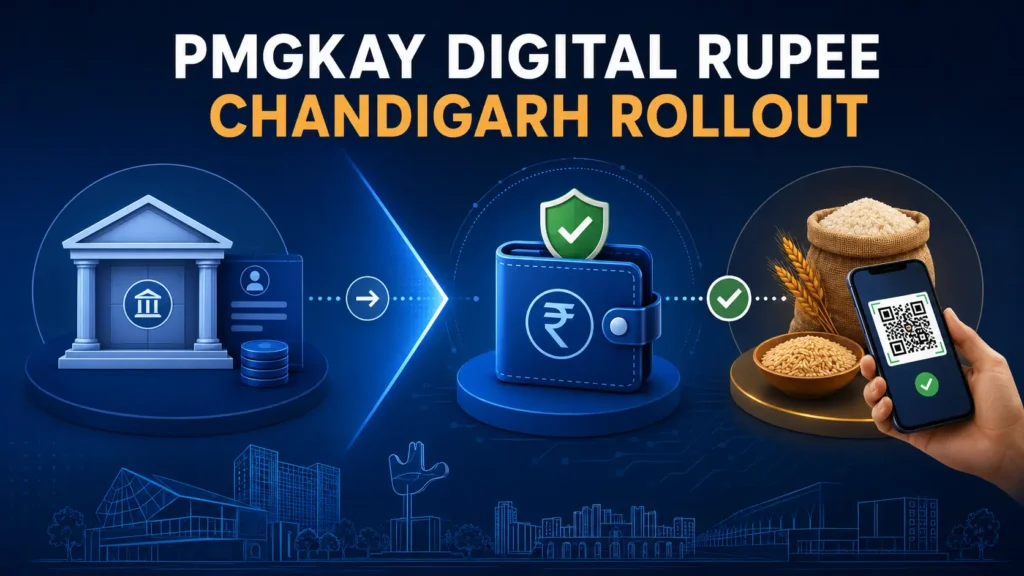





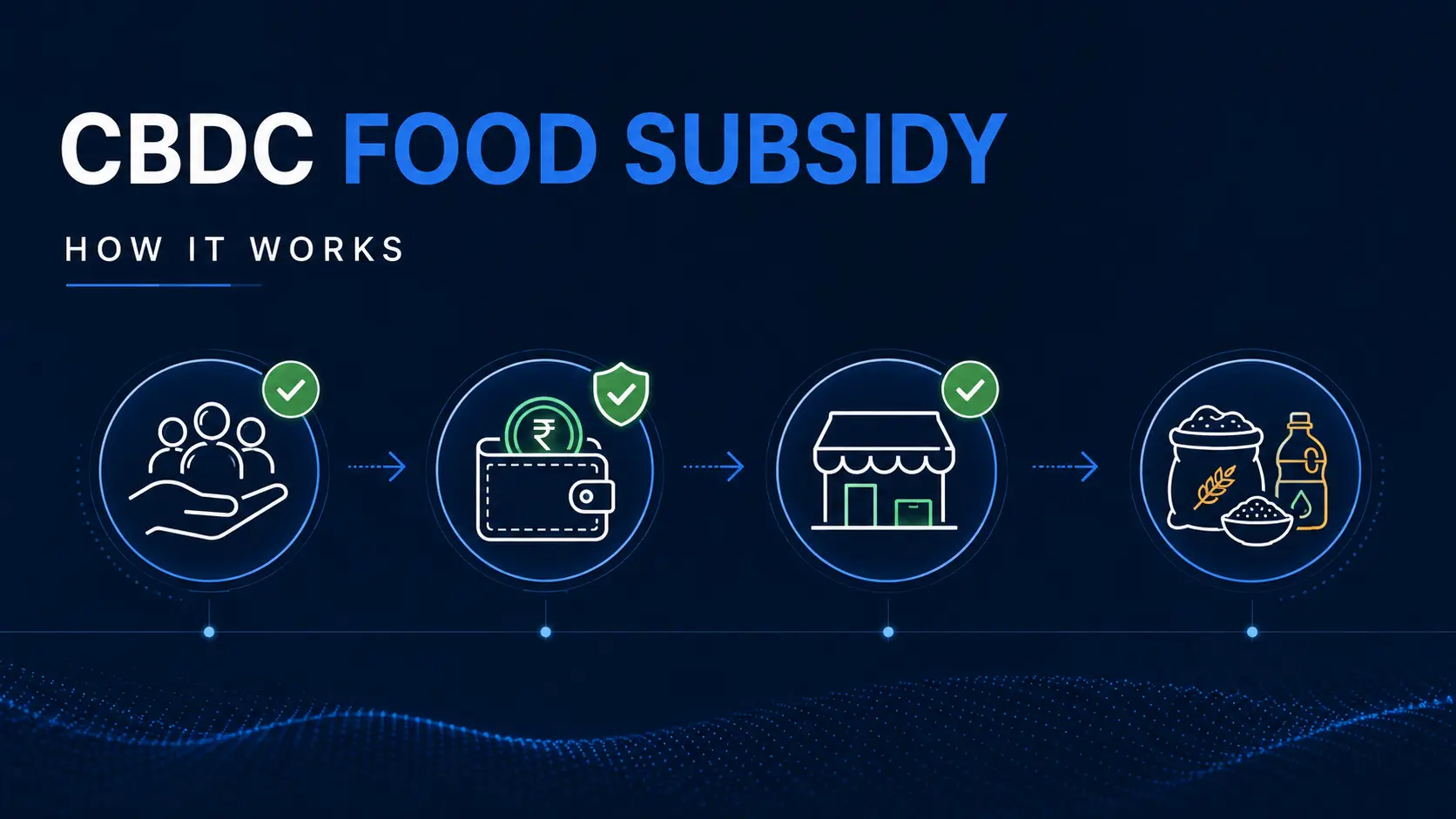
CBDC food subsidy is a welfare-payment model in which eligible subsidy value is issued as programmable Digital Rupee rather than being transferred as ordinary money into a conventional bank account. The central difference is not simply that the payment is digital. India already has digital bank transfers and UPI. CBDC allows the sponsor of a benefit to attach conditions to how that particular value can be used.
For food subsidy, that means a government transfer can be placed in a beneficiary’s Digital Rupee wallet and configured for eligible food purchases through authorised merchants or Fair Price Shops. The Government of India has already used this architecture in food-distribution pilots and implementations in Gujarat and Puducherry.
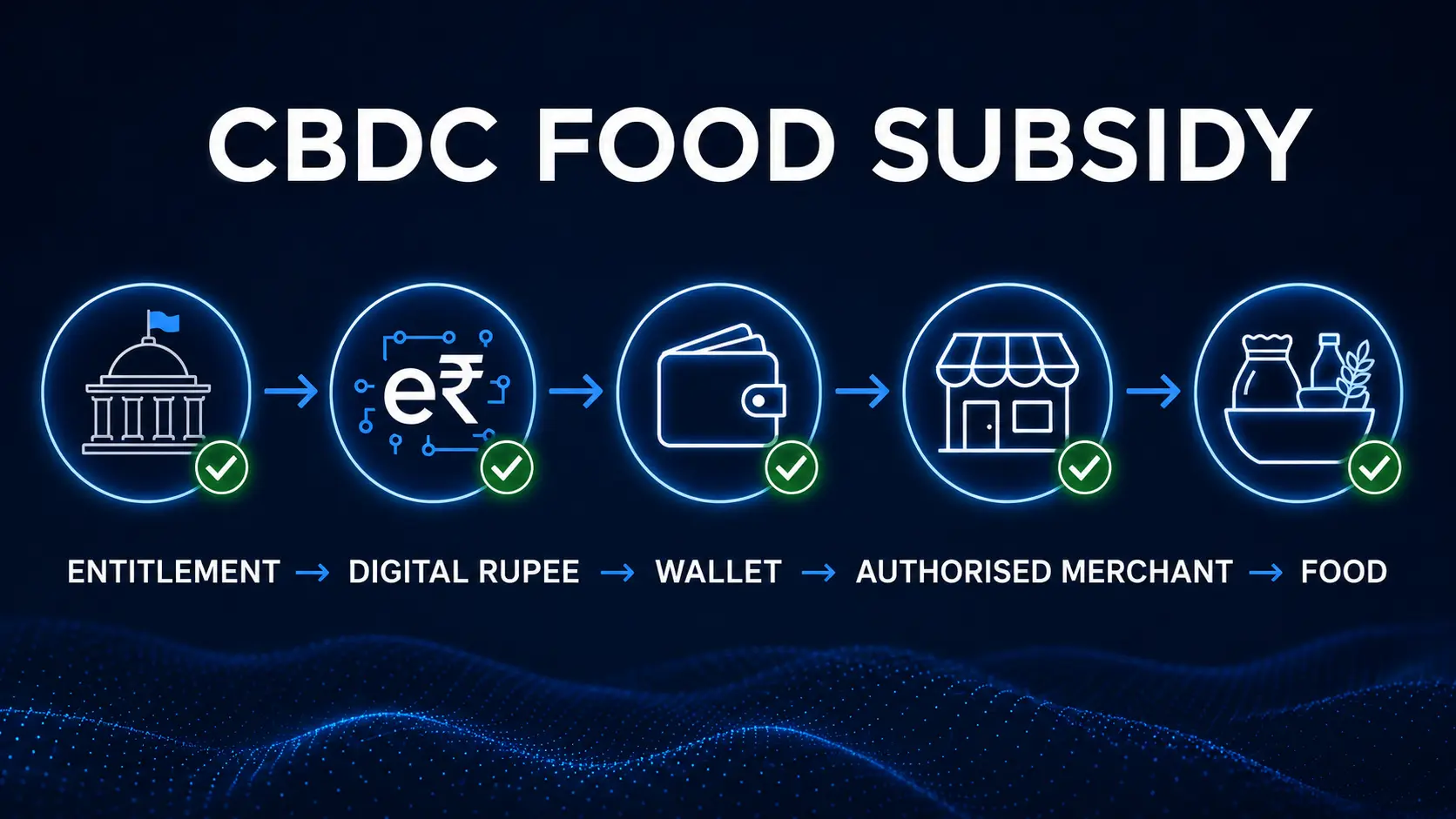
CBDC food subsidy in one payment chain
The February 2026 Puducherry launch provides one of the clearest official descriptions of this DBT architecture. The Government’s PIB release on the Puducherry rollout said identified beneficiaries would receive programmable CBDC tokens directly into CBDC wallets instead of conventional bank accounts. The tokens were intended to be redeemable for eligible food purchases through authorised merchants and Fair Price Shops.
Gujarat’s implementation used the same underlying idea but added QR-code or coupon-code transactions at Fair Price Shops. The government also said FPS dealers could receive their margins in real time under that model.
How this differs from ordinary food-subsidy DBT
Chandigarh, Puducherry and part of Dadra and Nagar Haveli provide a useful comparison because food subsidy there has already been delivered in cash-transfer mode for years. The Department of Food and Public Distribution says Chandigarh and Puducherry began direct cash transfer in September 2015 and part of Dadra and Nagar Haveli followed in March 2016. Under that model, the cash equivalent of food subsidy is transferred into an eligible household’s bank account.
| Feature | Ordinary bank DBT | Programmable CBDC subsidy |
|---|---|---|
| Where value is held | Bank account | Digital Rupee wallet |
| Form of money | Commercial bank deposit | RBI-issued central bank digital currency |
| Purpose restriction | Not inherent to ordinary bank money | Can be programmed for a defined purpose |
| Merchant restriction | Ordinary account balance is generally not tied to a merchant class | Programme can restrict use to authorised merchants or merchant categories |
| Geographic or expiry rules | Not an inherent feature of ordinary DBT money | Programmability can apply conditions such as geography or expiry |
| Interest | Depends on the bank account | Retail e₹ is designed as digital cash rather than an interest-bearing deposit |
The Reserve Bank of India’s Digital Rupee guidance describes e₹ as a digital form of the Indian rupee issued by the central bank and stored in a digital wallet. RBI also describes programmability as a way to ensure that funds are used for a specified purpose, with possible conditions including merchant category, geography or expiry.
Why government wants programmability in welfare payments
The official argument centres on control, traceability and delivery efficiency. In its Puducherry launch material, the government described the CBDC food-subsidy system as a way to make transfers more transparent and efficient while ensuring that the value remains purpose-bound. It also said the mechanism could reduce some friction caused by repeated biometric authentication and e-POS operational problems.
The Gujarat rollout similarly described secure, traceable, real-time transactions and a digital trail intended to strengthen monitoring and accountability.
Those are programme objectives. They should not automatically be treated as proven outcomes. Evidence on transaction success, accessibility, beneficiary experience, merchant coverage and grievance handling is still needed to judge whether the model performs better in practice.
The trade-off: control versus flexibility
Programmability addresses one policy problem by creating another design choice. If a food-subsidy transfer is restricted to eligible purchases, the government gains greater control over how that benefit is used. The beneficiary, however, has less flexibility than with unrestricted money credited to an ordinary bank account.
That distinction has also surfaced in independent reporting on India’s CBDC programme. Reuters reported in April 2026 that policymakers were looking at programmable e₹ as a tool for welfare delivery while critics cautioned that overly restrictive programming could weaken some of the cash-like characteristics that make CBDC attractive to users.
Where can a CBDC food subsidy be spent?
There is no single answer for every programmable CBDC scheme because spending rules are set by the programme. In the Puducherry PMGKAY model, the government said the tokens would be redeemable for eligible food purchases through authorised merchants and Fair Price Shops.
RBI’s general CBDC framework allows programmability around conditions such as merchant category, location and expiry. A future government benefit could therefore use restrictions that differ from the current food-subsidy model.
Do beneficiaries need a bank account?
The answer depends on the wallet configuration and provider. SBI’s current e₹ documentation provides one example: it describes an Aadhaar-linked special-purpose wallet for receiving government benefits and says a non-SBI customer can use its e₹ app for receipt and payment of government subsidy.
That does not mean every PMGKAY CBDC rollout will use SBI or follow the same onboarding flow. The Puducherry implementation, for example, involved Canara Bank as a designated banking partner.
The practical rule is to follow the wallet and identity requirements specified for the particular government programme rather than assuming that a conventional bank account is always mandatory.
What about people without smartphones?
The government specifically acknowledged this issue during the Puducherry rollout. The Department of Food and Public Distribution said special emphasis had been placed on inclusion of feature-phone users.
RBI is also exploring offline e₹ functionality for areas with weak or unavailable internet connectivity. Its published guidance describes approaches involving telecom connectivity and NFC-based transactions, although those features should not be assumed to be available in every welfare rollout.
This is an area where implementation matters more than policy design. A programme can formally support low-connectivity users but still fail them if onboarding, wallet recovery or payment acceptance is difficult in practice.
What changes for Fair Price Shops and merchants?
This means the success of CBDC food subsidy cannot be judged only by whether the government can issue digital tokens. Beneficiaries need enough usable purchase points, while merchants need reliable acceptance, settlement and support.
Does CBDC remove biometric authentication?
The Gujarat rollout says its CBDC-based transaction flow eliminates repeated biometric authentication for covered purchases and uses QR or coupon-code based payments. The government presented this as a way to reduce biometric and e-POS friction.
That does not establish that Aadhaar or identity verification disappears from the welfare system altogether. Identity may still be required for beneficiary identification, wallet creation or programme onboarding. What changes is the transaction mechanism at the point of purchase.
What if a payment fails or the phone is lost?
This is where the distinction between the welfare programme and the wallet provider becomes important. Wallet providers maintain their own recovery and transaction-support processes. SBI, for example, describes wallet recovery on a new device using the same mobile number or SIM and provides procedures for viewing transactions and managing wallet access.
The grievance mechanism for a government subsidy should still come from the authority and wallet provider responsible for that specific rollout. A beneficiary should preserve the beneficiary identifier, wallet reference, transaction reference and any error message or screenshot when reporting a failure.
For a dedicated setup and troubleshooting guide, see TPS’s companion Digital Rupee subsidy wallet guide.
Is this replacing PMGKAY across India?
No nationwide replacement has been established. The government has been expanding CBDC use through selected pilots and implementations. The Puducherry launch identified Chandigarh and Dadra and Nagar Haveli among subsequent rollout locations and described a gradual expansion path.
RBI’s wider direction also shows continued exploration of programmability across Direct Benefit Transfer and other defined-purpose use cases. That indicates an expansion trajectory, not evidence that every PMGKAY beneficiary in India is being moved to a CBDC wallet now.
Current Chandigarh rollout
Chandigarh is important because it already operates food subsidy in DBT mode, making it a natural location for moving from conventional bank-account transfers toward programmable CBDC. TPS is tracking the reported August 14 rollout separately because local implementation questions — including wallet provider, beneficiary cohort, authorised merchants and grievance procedures — are time-sensitive.
Read the current TPS report: PMGKAY Digital Rupee subsidy in Chandigarh: what changes for beneficiaries.
What evidence will show whether the model works?
The strongest evidence will come after implementation rather than from launch statements. Useful measures would include successful wallet activation, transaction completion, merchant availability, grievance volumes, failed-payment resolution, access across device types, merchant settlement performance and any independently measured change in leakage or administrative cost.
Until such evidence is available, claims about savings, fraud reduction, improved beneficiary satisfaction or economic gains should be treated as programme objectives or potential outcomes rather than established results.
Related TPS coverage
Verification notes
Confirmed
India’s CBDC food-subsidy implementations use programmable Digital Rupee for defined welfare purchases. Puducherry’s official PMGKAY model directs subsidy into beneficiary CBDC wallets rather than conventional bank accounts and restricts use to eligible food purchases through authorised outlets. Gujarat’s official implementation describes QR or coupon payments, a digital transaction trail and real-time FPS dealer margins.
Government position
The government says the model can improve transparency, efficiency and accountability while addressing some biometric and e-POS friction.
Not established
TPS has not found evidence establishing a nationwide CBDC conversion of PMGKAY, quantified economic savings attributable to the food-subsidy CBDC model, independently verified leakage reduction, beneficiary-satisfaction gains or an employment effect caused by the programme.
Verification method
TPS reviewed the Government of India’s official PIB material for the Gujarat and Puducherry CBDC food-subsidy implementations, the Department of Food and Public Distribution’s current NFSA cash-transfer framework, the Reserve Bank of India’s Digital Rupee guidance covering wallets and programmability, and SBI’s current CBDC documentation for an example of government-subsidy wallet access and recovery. Reuters reporting was used for independent context on India’s wider welfare-CBDC strategy and the policy debate around restrictive programmability.
Programme objectives were not converted into observed outcomes. Where a wallet-provider workflow is used as an example, it is identified as provider-specific rather than being assumed to apply to every government CBDC rollout.
Sources checked
- PIB — CBDC-based PMGKAY food-subsidy implementation in Puducherry
- PIB — CBDC-based Digital Food Coupon implementation in Gujarat
- Department of Food and Public Distribution — NFSA implementation and food-subsidy DBT
- Reserve Bank of India — Digital Rupee FAQ and programmability
- State Bank of India — Digital Rupee wallet and government-subsidy guidance
- Reuters — India’s programmable Digital Rupee and welfare strategy
Limitations and unresolved facts
CBDC food-subsidy implementation can differ by geography, government programme and wallet provider. A wallet provider, eligible merchant network, feature-phone method, coupon design, transaction limit or grievance procedure documented in one implementation should not automatically be assumed to apply to another.
Reliable nationwide evidence on beneficiary adoption, transaction failure, merchant access, economic savings, leakage reduction and satisfaction specifically attributable to CBDC food-subsidy delivery remains incomplete. Future implementation data could materially change the assessment of the programme’s advantages and trade-offs.
Last verified: August 13, 2026, 5:30 PM IST.