






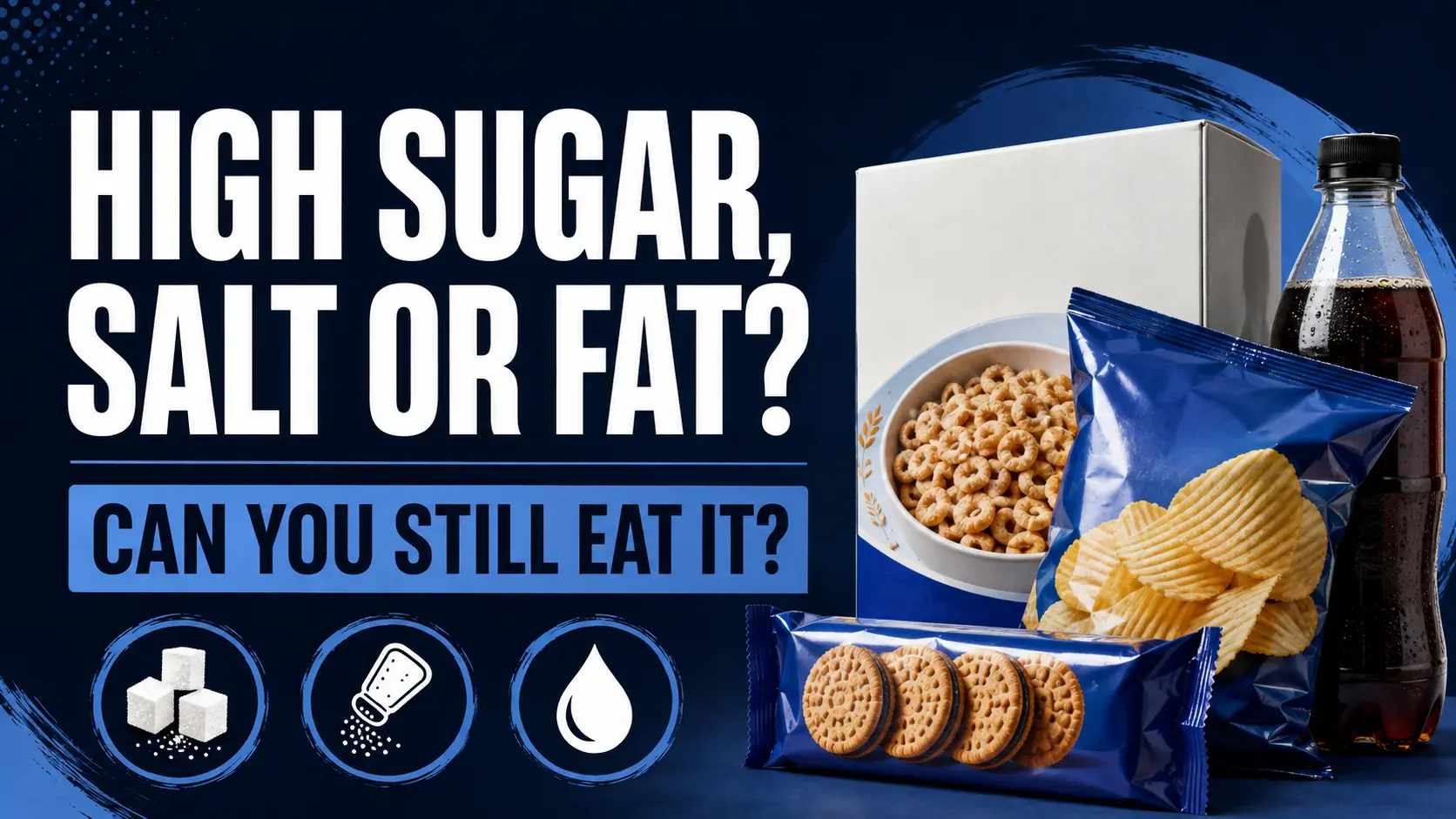
India still does not have a final nationwide rule requiring red “HIGH SUGAR”, “HIGH SALT” or “HIGH FAT” warnings on packaged food. FSSAI has proposed such front-of-pack warnings, and the Supreme Court has now increased pressure for a concrete implementation pathway.
At the September 10, 2026 hearing, the Supreme Court questioned why FSSAI’s first phase would require at least two covered nutrients to exceed the relevant limits before a red warning appears. The government’s lawyer said FSSAI was open to rolling out the stricter approach in one go, which would mean a product high in even one covered nutrient could receive a warning.
In its September 10 order, the Court directed the Union government to provide a clear pathway for implementation within 10 days. That is a material regulatory step, but it is not the same as a final nationwide FSSAI notification. Final thresholds, coverage, exemptions, commencement dates and detailed compliance rules remain unresolved.
What exactly has FSSAI proposed?
In a compliance affidavit placed before the Supreme Court in August 2026, FSSAI proposed red hexagonal front-of-pack warnings for packaged foods and beverages high in specified nutrients of concern. Current reporting describes warnings such as “HIGH SUGAR”, “HIGH SALT” and “HIGH FAT”.
The original proposal used a phased approach. In phase one, a warning would apply when at least two covered nutrients crossed the proposed limits. A later phase would extend warnings to products high in even one covered nutrient. The Supreme Court questioned that phased design on September 10, and FSSAI indicated it was open to a stricter one-go rollout.
Certain basic or single-ingredient foods have been proposed for exemption. The exact final coverage, nutrient thresholds, exemption list, transition period and commencement date still depend on the controlling regulatory framework.
What did the Supreme Court do on September 10?
The Court questioned whether a product should escape a warning merely because only one of the covered nutrients is high. FSSAI’s lawyer said the regulator could consider rolling out the stricter warning approach in one go rather than waiting for a later phase.
The written order then directed the Union government to provide a clear implementation pathway within 10 days. The Court also expressed concern that without a specific timeline the stricter second phase could be delayed indefinitely.
The practical takeaway is that the regulatory process has moved forward, but consumers and food businesses still need the controlling FSSAI notification and any further court directions before treating the warning system as finally implemented nationwide.
Why was the two-nutrient trigger challenged?
Health activists argued that requiring two nutrients to cross the limits could allow a product very high in only one nutrient — for example sugar — to avoid a warning in the first phase.
The dispute therefore concerns not only whether India should use front-of-pack warnings, but how sensitive the trigger should be and whether one excessive covered nutrient should be enough to require the warning from the start.
How is this different from India’s earlier front-of-pack proposals?
| Policy stage | What it proposed | Why it matters now |
|---|---|---|
| 2022 draft | Indian Nutrition Rating using an overall star-style front-of-pack score. | Important background, but different from direct red nutrient warnings. |
| 2025 draft | More prominent per-serving RDA contribution for added sugar, saturated fat and sodium. | Expanded numerical disclosure rather than a simple “high in” front warning. |
| August 2026 proposal | Red hexagonal warnings for packaged foods high in specified nutrients. | This is the warning-label direction now under Supreme Court supervision. |
| September 10, 2026 review | The Court questioned the two-phase trigger; FSSAI said it was open to a one-go rollout. | The Union government must provide a clear implementation pathway within 10 days. |
What about FSSAI’s separate school-food thresholds?
FSSAI has also published a separate 2026 draft amendment to the Safe Food and Balanced Diets for Children in School Regulations. That draft would add definitions for food products high in added fat, added sugar or salt for the purpose of those school-food rules.
- High added fat: more than 4.2 g per 100 g for solid food or more than 1.5 g per 100 ml for liquid food.
- High added sugar: more than 3 g per 100 g for solid food or more than 2 g per 100 ml for liquid food.
- High salt: more than 0.625 g per 100 g for solid food or more than 0.175 g per 100 ml for liquid food.
Comments on that draft are open until October 9, 2026.
What would a high sugar, salt or fat warning actually tell you?
The warning’s immediate purpose would be to make a nutrient concern visible without requiring a shopper to search the back of the packet or calculate the product’s nutritional profile.
An Indian randomized field experiment involving 2,869 adults compared several front-of-pack systems. In the control group, 39.1% correctly identified all foods high in nutrients of concern. The warning-label group reached 60.8%, the strongest result among the systems tested.
The same experiment did not show a statistically significant reduction in purchase intentions in its main analysis. Better recognition therefore does not guarantee that every shopper will change what they buy.
Can children still eat food carrying a warning?
A warning by itself should not be interpreted as saying that a child can never consume the food. It signals that the product is high in a nutrient whose excessive intake deserves attention.
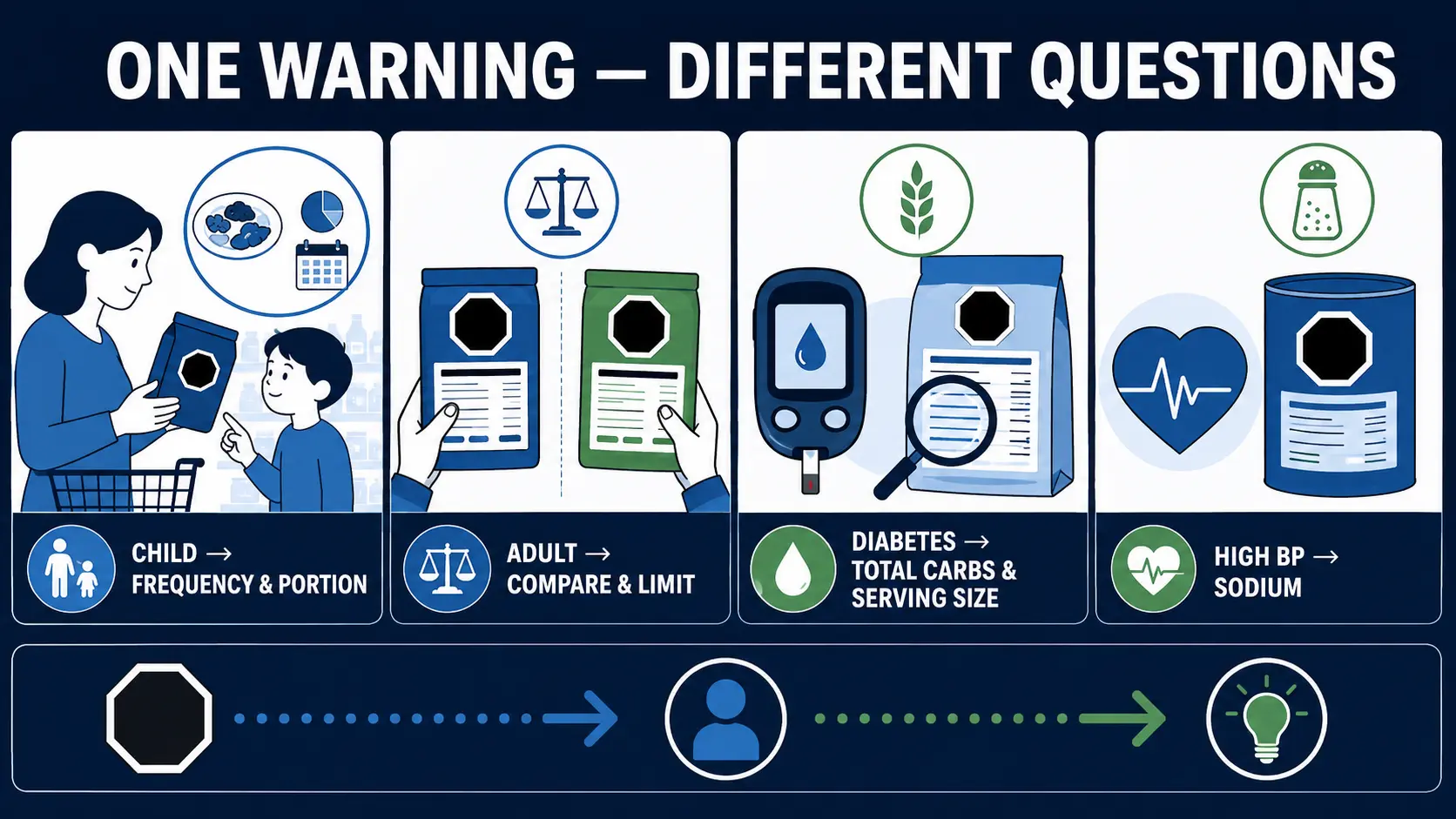
For children, useful follow-up questions include how often the product is eaten, the portion size, what it replaces in the diet and whether lower-sugar, lower-salt or lower-fat alternatives are available.
The World Health Organization notes that food marketing to children often promotes products high in saturated fat, trans fat, free sugars and/or sodium and can influence preferences and dietary intake.
- Check which nutrient is being flagged.
- Compare similar products rather than judging the packet in isolation.
- Check serving size and how much the child is likely to eat.
- Think about frequency across the week, not only one serving.
- Do not treat cartoons, sports imagery or health-sounding claims as substitutes for nutrition information.
Can a generally healthy adult still eat it?
For a generally healthy adult, a warning is best understood as a reason to compare products, consider portion size and limit repeated exposure to the flagged nutrient rather than an automatic instruction never to eat the food.
WHO recommends limiting free sugars to less than 10% of total daily energy intake and limiting excessive salt and unhealthy fats across the overall diet. One packet does not describe the rest of a person’s diet, so frequency and total intake still matter.
What if you have diabetes?
A high-sugar warning would be useful information, but it would not be enough by itself to determine how a food affects blood glucose or whether it fits an individual’s diabetes plan.
The American Diabetes Association advises people reading packaged-food labels to start with serving size and total carbohydrate. Total carbohydrate includes sugar, starch and fibre, so looking only at the sugar line can miss other carbohydrate in the food.
| Reader | What the warning tells them | What still needs checking |
|---|---|---|
| Child | The product is high in a nutrient that should not dominate the diet. | Frequency, portion, overall diet and alternatives. |
| Generally healthy adult | A quick reason to compare or limit the product. | Serving size, total diet and other high-in foods eaten that day. |
| Person with diabetes | A high-sugar warning is useful but incomplete. | Total carbohydrate, serving size, fibre, glucose response and the individual’s meal plan. |
| Person managing hypertension | A high-salt or high-sodium warning is particularly relevant. | Total sodium across the diet and clinician-recommended limits. |
What does a high-salt warning mean for someone with high blood pressure?
A high-salt or high-sodium warning provides a quick reason to inspect the detailed sodium value and compare alternatives. Sodium does not directly raise blood glucose, but excessive sodium intake is relevant to hypertension and cardiovascular risk.
Someone managing both diabetes and hypertension may therefore need to consider carbohydrate and sodium together instead of focusing only on sugar.
What about saturated fat?
A fat warning identifies a different nutritional issue from sugar or salt. A product may be high in one nutrient but not another, which is why a direct nutrient-specific warning can be more immediately interpretable than a single overall nutrition score.
Does a warning mean the product is banned or recalled?
No. A front-of-pack nutrient warning, a product recall, a regulatory ban and a food-safety violation are different states.
TPS separately explains food colour rules in India, which concern whether particular additives may be used in particular foods.
TPS also has a separate guide to FSSAI bans versus product recalls. Those enforcement actions should not be confused with a nutrition warning intended to inform a dietary choice.
What should you do when you see a warning?
- First: identify the nutrient being flagged.
- Second: check the serving size and how much you are likely to eat.
- Third: compare a similar product.
- Fourth: if you have diabetes, check total carbohydrate rather than relying only on a sugar warning.
- Fifth: if you are managing hypertension or cardiovascular risk, pay particular attention to salt or sodium and saturated fat where relevant to your care plan.
- Finally: treat the warning as decision information, not proof that one serving is toxic or that the food is legally banned.
What remains unresolved in India?
The Supreme Court has now required a clear implementation pathway, but that does not itself settle all details of the final warning-label framework.
Still unresolved are the controlling nationwide nutrient thresholds, precise coverage and exemptions, whether the final system will formally adopt a one-go single-nutrient trigger, the commencement and transition dates, display specifications and detailed enforcement rules.
Until the controlling FSSAI framework is issued, the safe current statement is: red front-of-pack warnings have been formally proposed, the Supreme Court has pressed for a clear implementation pathway, but the warnings are not yet a fully implemented nationwide packaging requirement.
Verification method
TPS checked the Supreme Court’s September 10, 2026 order in the existing front-of-pack warning-label proceeding and current reporting on the hearing, FSSAI’s willingness to consider a stricter one-go rollout, and the Court’s direction for a clear implementation pathway within 10 days. The consumer explanation was also checked against existing FSSAI drafts, the Indian randomized front-of-package labelling experiment, WHO guidance and American Diabetes Association food-label guidance.
Sources checked
- Supreme Court of India — September 10, 2026 order in 3S And Our Health Society v Union of India
- Reuters — FSSAI open to stricter warning-label rollout after Supreme Court scrutiny
- Reuters — Supreme Court orders clear implementation pathway within 10 days
- FSSAI — 2026 draft school-food definitions for high added fat, sugar and salt
- FSSAI — Draft Front-of-Pack Nutritional Labelling Regulations, 2022
- FSSAI — Draft Labelling and Display Amendment Regulations, 2025
- Indian randomized field experiment on front-of-package labels
- WHO — Policies to protect children from harmful food marketing
- WHO — Healthy diet guidance
- American Diabetes Association — Reading food labels
Limitations and unresolved facts
The red-warning system is still not a final nationwide packaging mandate. The Union government must provide a clear implementation pathway within 10 days of the September 10 order, while final notified nutrient thresholds, coverage, exemptions, implementation date, phase structure and detailed compliance rules remain unresolved. FSSAI’s separate 2026 school-food thresholds should not automatically be treated as the final general warning-label standard.
Individual dietary needs vary, particularly for children and people with diabetes, hypertension, kidney disease or other medical conditions. This article does not assign a universal safe serving to any specific packaged product.
Last verified: September 11, 2026, IST.