






Can BHMS doctors practise allopathy in India? A BHMS qualification does not by itself give a homoeopathy practitioner a general right to independently practise another system of medicine. The National Commission for Homoeopathy’s professional-conduct framework treats practising another system as an ethical or professional misconduct issue.
The question of can BHMS doctors practise allopathy becomes more complicated because the NCH framework includes a narrower exception connected to government health programmes. That exception should not be confused with a blanket right to prescribe modern medicine in private practice.
The NCH clarification reviewed by TPS says a homoeopathic practitioner may work under a National Health Programme or another Central or State government programme after completing training or a course recognised or prescribed by the competent authority.
Can BHMS doctors practise allopathy in India?
The short answer is: not as a general independent practice right merely because a practitioner holds a BHMS degree.
The National Commission for Homoeopathy lists the National Commission for Homoeopathy (Professional Conduct, Etiquette and Code of Ethics for Practitioners of Homoeopathy) Regulations, 2022 as the governing professional-conduct framework for registered homoeopathy practitioners.
For people searching can BHMS doctors practise allopathy, the central distinction is between general cross-practice and a specific role performed under an authorised government programme.
The fresh NCH clarification surfaced in TPS monitoring addresses cross-practice and points to Regulation 36(y), including its proviso. According to that clarification, practising a system of medicine other than homoeopathy falls within professional or ethical misconduct, subject to the limited government-programme exception described below.
In practical terms, three questions must be kept separate: holding a BHMS qualification, completing additional training, and being specifically authorised to perform defined duties under a government programme. One does not automatically establish the others. A practitioner relying on the exception should therefore be able to identify the programme, the recognised or prescribed training, and the authority under which the particular duty is being performed.
When can BHMS doctors practise allopathy under a government programme?
This is the part that can easily disappear in headlines stating simply that homoeopathy practitioners cannot practise allopathy.
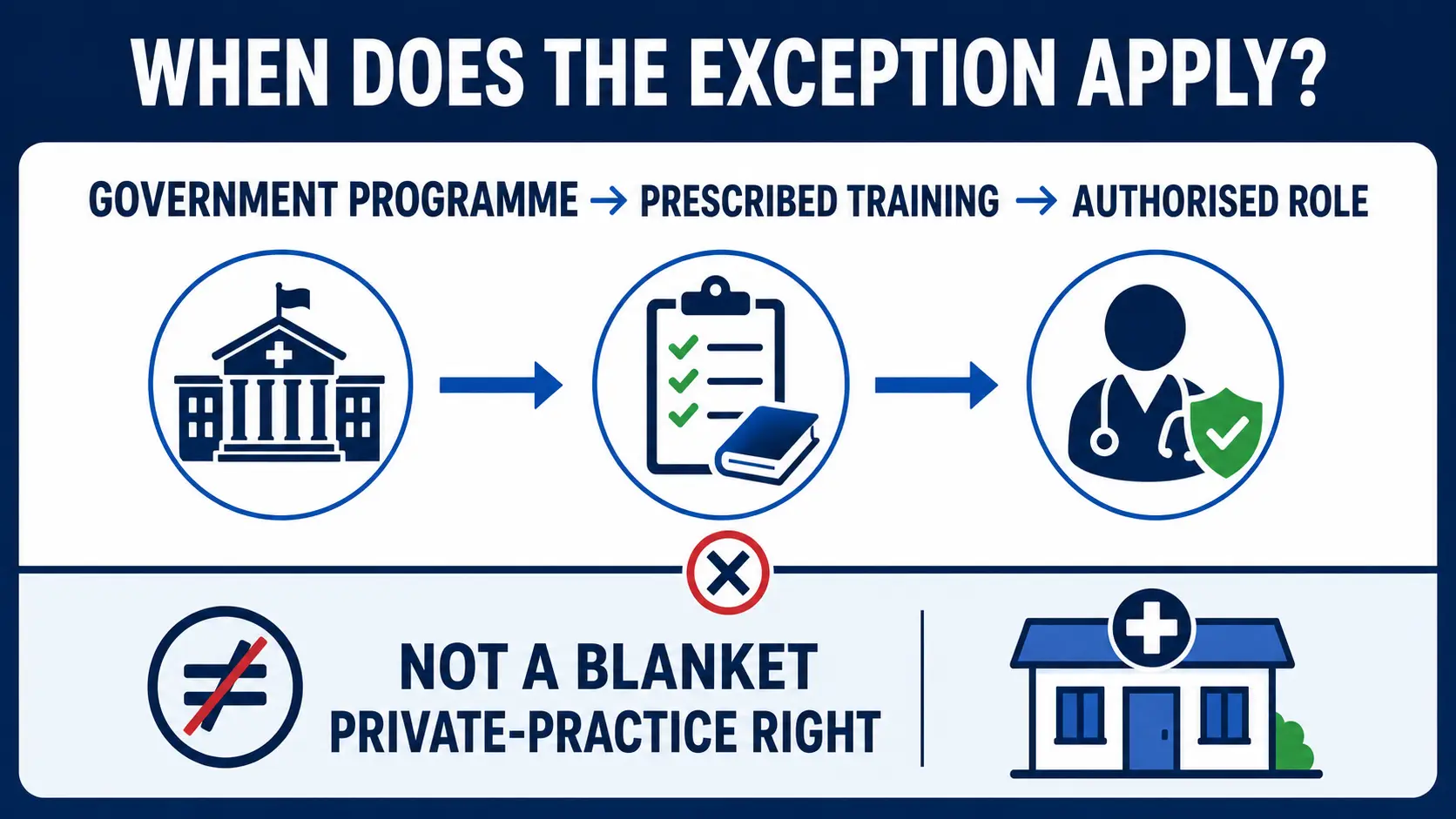
The exception recorded in the NCH clarification applies when a homoeopathic practitioner works under a National Health Programme or another Central or State government programme and has completed the training or course recognised or prescribed by the competent authority for that work.
That makes the exception programme-specific, training-linked and authority-dependent.
Does a short course let BHMS doctors practise allopathy everywhere?
The NCH clarification does not support that broad conclusion.
The exception is connected to the government programme for which the practitioner has been trained or authorised. It should therefore not be read as saying that completion of any short course automatically converts a BHMS practitioner’s professional scope into that of an MBBS doctor.
When considering can BHMS doctors practise allopathy after additional training, three questions need to remain separate: what was taught during BHMS education, what a particular government programme authorises, and what the practitioner’s independent registered scope of practice permits.
Can a BHMS doctor prescribe allopathic medicines in a private clinic?
The fresh NCH clarification does not create a general private-clinic exemption.
Its stated exception concerns authorised work under National Health Programmes or other Central or State government programmes after prescribed or recognised training.
A doctor therefore should not treat participation in such a programme as automatic permission to carry the same cross-system practice into an unrelated private clinic.
What does this mean for BHMS doctors working under NHM or other government schemes?
Government health programmes are where the exception becomes most relevant.
The Ministry of Ayush has separately confirmed that mainstreaming AYUSH is one of the strategies under the National Health Mission. AYUSH services are co-located at Primary Health Centres, Community Health Centres and District Hospitals, and the engagement and training of AYUSH doctors and paramedics is supported under NHM.
That integration does not mean every AYUSH practitioner has unrestricted cross-practice rights. It helps explain why a programme-specific exception exists: government health services may assign trained practitioners defined duties within an authorised public-health programme.
Does the NCH clarification create a new right for BHMS doctors?
The safer reading is no.
The alert reviewed by TPS describes the August 2026 document as a clarification of Regulation 36(y), including its existing proviso, rather than a new regulation creating a nationwide practice right.
That distinction matters when answering can BHMS doctors practise allopathy. A clarification explains how NCH says an existing professional-conduct rule should be understood; it does not automatically amend every state law, registration rule or programme condition affecting medical practice.
What about Maharashtra and modern pharmacology courses?
This issue is particularly sensitive because Maharashtra has had a long-running policy and professional dispute around homoeopathy practitioners who complete additional modern-pharmacology training.
The NCH clarification should not be treated as a shortcut for deciding every Maharashtra-specific legal question. State registration laws, government orders, course recognition, court proceedings and the exact scope of any state authorisation may all matter independently.
TPS therefore does not interpret the NCH clarification as automatically validating or invalidating every state-level arrangement. Those questions need to be checked against the specific state instrument concerned.
Does studying modern medicine during BHMS change the legal scope?
Not automatically.
NCH’s BHMS education framework includes pharmacology and other biomedical subjects. Educational exposure can be important for clinical understanding and for defined responsibilities under public-health programmes.
But studying a subject and being legally authorised to practise an entire system of medicine are not the same thing.
So the answer to can BHMS doctors practise allopathy simply because they studied pharmacology should not be inferred from curriculum exposure alone. The actual scope depends on registration, professional-conduct rules and any specific statutory or programme authorisation.
Can a BHMS doctor work in a government hospital?
BHMS practitioners can hold authorised homoeopathy and AYUSH roles in government health systems, subject to the relevant recruitment and registration requirements.
Government policy also provides for co-location and integration of AYUSH services within PHCs, CHCs and district hospitals.
But employment inside the same hospital as modern-medicine doctors does not by itself erase the distinction between professional systems. The practitioner’s permitted duties still depend on the post, programme, training and applicable rules.
What should a BHMS doctor check before accepting cross-system duties?
- Is the work part of an identified Central or State government programme?
- Is there an official order, appointment or programme document defining the practitioner’s role?
- Has the competent authority prescribed or recognised the required training?
- Has the practitioner actually completed that training?
- What exact medicines, procedures or clinical responsibilities does the programme permit?
- Does the permission operate only while working under that programme?
- Are there additional State Council, registration or state-law requirements?
What should patients understand?
Patients should not assume that every person using the title “doctor” has the same qualification or identical scope of practice.
A BHMS practitioner is trained and registered in homoeopathy. A government programme may authorise additional defined duties after specified training, but that is different from holding an MBBS qualification or an unrestricted modern-medicine registration.
If the system of treatment matters to you, it is reasonable to ask the practitioner what qualification they hold, what system they are registered under and, where cross-system treatment is being provided under a government programme, under what programme authority they are acting.
Can BHMS doctors practise allopathy? What the clarification does and does not mean
| Question | What the clarification means |
|---|---|
| Can a BHMS doctor independently practise allopathy everywhere? | No general right of that kind is established by the NCH clarification. |
| Can cross-practice amount to professional misconduct? | Yes. The NCH clarification refers to Regulation 36(y) in that context. |
| Is there an exception? | Yes, for specified work under National Health Programmes or other Central or State government programmes after recognised or prescribed training. |
| Does completing any modern-pharmacology course create nationwide allopathy rights? | No such blanket right is established by this clarification. |
| Does government-programme permission automatically extend to private practice? | The clarification does not establish that. |
| Does the clarification settle every state-level cross-practice dispute? | No. State laws, registrations, orders and programme rules may still require separate examination. |
Why this clarification matters for medical students and doctors
Questions about professional scope sit alongside much broader decisions about medical education, admission routes, counselling and registration in India.
Students entering medicine in 2026 are also navigating changing counselling procedures and eligibility requirements. TPS is separately tracking Maharashtra NEET UG counselling 2026 and the NEET UG 2026 Round 1 choice-filling process.
State-level processes can also create separate action requirements. Karnataka candidates, for example, can check TPS’s explainer on KEA NEET roll-number linking, while candidates using overseas or sponsor-based admission routes can review the separate guide to NEET 2026 NRI quota sponsor eligibility.
Those admission processes are separate from the NCH professional-conduct question covered here, but the distinction is useful: admission eligibility, medical qualification, professional registration and legal scope of practice are different stages and should not be treated as interchangeable.
Why the NCH clarification matters now
India has a large homoeopathy workforce while government policy also integrates AYUSH practitioners into parts of public-health delivery.
That creates a practical reason for doctors, patients and administrators to understand exactly when can BHMS doctors practise allopathy-related duties and when a government-programme exception does not apply.
The important distinction is between integration and unrestricted cross-practice. A defined role under an authorised public-health programme should not automatically be converted into a claim of unrestricted private-practice authority.
Verification method
TPS checked the National Commission for Homoeopathy’s current rules and regulations material to identify the Professional Conduct, Etiquette and Code of Ethics for Practitioners of Homoeopathy Regulations, 2022 as the governing ethics framework. The fresh cross-practice interpretation was checked against the August 14, 2026 NCH alert captured during TPS monitoring. Government context on AYUSH integration and training under National Health Mission was checked against Ministry of Ayush and PIB material.
Sources checked
- National Commission for Homoeopathy — Rules and Regulations
- PIB / Ministry of Ayush — Integration of AYUSH in national health systems
- PIB / Ministry of Ayush — World Homoeopathy Day 2026 background and NCH role
- National Commission for Homoeopathy — official website and public notices
Limitations and unresolved facts
TPS’s monitoring system captured an NCH public notice dated August 14, 2026 clarifying Regulation 36(y) and its government-programme proviso. During the publication-verification pass, the specific fresh notice was not independently retrievable from the indexed NCH or PIB pages available to TPS. The governing 2022 professional-conduct regulations themselves are listed by NCH.
This article therefore does not claim that the clarification creates a new statutory right, overrides state law or determines the legality of every state-specific modern-pharmacology or cross-practice programme. Those questions require the exact state law, government order, registration rule and programme conditions to be examined separately.