






Port disruption container shipment problems are easy to misread. A port can be congested while your vessel has already berthed. Another terminal in the same port may still be operating normally. Your carrier may have omitted the port, blanked the sailing, rolled the container to another vessel or changed the transshipment plan entirely.
The useful question is therefore not simply “Is this port disrupted?” It is:
“Does the disruption actually intersect with my container, vessel, voyage, terminal or onward connection?”
Direct answer
How do you know if your container is actually affected?
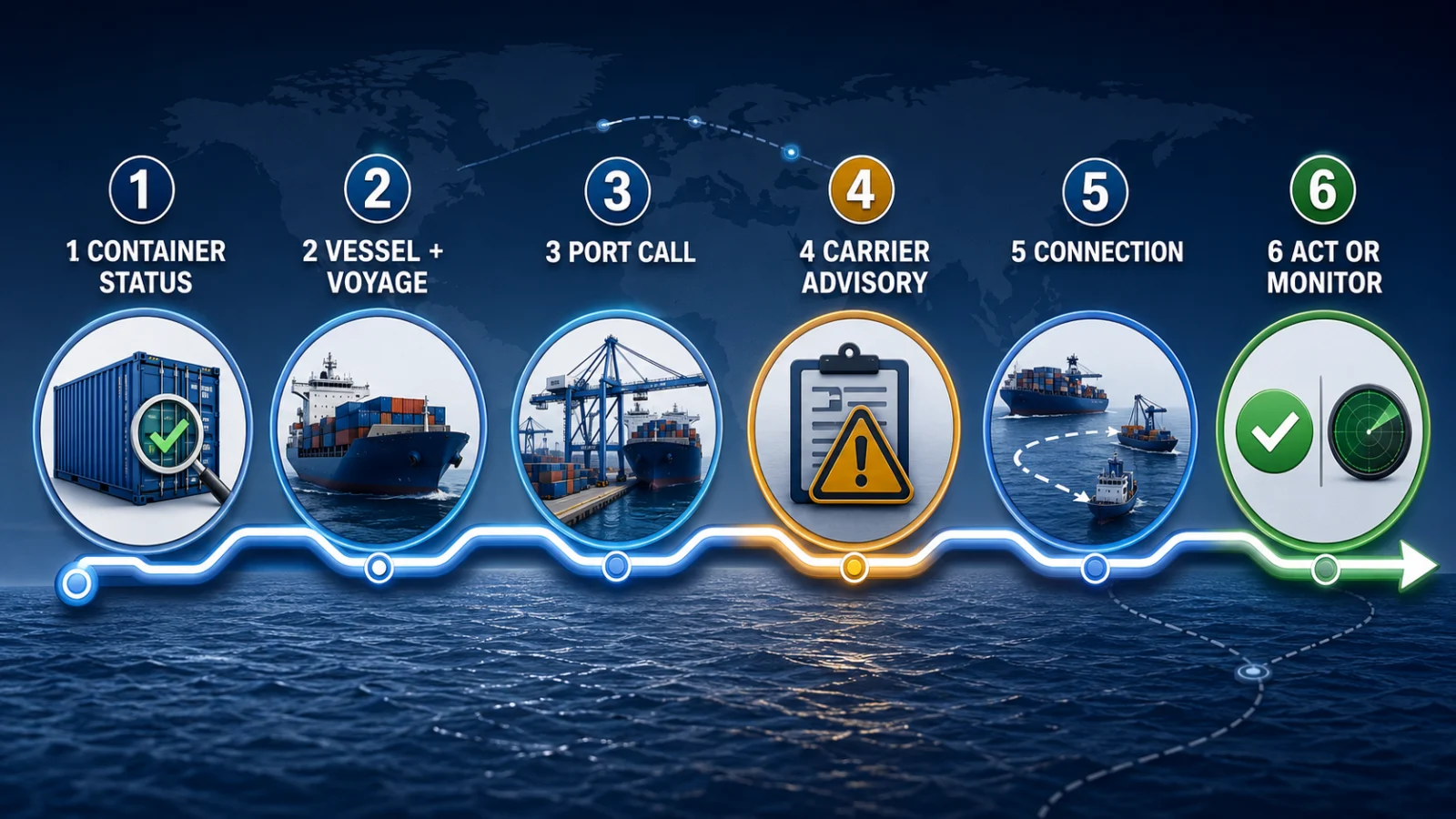
Start with your own shipment record. Confirm the latest container milestone, identify the current vessel and voyage, check whether the exact port call still exists, and then look for a carrier advisory covering that service.
Port-wide congestion is a risk signal. Shipment tracking and carrier evidence are what turn that signal into a shipment-specific conclusion.
Most important distinction
Congestion is not the same as shipment impact
A vessel queue, congestion map or delayed ETA does not prove why your container is late.
Your cargo may instead be affected by a port omission, blank sailing, missed connection, terminal hold, customs status or inland evacuation bottleneck.
Strong shipment evidence
- Carrier container or booking milestone
- Exact vessel and voyage
- Carrier advisory covering that service
- Confirmed port omission or blank sailing
- Assigned replacement vessel or routing
Useful corroboration
- Terminal operational notice
- Port congestion alert
- AIS vessel position
- Independent waiting-time data
- Shipping-industry reporting
What TPS infers
- A disruption matters only when it intersects with your actual shipment path.
- A changing ETA is a symptom, not proof of cause.
- Transshipment and inland evacuation can create delays even when the vessel leg itself is complete.
Not established by a port headline
- Your container is definitely delayed
- Your vessel has been rolled
- The port is fully closed
- Your cargo has missed its connection
- Rerouting is automatically the best option
In this guide
- Start with your shipment
- Evidence hierarchy
- Read the latest container milestone
- Confirm vessel and voyage
- Check whether the port call still exists
- Blank sailing vs port omission
- What AIS can and cannot prove
- Check the terminal, not just the port
- Transshipment delays
- Container rollover
- Vessel waiting vs container dwell
- How to interpret ETA changes
- Watch, verify or act
- When rerouting helps
- Demurrage, detention and evidence
- Verification boundaries
- Limitations
- FAQs
Start with your shipment, not the disruption headline
Before opening a congestion map or shipping-news article, collect the shipment identifiers that allow you to connect the disruption to your cargo.
Container identity
Use the container number, booking number or bill of lading reference to locate the carrier’s own shipment milestones.
Current ocean leg
Identify the vessel and voyage currently carrying — or scheduled to carry — the container.
Route position
Know whether the box is at origin, at sea, at a transshipment hub, discharged at destination or already waiting for inland movement.
Without those three layers, a disruption report remains general network intelligence rather than evidence about your shipment.
Common mistake: using the vessel or voyage shown on the original booking confirmation even after the carrier has rolled the cargo or changed the service plan.
The shipment evidence ladder
Different sources answer different questions. The order matters.
| Evidence source | Best use | What it does not prove |
|---|---|---|
| Carrier container / booking tracking | Latest reported milestone for your box | The complete operational cause of a delay |
| Carrier advisory | Confirmed service change, omission, blank sailing or reroute | That every booking on the service has identical handling |
| Carrier sailing schedule | Current planned vessel rotation, ETD and ETA | That the schedule will not change again |
| Terminal / port notice | Local berth, yard, gate or operational conditions | The final downstream plan for your individual booking |
| AIS / vessel tracking | Where the vessel appears to be and whether it is moving or waiting | Why it is waiting or your container’s customs status |
| Congestion analytics | Broad waiting-time and port-pressure trends | Whether container ABCD1234567 is actually delayed |
| Shipping-industry reporting | Detecting wider disruption and network consequences | Shipment-specific execution for your booking |
Editorial interpretation: industry reporting is often the fastest way to learn that a disruption exists. Carrier and shipment-level records are normally stronger for proving what happens to one specific container.
Read the latest container milestone first
The latest actual milestone is usually more useful than repeatedly refreshing the displayed ETA.
Typical events include:
- empty container released;
- gate-in;
- loaded on vessel;
- vessel departed;
- arrived at transshipment port;
- discharged;
- loaded on connecting vessel;
- arrived at destination;
- customs or terminal release;
- gate-out.
What an ETA change tells you
- The carrier currently expects a different arrival time.
- The schedule or shipment path has changed somewhere.
- Further verification is needed.
What it does not tell you
- The exact cause
- Whether the container was rolled
- Whether congestion is responsible
- Whether the port is closed
- Whether the final delivery date is now certain
Confirm the vessel and voyage carrying the container
A container can move through more than one vessel, particularly on transshipment routes.
Identify the vessel and voyage attached to the shipment’s current leg, then compare that information with the carrier’s latest sailing schedule and operational notices.
Shipment verification path
Check whether your exact port call still exists
A major disruption does not always result in a vessel arriving late. A carrier can remove the affected port from the voyage entirely.
This is a port omission.
Maersk’s booking terms describe a port omission as the omission of a scheduled relevant port call due to operational circumstances. Current carrier advisories show that cargo affected by an omitted port can be moved through an alternative routing, protected on a later service or handled through another port.
If the affected port disappears from the current voyage rotation, stop relying on the original ETA. The useful question becomes: what contingency has the carrier assigned to your booking?
Blank sailing, port omission, delay and rerouting are different events
| Event | What changed | Possible cargo consequence |
|---|---|---|
| Port omission | The vessel continues but skips one scheduled port | Alternative discharge, later call or rerouting |
| Blank sailing | A scheduled sailing or vessel position is cancelled | Booking moves to a later or alternative service |
| Schedule delay | The service still operates but later than planned | ETD and ETA shift |
| Rerouting / diversion | The planned path or discharge point changes | Extra transshipment or inland movement |
| Port congestion | Port or terminal capacity cannot process traffic normally | Berthing, discharge, pickup or connection delay |
| Rollover | The container moves from one planned sailing to a later one | Vessel and voyage assignment changes |
Maersk’s June 2026 FI3 schedule reset is a useful example of why these distinctions matter. Prolonged waiting and congestion resulted in a blanked vessel position and cargo rebooking across the network. The operational consequence was therefore not simply “the port queue became longer.”
Use AIS to verify vessel behaviour — not the complete cause
AIS can help answer:
- Has the vessel reached the port area?
- Is it still at sea?
- Is it waiting offshore?
- Has it berthed?
- Has it departed?
- Has it apparently changed course?
That makes AIS useful when a schedule suddenly moves.
AIS can support
- vessel position;
- movement trend;
- apparent waiting;
- berth / departure timing.
AIS does not prove
- the reason for waiting;
- container customs status;
- terminal release;
- whether your box missed a connection.
Known limitation
- destination data can be stale;
- coverage varies;
- public AIS can be incomplete;
- different services may interpret waiting differently.
TPS use
- corroborate carrier information;
- identify unusual vessel behaviour;
- never substitute it for shipment milestones.
Check the terminal, not only the port name
Large ports contain multiple terminals, and disruption can be uneven.
One terminal may face:
- berth congestion;
- yard congestion;
- equipment failures;
- labour shortages;
- reefer-plug constraints;
- rail or trucking bottlenecks;
- temporary safety restrictions;
while another terminal in the same port complex continues working normally.
The JNPA congestion episode in India illustrates this distinction. Government intervention focused on container evacuation and inland movement, including rail evacuation and measures related to trailer-driver shortages. That is a different failure mode from vessels simply waiting for an ocean berth.
Best diagnostic rule: once your container has been discharged, stop analysing the problem only through vessel queues. Shift attention to terminal release, customs and inland evacuation.
For transshipment cargo, check every leg separately
A container can complete the first voyage successfully and still accumulate a serious delay at the hub.
Typical transshipment chain
Verify:
- Did Vessel A reach the transshipment hub?
- Was the container discharged?
- Which connecting vessel was originally planned?
- Did that vessel sail before the box became available?
- Has the carrier assigned a replacement connection?
- What is the revised destination ETA?
A box sitting at a hub after the first vessel has departed may be facing a missed connection rather than congestion at the final destination.
How to recognise a container rollover
A rollover usually means the cargo planned for one sailing is moved to a later sailing.
Possible causes include:
- capacity constraints;
- late gate-in;
- schedule disruption;
- blank sailing;
- port omission;
- missed transshipment;
- operational restrictions.
Strong rollover evidence
- vessel changes;
- voyage changes;
- carrier explicitly confirms rebooking;
- container milestone shows later loading.
Weak rollover evidence
- ETA moved;
- port is congested;
- vessel appears late;
- third-party tracker predicts delay.
Do not confuse vessel waiting with container dwell
Before berth
The vessel may wait outside the port because a berth or terminal window is unavailable.
After discharge
The container may already be ashore but still blocked by customs, documentation, yard congestion, rail or trucking.
After release
The box may be available but not yet collected, creating a different commercial and free-time problem.
This distinction matters because congestion maps based on vessel positions are strongest at showing the first stage. They are much weaker at proving why a container remains inside a terminal after discharge.
Treat ETA as a symptom, not a diagnosis
A changing ETA can result from:
- port congestion;
- weather;
- port omission;
- blank sailing;
- transshipment failure;
- vessel mechanical problems;
- carrier network recovery;
- customs delays;
- inland disruption.
Editorial interpretation: the ETA is useful because it tells you something changed. The vessel, voyage, port call, milestone and carrier advisory tell you what changed.
Watch, verify or act
1
WATCH
The port is congested, but your vessel remains scheduled and there is no carrier advisory affecting your service.
2
VERIFY
Your ETA moved, the vessel is waiting unusually long, or the voyage rotation changed.
3
ACT
Your voyage is blanked, port call omitted, container rolled, connection missed or alternative routing confirmed.
When rerouting helps — and when it can make things worse
Rerouting is not automatically the best response to congestion.
Before changing the path, check:
- whether the container is already loaded;
- whether diversion is operationally possible;
- congestion at the alternative port;
- availability of onward capacity;
- additional transshipment;
- customs implications;
- inland movement from the new discharge port;
- new ETA;
- extra freight and handling charges;
- free-time implications.
A shorter route is not always the faster route. A longer path with a stable connection can outperform a theoretically shorter path through a severely disrupted hub.
Protect the evidence if charges later become disputed
Port disruption can create demurrage, detention, storage or other operational cost, but the correct charge depends on where the container is and which party controls it.
Preserve:
- booking confirmation;
- original ETA and ETD;
- revised ETA and ETD;
- carrier advisories;
- terminal notices;
- container milestones;
- customs-release timing;
- gate-out timing;
- empty-return timing;
- communications about rerouting or carrier holds.
Build a shipment disruption timeline
What congestion platforms can tell you
Independent maritime-data providers can be useful early-warning tools because they measure vessel queues, waiting times, port stay and schedule reliability.
Xeneta’s congestion methodology explicitly cautions that port congestion is only one part of reliability analysis and should be interpreted alongside schedule deviation and service performance.
MarineTraffic similarly provides vessel, port and container-related operational intelligence based on AIS and associated data.
They can help answer
- Where is congestion building?
- Are vessels waiting unusually long?
- Which port or terminal appears pressured?
- Is schedule reliability deteriorating?
They cannot automatically answer
- Why your specific box is late
- Whether your container cleared customs
- Whether your carrier rolled the booking
- What contingency applies to your cargo
Related TPS maritime guides
Why Strait of Hormuz matters to India
Use this for the wider energy, shipping and chokepoint-risk layer.
Indian seafarer Strait of Hormuz guide
Use this for seafarer deployment, consent and emergency considerations rather than cargo routing.
Verification notes: what is confirmed, inferred and unresolved
Confirmed from reviewed sources
- Carriers use port omissions and blank sailings as operational responses.
- Affected cargo can be reassigned or rerouted.
- Port congestion can involve inland evacuation constraints as well as vessel waiting.
- AIS and congestion tools have interpretation limits.
Carrier / industry reported
- Specific Maersk advisories show omission and schedule-reset behaviour.
- ONE material shows congestion and transshipment consequences.
- Lloyd’s List documents continuing global congestion pressure.
Editorial interpretation
- Shipment-level evidence should outrank general disruption headlines.
- A changing ETA should trigger investigation rather than immediate attribution.
- Different operational stages require different data sources.
Shipment-specific unknowns
- Whether an individual box is delayed
- Why a particular vessel is waiting
- Whether a rollover occurred
- Which reroute will be cheapest or fastest
- Whether charges will ultimately apply
Verification method
ThePulseSignal reviewed carrier primary sources from Maersk, Hapag-Lloyd and ONE to verify how port omissions, blank sailings, congestion and rerouting can affect customer cargo.
Government of India material on JNPA was used to distinguish vessel-side congestion from inland container-evacuation constraints.
Xeneta and MarineTraffic material was used to define what port-congestion and vessel-position data can and cannot establish.
Specialist shipping reporting was used as context for the recurring scale of global congestion, but shipment-specific conclusions are deliberately tied to carrier and container evidence.
Limitations and unresolved facts
No public article can determine the live status of an individual container without shipment-specific identifiers and current carrier data.
- Carrier tracking can change after this article is read.
- AIS can be incomplete, delayed or based on stale vessel declarations.
- Port-wide congestion does not prove terminal-wide disruption.
- Terminal disruption does not prove every service is affected equally.
- A revised ETA does not establish the cause of delay.
- A vessel waiting offshore does not establish that the port is closed.
- A port omission does not mean the cargo has been cancelled.
- A blank sailing does not mean every booking is handled identically.
- Demurrage, detention and free-time treatment depends on contract and carrier terms.
- Alternative routing can create new customs, transshipment or inland costs.
- Recovery of port operations does not mean accumulated backlog disappears immediately.
Port disruption container shipment: frequently asked questions
Does port congestion mean my container will be delayed?
No. Congestion increases risk, but shipment impact depends on your vessel, voyage, terminal, transshipment plan and current container milestones.
How can I tell if my vessel is waiting for a berth?
Check AIS or vessel-position data together with the carrier schedule and terminal status. Waiting can be visible, but AIS alone does not prove the reason.
What is a port omission?
A port omission occurs when a scheduled vessel call is skipped while the service continues. The carrier may reroute affected cargo or protect it on another sailing.
What is a blank sailing?
A blank sailing is the cancellation of a scheduled sailing or vessel position. Affected bookings may move to later or alternative capacity.
Why is my container stuck at a transshipment port?
Possible reasons include a missed onward connection, congestion, schedule changes or lack of capacity. Confirm whether a replacement connecting vessel has been assigned.
Can AIS tell me whether my container is delayed?
AIS can help track the vessel carrying the container, but it cannot prove customs, terminal release or the full status of the container itself.
Why did my ETA change even though the port is open?
Port availability is only one factor. Schedule recovery, vessel delay, omission, blank sailing, transshipment failure, weather and inland disruption can all change ETA.
Should I reroute immediately if a port becomes congested?
Not automatically. First establish whether your own service is affected and compare the alternative route’s capacity, cost, customs implications and connection reliability.
Bottom line
A port disruption container shipment investigation should always move from broad risk to specific evidence.
Best evidence chain: container milestone → current vessel and voyage → exact port call → carrier advisory → transshipment connection → terminal / AIS corroboration.
The strongest conclusion is not:
“The port is congested.”
It is something specific and provable, such as:
“My container was loaded on Vessel A, that voyage has omitted Port B, and the carrier has reassigned the booking through Port D on Vessel C.”
That is the level of evidence you need before changing routing, promising a revised delivery date or attributing a shipment delay to a particular port disruption.
Last verified: August 22, 2026. This guide was prepared using current carrier operational material, government port-congestion evidence and maritime tracking methodology. Shipment-specific status must still be checked against the live carrier, vessel, voyage and terminal record.