




Commercial traffic through the Strait of Hormuz remains severely constrained. Reuters reported on September 21 that 12 tracked commodity vessels crossed over the weekend, down from 35 the previous weekend. Visible ship traffic remains only a fraction of pre-war levels, while some oil tankers continue to move with AIS transponders switched off.
Separately, U.S. Central Command said that as of September 15, U.S. forces had redirected 103 commercial vessels to ensure compliance with the U.S. naval blockade against Iran. That is a cumulative blockade-enforcement count, not a count of the weekend’s Hormuz transits and not proof that 103 vessels were all turned away from the Strait on one day.
The strongest current description is therefore severely constrained and militarily managed commercial passage, but not a proven universal physical closure. Some vessels continue to cross, and ship-tracking data may miss vessels operating with AIS transponders switched off.
Direct answer
Is the Strait of Hormuz completely closed?
No universal physical closure is established by the current evidence. Reuters reported 12 tracked commodity-vessel transits over the weekend. Traffic nevertheless remains far below normal levels, and the operating environment includes military protection, blockade enforcement, attacks, rerouting and vessels using reduced-visibility or dark-transit practices.
Current shipping state
Only 12 tracked commodity vessels crossed over the weekend
Reuters reported 12 tracked commodity-vessel transits over the weekend, down from 35 the previous weekend. Before the war, the Strait typically handled about 125 large commercial vessels per day.
Current Hormuz status — September 21, 2026
Weekend traffic fell sharply, but oil flows remain larger than visible ship counts suggest
Reuters reported provisional Kpler data showing 12 tracked commodity vessels transited Hormuz over the weekend, down from 35 the previous weekend.
On Sunday, four tracked vessels exited the Strait and two small oil tankers entered the Gulf. On Saturday, five vessels left the Gulf carrying agricultural products, LPG and fertiliser, while an empty very large gas carrier entered.
The tracked count is not an exhaustive census. Reuters reported that some Middle Eastern oil tankers continue to travel with AIS transponders switched off, which means visible vessel counts can understate physical oil movements.
Oil flows therefore tell a more nuanced story than ship counts alone. Kpler data cited by Reuters showed 13 tankers carrying about 34 million barrels of crude exited the Strait in the week of September 13, with Saudi Arabia accounting for about half of the volume and Iraq about 35%.
Saudi crude exports also recovered to more than 4 million barrels per day so far in September after falling to 2.4 million bpd in August, as Saudi Aramco increased shipments through Hormuz after disruption to its East-West pipeline and Yanbu route.
CENTCOM’s 103-vessel figure measures blockade enforcement, not current Strait throughput. CENTCOM said that as of September 15, U.S. forces had redirected 103 commercial vessels to ensure compliance with the blockade against Iran. The count is cumulative and should not be added to, subtracted from or substituted for daily Hormuz transit data.
Confirmed or directly reported
- Reuters reported 12 tracked commodity vessels transited Hormuz over the weekend, down from 35 the previous weekend.
- Before the war, the Strait typically handled about 125 large commercial vessels per day.
- Kpler data cited by Reuters showed 13 crude tankers carrying about 34 million barrels exited the Strait in the week of September 13.
- CENTCOM said U.S. forces had redirected 103 commercial vessels as of September 15 to ensure compliance with the U.S. blockade against Iran.
- Limited commercial passage continues, so a universal physical closure is not established.
- Reuters reported on September 18 that Bab el-Mandeb traffic was 23 commodity-vessel crossings against a 10-day average of about 26.
- ICEGATE maintains an official return-of-export-cargo procedure for affected Indian cargo returning from international waters because of the Hormuz disruption.
Reported but not fully resolved
- Some vessels are using routes with AIS visibility reduced or unavailable, so publicly tracked counts may understate physical traffic.
- Visible vessel counts can understate physical oil flows because some tankers are moving with AIS transponders switched off.
- The eventual date and terms of a rescheduled Iran-Gulf meeting remain unresolved.
- The duration of the current low-traffic state and the cumulative effect on Gulf energy shipments remain uncertain.
- Daily transit counts can change quickly and should not be treated as a permanent operating level.
What this means for India
- Very low visible Hormuz traffic increases uncertainty around Gulf energy shipments, vessel scheduling, freight and war-risk insurance.
- Saudi Arabia has increased crude exports through Hormuz after disruption to its Red Sea export route, showing that current oil flows can remain substantial even while tracked vessel counts stay depressed.
- The CENTCOM blockade tally confirms that commercial shipping is operating within an active military-enforcement environment, not simply a voluntary commercial slowdown.
- Simultaneous traffic weakness at Hormuz and Bab el-Mandeb reduces flexibility across two critical regional shipping corridors.
- India’s crude exposure can be reduced through alternative suppliers and outside-Hormuz export routes, while LPG and some LNG flows remain harder to substitute.
Not established
- A complete physical closure of every commercial Hormuz transit.
- A normal unrestricted reopening.
- That the 12 tracked weekend commodity-vessel transits represent every vessel physically crossing Hormuz.
- That low visible vessel counts mean oil export volumes have fallen in the same proportion.
- That CENTCOM’s 103 redirected vessels were all redirected from Hormuz itself on September 15.
- That the 103-vessel blockade tally is equivalent to a daily transit count.
- A nationwide Indian crude, petrol, diesel or LPG shortage caused by the current disruption.
In this guide
- Current Hormuz shipping status
- What CENTCOM’s 103 redirected vessels mean
- Why Bab el-Mandeb matters
- Why vessel-security risk remains high
- What happened to the Iran-Gulf Oman talks
- What the ICEGATE cargo-return advisory means
- What India is doing
- Why Hormuz matters to India
- Crude, LPG and LNG exposure
- Does this mean a fuel shortage?
- Which routes can avoid Hormuz?
- Can Chabahar bypass Hormuz?
- Indian seafarer exposure
- Limitations
- FAQs
What is the current Strait of Hormuz shipping status?
The Strait cannot accurately be described as either operating normally or being physically impassable to every commercial vessel.
Reuters reported on September 21 that provisional Kpler data showed 12 tracked commodity vessels crossed over the weekend, down from 35 the previous weekend.
On Sunday, four tracked vessels exited and two small oil tankers entered the Gulf. On Saturday, five vessels left the Gulf and one empty very large gas carrier entered.
The strongest current description is severely constrained commercial passage under elevated military and security controls.
The tracking boundary matters. Some vessels switch off transponders during voyages through the conflict zone, so public vessel counts should not be interpreted as an exhaustive physical census of every ship crossing the waterway.
Reuters also reported that some oil tankers are travelling with AIS transponders switched off. The visible traffic count therefore does not capture every physical movement or the full volume of oil leaving the Gulf.
What does CENTCOM’s 103 redirected vessels figure mean?
U.S. Central Command said that as of September 15, U.S. forces had redirected 103 commercial vessels to ensure compliance with the U.S. naval blockade against Iran.
This figure describes cumulative enforcement activity associated with the blockade. It does not mean that 103 commercial ships attempted to cross Hormuz on September 15, nor does it mean 103 vessels were all turned away from the Strait itself.
CENTCOM announced in July that the resumed blockade would apply to maritime traffic entering and exiting Iranian ports while U.S. forces continued to support regional traffic not violating the blockade. The latest 103-vessel count shows that this enforcement operation remains active.
For readers assessing shipping risk, the CENTCOM number is best understood alongside—not instead of—daily vessel-tracking data. One measures blockade enforcement; the other measures observed commercial movement through the Strait.
Why does the Bab el-Mandeb decline matter?
Recent Reuters reporting has also shown pressure on Bab el-Mandeb traffic, keeping the Red Sea route under strain alongside Hormuz.
Hormuz and Bab el-Mandeb are separate chokepoints, but pressure at both can compound uncertainty across Gulf and Red Sea shipping. For India, that can affect freight costs, voyage planning, insurance, energy-cargo routing and seafarer exposure.
The Bab el-Mandeb figure does not establish a complete Red Sea closure. It shows that the second major regional maritime route also remains under strain.
Why does vessel-security risk remain high?
The current traffic decline is occurring after a series of attacks and confrontations involving commercial shipping and military forces around Hormuz.
Recent reporting has included a vessel struck while transiting the Strait, attacks on tankers and a confrontation in which CENTCOM said Iranian small boats attempted to take possession of a U.S. unmanned surface vessel.
For Indian buyers, shipping companies and seafarers, this keeps war-risk insurance, crew safety, voyage approval, vessel screening, scheduling and cargo-delay risk materially relevant.
What happened to the Iran-Gulf Oman talks?
The diplomatic track has not yet produced an operational Hormuz agreement.
A meeting in Oman between Iran and Gulf Arab states had been scheduled for September 14 to discuss issues including possible arrangements for the Strait. Oman’s foreign minister said on September 13 that the meeting was postponed in the interests of consensus.
No replacement date was established in the reviewed evidence. The proposed regional arrangement should therefore not be treated as a completed agreement, guaranteed safe channel or proof of normal reopening.
What does the ICEGATE advisory mean for Indian export cargo?
ICEGATE maintains an advisory titled Advisory-Return of Export Cargo from International Waters due to closure of Strait of Hormuz.
The current ICEGATE electronic-filing index identifies the advisory as version 1.2 dated April 29, 2026, while the archive records version 1.0 dated April 28, 2026.
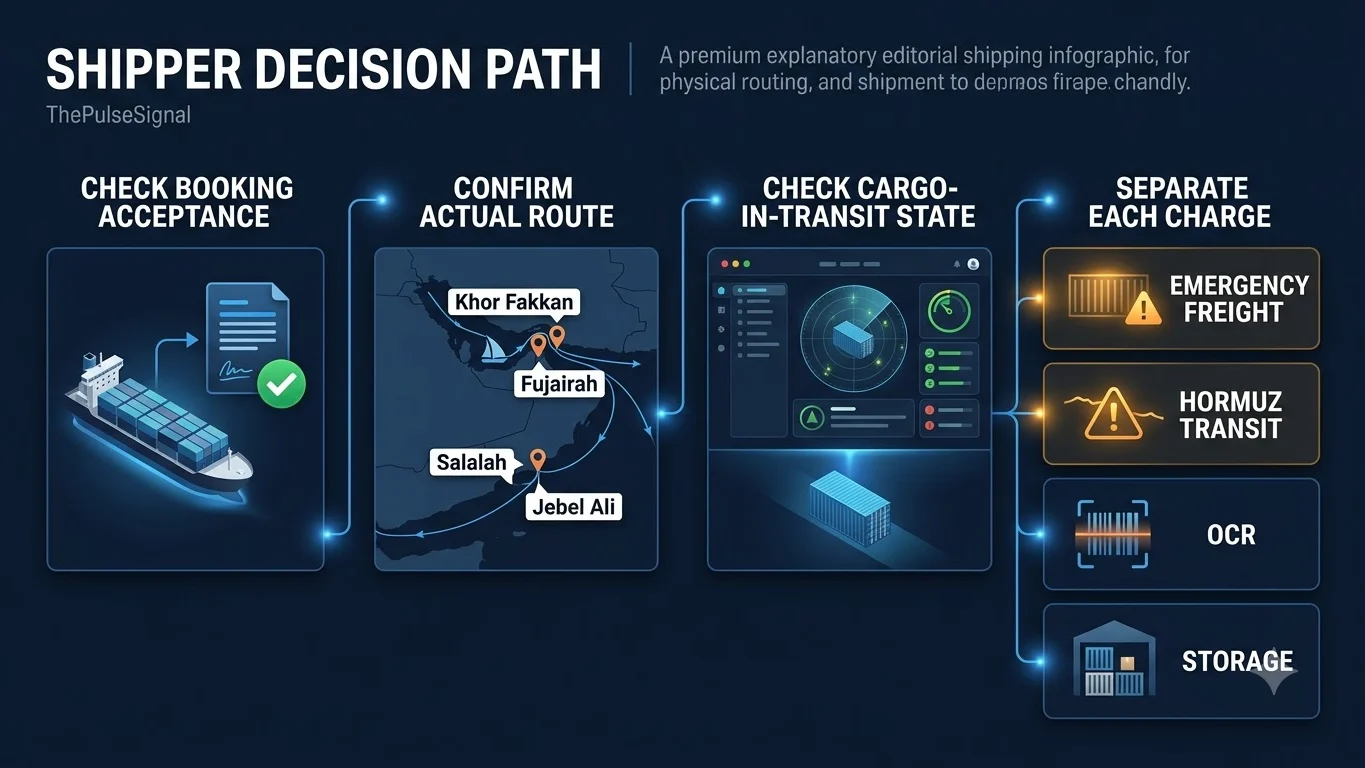
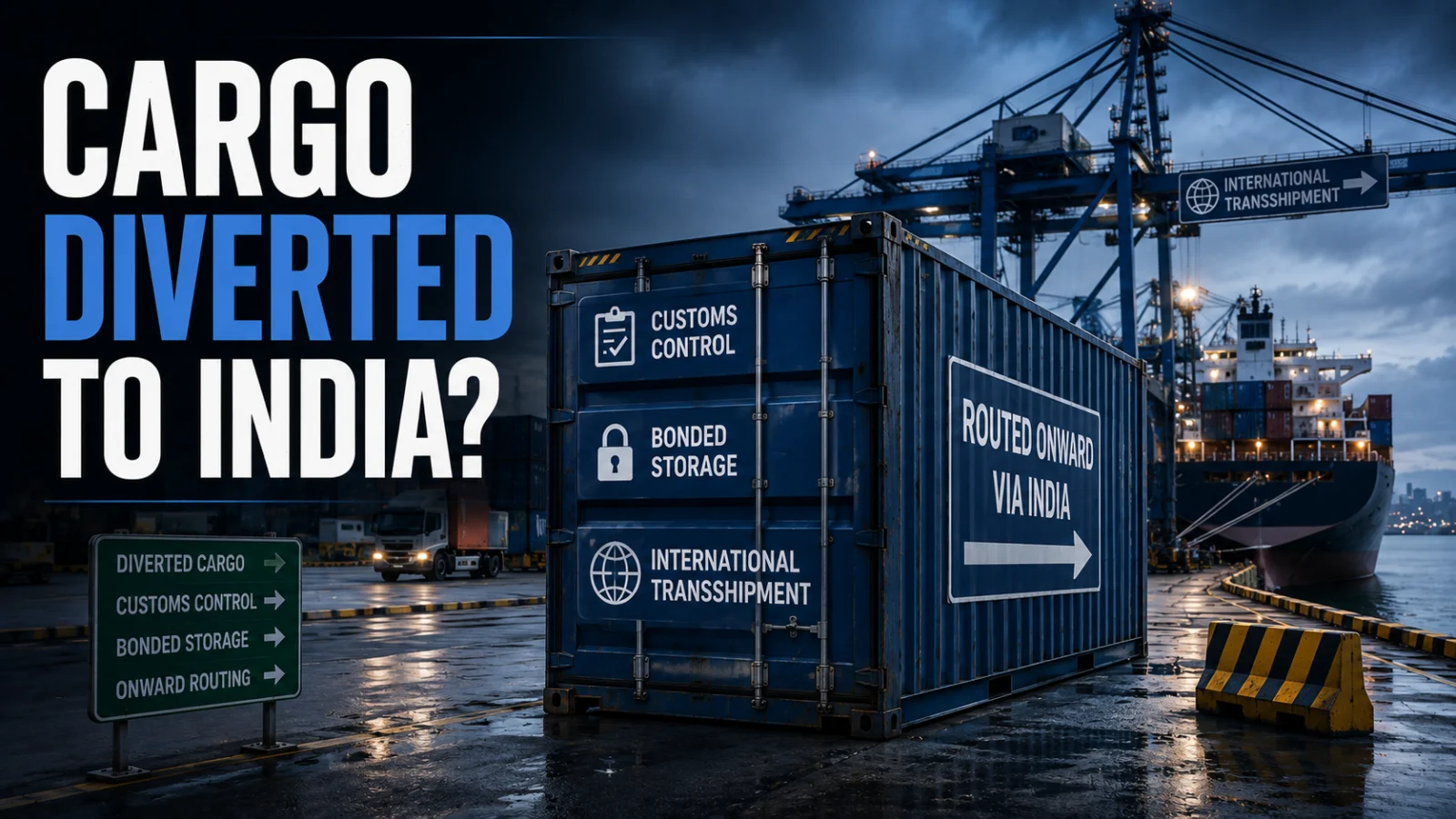
The advisory establishes a concrete India-facing customs consequence: export cargo that has already moved toward international waters can require a formal customs process when it returns instead of completing the intended voyage.
ICEGATE’s use of the word “closure” in the advisory title should not be generalized into proof that every vessel is physically unable to cross Hormuz. Current tracking continues to show limited commercial transits.
Exporter action: if cargo is returning to India because the voyage cannot proceed through the affected corridor, use the current ICEGATE procedure and shipment-specific customs instructions rather than assuming the export can simply be reversed administratively.
What is India doing about Hormuz risk?
India’s response is not built around one single route or one single fuel.
Government briefings have highlighted diversification of crude-oil sources, use of routes and terminals outside Hormuz where available, monitoring of LPG and other energy supplies, coordination with shipping and energy companies, and contingency planning for trade and logistics disruption.
That distinction matters because India’s crude-oil exposure is materially different from its LPG exposure. A measure that reduces crude-route dependency does not automatically solve LPG, LNG, container-shipping or seafarer risk.
Why does the Strait of Hormuz matter to India?
Energy
Persian Gulf crude, LPG and LNG can depend on Hormuz depending on supplier and loading terminal.
Shipping
Conflict raises war-risk insurance, freight costs, voyage uncertainty, vessel-screening requirements and scheduling risk.
Trade
Export cargo can face diversion, return-to-port and customs-processing consequences when voyages cannot proceed normally.
People
Indian seafarers can face direct crew-safety, contract, repatriation and voyage-risk consequences.
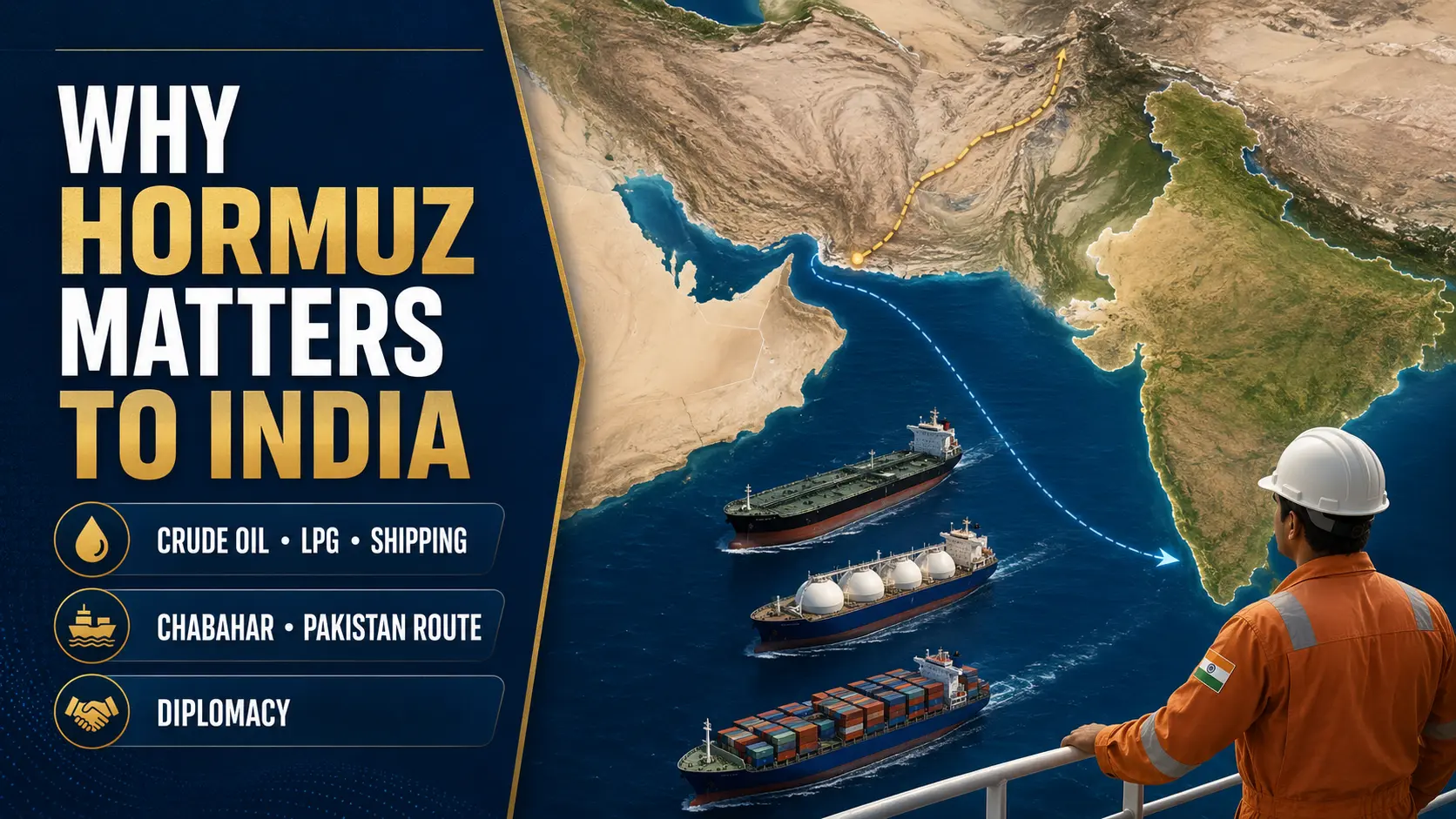
The Strait connects the Persian Gulf with the Gulf of Oman and Arabian Sea. India’s exposure cannot be reduced to one percentage because crude, LPG, LNG, trade cargo and seafarer risk follow different routes.
How exposed is India through crude oil, LPG and LNG?
Crude oil
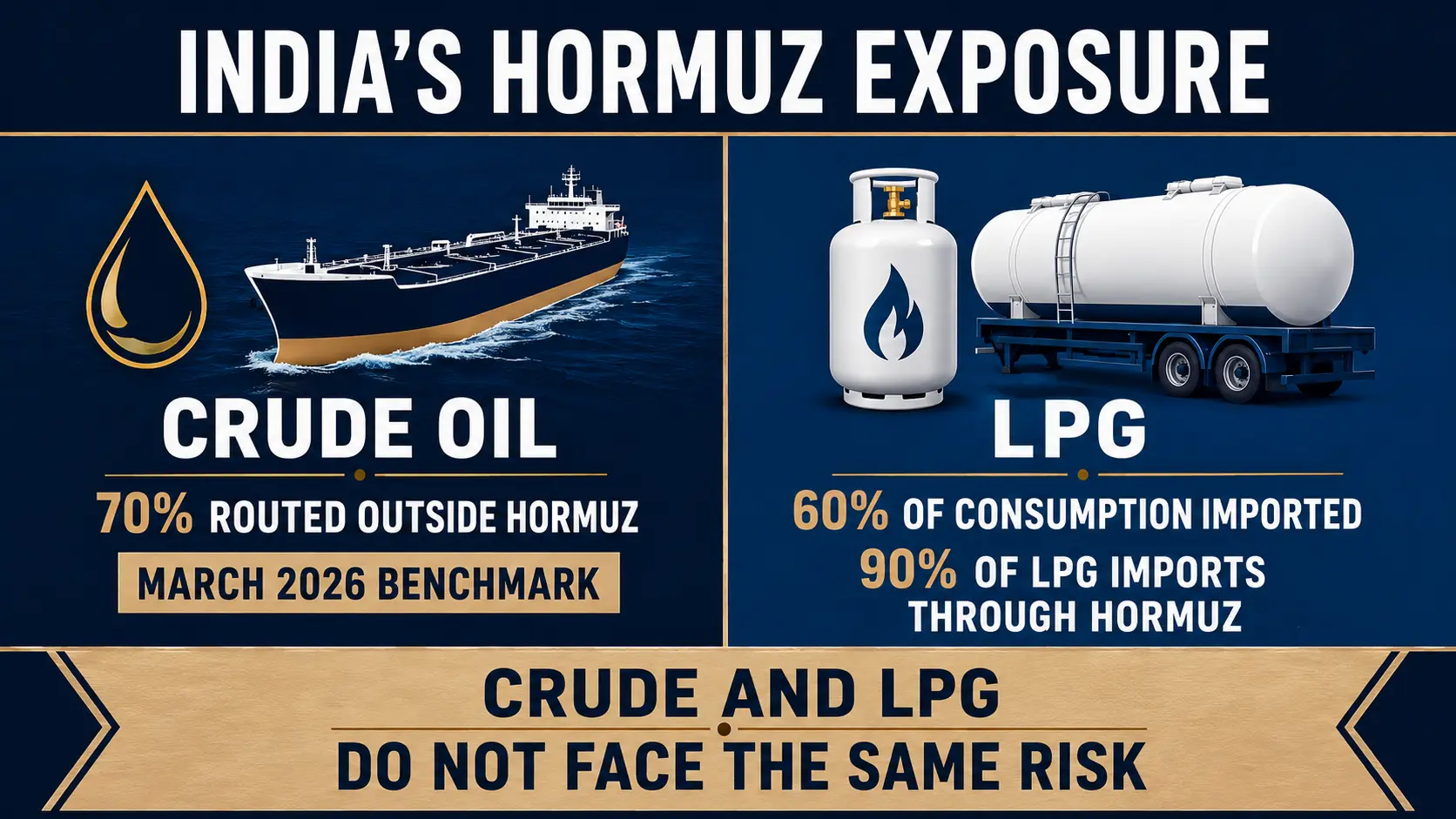
India’s March 2026 government briefing said roughly 70% of crude imports were already arriving through routes outside Hormuz.
Crude exposure is therefore significant but more diversified than the assumption that most Indian crude imports must use the Strait.
LPG
The same government benchmark said India imported around 60% of LPG consumption, with roughly 90% of those imports passing through Hormuz.
That makes LPG structurally more exposed than crude oil.
LNG
India imports LNG from Gulf suppliers including Qatar. LNG loaded at Persian Gulf export terminals normally depends on Hormuz unless another export route is available.
Reuters reported on September 18 that three LNG vessels reappeared outside the Strait, including Marigold LNG signaling Dabhol after loading at Das Island in the UAE. That remains evidence that some LNG movement has continued despite the disruption.
The September 21 weekend data still show severely constrained visible traffic. The precise current share of Indian LNG imports using the Strait should not be inferred without live route-level data, and tracked vessel counts can miss ships operating with AIS switched off.
Does the disruption mean India is running out of petrol, diesel or LPG?
No nationwide Indian fuel shortage is established by the current evidence.
Severely constrained Hormuz traffic can increase freight, insurance, scheduling, procurement and price risks. Those risks are not proof that Indian refineries or distributors have exhausted inventories.
- Hormuz commercial traffic: 12 tracked commodity vessels over the weekend, down from 35 the previous weekend.
- Crude movement: 13 tankers carrying about 34 million barrels exited in the week of September 13, according to Kpler data cited by Reuters.
- CENTCOM blockade enforcement: 103 commercial vessels redirected cumulatively as of September 15.
- Bab el-Mandeb traffic: Reuters reported 23 commodity-vessel crossings on September 18 versus a 10-day average of about 26.
- Continuing limited commercial transit: established by tracked vessel movement.
- Export-cargo return procedure in India: officially available through ICEGATE.
- Complete universal closure: not established.
- Nationwide Indian retail-fuel shortage: not established.
Which energy routes can avoid Hormuz?
Fujairah and UAE pipeline infrastructure
Crude delivered to Fujairah on the Gulf of Oman side can be exported without a tanker crossing Hormuz after loading there.
Non-Gulf suppliers
Crude sourced from countries whose export terminals do not sit inside the Persian Gulf can avoid the Strait entirely.
Oman
Oman’s Arabian Sea-facing ports lie outside the Persian Gulf, so cargo originating there can reach India without crossing Hormuz.
Persian Gulf terminals
Oil, LPG or LNG loaded inside the Persian Gulf normally still requires Hormuz unless an alternative pipeline, transshipment arrangement or outside-Hormuz terminal is available.
Can Chabahar bypass the Strait of Hormuz?
Chabahar bypasses Hormuz for cargo using Chabahar itself, but it does not replace Hormuz for Gulf-origin energy cargoes loaded inside the Persian Gulf.
India’s long-term contract for Shahid Beheshti Port at Chabahar gives India a strategic logistics route on Iran’s Gulf of Oman coast. That can support trade connectivity toward Afghanistan and Central Asia without requiring those Chabahar cargoes to pass through Hormuz.
But Chabahar is not a universal substitute for tankers loading crude, LPG or LNG at terminals located inside the Persian Gulf.
Why are Indian seafarers part of India’s Hormuz exposure?
India’s exposure is not only about imported energy.
Indian nationals serve on international commercial vessels operating across Gulf routes. Elevated military activity, vessel strikes, diversions, dark routing and delayed port calls can therefore create direct crew-safety, employment, contract and repatriation consequences even when the cargo is not destined for India.
Limitations and unresolved facts
- The 12-vessel weekend figure is provisional tracked commodity traffic, not an exhaustive count of every physical Hormuz crossing.
- Commercial traffic counts can miss vessels operating with AIS disabled or otherwise not visible in tracking datasets.
- The September 18 LNG-vessel movements do not establish normal LNG traffic or a general reopening.
- Marigold LNG signaling Dabhol indicated an announced destination, not proof of final delivery.
- CENTCOM’s 103-vessel figure is a cumulative blockade-enforcement tally and must not be treated as a daily Strait transit count.
- The duration of current U.S. blockade enforcement and Iranian restrictions remains uncertain.
- No confirmed replacement date was established for the postponed Iran-Gulf meeting in Oman.
- The March 2026 Indian crude and LPG figures are structural government benchmarks rather than real-time cargo-route data.
- The exact route of every India-bound crude, LPG or LNG cargo is not publicly available.
- Current evidence does not establish nationwide Indian petrol, diesel or LPG rationing.
Strait of Hormuz and India: frequently asked questions
Is the Strait of Hormuz completely closed?
No universal physical closure is established by current tracked vessel evidence. Reuters reported 12 tracked commodity-vessel transits over the weekend, although traffic remains severely constrained.
How much traffic is currently crossing Hormuz?
Reuters reported 12 tracked commodity-vessel transits over the weekend, down from 35 the previous weekend. Tracking data may not capture every physical crossing because some vessels operate with AIS switched off.
Are LNG ships moving again?
Yes, some LNG movement has been observed. Reuters reported three LNG vessels reappeared outside the Strait on September 18, including Marigold LNG signaling Dabhol, but that did not establish a normal reopening.
What does CENTCOM’s 103-vessel number mean?
It is a cumulative count of commercial vessels CENTCOM says U.S. forces redirected to ensure compliance with the blockade against Iran as of September 15. It is not a one-day Hormuz transit count.
What is happening at Bab el-Mandeb?
Recent Reuters reporting shows the Red Sea chokepoint also remains under pressure, limiting route flexibility while Hormuz traffic is severely constrained.
What happened to the Oman Hormuz meeting?
The planned September 14 meeting between Iran and Gulf states was postponed. No replacement date was established in the reviewed evidence.
When was the ICEGATE Hormuz return-cargo advisory issued?
The current ICEGATE index identifies version 1.2 dated April 29, 2026, while the archive records version 1.0 dated April 28.
Does India depend on Hormuz for most crude oil?
No. A March 2026 Indian government briefing said roughly 70% of crude imports were arriving through routes outside Hormuz.
Is LPG more exposed than crude?
Yes. The same government benchmark said roughly 90% of India’s imported LPG passed through Hormuz.
Does Chabahar bypass Hormuz?
Chabahar itself lies outside Hormuz, so cargo using Chabahar can bypass the Strait. It does not replace Hormuz for Gulf-origin energy loaded at Persian Gulf terminals.
Does the disruption mean India has a petrol or LPG shortage?
No nationwide shortage is established by the current evidence. Shipping disruption can raise costs and risk without proving physical retail shortage.