






International transshipment in India can allow foreign-bound cargo diverted into the country to be temporarily unloaded, stored and moved onward without automatically becoming a domestic import. Under the current CBIC framework, qualifying cargo remains under Customs control while it is handled for onward international transshipment or re-export.
The practical question is not simply whether the cargo physically arrived at an Indian port or airport. The important question is which Customs state the shipment is in. A diverted shipment can land in India while remaining foreign transit cargo, provided the applicable transshipment, storage, custody and onward-movement requirements are satisfied.
The current special facilitation under CBIC Circular No. 36/2026-Customs runs through 31 October 2026 unless it is extended, replaced or otherwise changed. That date is important, but the durable reader problem is broader: how to keep a diverted foreign shipment inside the correct Customs-controlled transit pathway.
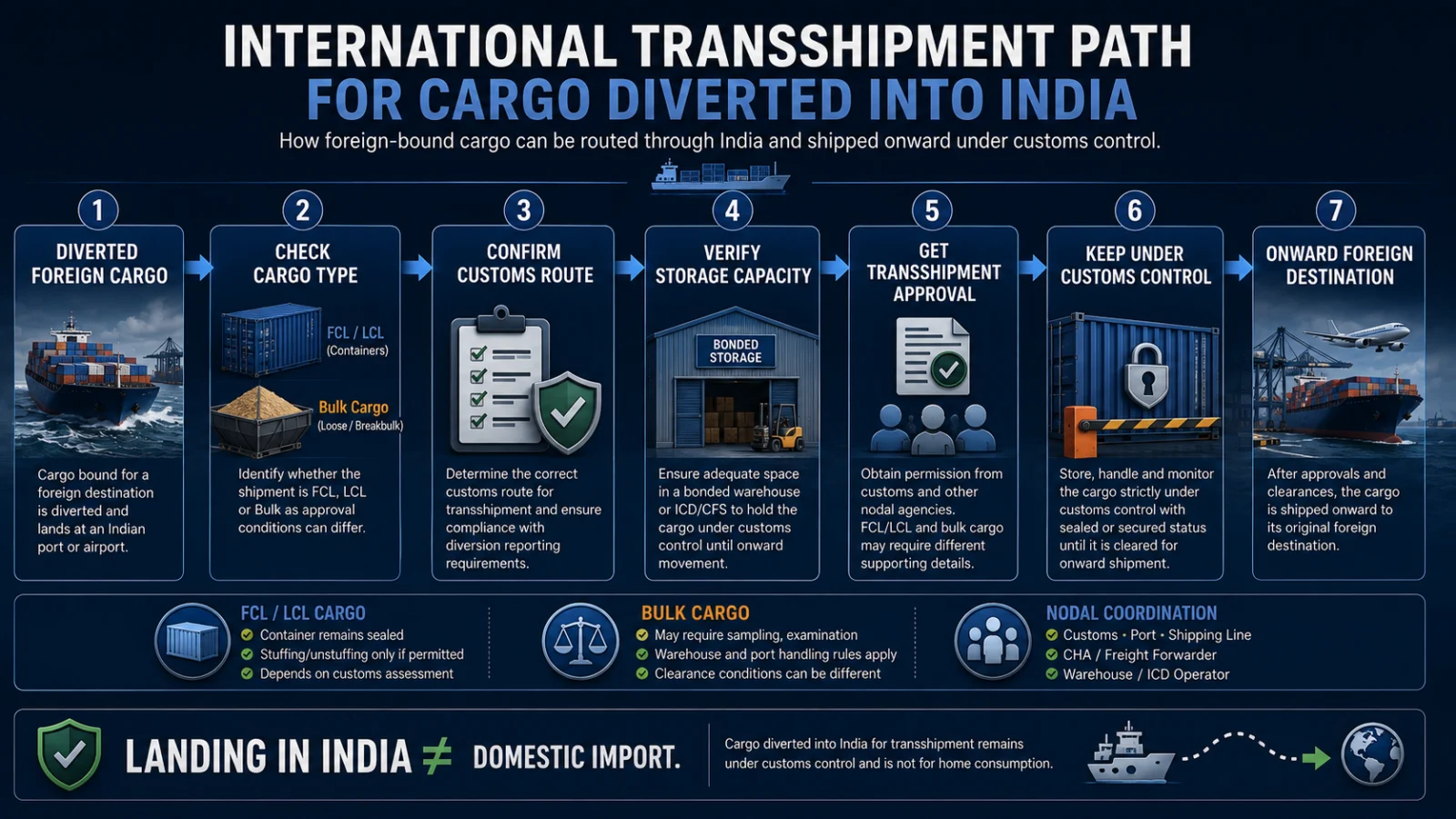
International transshipment decision path for diverted cargo
1. Confirm that the cargo is foreign-bound. The current facilitation is designed for cargo diverted to India while its intended destination remains outside India.
2. Identify the cargo type. FCL and LCL cargo are covered by the international-transshipment framework. Liquid bulk, breakbulk and dry or solid bulk cargo can require case-by-case permission for temporary unloading, storage and onward transshipment.
3. Identify the Indian Customs route. Determine the arrival Customs station, any intermediate Customs station and the intended onward foreign destination.
4. Verify storage and handling readiness. Customs-controlled or approved bonded storage, custodian capability and local infrastructure must support the proposed movement.
5. Obtain the required transshipment permission and coordination. Multi-station movements can require coordination and consent between the relevant Customs nodal officers.
6. Keep the cargo under Customs control. The shipment must remain accounted for within the approved transit, storage and re-export process rather than being treated as domestic cargo.
7. Complete onward movement to the foreign destination. Customs permission does not replace carrier, terminal, storage or operational requirements that may separately affect the shipment.
Does cargo become an Indian import when it is unloaded in India?
No, not merely because it is unloaded in India. Physical arrival and domestic import clearance are different states.
A shipment using the international-transshipment route remains under Customs supervision for onward international movement. The current facilitation is not a blanket permission to move the goods into the Indian domestic market, and it should not be interpreted as a general waiver of normal import requirements.
This distinction is central for cargo owners and freight forwarders. A diversion caused by a shipping disruption can change the physical route without automatically changing the commercial destination or Customs status of the goods.
Are both FCL and LCL cargo covered?
Yes. The current framework permits international transshipment of both full container load (FCL) and less than container load (LCL) cargo through Indian seaports and international airports, subject to the applicable Customs procedures.
That does not mean every shipment will move through the same physical process. Container location, custodian arrangements, onward carrier availability, Customs-station capability and whether another Customs station is involved can affect the actual routing.
What about liquid bulk, breakbulk and dry or solid bulk cargo?
These cargo types are not treated as an automatic equivalent of a normal container transshipment movement. Under the current Circular 36 framework, temporary unloading, storage and onward transshipment or re-export can be permitted case by case.
This distinction matters because bulk cargo may require different infrastructure, safe-storage arrangements, handling equipment and local Customs oversight. A cargo owner should therefore not assume that the existence of the CBIC facilitation guarantees that every port or Customs station can physically or operationally accept the shipment.
Can diverted cargo move through more than one Customs station?
Yes, the framework can support movement involving more than one Customs station, but the route requires proper Customs coordination rather than an informal transfer between locations.
The reviewed framework requires coordination between the relevant nodal officers, including confirmation that the receiving location has appropriate storage, infrastructure and logistics capability for the cargo involved.
This creates a practical checkpoint for freight forwarders: before planning a second Indian movement, confirm that the receiving Customs station and custodian can accept the cargo and that the required Customs consent is in place.
Where can foreign transit cargo be stored in India?
The current framework allows temporary handling within Customs-controlled areas and approved storage or bonded arrangements appropriate to the cargo and permission granted.
The important principle is that the shipment remains traceable and controlled. Custodians are responsible for safe custody, handling and accounting while cargo remains under their charge, and irregularities or discrepancies must be handled within the applicable Customs process.
A warehouse, terminal or storage location being geographically convenient does not by itself make it suitable for the transshipment route. Customs approval and operational capability remain separate requirements.
Does CBIC Circular 36 guarantee that a diverted shipment will be accepted?
No. The circular creates a facilitation route; it does not guarantee operational acceptance of every shipment.
Actual movement can still depend on cargo type, port or airport capability, Customs approval, available storage, custodian readiness, carrier arrangements and the logistics needed for onward movement.
For bulk and other cargo requiring case-specific permission, this distinction is especially important. The existence of the rule should be treated as a legal and procedural pathway, not as confirmation that a particular shipment has already been approved.
Does the transshipment framework waive storage, detention or demurrage charges?
No general waiver of carrier, terminal, demurrage, detention or storage charges was established in the reviewed Circular 36 framework.
Customs permission answers whether the cargo can use the international-transshipment route. It does not by itself determine what a shipping line, terminal, container operator, warehouse or other service provider may charge.
That distinction prevents two separate problems from being confused:
- Customs status: whether the cargo can legally remain in international transit through India.
- Commercial charges: what the carrier, terminal, container operator or storage provider may charge while that cargo waits or moves.
Can the goods be sold or cleared for home consumption in India under this facility?
Not through the international-transshipment facilitation itself.
The current framework is for temporary handling and onward foreign movement. If a party instead wants to import the goods into India for domestic use or sale, that would require a separate applicable import and Customs-clearance process. TPS is not treating the transshipment framework as a general domestic-import permission.
What should a freight forwarder or cargo owner verify first?
Before arranging movement, identify the shipment’s actual state:
- Original foreign destination: confirm that the cargo remains intended for a destination outside India.
- Cargo type: determine whether it is FCL, LCL, liquid bulk, breakbulk or dry/solid bulk.
- Arrival Customs station: identify where the cargo has actually landed or will be diverted.
- Storage requirement: determine whether temporary Customs-controlled or bonded storage is necessary.
- Intermediate movement: establish whether another Indian Customs station must be used before onward departure.
- Approval state: confirm that the required Customs permissions and nodal-officer coordination are complete.
- Onward carriage: confirm the carrier, terminal and operational path to the final foreign destination.
This sequence is useful because it prevents a common failure: arranging the physical movement first and only later discovering that the Customs route, storage site or receiving station has not been cleared.
How is this different from a port-of-refuge situation?
A ship may call at a port of refuge because the vessel or voyage needs a safe place during an emergency or disruption. That is a broader maritime-operational problem.
This article answers a narrower Customs question: once foreign-bound cargo is diverted into India, how can that cargo remain in an international transit state and continue to another foreign destination?
The two situations can overlap in real operations, but they are not the same reader task. A vessel’s reason for entering a port does not by itself determine the Customs procedure that applies to the cargo.
What changes after 31 October 2026?
The answer is currently unknown. Circular 36 states that the present temporary facilitation runs through 31 October 2026. TPS has not established that the special framework will automatically continue beyond that date.
CBIC could extend it, replace it, issue new instructions or allow the temporary measure to lapse. Cargo owners should therefore verify the controlling rule before relying on this special facilitation for shipments moving close to or after the current end date.
What is the practical rule to remember?
Landing in India is not the same as importing into India. A foreign-bound shipment can use Indian Customs infrastructure for temporary unloading, storage and onward international transshipment when the applicable conditions are met.
The correct operational sequence is to confirm the cargo type, identify the Customs route, verify storage and receiving-station capability, obtain the required permissions, keep the cargo under Customs control and complete onward foreign movement. Treat Customs approval, physical capacity and commercial carrier or terminal arrangements as separate checkpoints rather than one automatic permission.