







SEBI nomination rules September 1 2026 are now in effect for demat accounts and mutual fund folios. The most important distinction is that the rule does not mean every existing investor must submit a fresh nomination today. For a new single-holder demat account or mutual fund folio opened under the implemented framework, the investor must either register a nominee or formally opt out of nomination. Nomination remains optional for jointly held accounts and folios.
Direct answer
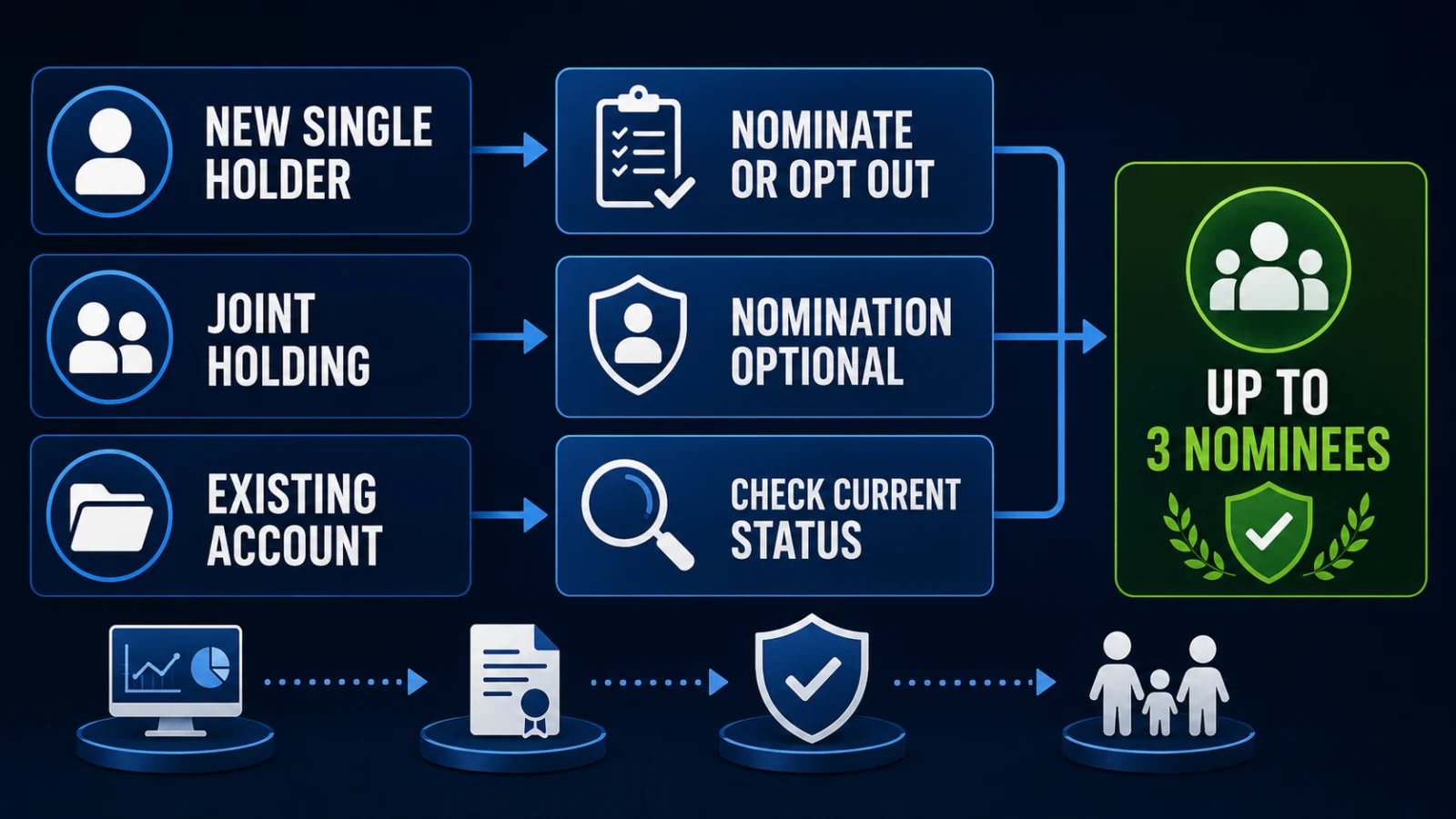
If you are opening a new demat account or mutual fund folio as a single holder, you now need to make an explicit choice: add a nominee or opt out. If the account or folio is jointly held, nomination remains optional. Existing investors should first check their current nomination status rather than assuming that all older accounts require immediate re-nomination.
What actually changed on September 1
SEBI issued the controlling circular on May 29, 2026. September 1 is the implementation date of that already-announced framework, not the publication date of a new circular. The change therefore matters because guidance that previously described the rules as upcoming is now stale: the modified nomination process is operative.
Under the framework, an investor can register up to three nominees. Nomination can be submitted through online or offline modes, subject to the procedures offered by the relevant depository participant, depository, asset management company or registrar and transfer agent. SEBI also permits nomination to be changed or cancelled later; the framework does not impose a numerical limit on such changes or cancellations.
Which rule applies to you?
You are opening a new single-holder account or folio
You must make an explicit nomination decision. Either register one or more nominees, up to the permitted limit of three, or complete the prescribed opt-out process.
You have a jointly held account or folio
Nomination remains optional. If joint holders decide to register, change or cancel a nomination, the applicable joint-holder consent and authentication requirements must be followed.
You already have an existing account or folio
Do not assume that September 1 creates a blanket requirement to submit a fresh nominee. Check whether a valid nomination is already recorded, whether you previously opted out, and whether your DP, AMC or RTA is asking for any current action. Existing accounts without nomination can receive periodic reminders under the SEBI framework.
What information is required for a nominee?
The SEBI framework requires core nominee information including the nominee’s name and relationship with the investor. Where the nominee is a minor, the date of birth is also relevant. Other details can depend on the prescribed form and intermediary workflow. Investors should use the current official form or digital flow supplied by their DP, depository, AMC or RTA rather than relying on an old screenshot or third-party checklist.
Can you opt out instead of naming a nominee?
Yes. The revised framework preserves an opt-out route for eligible single-holder accounts and folios. This is why headlines that simply say nomination is mandatory can be misleading without the second half of the rule. The practical requirement for a new single-holder account is to make an explicit choice between nomination and a formal opt-out, not necessarily to name a nominee.
What happens after you submit or change a nomination?
The regulated entity is expected to acknowledge nomination-related submissions or changes. Keep that acknowledgement or confirmation with your account records. The exact confirmation screen, authentication method and processing flow can vary between intermediaries, so TPS does not assume that every broker, depository participant, AMC or RTA uses an identical interface.
What existing investors should do now
First, check the nomination status shown in your current demat or mutual fund service account. If a valid nomination is already recorded and you do not want to change it, this effective-date change does not by itself establish that you must submit the same nomination again. If no nomination is recorded, decide whether you want to nominate or use an available opt-out route, then follow the current official process provided by your intermediary.
Investors without a recorded nomination, including those who have opted out where applicable, may receive periodic nomination nudges and first-login messages explaining the benefits of nomination. A reminder should not be interpreted by itself as proof that an existing account has been frozen or that all existing investors face an immediate compulsory nomination deadline.
What did not change
September 1 did not create a new blanket rule forcing every existing investor to nominate someone. Jointly held accounts and folios still have optional nomination, and the opt-out mechanism remains important for new single-holder accounts. The current change is the commencement of the May 29 framework and the resulting operational workflow for investors and intermediaries.
How this was verified
ThePulseSignal reviewed the controlling SEBI circular dated May 29, 2026, including the September 1 commencement, the single-versus-joint distinction, nominee limit, opt-out provisions, acknowledgement obligations and reminder framework. Current investor-service surfaces from major mutual-fund RTAs were also checked to confirm that nomination and opt-out workflows are being presented to investors. Platform-specific rollout remains variable, so readers should verify their own intermediary’s current instructions before acting.
What remains unresolved
The regulatory framework is confirmed, but first-day implementation may not be identical across every depository participant, broker, AMC or registrar. TPS has not verified every intermediary interface, and this article should not be read as confirmation that a particular broker or fund platform has implemented every screen or authentication step in exactly the same way.