






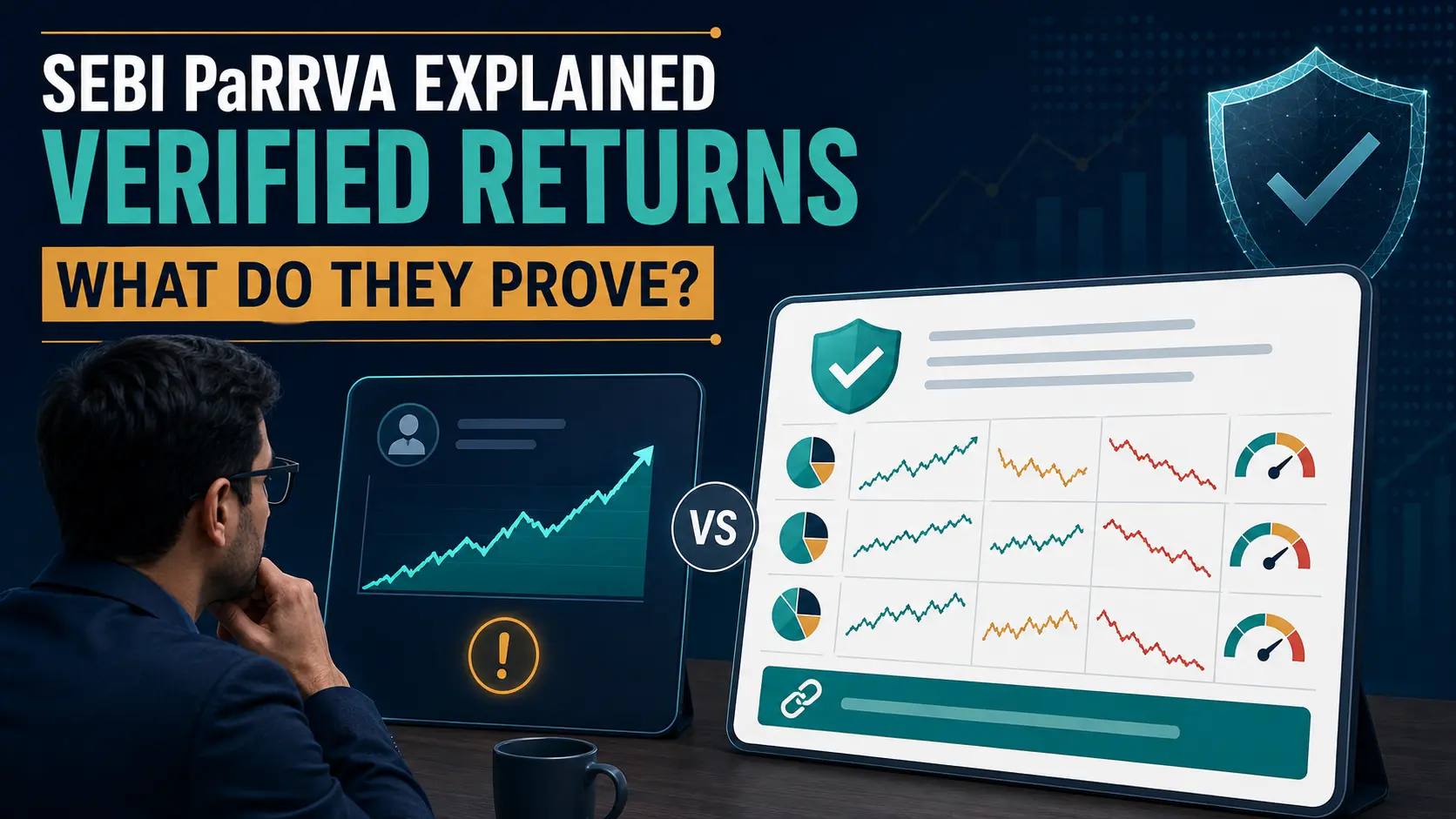
SEBI’s PaRRVA framework verifies prescribed historical risk-and-return metrics used by eligible investment advisers, research analysts and algorithmic-trading providers. A PaRRVA-verified claim means that the historical metrics were processed under the official verification framework. It does not mean that SEBI recommends the intermediary, approves the strategy or guarantees similar returns.
The distinction matters because the word “verified” can sound stronger than it is. Verification improves the reliability and presentation of historical claims, but an investor must still examine the complete performance record, associated risk, period covered, disclaimers and the intermediary’s regulatory status.
Direct answer
PaRRVA verifies historical risk-and-return metrics, not future investment success.
It is designed to reduce selective or unsupported performance advertising. It does not certify that an adviser is fully compliant with every SEBI rule, that a particular recommendation is suitable for you or that the displayed return will be reproduced in your account.
What is PaRRVA?
PaRRVA stands for Past Risk and Return Verification Agency.
Under the operational framework, CARE Ratings Limited is the recognised PaRRVA and the National Stock Exchange acts as the PaRRVA Data Centre, or PDC. Regular services began on May 4, 2026.
Contents
Who can use PaRRVA-verified performance claims?
The framework covers specified regulated persons that are permitted to make claims using PaRRVA-verified risk-and-return metrics.
These include:
- SEBI-registered Investment Advisers;
- SEBI-registered Research Analysts;
- algorithmic-trading providers onboarded by stock brokers and empanelled with a recognised stock exchange;
- other intermediaries permitted to provide investment-advisory, research-analysis or algorithmic-trading services.
This does not mean every registered adviser or analyst must publish a performance record. PaRRVA becomes relevant when an eligible regulated person wants to communicate past-performance or risk-and-return claims in a manner permitted by SEBI.
For the current IA and RA enrolment deadline, affected entities should use the separate SEBI PaRRVA deadline and enrolment guide.
How does the PaRRVA verification process work?
The framework separates the responsibility for defining the methodology from the technical processing of the data.
1.The regulated person records its advice or recommendation
Investment Advisers and Research Analysts are expected to share their advice or recommendation with the PDC at the time it is issued or at the end of the day, depending on the type of recommendation.
2.The PDC receives data from multiple sources
The verification system may receive information from regulated persons, stock exchanges, clearing corporations, depositories and AMFI for mutual-fund NAV data.
3.PaRRVA defines the verification methodology
PaRRVA specifies how the risk-and-return metrics are computed, which data points are required and what fields must appear in the verified output.
4.The PDC processes the verification request
The PaRRVA Data Centre operates the technical verification system and processes the information using the methodology specified by PaRRVA.
5.The verified output is returned to PaRRVA
The PDC sends the processed output to PaRRVA in a defined format for dissemination.
6.PaRRVA displays the verified metrics
The verified risk-and-return metrics are to be displayed on PaRRVA’s website with the required disclosures and made accessible to regulated persons and investors.
SEBI’s framework requires PaRRVA and the PDC to retain relevant verified outputs and input records for at least five years.
Important: The verification is based partly on data submitted by regulated persons or their agents and partly on information obtained from market infrastructure and other identified sources. Investors should not interpret verification as an audit of every aspect of the intermediary’s business.
What does “PaRRVA verified” mean?
A genuine PaRRVA-verified claim should indicate that the displayed historical risk-and-return metrics were processed through the prescribed PaRRVA-PDC framework.
Depending on the relevant service and methodology, the verification system is intended to connect the underlying advice, recommendation or algorithmic record with market data used to calculate the specified historical metrics.
In practical terms, verification is meant to make it harder for an intermediary to:
- publish an unsupported self-calculated return;
- show only one successful recommendation while concealing the wider record;
- select arbitrary dates that produce a favourable result;
- omit negative returns or relevant risk information;
- make client-specific performance claims under the general verified-metrics framework.
What does PaRRVA verification not mean?
The intermediary has entered the applicable verification framework.
The historical metric was processed under the prescribed methodology.
Performance is presented together with specified risk information.
The person is regulated for the activity covered by the registration.
The metric represents the result produced under the verification assumptions.
PaRRVA verification is not a compliance certificate.
SEBI’s required disclaimers specifically state that verification should not be treated as assurance that the regulated person complies with every rule, regulation or regulatory guideline that governs it.
How must PaRRVA-verified returns be presented?
SEBI’s presentation rules are designed to prevent an adviser, analyst or algo provider from using verification as a label on a selectively chosen success story.
No selective display of one winning product or strategy
An adviser that had several portfolios, recommendations or strategies verified for a particular period cannot display only one favourable result as though it represents the complete record.
Similarly, an algorithmic-trading provider that submitted multiple algorithms for verification cannot show only the best-performing algorithm without the required wider context.
The overall range must be disclosed
A claim involving one verified portfolio or algorithm must also identify the total number of portfolios or algorithms verified for the relevant period and refer to the range of positive and negative returns and other applicable risk-and-return metrics.
Stock recommendations cannot be cherry-picked
Claims relating to single-stock, derivative or intraday recommendations must present the number and range of positive and negative results across the relevant recommendations.
Such a claim must not name a specific stock or derivative instrument as the centre of the performance promotion.
Favourable dates cannot be chosen arbitrarily
The verified metrics must relate to specified periods. The intermediary cannot create a misleading result by selecting an arbitrary start date, end date or narrow time window only because it produces a favourable outcome.
Every claim must connect to the overall PaRRVA record
Electronic and physical claims must contain a link or QR code leading to the overall summary of risk-and-return metrics on PaRRVA’s website.
Printed material must also carry the overall summary supplied by PaRRVA.
Client-specific return claims are not allowed
Investment Advisers and Research Analysts may display permitted metrics relating to advice or recommendations. They cannot present a particular client’s return as the verified result for marketing purposes.
Seven critical checks before trusting a PaRRVA performance claim
1.Open the PaRRVA link or QR code
Do not rely only on a screenshot, social-media post, brochure or adviser-created graph. A permitted claim should lead to the overall record displayed through the PaRRVA framework.
2.Confirm whose performance is being shown
Check the intermediary, registration category, service and relevant portfolio, recommendation set or algorithm. Similar names and group-company branding can create confusion.
3.Check the complete period
Look at the start date, end date and duration. Be cautious when an advertisement highlights only a short market phase without explaining the longer record.
4.Look for negative outcomes and risk metrics
A credible presentation should not show only profits. Check the stated range of positive and negative returns and the accompanying measures of risk.
5.Compare the advertised result with the overall summary
Determine whether the promoted portfolio or algorithm was one of several verified items and whether the advertisement fairly represents the broader record.
6.Read the disclaimers
The disclosure should make clear that historical performance does not predict future results, no assured return is being promised and the verified result may differ from the return actually received by a client.
7.Verify the intermediary separately
PaRRVA verification does not replace checks on SEBI registration, disciplinary history, fees, conflicts, suitability, complaint handling and the exact contractual service being offered.
Why might an investor’s actual return differ from the verified return?
The verified figure represents the return that a client would have accrued under the underlying advice or recommendation and the applicable methodology.
An individual investor’s result may differ because of:
- the market price available when the investor placed the order;
- delayed execution;
- partial execution or insufficient liquidity;
- the investor entering after the recommendation was issued;
- the investor exiting before or after the assumed exit point;
- different investment amounts or portfolio allocation;
- taxes, charges and other account-level factors;
- the investor not following every recommendation.
That difference does not automatically show that the verified metric is false. It shows why historical modelled performance and an individual account outcome are not necessarily identical.
Does PaRRVA allow expected future-return claims?
The framework permits specified claims using verified historical risk-and-return metrics. It should not be read as permission to promise expected future returns.
The stock-broker rules previously restricted direct or indirect references to past or expected future performance of an algorithm. SEBI created an exception for references to PaRRVA-verified risk-and-return metrics made in the prescribed manner.
That exception does not convert a future-profit prediction, guaranteed-return statement or assured-performance claim into a permitted PaRRVA claim.
Statements such as “guaranteed monthly return,” “SEBI-approved profits,” “verified strategy with no risk” or “the same return is assured” should not be treated as valid merely because PaRRVA is mentioned.
What about old CA- or CMA-certified performance?
A separate transitional arrangement applies to certain Investment Adviser and Research Analyst performance from before PaRRVA became operational.
That older data may be communicated only under the applicable conditions, including:
- a specific request from the client or prospective client;
- certification by a member of ICAI or ICMAI;
- one-to-one communication;
- no publication to the general public through the adviser’s website, public media or another public route;
- the mandatory disclaimer stating that the data is not PaRRVA-verified and does not guarantee future results.
After May 3, 2028, Investment Advisers and Research Analysts may communicate or display only PaRRVA-verified risk-and-return metrics and cannot use performance relating to the pre-operationalisation period in client communications.
The current enrolment rule and transitional dates are explained in the SEBI PaRRVA deadline guide.
Can an adviser publish only its best recommendation?
No, not as a compliant representation of the verified record.
SEBI’s framework prohibits selective presentation and wilful omission of relevant risk-and-return metrics. A claim about one portfolio or algorithm must be presented with information about the wider verified set and the applicable range of positive and negative outcomes.
The existence of a PaRRVA number, badge, link or QR code does not cure an advertisement that materially misrepresents the underlying overall record.
What can investors do about a misleading PaRRVA claim?
First, preserve the evidence:
- take a screenshot of the advertisement or message;
- save the URL, QR-code destination and PaRRVA record shown;
- record the date and platform where the claim appeared;
- keep the adviser or provider’s name and SEBI registration details;
- preserve related emails, payment records and client agreements.
Investors should first use the intermediary’s grievance channel where appropriate.
SEBI’s framework states that investor complaints against an intermediary concerning PaRRVA-verified risk-or-return metrics, and complaints against PaRRVA itself, are to be handled through SEBI SCORES. Disputes may proceed through the applicable Online Dispute Resolution portal.
A market loss by itself does not establish that the verification was wrong. The complaint should identify the suspected misrepresentation, omission, mismatch, unauthorised claim or failure to follow the applicable presentation rules.
Frequently asked questions
Is PaRRVA a SEBI rating of an investment adviser?
No. PaRRVA verifies prescribed historical risk-and-return metrics. It does not rate, recommend or endorse the adviser.
Who is the recognised PaRRVA?
CARE Ratings Limited has been recognised as PaRRVA, with the National Stock Exchange acting as the PaRRVA Data Centre.
Does PaRRVA verification guarantee future returns?
No. The mandatory disclosures explicitly state that verified historical returns do not guarantee assured or similar future returns.
Can an investor independently check a verified claim?
The framework requires claims to provide a link or QR code to the overall risk-and-return summary on PaRRVA’s website. Investors should use that record rather than relying only on the intermediary’s graphic.
Can an adviser show only one successful stock recommendation?
No. The presentation must be holistic and must cover the number and range of positive and negative outcomes across the relevant recommendations. Specific stock or derivative names cannot be used as the centre of such a verified performance claim.
Does PaRRVA confirm that the intermediary follows every SEBI rule?
No. SEBI’s disclaimer says verification must not be considered assurance that the regulated person complies with all applicable rules and regulatory guidelines.
Why can my return differ from the PaRRVA figure?
Execution prices, timing, liquidity, allocation, charges and whether the investor followed the recommendation can cause an individual account result to differ from the verified historical metric.
Where can I report a misleading verified-return advertisement?
Preserve the evidence and use the intermediary’s grievance channel. Investor complaints concerning PaRRVA metrics or PaRRVA may be raised through SEBI SCORES, with applicable disputes proceeding through the ODR framework.
How this was verified
ThePulseSignal reviewed SEBI’s April 4, 2025 PaRRVA framework, including the categories covered, division of responsibility between PaRRVA and the PDC, data-processing workflow, record-retention rule, presentation restrictions, mandatory disclaimers and investor complaint mechanism.
The April 29, 2026 operational circular was checked to confirm that CARE Ratings Limited was recognised as PaRRVA, NSE was designated as the PDC and regular operations began on May 4, 2026.
The October 30, 2025 circular was reviewed separately for the transitional treatment of ICAI- or ICMAI-certified pre-PaRRVA performance. The August 3, 2026 extension circular was used only for the current IA and RA enrolment deadline and does not alter the core meaning of PaRRVA verification.
Article last verified: August 4, 2026.
What remains unresolved
- The live investor search interface and exact fields displayed for every category were not independently tested.
- The detailed current calculation methodology for every adviser, analyst, portfolio and algorithm category was not reproduced in the reviewed SEBI circulars.
- The framework does not establish that every model, hypothetical or back-tested claim is eligible for verification.
- The exact charges, onboarding duration and operational service levels may depend on PaRRVA’s current terms.
- The presentation methodology may evolve through the Oversight Committee, Industry Standards Forum consultation and future SEBI directions.
- Verification should not be treated as a substitute for personalised financial advice or suitability assessment.