






Everest hing FSSAI ban searches can easily create the wrong impression. The current regulatory action is not a ban on every Everest product or every product sold by Laljee Godhoo. FSSAI’s action concerns compounded hing or asafoetida manufactured by Everest Food Products and Laljee Godhoo/LG Brand Unit after legal samples collected during market surveillance were found substandard or non-conforming.
Which products are affected by the FSSAI hing action?
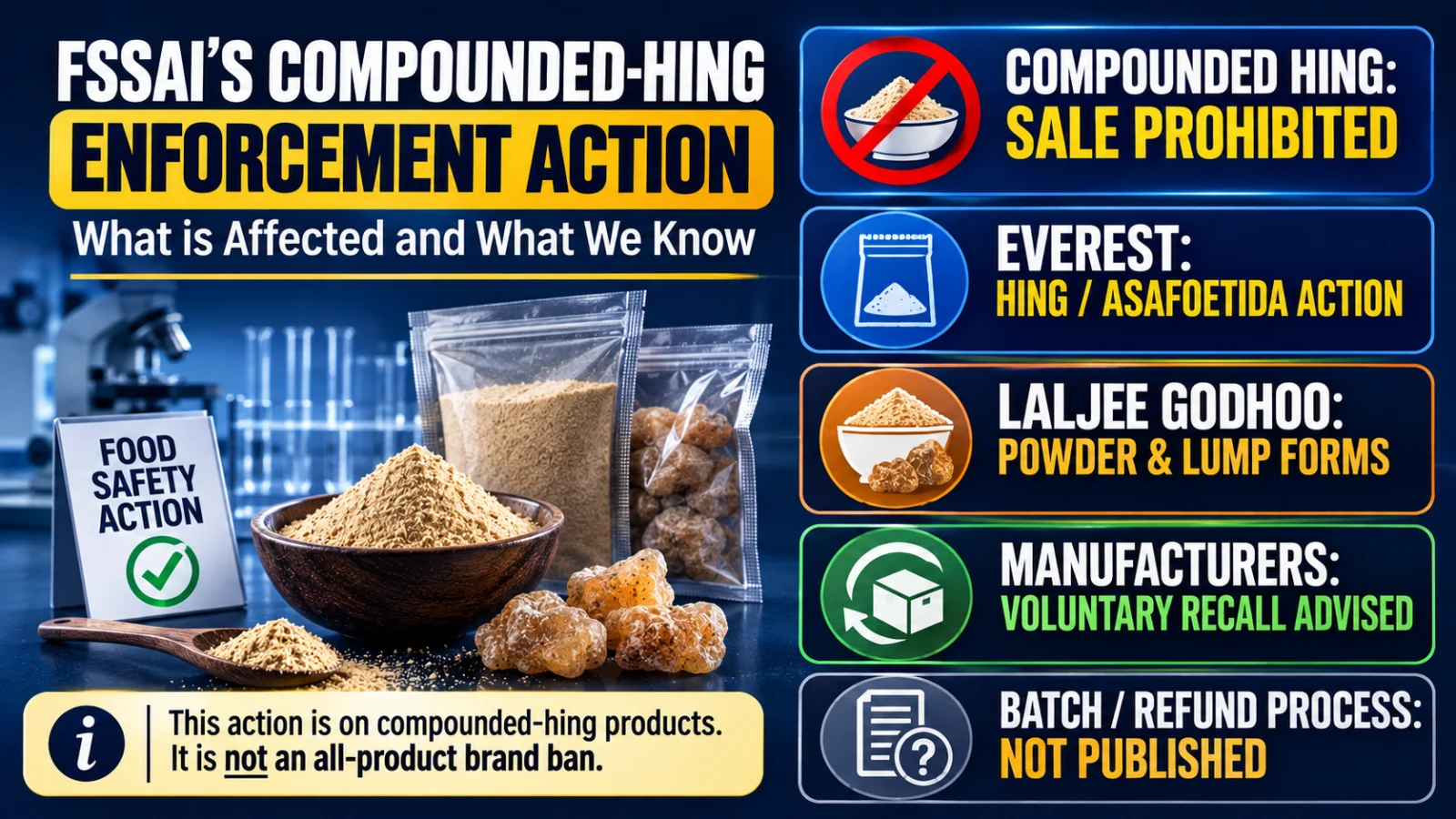
FSSAI issued Prohibition of Sale orders covering compounded hing or asafoetida from the two named manufacturers. Current FSSAI-attributed reporting identifies Everest compounded asafoetida including Yellow Hing Powder and Black Hing Powder, while the Laljee Godhoo action covers compounded hing or asafoetida in powder and lump forms. The material reviewed for this article did not provide a public retail batch, pack-size or SKU list.
This is not a ban on every Everest or Laljee Godhoo product
The evidence reviewed does not support describing the enforcement action as a company-wide or brand-wide prohibition. The current action is hing-specific. Consumers should therefore avoid assuming that unrelated Everest masalas, unrelated Laljee Godhoo foods or hing from other manufacturers are covered by this particular order.
That distinction is important because a simplified headline such as “Everest banned” removes the product boundary established by the regulatory action.
Why did FSSAI prohibit the compounded hing?
FSSAI said its action followed surveillance inspections, legal sampling and laboratory testing at the licensed manufacturing units. The government release states that legal samples were found substandard or non-conforming with applicable food standards.
For Everest, current reporting based on the FSSAI enforcement details identifies compounded asafoetida samples that did not meet the prescribed minimum alcohol-soluble-extract requirement. Reported test values included 0%, 3.29% and 4.4% against a 5% minimum. These figures describe the cited laboratory samples and should not be treated as measurements of every retail pack in a consumer’s home.
For Laljee Godhoo, the government release says all six sampled raw-hing varieties contained starch between 15% and 32%, compared with a maximum permitted level of 1%. That finding relates to the sampled raw hing and should not be extrapolated into an unsupported claim that every finished retail pack contained the same percentage.
What does the Laljee Godhoo order cover?
Current enforcement reporting describes Laljee Godhoo/LG compounded hing or asafoetida in both powder and lump forms. The underlying inspection also identified non-compliance in sampled raw-hing varieties used by the manufacturer.
Again, no public batch-by-batch consumer list was recovered during this research, so TPS cannot responsibly tell a reader that a particular pack number is affected unless a later FSSAI or manufacturer notice identifies it.
Did FSSAI order a recall?
FSSAI advised the manufacturers to initiate a voluntary recall of all substandard products currently in the market and to submit corrective action plans. That is an important part of the enforcement state, but it should not be converted into a claim that FSSAI has published a universal household return instruction for every pack carrying either brand name.
The prohibition of sale and the manufacturer-directed voluntary recall are related but distinct ideas. The first controls continued sale of the affected products. The second asks the manufacturers to remove substandard products already in market circulation.
FSSAI’s general food-recall framework also explains that a food recall is intended to withdraw non-compliant food from the market and consumers. A recall notice should identify the recalling business and product details such as the food name, brand, pack size, batch or code number and date information. That means consumers should verify a specific pack against an actual recall notice rather than assume every pack under a brand is automatically covered.
I already bought Everest or LG hing. What should I do?
First, confirm whether the product you hold is compounded hing or asafoetida from one of the named manufacturers. Do not assume another Everest spice or an unrelated Laljee Godhoo product is covered.
Second, look for a current FSSAI, manufacturer or retailer recall notice that identifies your product using pack-level information such as the product name, brand, pack size, batch or code number and relevant date details. FSSAI’s recall framework uses these identifiers to distinguish affected food from unrelated stock.
The public event-specific material reviewed for the Everest and Laljee Godhoo action still does not establish a universal consumer refund, return or disposal process. If a retailer or manufacturer publishes a specific recall instruction for your pack, follow that current instruction.
Is there an official batch or SKU list?
No exact retail batch, SKU or pack-size list was recovered from the primary public release or the supporting enforcement coverage reviewed for this article. The regulatory action identifies the manufacturers and affected compounded-hing product forms more clearly than it identifies individual consumer packs.
FSSAI’s general recall procedure shows why pack-level identifiers matter: consumer recall notices are expected to identify details such as the food, brand, pack size and batch or code number. Until an event-specific notice publishes those details for the affected hing products, a reader cannot reliably determine inclusion from a batch number using the public prohibition release alone.
How long does the prohibition remain in force?
Current FSSAI-attributed reporting describes the prohibition as taking effect immediately and continuing until further orders. That means the status can change if FSSAI later modifies, lifts or replaces the prohibition.
What happens next?
The named manufacturers were asked to submit corrective action plans and were advised to initiate voluntary recalls of substandard products already in the market. Further regulatory action, company responses, recall details or eventual lifting of the prohibition may therefore create a new information state.
Consumers and retailers should treat any later FSSAI order or manufacturer recall notice as controlling over older news coverage.
What the FSSAI action does not establish
- It does not establish that every Everest product is banned.
- It does not establish that every Laljee Godhoo product is banned.
- It does not establish that all hing sold in India is unsafe or prohibited.
- It does not prove that every consumer-held pack contains the same laboratory values found in sampled products.
- It does not provide a universal consumer refund, return or disposal procedure in the event-specific public material reviewed.
- It does not establish illness or toxicity from the affected products merely from the reported quality-standard failures.
How this was verified
ThePulseSignal reviewed the Ministry of Health and Family Welfare/PIB publication reporting FSSAI’s Prohibition of Sale orders, the stated surveillance and laboratory findings, the voluntary-recall advice and corrective-action requirement. FSSAI’s current food-recall guidance was also checked to clarify how an actual recall notice should identify affected food using product and pack-level information. Current reporting reproducing enforcement details was used to clarify identified Everest variants, Laljee Godhoo product forms, laboratory figures and the continuing-until-further-orders state.
Limitations and unresolved facts
The reviewed event-specific public evidence does not provide an exact retail SKU, batch or pack-size list, a universal consumer refund or return workflow, disposal instructions, nationwide distribution details, complete company responses or an appeal outcome. FSSAI’s general recall framework explains what recall notices normally identify, but it does not itself establish which individual Everest or Laljee Godhoo consumer packs are included in this particular action. The individual underlying prohibition-order documents were not recovered beyond the government public release and detailed current reporting.