






To check IMEI on Sanchar Saathi before buying a phone, first obtain the IMEI from the handset itself and then verify it through the government’s Sanchar Saathi/CEIR service. Compare the returned manufacturer, brand and model with the device in front of you. If the official result reports the IMEI as black-listed, duplicate or already in use, the government guidance says to avoid buying that handset.
An IMEI check is useful evidence, but it is not a complete authenticity certificate. A result that looks normal does not by itself prove that the seller owns the phone, that the invoice is genuine, that the warranty is valid or that every other transaction risk has been cleared.
Direct answer
Before paying, dial *#06# on the handset to display its IMEI. You can also find an IMEI on the device packaging or invoice, but the handset itself is important because it helps prevent you from checking a different number supplied by a seller. Verify the number through the official Sanchar Saathi/CEIR service. The official service also documents an SMS method: send KYM <15-digit IMEI> to 14422.
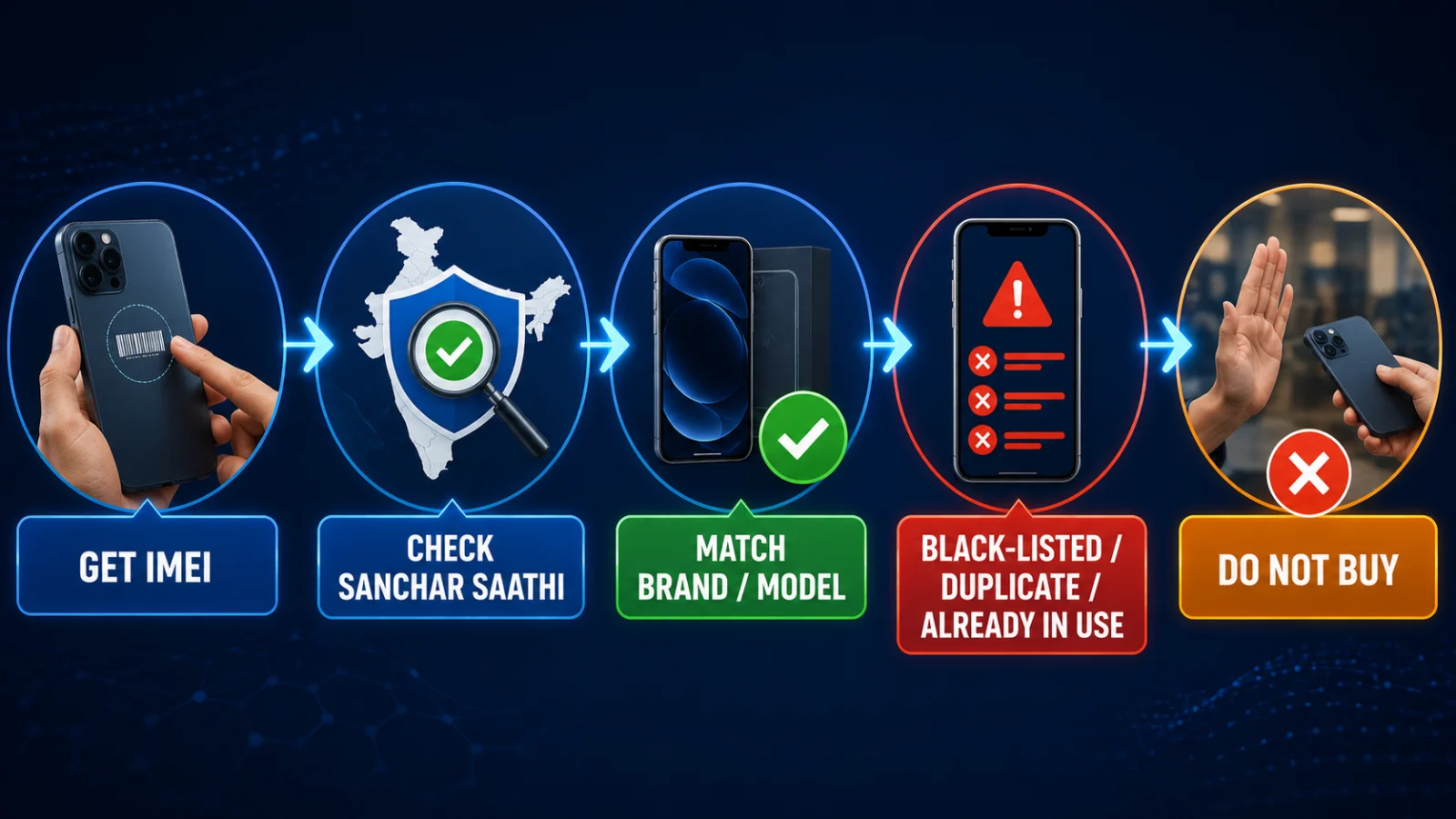
How to check IMEI on Sanchar Saathi before you buy
1. Get the IMEI from the actual handset
Dial *#06# and record the IMEI shown by the phone. If the handset supports two SIM slots, it may have two IMEIs. Treat both identifiers as relevant to the device you are evaluating.
2. Compare the identifiers
Compare the handset IMEI with the number printed on the box and, when available, the invoice. A mismatch is a reason to stop and resolve the discrepancy before paying.
3. Run the official verification
Submit the 15-digit IMEI through Sanchar Saathi/CEIR or use the officially documented KYM SMS route. Do not treat a portal error, failed OTP or unavailable service as a successful verification.
4. Compare the returned device details
The official service can return device information such as manufacturer, brand and model. Those details should be consistent with the handset being sold.
5. Interpret the status before deciding
If the result is black-listed, duplicate or already in use, do not proceed with the purchase. If the result is invalid or the returned device identity does not match the handset, stop the transaction until the discrepancy is credibly resolved.
What does a black-listed IMEI mean for a buyer?
For the pre-purchase decision, the important point is straightforward: official CEIR guidance tells users not to buy a handset when the IMEI result is black-listed. TPS does not recommend trying to bypass, alter or remove such a status. The safer action is to reject the transaction and let the seller resolve the device’s status through legitimate channels.
What does duplicate IMEI mean?
A duplicate result is another official warning state for a prospective buyer. It indicates that the identifier is not a clean basis for proceeding with the purchase. Do not assume that a phone is safe merely because it powers on, accepts a SIM or otherwise appears functional.
What does already in use mean?
Sanchar Saathi’s buyer guidance also identifies an already in use result as a reason to avoid purchasing the handset. The exact underlying history can differ, so the article should not speculate about theft, cloning or ownership from that message alone. For the buyer’s immediate decision, the safe conclusion is simply not to proceed until the issue is legitimately resolved.
What if the IMEI is valid but the model does not match?
A resolving IMEI is not enough when the returned device identity conflicts with the physical phone. If Sanchar Saathi reports a manufacturer, brand or model inconsistent with the handset in front of you, stop the transaction and investigate. The purpose of the check is not only to see whether the number exists but also to compare the identifier’s device information with the actual handset.
Should you check both IMEIs on a dual-SIM phone?
Yes. Official CEIR documentation explains that a dual-SIM handset can have two IMEIs because an identifier is associated with each SIM slot. For a used-phone purchase, checking only one identifier leaves part of the device unverified. Record and verify both when the handset exposes two IMEIs.
Does a valid IMEI prove the phone is safe to buy?
No. The reviewed official material supports using IMEI verification to identify the handset and identify warning states, but it does not establish that a normal result proves seller ownership, genuine purchase history, remaining warranty, financing status, physical condition or future freedom from blocking.
Use the IMEI result as one layer of evidence. Separately compare the handset, box and invoice; establish who is selling the device; inspect its condition and functionality; and avoid paying when the official device information or transaction evidence is inconsistent.
A practical pre-payment decision rule
| What you see | What to do |
|---|---|
| Expected brand/model and no warning state | Continue with the rest of your seller, invoice and handset checks. Do not treat this as automatic purchase approval. |
| Black-listed | Do not buy the handset. |
| Duplicate | Do not buy the handset. |
| Already in use | Do not buy the handset. |
| Invalid IMEI | Stop and resolve the discrepancy before considering payment. |
| Returned brand or model does not match the phone | Stop the transaction and investigate the mismatch. |
| Official verification service is unavailable | Retry through an official route; do not interpret an unsuccessful check as a clean result. |
What Sanchar Saathi IMEI verification does not replace
IMEI verification is different from checking whether SIM connections are registered in your name, reporting suspected fraudulent communications or blocking a handset after it is lost or stolen. Those are separate Sanchar Saathi functions and should not be merged into this pre-purchase decision.
Verification note
TPS reviewed the official Sanchar Saathi/CEIR handset-genuineness guidance, its IMEI verification workflow and user documentation, and reconciled those sources with the Department of Telecommunications’ current public warning on IMEI tampering. The central buying rule is evidence-backed: verify the handset’s actual identifier and avoid a purchase when the official service reports black-listed, duplicate or already-in-use status.