




The PMMVY saturation drive 2026 is scheduled to begin on September 9 as part of Rashtriya Poshan Maah. The Ministry of Women and Child Development says the drive is intended to enrol eligible pregnant and lactating women under Pradhan Mantri Matru Vandana Yojana and expedite Direct Benefit Transfers.
That does not mean PMMVY eligibility has changed, every pending payment will automatically arrive, or every existing beneficiary needs to apply again. The most useful action depends on your current state: not enrolled, already registered, approved but unpaid, or facing a pending/rejected application.
What changes with the PMMVY saturation drive from September 9?
The fresh change is the nationwide enrolment and implementation push. The government has announced a 100% saturation objective for eligible beneficiaries and says DBTs will be expedited. The September 7 announcement did not introduce a new PMMVY benefit amount, a new nationwide eligibility rule or a guarantee that every pending DBT will be paid during the campaign.
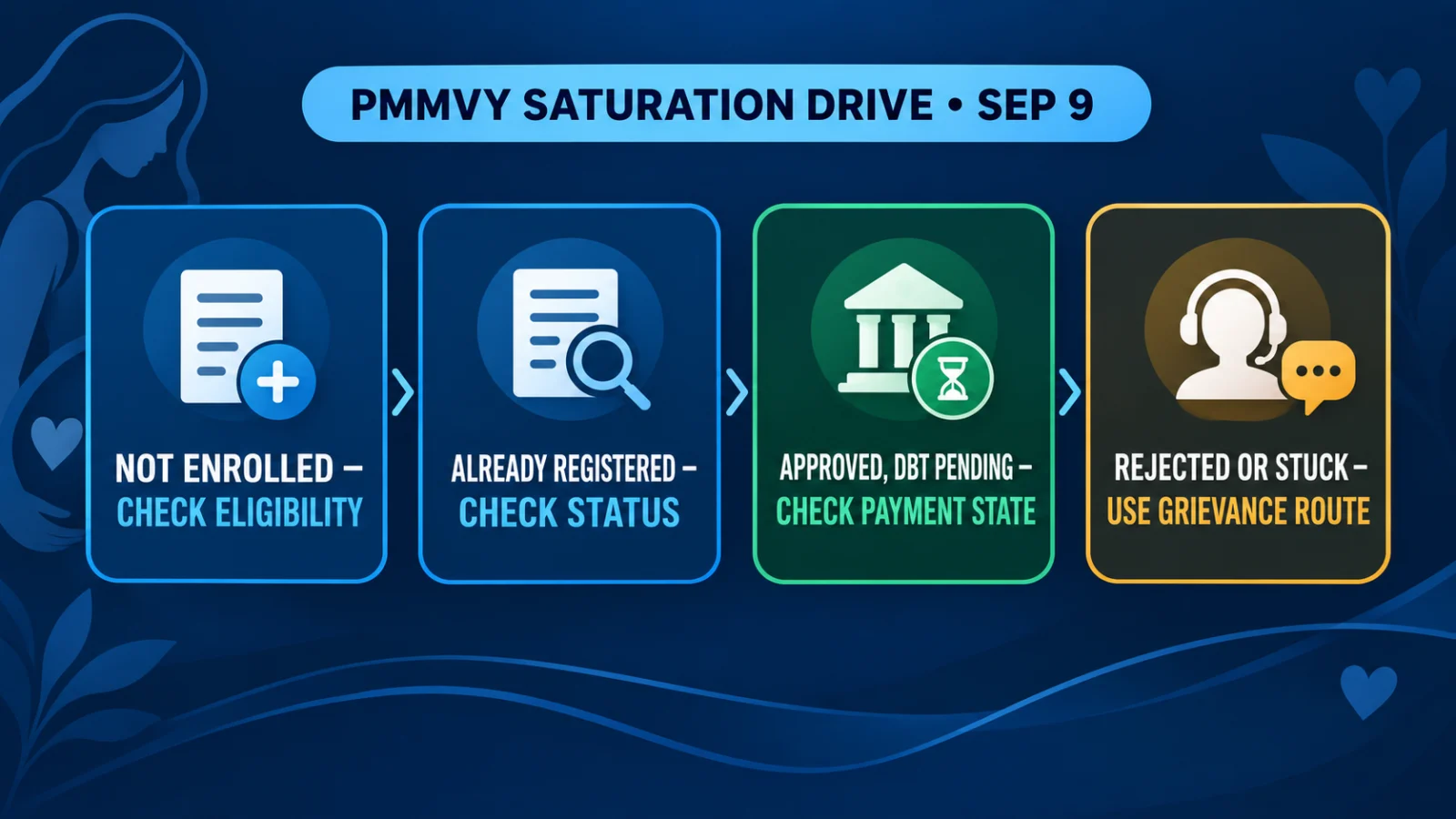
Who should take action during the PMMVY saturation drive?
If you are eligible but not enrolled
Check the current PMMVY eligibility conditions and use the authorised registration route. Eligible women can self-register through the PMMVY system, while Anganwadi Workers or ASHAs can also assist with beneficiary registration under the current programme framework.
If you are already registered
Do not submit a duplicate application merely because a saturation drive has started. First check the state of your existing application and whether any required verification or correction remains pending.
If your application is approved but DBT has not arrived
Check the payment/disbursement state and verify whether Aadhaar, beneficiary approval and the bank-account or DBT-linked record are in the expected state. The Ministry’s promise to expedite DBTs is an administrative objective, not a guarantee of automatic payment for every pending beneficiary.
If your application is pending, rejected or has an unresolved problem
Use the official application-status or grievance route and contact the authorised local implementation channel when necessary. A saturation drive does not by itself prove that a rejected application will be automatically reconsidered.
Does the September 9 drive change PMMVY eligibility?
No new nationwide eligibility rule was announced in the September 7 saturation-drive release. Existing PMMVY eligibility conditions continue to control who can receive the benefit.
The programme covers eligible pregnant and lactating women under the current PMMVY framework, but individual eligibility depends on the applicable scheme conditions and implementation state. TPS cannot determine a person’s eligibility from a public article alone.
Has the PMMVY benefit amount changed?
No benefit-amount change was announced with the September 9 saturation drive. Under the current central PMMVY framework reviewed for this article, the first living child can attract ₹5,000 in two instalments, while a second child can attract ₹6,000 in one instalment when the second child is a girl, subject to the applicable eligibility and scheme conditions.
The saturation announcement should therefore be read as an enrolment and DBT-implementation push, not as a new cash-benefit revision.
How can an eligible woman enrol in PMMVY?
Current official PMMVY material supports beneficiary self-registration through the programme’s online system. Eligible women can also receive registration assistance through authorised frontline workers such as Anganwadi Workers or ASHAs.
If you are not yet registered, the September saturation campaign is a reason to check whether you qualify and whether your local Anganwadi or authorised PMMVY implementation channel is conducting beneficiary outreach.
Do not use an unofficial portal or pay an intermediary merely because the campaign is being promoted nationally.
If you already applied, should you register again?
Not automatically. The September 7 announcement does not tell existing applicants to submit duplicate registrations.
If you already have a PMMVY application, first determine its current state. A duplicate submission can create additional confusion if the underlying issue is actually incomplete verification, a payment-stage problem or a beneficiary-record mismatch.
Will a pending PMMVY DBT be paid automatically during the drive?
No automatic-payment guarantee was announced. The Ministry says the saturation drive will help expedite DBTs. That wording supports faster administrative follow-up as an objective, but it does not establish that every pending payment will clear immediately or on September 9.
A beneficiary can remain unpaid for different reasons, including an incomplete application state, unresolved beneficiary verification, Aadhaar-related requirements, bank or DBT mapping issues, or another candidate-specific processing state.
How can you check whether your PMMVY application or payment is pending?
The current PMMVY digital system includes beneficiary search and tracking functions for application approval and payment/disbursement state. If you are already registered, checking that state is more useful than assuming the new saturation drive automatically resets your application.
Keep your beneficiary/application reference and relevant identity details available when checking the official system or seeking assistance through an authorised implementation channel.
What should you check if DBT has not reached your bank account?
Start by separating four different states:
- Application not approved: the benefit may not yet have reached the payment stage.
- Application approved but payment pending: check the current payment/disbursement state.
- Aadhaar or beneficiary verification issue: verify the requirements shown in the authorised PMMVY process.
- Bank or DBT-linked record problem: confirm the beneficiary banking details through the official or authorised support route.
TPS has not accessed any private beneficiary account and cannot diagnose a specific payment failure from public information alone.
What if your application is rejected or stuck?
Current PMMVY systems include grievance and application-tracking functions. If the application is rejected, stalled or shows a state you do not understand, preserve your application details and use the authorised grievance or local implementation route.
The saturation campaign may increase outreach, but the September 7 announcement does not create a confirmed automatic reconsideration mechanism for every rejected or pending case.
What does “100% saturation” actually mean?
The phrase describes the government’s campaign objective of reaching and enrolling all eligible beneficiaries. It should not be interpreted as proof that all eligible women are already registered or that all current beneficiary records have been successfully processed.
The usefulness of the drive will depend on actual implementation by States, Union Territories and frontline Anganwadi/community systems after the September 9 launch.
Will there be a PMMVY enrolment camp near you on September 9?
A universal beneficiary camp timetable was not identified in the September 7 national announcement. States, Union Territories or local Anganwadi structures may issue their own implementation details, outreach schedules or enrolment instructions.
If you are waiting for a local camp, check current instructions from your authorised State/UT implementation channel or Anganwadi Centre instead of assuming every locality will hold a camp on the launch date.
What helpline should PMMVY beneficiaries use?
Current 2026 government material identifies 1515 as the PMMVY/POSHAN helpline after the earlier 14408 number was changed. Beneficiaries should still confirm the latest official contact information before relying on an older number found in archived pages or third-party guides.
What beneficiaries should do now
- If you are not enrolled, check current PMMVY eligibility and use an authorised registration route.
- If you are already registered, check your application and payment state before attempting another submission.
- If payment is pending, verify approval, Aadhaar and DBT-related status rather than assuming the saturation drive guarantees payment.
- If your application is rejected or stuck, use the official grievance or authorised local implementation route.
- Watch for State/UT or local Anganwadi instructions after the September 9 launch.
- Do not assume the drive changes benefit amounts or eligibility unless a later official rule says so.
Verification note
ThePulseSignal reviewed the September 7 Ministry of Women and Child Development/PIB announcement establishing the September 9 Poshan Maah launch and PMMVY saturation-drive objective, then reconciled it against current official PMMVY eligibility, registration, DBT, status-tracking and grievance material. The fresh announcement confirms the campaign but does not establish a new nationwide eligibility rule, higher benefit amount, automatic payment guarantee or universal local camp schedule.
Limitations and unresolved facts
State and Union Territory execution details were not yet fully available during this review. TPS cannot verify an individual beneficiary’s eligibility, application approval, Aadhaar or bank mapping, payment state or grievance outcome. The exact PMMVY Toolkit contents, local camp schedules, any campaign-specific DBT processing timeline and whether a particular rejected or pending application will receive accelerated action remain unresolved until further official implementation guidance appears.