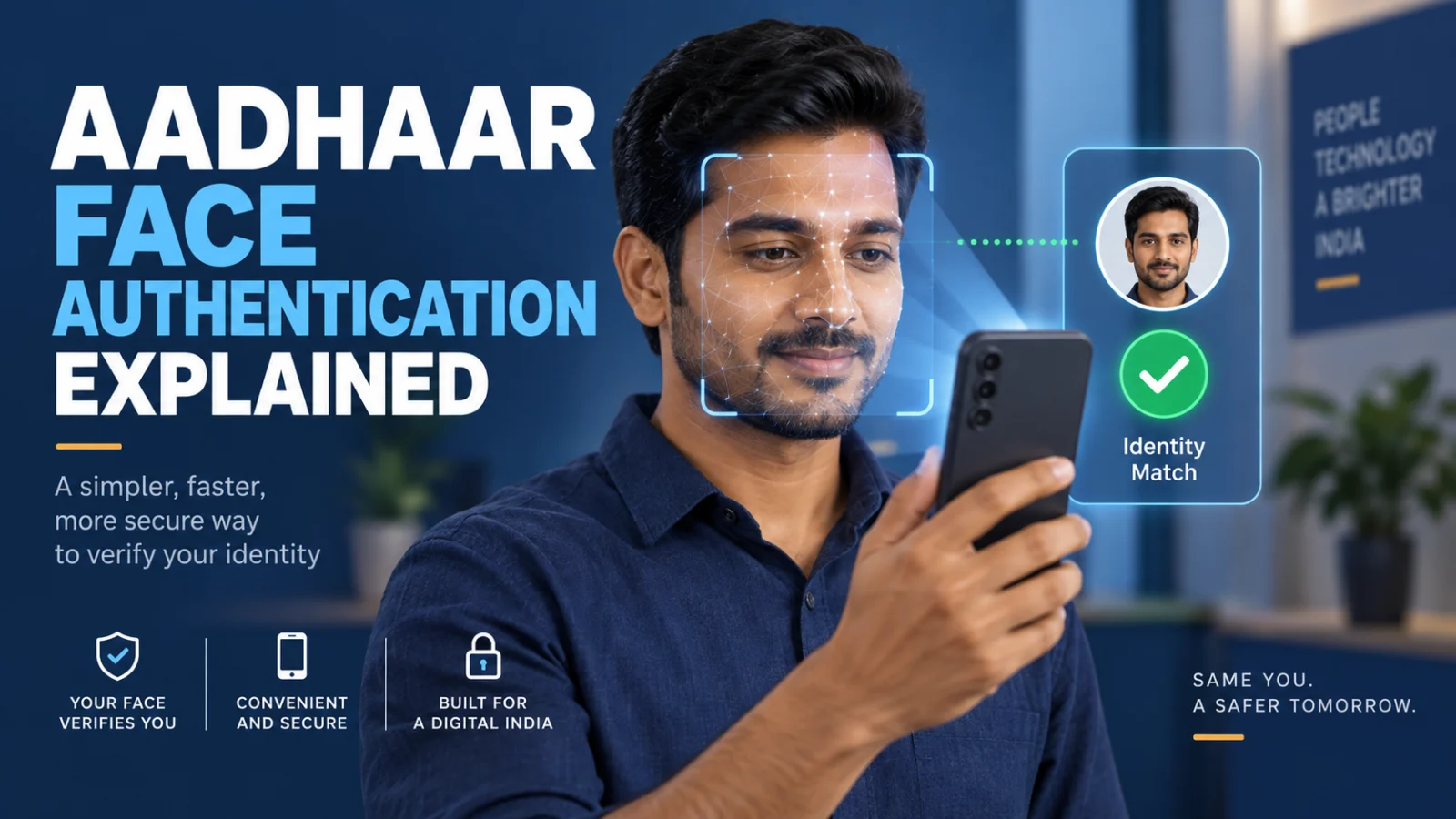






The Aadhaar Face Authentication SDK changes how banks, fintechs and other authorised service providers can build Aadhaar face authentication into their apps. UIDAI has launched a native Android and iOS SDK plus a Sandbox, allowing an organisation to integrate and test Aadhaar Face Authentication inside its own application instead of always sending the user to the separate Aadhaar FaceRD app.
Do you still need Aadhaar FaceRD after the new SDK launch?
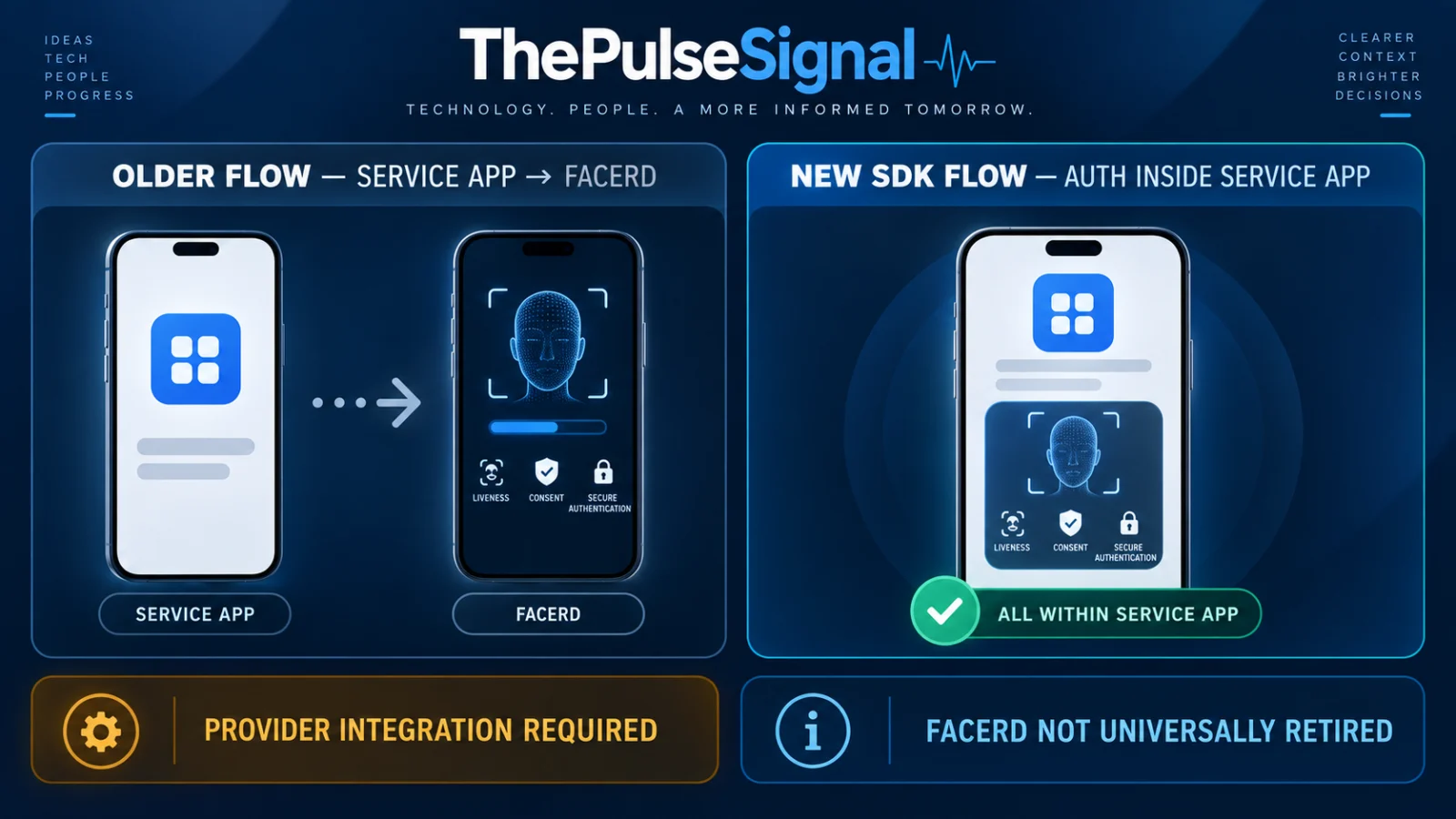
It depends on the service you are using. UIDAI’s new SDK can allow a bank, fintech or other ecosystem partner to perform Aadhaar Face Authentication inside its own app after integration and production deployment. That can remove the need to switch to the separate FaceRD app for that particular journey.
However, UIDAI has not announced that FaceRD is universally discontinued. Existing services can continue to use the older FaceRD-based workflow until they migrate or provide another supported authentication flow.
What was the earlier Aadhaar Face Authentication flow?
UIDAI’s existing public Face Authentication guidance describes a two-app journey for many implementations. The requesting bank, government service or other entity initiates authentication in its own application, while the separate Aadhaar FaceRD application performs the face capture and related authentication functions.
The user may therefore be moved from the requesting app to FaceRD and then back to the original service after authentication.
What changes with the Aadhaar Face Authentication SDK?
The newly launched SDK gives ecosystem partners a native integration route for Android and iOS. A provider that integrates and deploys it can keep more of the authentication journey inside its own application.
The important change is therefore architectural rather than universal: UIDAI has created a way to reduce dependence on app-switching, but each bank, fintech, insurer, broker, government department or other authorised entity still needs to integrate and deploy the SDK before its users see that change.
Is Aadhaar FaceRD being discontinued?
No universal FaceRD retirement or deprecation has been established in the material reviewed by TPS.
UIDAI’s launch says the new approach can reduce the need for a separate FaceRD app in supported integrated journeys. That is different from saying FaceRD is obsolete for every existing Aadhaar face-authentication service.
Will every bank and fintech automatically switch to the new SDK?
No. The SDK launch does not automatically change the authentication flow inside every participating service.
Providers still need to integrate the SDK, test their implementation and complete the relevant production-onboarding process before customers can use the embedded journey.
What is the UIDAI Face Authentication Sandbox?
The Sandbox is a controlled pre-production testing environment for organisations integrating Aadhaar Face Authentication.
UIDAI’s launch material says participating entities can test multiple stages and failure states before production deployment, including provisioning and consent, face capture, liveness, authentication, response handling, network interruptions, timeouts, invalid signatures and spoof-attempt scenarios.
Does Sandbox access mean a provider is already live?
No. Testing in the Sandbox is not the same as completing production onboarding or deploying the new flow to customers.
A bank or fintech may be evaluating or integrating the SDK without yet making the embedded face-authentication journey available in its public application.
Which platforms does the new SDK support?
UIDAI’s September 9 launch explicitly describes native support for Android and iOS applications.
TPS has not yet verified the minimum Android API level, minimum iOS version or other final device and SDK-version requirements for this new package. Older FaceRD compatibility specifications should not automatically be treated as the final compatibility rules for the newly launched SDK.
What should users do right now?
Follow your service’s current flow
If your bank, fintech or government service still opens or asks for Aadhaar FaceRD, continue using the workflow that the service currently supports.
Do not uninstall FaceRD just because the SDK launched
The launch does not establish that all existing services have migrated away from FaceRD.
Look for a provider-specific rollout
An in-app face-authentication experience should be treated as provider-specific until the bank or service confirms that it has deployed the new SDK.
Use official current guidance if the flow changes
Check UIDAI and the requesting service’s current instructions when authentication steps, app requirements or fallback methods change.
What if face authentication fails inside the provider app?
The new Sandbox supports testing of failure and error states, but TPS has not verified one universal consumer fallback flow for every provider deployment.
A bank or service may implement its own retry, escalation or alternate-authentication process within UIDAI’s permitted framework. Users should therefore follow the failure instructions shown by the specific service rather than assuming that every implementation behaves identically.
Has anyone already deployed the new SDK?
TPS did not verify a named bank, fintech, insurer or broker as being in production with the newly launched September 2026 SDK at the time of this review.
This distinction matters because UIDAI says Aadhaar Face Authentication itself has already been adopted widely, but existing Face Authentication adoption should not be described as adoption of the new SDK.
What happens next?
The next useful updates will be UIDAI technical documentation, production-onboarding details, Android and iOS compatibility requirements, first named provider deployments and any explicit FaceRD transition or deprecation guidance.
TPS will update this same URL as those details become verifiable rather than creating another page for the same FaceRD-versus-embedded authentication problem.
Verification note
TPS reviewed UIDAI’s September 9 SDK and Sandbox launch, UIDAI’s existing Face Authentication and FaceRD guidance, current developer/sandbox material and same-day reporting describing the Android/iOS integration and reduced need for app switching. The launch is confirmed, while provider-specific deployment and full FaceRD transition details remain unresolved.