





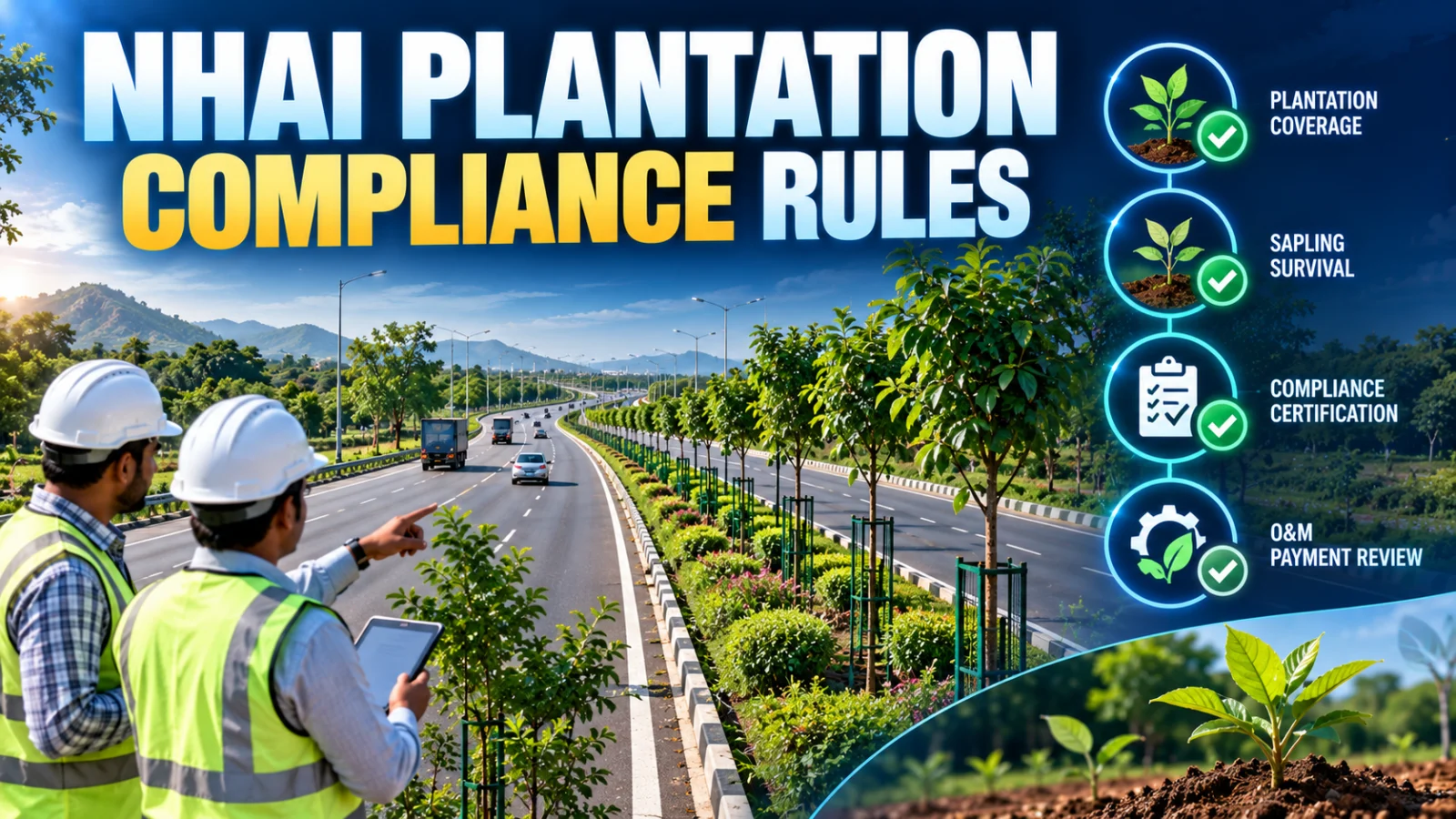
NHAI plantation compliance now has clear quantitative checkpoints for applicable National Highway projects. NHAI says plantation should cover at least 80% of the available right of way earmarked for plantation, while planted saplings must show at least 90% survival at inspection for provisional completion assessment. The 90% survival requirement also continues into the operation and maintenance stage, where it can affect O&M or annuity payments and maintenance-compliance assessment.
Direct answer: the 80% threshold is not 80% of the entire highway ROW. It applies to the available ROW that is earmarked for plantation. Reaching that threshold also does not mean the remaining plantation can simply be abandoned. NHAI says outstanding plantation must be identified with a completion timeline, while financial withholding may continue where the applicable contract or concession agreement provides for it.
What the 80% NHAI plantation compliance threshold means
For PCC or PCOD consideration, the project must have plantation over at least 80% of the available ROW earmarked for plantation. This distinction matters because the denominator is the plantation-designated available ROW, not every metre of the highway corridor.
The threshold functions as a minimum compliance checkpoint for provisional completion. If some plantation remains incomplete, the shortfall has to be identified and a specific timeline must be recorded for completing the balance work.
Minimum plantation coverage of the available ROW earmarked for plantation for PCC/PCOD assessment.
Minimum survival of planted saplings at the relevant inspection.
Any remaining plantation must still be identified and completed under a stated timeline.
Contractual financial withholding may apply until required plantation and survival conditions are achieved.
What the 90% survival requirement means
NHAI requires at least 90% survival of planted saplings at the time of inspection. The survival requirement is therefore separate from the plantation-coverage requirement: a project can have sufficient planted area but still fail the survival checkpoint if too many plants have died.
The rule also continues after provisional completion. During O&M, the minimum 90% survival rate must be maintained. This makes plantation maintenance a continuing compliance obligation rather than a one-time activity completed before the road opens.
Can PCC or PCOD be recommended if plantation is incomplete?
The reviewed NHAI release supports a conditional answer. Plantation on at least 80% of the available plantation-designated ROW is the stated threshold for provisional completion assessment, but any shortfall beyond that point must still be highlighted with a specific completion timeline.
NHAI also says appropriate financial withholding may be enforced as provided in the relevant contract or concession agreement until the remaining plantation is completed and the prescribed target is achieved. The release does not establish one universal withholding amount for every project.
How plantation compliance affects O&M and annuity payments
The 90% survival requirement extends into the O&M period. For EPC, HAM and BOT Annuity projects, NHAI says O&M or annuity payment processing is linked to maintaining the prescribed survival rate. For BOT-Toll projects, plantation survival is also considered when maintenance compliance is assessed.
This means project teams should treat plantation survival as part of continuing contract administration. A plantation that satisfied the initial inspection can later create a compliance issue if mortality reduces survival below the required level during O&M.
What happens when planted saplings die?
NHAI requires timely replacement of plant casualties. The replacement should use plants of similar age and growth so that the plantation does not technically satisfy the count while materially falling behind in maturity or development.
That requirement makes mortality tracking important. Project teams need to know not only how many plants were originally planted, but how many remain alive, where replacements are required and whether the replacement stock is comparable in age and growth.
Who verifies plantation survival?
NHAI says its environment and plantation experts will assist with field verification before relevant O&M or annuity payments are processed or maintenance compliance is certified. The practical evidence therefore needs to survive field inspection, not merely exist as a plantation schedule or contractor declaration.
NHAI plantation compliance checklist for project teams
Confirm the available ROW specifically earmarked for plantation under the project documents.
Verify that plantation covers at least 80% of that applicable area for PCC/PCOD assessment.
Confirm that at least 90% of planted saplings are surviving at inspection.
Identify any balance plantation and preserve the specific completion timeline.
Check the applicable contract or concession agreement rather than assuming a universal penalty or withholding amount.
Continue monitoring survival through O&M because the 90% requirement can affect payments and maintenance assessment.
Replace dead plants promptly with plants of similar age and growth.
Maintain project evidence that can be checked by NHAI environment or plantation experts.
Which existing rules still matter?
The new quantitative thresholds do not replace the underlying project contract or the broader plantation framework. The reviewed NHAI material refers to plantation obligations under applicable contract or concession agreements together with the Green Highways Policy 2015, IRC:SP:21-2009 and relevant MoRTH/NHAI guidance.
For a specific project, those controlling documents remain important because they may determine the plantation area, species or design requirements, payment provisions, maintenance obligations and consequences of non-compliance.
What remains unresolved
The reviewed primary release does not provide the underlying NHAI circular or guideline number, a universal formula for financial withholding, a clear transition rule for projects already close to PCC or PCOD when the new instruction was issued, or project-specific dispute and appeal mechanics.
Those questions should therefore be resolved from the applicable contract, concession agreement and any later NHAI circular or project-level direction rather than inferred from the general 80% and 90% thresholds.
Verification note
ThePulseSignal reviewed the September 9, 2026 NHAI/MoRTH release describing the plantation-compliance changes and compared the central requirements with current reporting. The primary release directly supports the 80% plantation threshold, 90% survival requirement, contractual withholding principle, continuing O&M survival requirement, casualty-replacement obligation and field-verification role. Project-specific exceptions, transition treatment and withholding amounts remain dependent on controlling contract documents and later NHAI guidance.