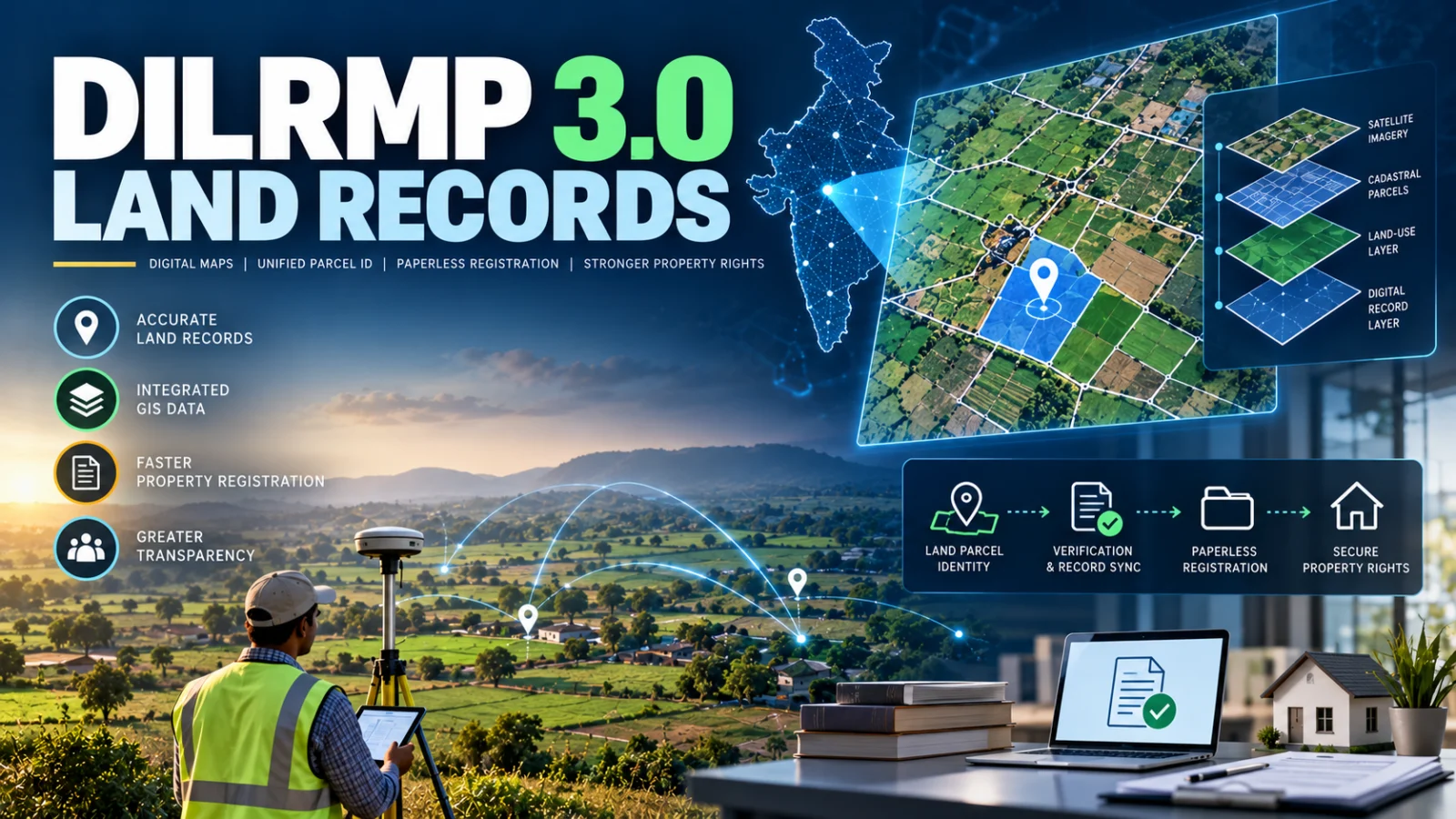





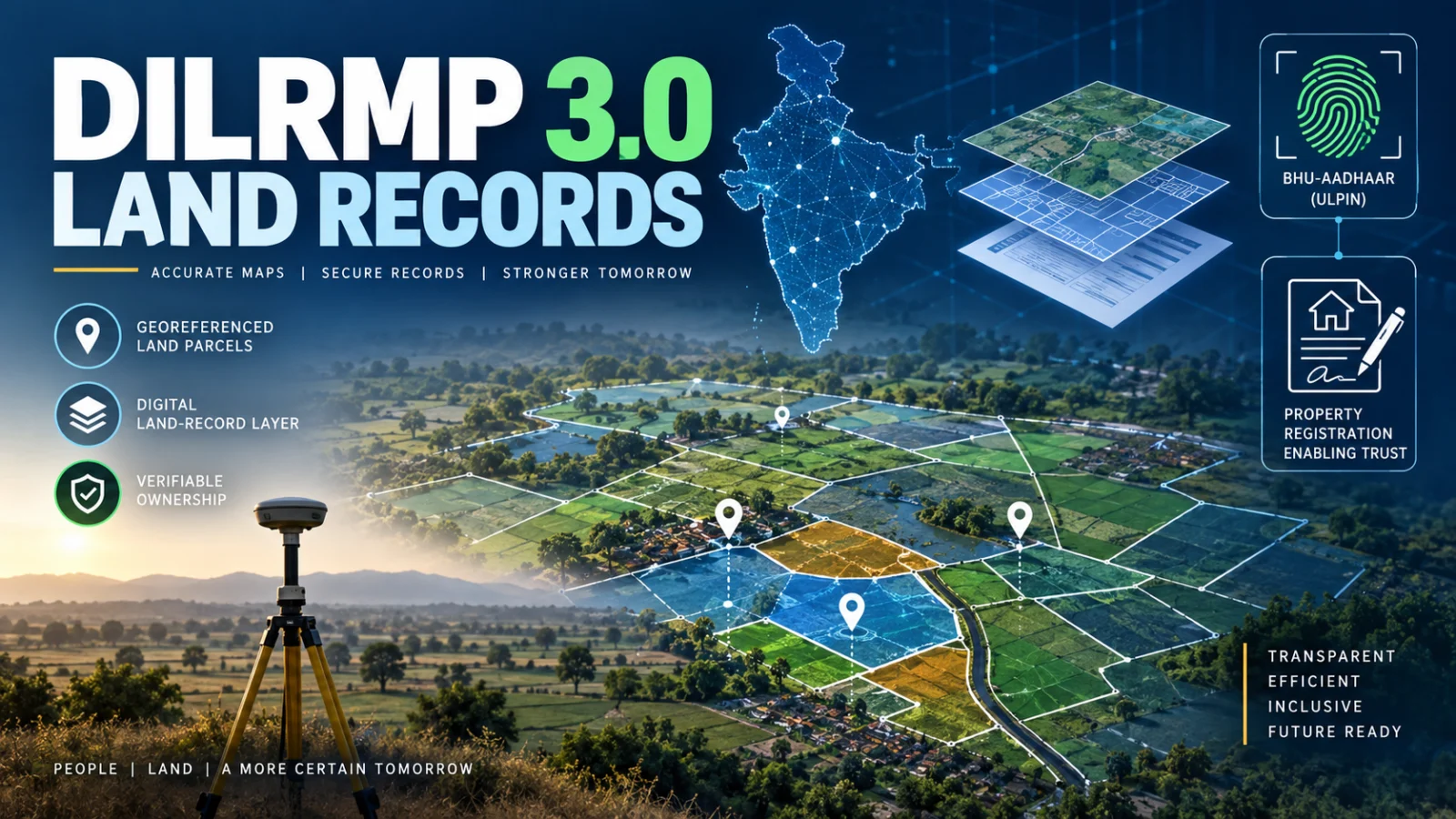
DILRMP 3.0 guidelines set out the next 2026–2031 phase of India’s Digital India Land Records Modernization Programme, with changes planned around Bhu-Aadhaar or ULPIN, digitised and georeferenced land maps, property registration, revenue-court systems and a more integrated digital land-record stack. The Department of Land Resources has publicly listed the DILRMP 3.0 Operational Guidelines, while the official launch is scheduled for September 10, 2026.
The most important point for landowners, buyers and other users is that a national programme roadmap is not the same as every feature becoming live across India immediately. Land administration remains dependent on State and Union Territory implementation, and the availability of specific digital services can differ by location and component.
What DILRMP 3.0 is changing
The Department of Land Resources has announced a five-year 2026–2031 roadmap with an anticipated outlay of ₹565.50 crore. The programme is intended to deepen the digitisation and integration of land administration rather than simply create one new national property portal.
The announced areas include wider use of the 14-digit Unique Land Parcel Identification Number, commonly referred to as ULPIN or Bhu-Aadhaar; digitisation and georeferencing of cadastral maps; paperless property-registration systems; a Registration Repository; integration of revenue-court case-management systems; and GIS-enabled land-data infrastructure.
What Bhu-Aadhaar or ULPIN means under the programme
ULPIN is designed to provide a unique identifier for a land parcel. Under DILRMP 3.0, the government plans to expand and strengthen this parcel-identification framework as part of a wider digital land-record system.
That does not mean every property in every state should be assumed to have a fully operational Bhu-Aadhaar today. Coverage and implementation depend on the underlying land-record, mapping and state-administration systems. Readers should check the current land-record or revenue service for their own state before relying on a ULPIN for a particular property process.
Paperless property registration does not mean nationwide instant rollout
The DILRMP 3.0 roadmap includes end-to-end paperless property registration and a Registration Repository. The programme also envisages modernisation of 75 Sub-Registrar Offices into Registration Seva Kendras, with ₹37.5 crore identified for that component in the official announcement.
These are important programme changes, but they should not be read as proof that every Sub-Registrar Office has already switched to one identical paperless workflow. State registration departments can be at different implementation stages, and the actual documents, payment process, identity checks, appointment system and registration steps remain controlled by the relevant state authorities.
Maps and land records are meant to become more closely linked
DILRMP has long covered computerisation of Record of Rights data and digitisation of cadastral maps. The 3.0 phase places further emphasis on georeferenced maps and an integrated land-data environment.
For a citizen, the practical value is that parcel identity, textual land records and mapped boundaries can become easier to connect digitally. However, digitised land records and georeferenced cadastral maps are separate implementation components, so a state can be more advanced in one area than another.
Revenue courts are also part of the integration plan
The announced roadmap includes further integration of Revenue Court Case Management Systems, or RCCMS. This is relevant because land administration is not limited to ownership records and registration: mutation, revenue proceedings and disputes can also move through different government systems.
The programme direction is toward better digital integration, but TPS has not verified a universal nationwide date on which all revenue courts or land-related proceedings will operate through one common integrated system.
What the Land Stack and NAKSHA components add
The Department of Land Resources has also linked DILRMP 3.0 with a GIS-enabled Land Stack and API-based integration. The NAKSHA urban land-record pilot is part of the broader effort to improve spatial and digital land information.
These components matter because future land administration may increasingly depend on structured connections between parcel identifiers, geospatial maps, registration information and government systems rather than isolated records held by separate offices.
What is confirmed now
- DILRMP 3.0 covers the 2026–2031 period.
- The official announcement gives an anticipated programme outlay of ₹565.50 crore.
- ULPIN or Bhu-Aadhaar expansion is part of the roadmap.
- Digitised and georeferenced cadastral maps remain a major programme component.
- Paperless property registration and a Registration Repository are planned.
- Seventy-five Sub-Registrar Offices are identified for modernisation as Registration Seva Kendras.
- Revenue-court system integration, NAKSHA and a GIS-enabled Land Stack are part of the announced direction.
What is not safe to assume yet
TPS has not verified that every feature becomes effective nationwide on September 10. The available evidence does not support claims that every property now has Bhu-Aadhaar, every registration office is paperless, every revenue court is integrated or every state follows the same citizen workflow from today.
The exact operative clauses, component-level deadlines, state-adoption requirements and implementation milestones should be read from the final DILRMP 3.0 Operational Guidelines and subsequent state-level instructions.
What should property owners and buyers do now?
If you are completing an actual land-record, mutation or registration task, continue using the current official service and procedure of the relevant State or Union Territory. Do not delay or alter a property transaction solely because DILRMP 3.0 has been announced unless the controlling state department has issued a corresponding change.
For Bhu-Aadhaar or ULPIN, verify whether the identifier is available for the relevant parcel through the official land-record system. For registration, follow the current Sub-Registrar or state registration instructions rather than assuming the future paperless model is already operational locally.
What happens after the September 10 launch
The next important evidence will be the complete operational-guideline text and any launch-day clarification from the Department of Land Resources. Those documents can establish which provisions are programme targets, which have defined implementation milestones and whether particular citizen-facing processes have immediate effective dates.
ThePulseSignal will treat later clarification as an update to this same DILRMP 3.0 page rather than creating a second URL for the same rollout event.
Verification note: ThePulseSignal reviewed the Department of Land Resources’ public DILRMP 3.0 guideline listing, the official PIB announcement describing the 2026–2031 roadmap and current DILRMP implementation information. Confirmed programme components are separated from rollout assumptions that still require operative guideline or state-level confirmation.