



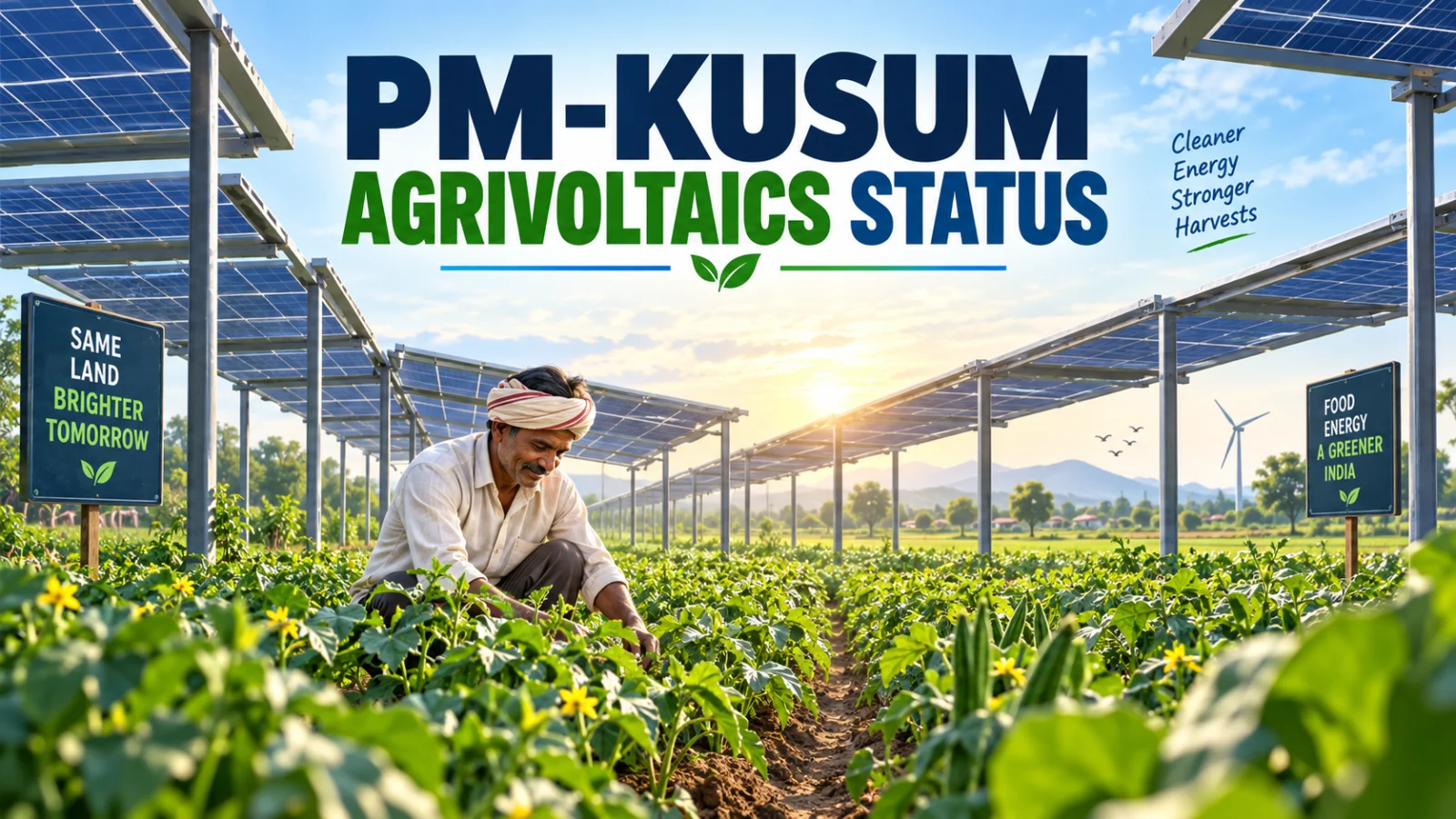
PM-KUSUM agrivoltaics is moving closer to becoming a dedicated part of the scheme’s next phase, but farmers should distinguish between what the government has confirmed and what is still not operational. The Ministry of New and Renewable Energy has said that the next PM-KUSUM phase will include a dedicated agrivoltaics component designed to allow farming and solar power generation on the same land.
The stated focus includes small and marginal farmers, Farmer Producer Organisations, cooperatives and panchayats. The government has also said the model is intended to let farmers retain ownership of their land while using the same land for agriculture and solar generation.
What is not confirmed yet is equally important: TPS has not found operative rules opening applications for the new agrivoltaics component, nor final rules fixing the subsidy, eligibility, project capacity, tariff, state participation or application route.
What the government has confirmed
On September 9, 2026, the Union Minister for New and Renewable Energy said the next phase of PM-KUSUM would carry a dedicated agrivoltaics component. The official statement described agrivoltaics as an approach that enables agricultural activity and solar power generation on the same parcel of land.
The government said the proposed model is intended to focus on small and marginal farmers, FPOs, cooperatives and panchayats. It also said farmer land ownership would remain with the farmer under the model being developed.
Is the proposed component 10 GW?
An earlier official MNRE statement from March 2026 said PM-KUSUM 2.0 was being prepared with a dedicated 10 GW Agri-PV component. That figure is important context, but it should not yet be treated as the final approved capacity of the eventual scheme component.
The September 9 announcement reconfirmed the dedicated agrivoltaics direction, but TPS has not verified a final operative approval document that fixes the new component at 10 GW. Until that happens, the safest description is that 10 GW was the earlier announced or proposed design figure.
Are PM-KUSUM agrivoltaics applications open?
No official application route for the new dedicated agrivoltaics component has been established in the evidence reviewed by TPS. The current announcement describes the next scheme phase and its intended structure, not an already-open farmer application programme.
That means farmers should not assume that an existing PM-KUSUM application portal, state process or implementing-agency route automatically covers this new component unless MNRE or the relevant state authority explicitly says so.
Is the subsidy already known?
No. Existing PM-KUSUM components use different financial-support structures. Some use central financial assistance, while others rely on different incentive or payment arrangements. Those existing percentages and mechanisms cannot safely be copied onto the future agrivoltaics component.
TPS has not verified a final central financial assistance percentage, farmer contribution, state subsidy, concessional-finance structure or other financial-support formula specifically for the new dedicated agrivoltaics component.
Who is expected to benefit?
The September announcement specifically identifies small and marginal farmers, FPOs, cooperatives and panchayats as focus groups. This supports the broad beneficiary direction, but it does not yet establish the legal eligibility rules that will determine who can actually participate.
For example, the final scheme may still need to define land-title requirements, lease arrangements, project-size thresholds, grid connectivity conditions, state participation and other operational criteria.
What does agrivoltaics mean for a farmer?
Agrivoltaics combines crop cultivation and solar generation on the same land rather than converting the entire parcel into a conventional ground-mounted solar site. Depending on the eventual design, solar structures can be arranged so that farming activity continues under or between panels.
The policy idea is therefore different from simply taking farmland out of agricultural use for a solar project. However, the government has not yet published the final technical requirements for panel height, spacing, crop compatibility, capacity or project layout under the new PM-KUSUM component.
Does the farmer keep ownership of the land?
The September 9 official statement says the planned model is intended to retain land ownership with farmers. That is an important policy signal, but the detailed legal and contractual structure still matters.
TPS has not yet verified final rules covering leasing, developer participation, power-purchase arrangements, land-use agreements, project financing or what happens if an FPO, cooperative or third-party developer is involved.
What should farmers not assume yet?
- Do not assume applications for the new agrivoltaics component are open.
- Do not assume the subsidy will be the same as an existing PM-KUSUM component.
- Do not assume the earlier 10 GW figure is the final approved capacity until formal rules reconfirm it.
- Do not assume every state or DISCOM will participate in the same way.
- Do not pay an intermediary based only on claims that the new PM-KUSUM agrivoltaics benefit is already available.
What happens next
The key next step is formal scheme approval and publication of operative PM-KUSUM next-phase rules. Those rules should clarify the new component’s eligibility, subsidy or financing structure, capacity limits, state participation, tariff or power-sale mechanism, technical requirements and application process.
The Agrivoltaics World Conference scheduled for October 21–23, 2026 is also a relevant monitoring point because further policy or implementation detail may emerge around the same programme direction.
ThePulseSignal will treat future operative rules as an update to this same PM-KUSUM agrivoltaics page rather than creating another URL for the same core farmer question.
Verification note: ThePulseSignal reviewed the September 9 MNRE/PIB policy statement, the March 2026 official PM-KUSUM 2.0 Agri-PV announcement and current PM-KUSUM support structures to separate confirmed policy direction from rules that have not yet been issued for the dedicated agrivoltaics component.