




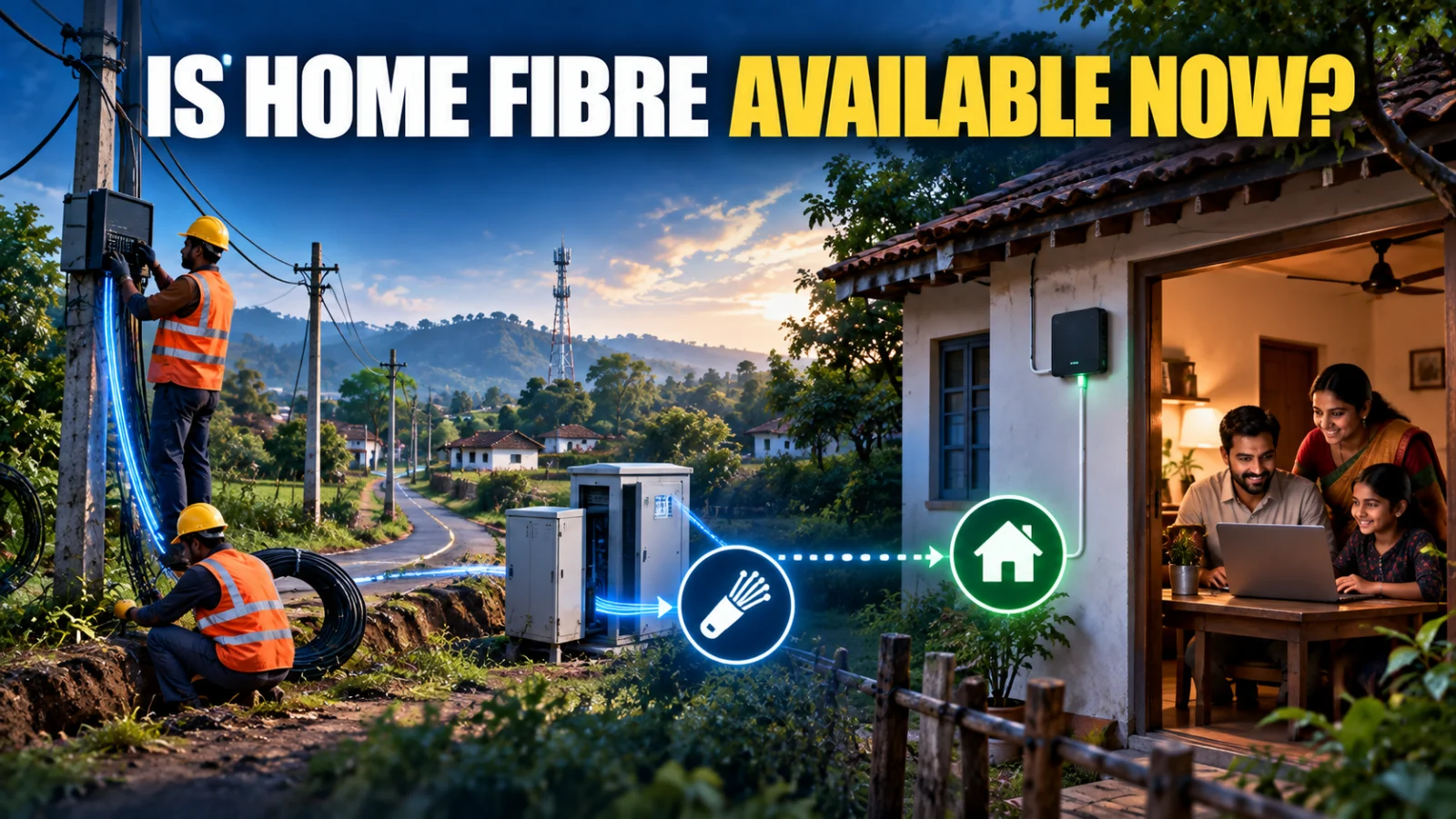
Jharkhand BharatNet home fibre is not automatically available in every village covered by the new state implementation agreement. The September 10, 2026 agreement moves the Amended BharatNet Programme into a defined implementation stage in Jharkhand, but actual household service still depends on whether the local network is connected and serviceable.
The official programme scope is large: ₹1,684 crore of Government of India support has been provisioned, 4,395 Gram Panchayats are in scope and 26,777 villages are to receive connectivity on demand. The government also says the initiative is expected to facilitate more than four lakh rural home-fibre connections. Those numbers describe programme scope and intended rollout; they do not mean four lakh connections are already active.
Does the Jharkhand BharatNet agreement mean home fibre is live now?
No. The agreement establishes the implementation framework and coverage scope. A household still needs to check whether its Gram Panchayat or village is currently connected and whether FTTH can be provisioned at the address.
What exactly changed under Jharkhand BharatNet?
The implementation agreement brings Jharkhand into a more concrete execution stage under the Amended BharatNet Programme. The official release says the state programme covers 4,395 Gram Panchayats. Of these, 4,387 existing Gram Panchayats are to be upgraded from linear network architecture to a ring structure, while eight newly created Gram Panchayats are also included.
The programme also identifies 26,777 villages for on-demand connectivity. The phrase on demand is important: inclusion in programme scope is not the same thing as a live fibre connection at every household.
Government support provisioned for Jharkhand’s implementation.
Total GPs covered by the state implementation programme.
Villages identified for on-demand connectivity, not proof of immediate service everywhere.
Are more than four lakh Jharkhand home-fibre connections already active?
No. The official release says the initiative is expected to facilitate more than four lakh rural home-fibre connections. That is a programme objective, not an achieved connection count.
TPS did not find a primary source establishing that more than four lakh Jharkhand households are already connected under this implementation agreement.
How to check Jharkhand BharatNet home fibre availability
Rural households can use the current official BharatNet FTTH demand process to check their location and raise a connection request. The service flow asks the user to select location information such as the state, district and Gram Panchayat.
Choose Jharkhand as the state in the official BharatNet demand process.
Use the location fields to identify the area where the connection is required.
If the area is already connected, a household can raise a demand for FTTH service. If it is not yet connected, the demand can still help identify future expansion need.
Keep the Demand ID or registered mobile details so the request can be tracked later.
The current official household-demand route is available through the BharatNet portal.
Who can raise a BharatNet FTTH demand?
The current BharatNet service information covers rural households as well as government institutions and private enterprises located in Gram Panchayats and villages. Actual provisioning still depends on network availability and technical feasibility at the requested location.
Does the ₹1,684 crore mean households receive a cash subsidy?
No household cash payment is established by the Jharkhand implementation release. The ₹1,684 crore figure is programme support provisioned for implementation.
The wider Amended BharatNet framework also provides financial incentives to BharatNet Udyamis for activating new home-fibre connections. That programme-side incentive should not be described as a cash subsidy paid directly to every household.
For the household, the most relevant current benefit is simpler: the official BharatNet service information says there is no installation charge for a new BharatNet FTTH connection under the current programme framework.
Is BharatNet home internet free after installation?
No. Free installation does not mean free monthly broadband.
The subscriber still pays the monthly charge for the selected broadband plan. Current official BharatNet plan information includes a Rural Entry Plan starting at around ₹259 per month, with other plan options available. Plan pricing can change and should be checked again before ordering.
| Cost or support question | Current answer |
|---|---|
| Installation charge | No installation charge under the current BharatNet FTTH programme information. |
| Monthly broadband charge | Paid by the subscriber according to the selected plan. |
| ₹1,684 crore | Jharkhand programme implementation support, not a household cash payment. |
| BNU incentive | Programme-side incentive linked to activation of new rural home-fibre connections. |
What information is normally needed to request a connection?
The current BharatNet household process indicates that applicants generally need contact information such as a mobile number and email address, together with the installation address. The service provider may request additional documents when the connection is processed.
Do not assume that raising a demand by itself proves that installation is complete. Preserve the Demand ID and check the subsequent service or feasibility status.
How long can installation take?
The current national BharatNet service information says installation usually takes around 3–10 working days after demand and feasibility verification, depending on the village and provider.
This timeframe should not be applied to a Jharkhand village that has not yet become network-ready under the new rollout. If the village itself still requires BharatNet expansion or upgrade work, household installation can take longer and no village-specific completion date should be assumed.
When will all 26,777 Jharkhand villages get service?
A village-by-village completion schedule was not established in the September 10 official release reviewed by TPS. The agreement defines programme scope and implementation responsibilities, but it does not provide a public service-ready date for every village.
This means two households within the overall 26,777-village programme footprint may reach the FTTH ordering stage at different times.
What happens next?
The expected sequence is network implementation and upgrades, village-level serviceability, household or institutional demand, FTTH activation and then measurable connection milestones.
The same Jharkhand BharatNet page should be updated when the government publishes material rollout information such as district or Gram Panchayat schedules, service-ready village data, home-fibre activation milestones, revised plans or clearer subsidy and implementation instructions.
Verification note
ThePulseSignal reviewed the September 10 PIB/Department of Telecommunications release confirming the Jharkhand Amended BharatNet implementation agreement and compared the announcement with the current official BharatNet household-demand and FTTH service information. This confirms the programme scope while showing that actual household availability remains location-specific.
Limitations and unresolved facts
- No village-by-village Jharkhand rollout or commissioning schedule was established in the reviewed release.
- The current number of service-ready Jharkhand villages under this implementation agreement is not established.
- The achieved number of new household FTTH activations is not yet established.
- The exact district-wise allocation of the projected home-fibre connections is unknown.
- The precise BharatNet Udyami incentive applicable to each Jharkhand activation was not established in the reviewed Jharkhand release.
- Current plan pricing and installation timelines can change and remain subject to local feasibility and provider conditions.