




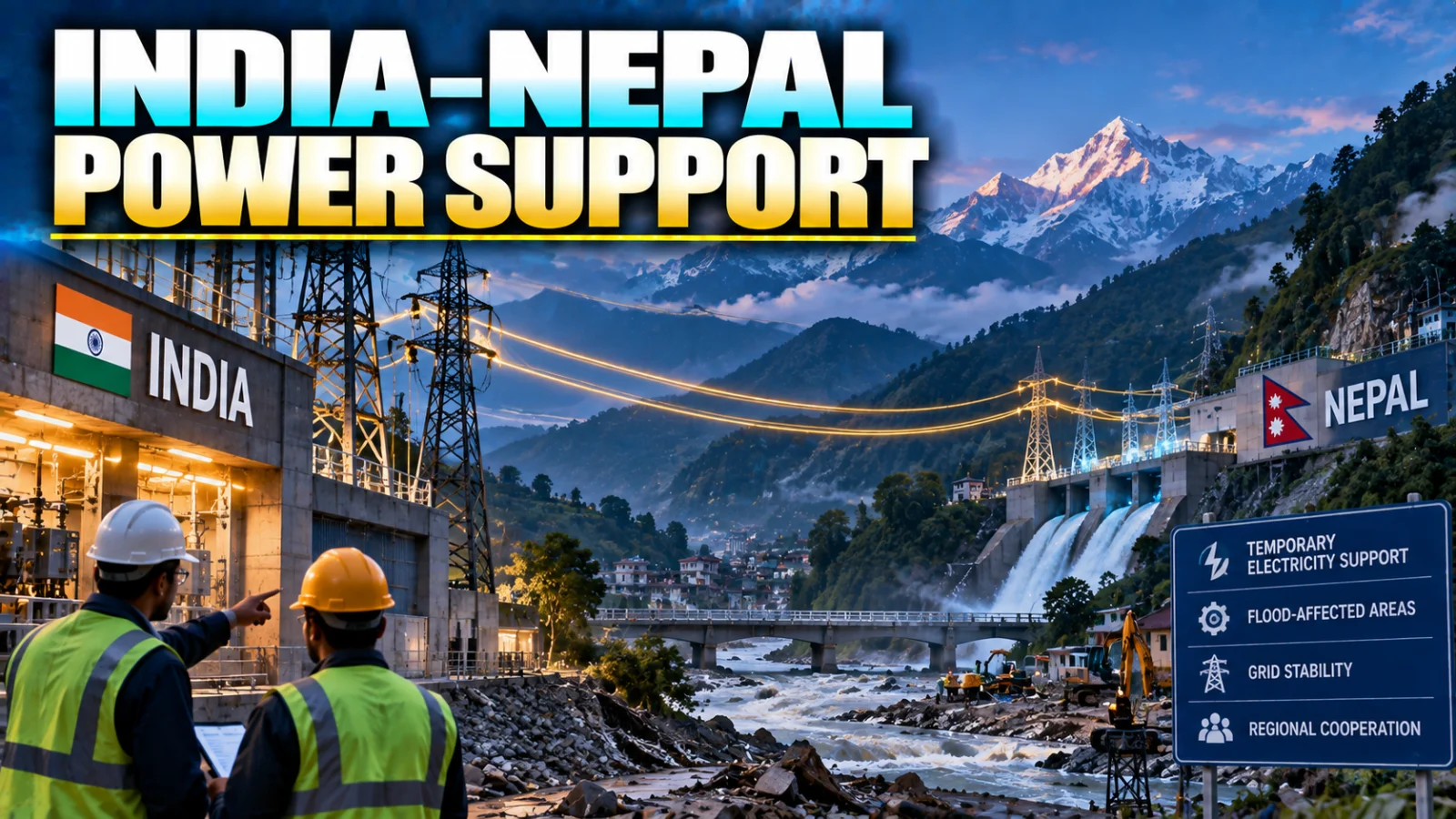
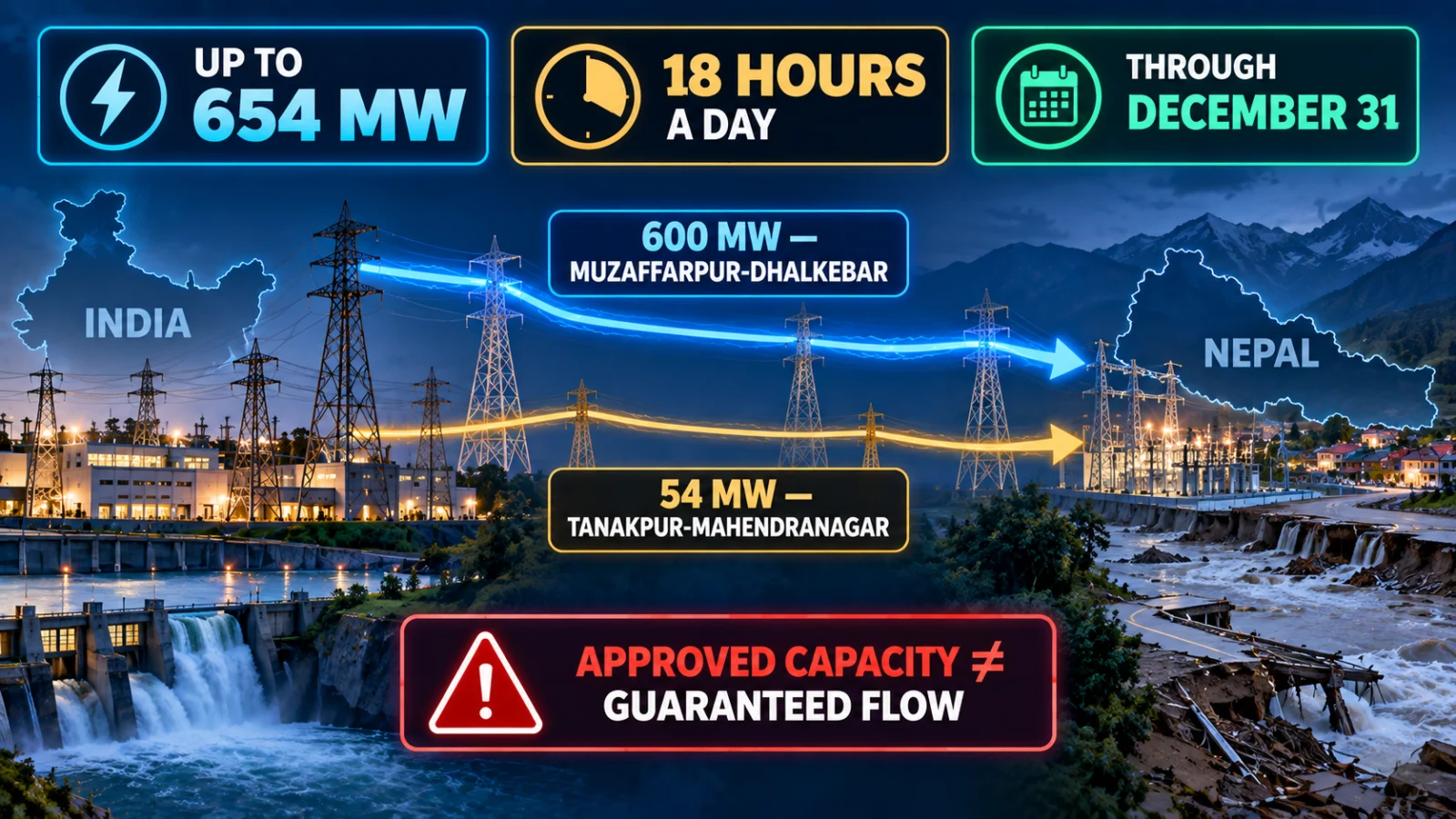
India power exports to Nepal have entered a new emergency phase after flood damage reduced Nepal’s hydropower supply. India has approved Nepal to import up to 654 MW of electricity for 18 hours a day through December 31, 2026, according to Reuters and other current reports citing India’s Ministry of Power.
The most important qualification is that 654 MW is the approved maximum capacity, not proof that Nepal receives 654 MW continuously. Actual electricity drawn can vary with Nepal’s demand, available transmission capacity, system conditions and the recovery of damaged domestic hydropower generation.
What did India approve for Nepal?
Current reporting says Nepal can import up to 654 MW from India during an 18-hour daily window through December 31. Indian Express reports that the approved window runs from midnight to 6 p.m.
The reported transmission split is up to 600 MW through the Muzaffarpur-Dhalkebar 400 kV interconnection and up to 54 MW through the Tanakpur-Mahendranagar 132 kV link.
TPS did not directly recover the underlying September Ministry of Power order or release, so these operating details remain attributed to multiple current reports citing the ministry.
Does Nepal receive 654 MW for all 18 hours?
Not necessarily. The approval establishes how much electricity Nepal is permitted to import under the temporary arrangement. It does not establish that the full 654 MW is physically delivered throughout every approved hour.
Actual imports may be lower depending on electricity demand, grid availability, transmission constraints, Nepal’s own hydropower output and other system conditions.
Why does Nepal need Indian electricity after the flood?
Nepal relies heavily on hydropower, so severe damage to generating assets can quickly reduce domestic electricity availability. The September flood created a generation shortfall large enough for Nepal to seek expanded electricity imports from India.
This does not contradict Nepal’s recent position as an electricity exporter. Nepal’s hydropower output varies significantly by season. During high-flow periods it can produce surplus electricity and export power to India, while during dry periods or major disruptions it can need imports from the same interconnected regional grid.
Why are India power exports to Nepal limited to 18 hours a day?
Indian Express reports that the approved window is midnight to 6 p.m., rather than a full 24 hours. The reported structure reflects India’s own grid and generation conditions, including stronger daytime supply from solar generation and tighter conditions during some evening and night periods.
The 18-hour approval therefore should not be read as an unconditional 24-hour emergency supply commitment.
Which power lines will carry the electricity?
The largest part of the reported approval is up to 600 MW through the Muzaffarpur-Dhalkebar 400 kV cross-border transmission line. A further 54 MW can reportedly move through the Tanakpur-Mahendranagar 132 kV interconnection.
These links are part of the established India-Nepal electricity-trading system and allow power to move across the border according to approved commercial and grid arrangements.
Will the 654 MW approval stop power cuts in Nepal?
No reviewed evidence guarantees that Nepal will avoid all power cuts. The additional import capacity should improve available supply, but the consumer-level outcome still depends on actual electricity drawn from India, domestic generation recovery, system demand, local transmission and distribution conditions, and any further damage or operational constraints.
A claim that the approval has completely solved Nepal’s electricity shortage would go beyond the evidence currently available.
Why did Nepal shift from exporting electricity to importing it?
The shift shows why Nepal’s electricity relationship with India is not simply one-way. Nepal can export surplus hydropower when river flows and domestic generation are strong, then import electricity when dry-season production or an exceptional disruption leaves generation below demand.
The current flood is an unusually severe example of that supply swing: hydropower damage reduced Nepal’s available generation and increased the need for temporary imports.
What happens after December 31?
The current reported approval runs through December 31, 2026. Indian Express reports that the arrangement is expected to be reviewed in December for possible continuation into January 2027.
No extension beyond December 31 is confirmed at this stage. A continuation decision, early hydropower recovery, a change in the daily import window or a reduction in Nepal’s supply shortfall would all materially change the current answer.
What remains unconfirmed?
- The direct September Ministry of Power or Central Electricity Authority approval document has not been recovered by TPS.
- The full 654 MW is not established as the actual power delivered throughout every approved hour.
- The consumer-level reduction in outages attributable specifically to the Indian imports is not yet established.
- The recovery timetable for all flood-damaged Nepal hydropower assets remains uncertain.
- No extension into January 2027 has been confirmed.
Verification note
ThePulseSignal reviewed current Reuters, Indian Express and Economic Times reporting that independently attributes the temporary 654 MW approval to India’s Ministry of Power. TPS also checked official India-Nepal power-trade background from the Embassy of India in Kathmandu to verify the established cross-border electricity framework and transmission relationship. The underlying September ministry approval document was not directly recovered, so the specific temporary operating terms remain attributed rather than presented as independently inspected primary text.