







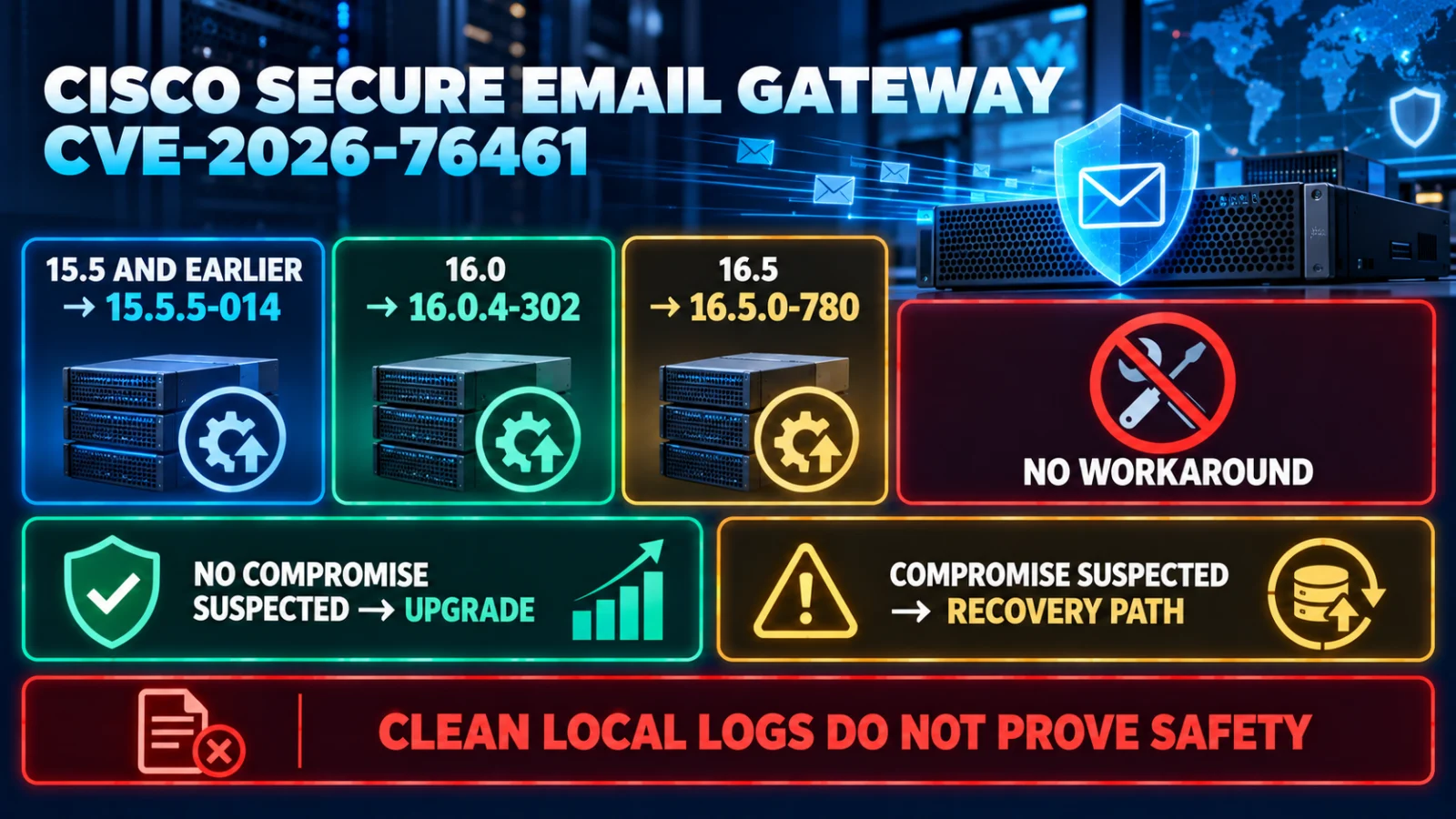
CVE-2026-76461 is actively exploited, according to Cisco. The Critical CVSS 9.8 vulnerability affects physical and virtual Cisco Secure Email Gateway appliances and can allow an unauthenticated remote attacker to execute commands with root privileges. Cisco says there is no workaround, so affected systems need a fixed software release.
The immediate task is not only to patch. Administrators should first identify the installed AsyncOS train, compare it with Cisco’s fixed-release guidance and decide whether the appliance is simply vulnerable or may already be compromised. Those two states require different responses.
What does CVE-2026-76461 allow an attacker to do?
Cisco describes CVE-2026-76461 as a SQL-injection vulnerability in the email-processing path of Secure Email Gateway. A remote unauthenticated attacker can send maliciously crafted email through an affected appliance and, if exploitation succeeds, execute arbitrary commands with root privileges.
Cisco also says it is aware of active exploitation. That statement applies specifically to CVE-2026-76461 and should not be generalized to every vulnerability included in Cisco’s broader September Secure Email hardening release.
Which Cisco products are affected?
Cisco says physical and virtual Secure Email Gateway appliances are affected, regardless of configuration, when they run vulnerable software.
For this specific CVE, Cisco says Secure Email and Web Manager and Secure Web Appliance are not affected. Other vulnerabilities in Cisco’s broader hardening release may have different product scope, so administrators should not merge those advisories into one affected-product list.
Which releases fix CVE-2026-76461?
| Current software train | Fixed release | Cisco guidance |
|---|---|---|
| 15.5 and earlier | 15.5.5-014 | Fixed; Cisco strongly recommends migration to 16.5.0-780 where applicable |
| 16.0 | 16.0.4-302 | Fixed; Cisco strongly recommends migration to 16.5.0-780 where applicable |
| 16.5 | 16.5.0-780 | Fixed release |
Administrators should verify the exact installed release before choosing an upgrade path. The fixed-release matrix is version-specific, and Cisco may revise it later.
Is there a workaround?
No. Cisco says there are no workarounds that address CVE-2026-76461. Hardening measures or access restrictions should not be treated as a substitute for moving an affected appliance to a fixed software release.
Which remediation path applies to your gateway?
Affected release, but no compromise is suspected
Upgrade the appliance to the fixed release for its software train. Cisco strongly recommends moving older affected trains toward 16.5.0-780 where applicable.
Compromise is suspected on a virtual appliance
Do not assume that installing the patch alone restores trust. Cisco recommends preserving forensic information before destructive action and, where possible, deploying a new virtual machine with fixed software, rebuilding the required configuration and renewing credentials and cryptographic material.
Compromise is suspected on a physical appliance
Cisco recommends contacting Cisco TAC for investigation and recovery assistance rather than relying on a routine software upgrade as the complete remediation path.
Secure Email Cloud customer
Cisco says Secure Email Cloud devices have already been upgraded to 16.5.0-780. Cisco also says customers whose cloud devices showed possible malicious activity were contacted directly for remediation and recovery work.
How can administrators check for attempted exploitation?
Cisco advises reviewing Secure Email Gateway mail_logs for suspicious SQL-related activity and gives examples of patterns that may indicate an attack attempt. Cluster administrators should review each device in the cluster rather than assuming one node’s logs represent the entire deployment.
The important limitation is that this check is not exhaustive. Successful exploitation can provide root privileges, and Cisco warns that an attacker with that access may remove or hide evidence. Administrators should also review external security, firewall and network telemetry for unusual activity associated with the appliance.
Does a clean mail log prove the gateway was not compromised?
No. The absence of the sample pattern in local logs does not conclusively establish that the system was never compromised. Root-level access can allow an attacker to alter or remove local evidence.
If there are other signs of intrusion, unexplained configuration changes, unusual outbound connections or suspicious activity around the appliance, use an incident-response path rather than treating a clean local log as a reason to stop investigating.
Is patching enough after suspected exploitation?
Not necessarily. A fixed release removes the vulnerability from the upgraded software state, but it does not automatically establish that an appliance which may already have been compromised is trustworthy.
For suspected virtual-appliance compromise, Cisco recommends preserving evidence and rebuilding onto a clean fixed deployment where possible. For physical appliances, Cisco recommends engaging TAC. Credential and cryptographic-material renewal may also be part of the recovery path depending on the affected environment and Cisco guidance.
What should administrators do now?
- Identify the exact Secure Email Gateway software release in use.
- Compare it with Cisco’s current fixed-release matrix.
- Upgrade affected systems because Cisco says there is no workaround.
- Review the available local and external security evidence for signs of exploitation.
- If compromise is suspected, follow Cisco’s recovery guidance instead of relying on patch-only remediation.
- Check the Cisco advisory again before change execution in case the fixed-release or incident-response guidance has been revised.
What remains unknown?
Cisco has confirmed exploitation but has not established a public victim count, exploitation geography or threat-actor attribution in the evidence reviewed for this article. The scale of exploitation and whether additional indicators or recovery guidance will be published remain unresolved.
Verification note
ThePulseSignal reviewed Cisco’s dedicated CVE-2026-76461 PSIRT advisory, Cisco’s accompanying September Secure Email hardening advisory and the Canadian Centre for Cyber Security alert. Cisco’s dedicated advisory directly confirms the active exploitation state, Critical severity, affected product, no-workaround status, fixed software releases and compromise-recovery guidance.