






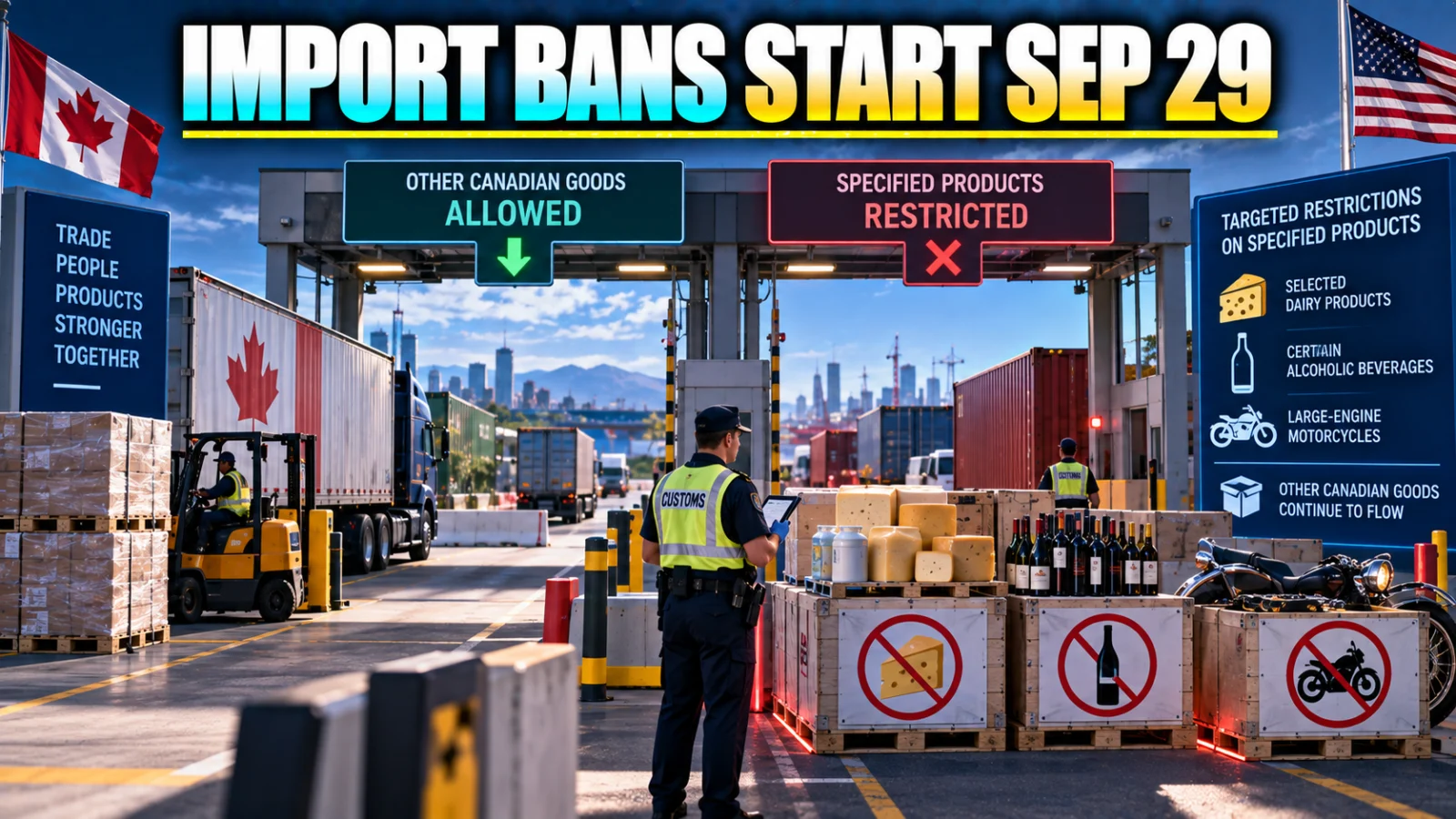
U.S. Canada import bans September 29 will apply to specified Canadian products covered by three Section 338 proclamations signed on September 8, 2026. The import exclusions take effect for covered goods imported on or after 12:01 a.m. Eastern Time on September 29, 2026.
The action is not a ban on all Canadian goods. Exact coverage is controlled by the tariff classifications and product descriptions in the applicable proclamation annexes covering specified alcoholic beverages, dairy and related products, and a defined motor-vehicle-related tariff line.
Why September 29 matters
The three exclusion proclamations establish a clear transition from an additional-duty state to an import-prohibition state for the products they cover.
For covered goods imported on or after 12:01 a.m. Eastern Time on September 29, the proclamations provide for exclusion from importation into the United States.
That makes the exact import date, tariff classification and annex scope operationally important for importers, exporters, brokers and logistics teams handling affected Canadian goods.
Is this a ban on all Canadian imports?
No. The proclamations apply only to the Canadian products identified in their respective annexes.
Category shorthand such as “dairy ban,” “alcohol ban” or “vehicle ban” can be misleading if it is read as covering every product in that industry. The legally controlling question is whether the shipment’s tariff classification falls within the applicable exclusion annex.
Which Canadian product groups are affected?
Alcoholic beverages
The alcoholic-beverage proclamation excludes selected Canadian alcoholic beverages identified in its annex. The reviewed annex contains specified tariff lines covering categories including beer, wine, vermouth, spirits and related alcoholic beverage classifications, with the precise tariff description controlling whether an individual product is covered.
Dairy and related products
The dairy proclamation applies to specified Canadian dairy and related products identified in its annex. It should not be summarized as an exclusion of every dairy product from Canada.
Importers should match the actual product to the controlling tariff line rather than rely only on commercial descriptions such as cheese, milk product or dairy ingredient.
Motorcycle-related products
The motor-vehicle exclusion annex reviewed by TPS identifies HTSUS 8711.50.00. That classification covers motorcycles, including mopeds, and cycles fitted with an auxiliary motor, with reciprocating internal-combustion piston engines exceeding 800 cc.
This narrow annex scope is why the September 29 action should not be described as a blanket ban on Canadian motor vehicles.
What happens to goods imported before September 29?
The proclamations include transition treatment for products that will become subject to the import ban but were imported before September 29 and had not yet been entered for consumption or withdrawn from warehouse for consumption.
Those goods remain subject to the applicable 50% Section 338 additional duty established under the earlier proclamations rather than automatically moving into the September 29 import-exclusion treatment.
This timing distinction is important for goods already moving through ports, bonded facilities or customs-entry processes as the effective date approaches.
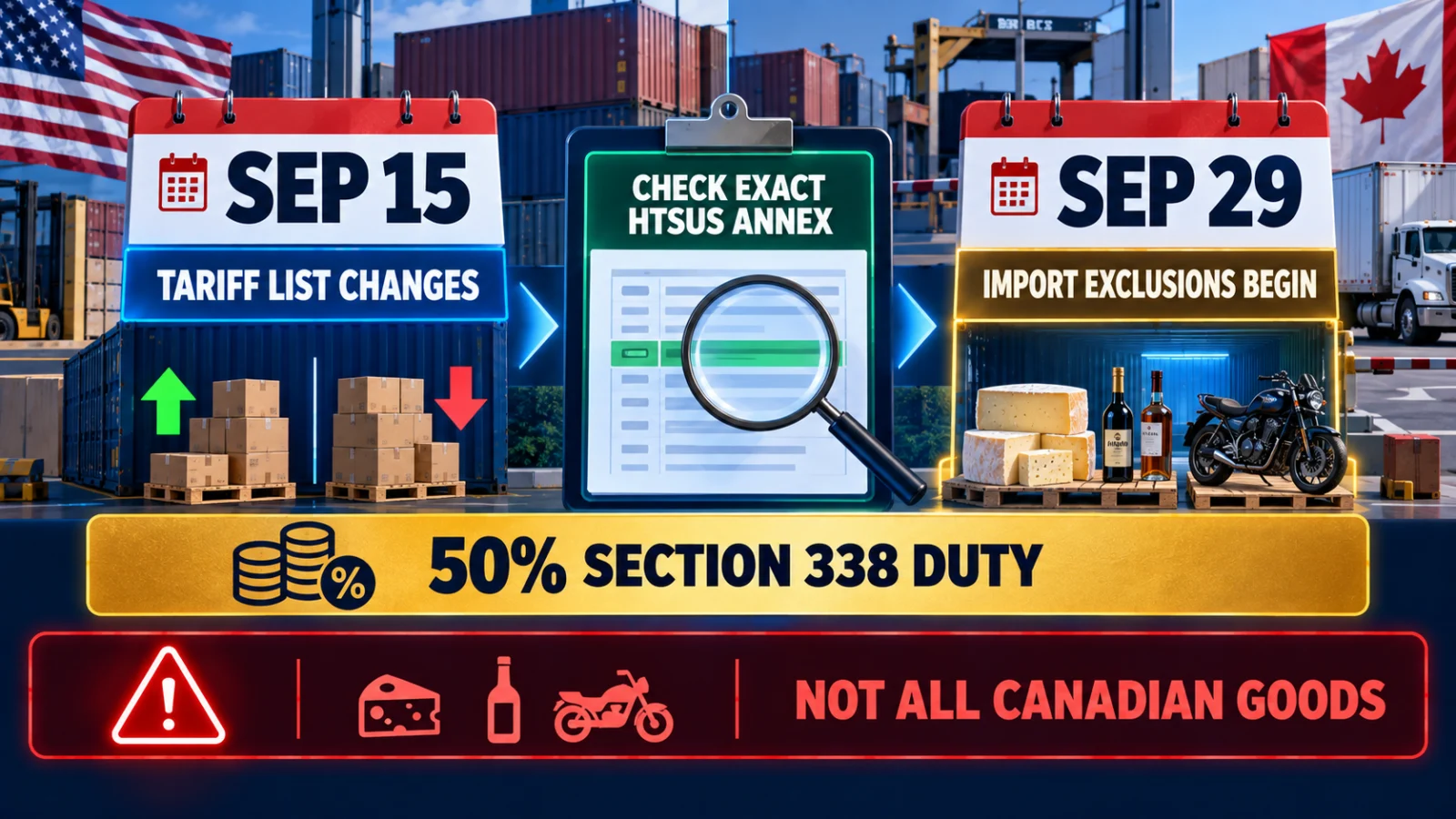
What changes on September 15 versus September 29?
There are two separate Section 338 changes that should not be merged.
- September 15: product additions and removals to certain existing 50% Section 338 tariff lists take effect.
- September 29: specified products listed in the three import-exclusion annexes become prohibited from importation.
A product added to a tariff list on September 15 is not automatically part of the September 29 import ban.
Are Canadian ATVs banned on September 29?
The reviewed White House material identifies all-terrain vehicles as part of the September 15 tariff-scope modification. The motor-vehicle import-exclusion annex reviewed by TPS instead identifies HTSUS 8711.50.00.
That means the current evidence does not support describing all Canadian ATVs as part of the September 29 import ban merely because they were added to a Section 338 tariff list.
How should an importer check whether a shipment is covered?
Establish whether the shipment falls within the country scope of the Canadian Section 338 action.
Do not rely only on a broad commercial category such as dairy, alcohol or vehicle.
Match the classification against the alcoholic-beverage, dairy or motor-vehicle import-exclusion annex as applicable.
A September 15 tariff-list addition is not automatically a September 29 prohibited import.
Determine whether the goods are imported before or on/after the September 29 effective time and whether they have been entered for consumption.
Review any later White House, U.S. Customs and Border Protection or tariff-schedule implementation guidance before final entry decisions.
Why Section 338 can produce both tariffs and outright import bans
Section 338 of the Tariff Act of 1930 gives the President authority to respond to discriminatory treatment of U.S. commerce. Earlier actions against Canada imposed additional ad valorem duties on specified products.
The September 8 proclamations use the exclusion authority for selected goods after the administration determined that the relevant Canadian practices had been maintained or increased.
For readers, that legal distinction has a practical consequence: a 50% duty still allows importation if all other requirements are met, while an import exclusion prohibits covered goods from being imported under the proclamation once the effective state applies.
Does USMCA origin status prevent the Section 338 action?
The White House states that the Section 338 tariffs apply to covered goods regardless of whether a good qualifies as originating under the United States-Mexico-Canada Agreement. Importers should therefore not assume that USMCA qualification by itself removes a shipment from these Section 338 measures.
The specific September 29 exclusion question still depends on whether the product is in the relevant import-ban annex.
What should Canadian exporters do before September 29?
Exporters shipping potentially covered products should confirm the U.S. HTSUS classification with their importer or customs adviser, identify whether the product appears in an exclusion annex, and check the expected U.S. import date rather than only the Canadian departure date.
They should also distinguish products still subject to the 50% duty from products that will become prohibited and monitor for any later implementation instructions before the effective date.
Verification note
ThePulseSignal reviewed the September 8 White House Section 338 proclamations covering alcoholic beverages, dairy and motor vehicles, their available annex material, and the White House fact sheet separating the September 15 tariff-scope changes from the September 29 import exclusions.
Limitations and unresolved facts
- Exact product coverage is controlled by the applicable HTSUS lines and annex language, not broad industry labels.
- Later White House, CBP or tariff-schedule implementation guidance could clarify or modify how the exclusions are administered.
- TPS has not determined the correct tariff classification for any individual commercial shipment.
- Product-specific classification disputes, exclusions, technical corrections or legal challenges may change the practical treatment of individual goods.
- The current evidence does not support describing all Canadian goods, all dairy, all alcohol, all vehicles or all ATVs as prohibited imports on September 29.