




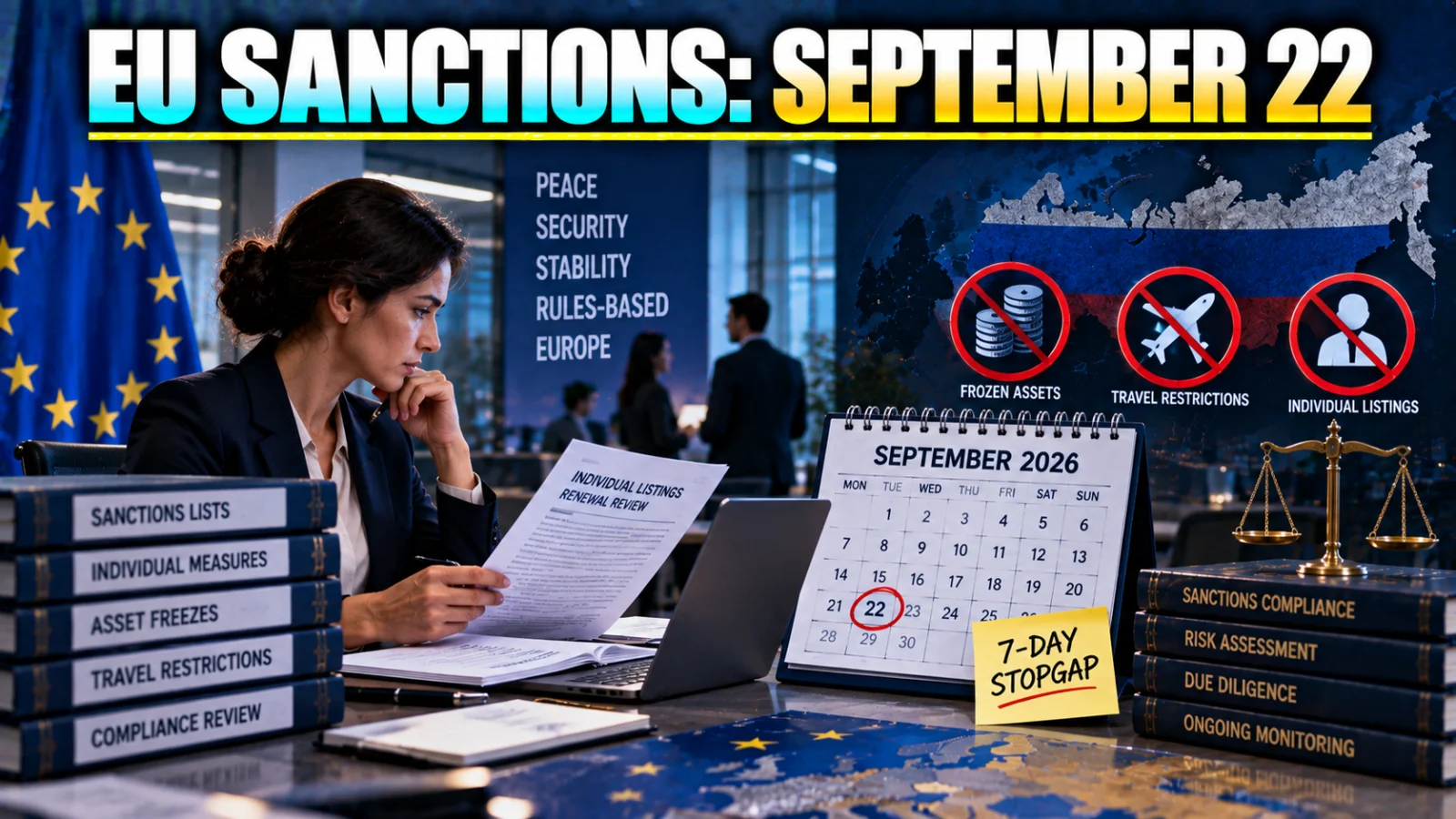
The current EU Russia sanctions September 22 deadline applies to the European Union’s individual Russia sanctions listings, not to the entire EU sanctions framework against Russia. An EU presidency spokesperson says member-state ambassadors agreed to keep the individual-listings regime in place for seven more days, until midnight on September 22, after they failed to agree on the normal six-month renewal.
The legal distinction matters. The underlying individual-listings regime is confirmed in EU law, and its previous expiry date was September 15, 2026. However, ThePulseSignal has not yet recovered the fresh Official Journal or EUR-Lex instrument implementing the seven-day extension itself, so the September 22 stopgap should be described as a strongly attributed current EU-presidency/Coreper state rather than as a newly recovered legal act.
Direct answer: the individual sanctions listings are reported to continue through September 22 while EU governments negotiate the next renewal. This does not mean all EU sanctions on Russia expire on September 22. The separate economic sanctions regime has a different legal basis and a later expiry timeline.
Which EU Russia sanctions were extended for seven days?
The short extension concerns the EU’s individual restrictive measures linked to actions undermining or threatening Ukraine’s territorial integrity.
The framework is built around Council Decision 2014/145/CFSP and Council Regulation (EU) No 269/2014. The measures apply to listed persons and entities rather than to the entire EU-Russia trade relationship.
The most recent primary legal instrument recovered before this stopgap is Council Decision (CFSP) 2026/696, which kept the individual-listings regime in force until September 15, 2026.
What restrictions remain under the individual-listings regime?
The regime includes targeted restrictions such as asset freezes and restrictions on making funds or economic resources available to listed persons and entities. Listed natural persons can also be subject to travel restrictions.
For sanctions-screening and compliance purposes, the key point is that the reported seven-day extension is intended to keep this individual-listings framework operating while member states continue negotiating the next renewal.
Do all EU sanctions on Russia expire on September 22?
No. The September 22 dispute should not be confused with the EU’s separate economic and sectoral sanctions against Russia.
The Council separately renewed those broader economic sanctions until July 31, 2027. They therefore do not share this September 22 deadline.
This distinction is one of the most important parts of the current sanctions story because a headline saying only that ‘EU Russia sanctions’ were extended for seven days can wrongly imply that the entire sanctions architecture is approaching expiry.
Why was the extension only seven days?
Current reporting says EU ambassadors did not reach agreement on the normal six-month renewal of the individual listings.
The seven-day stopgap gives member states more time to negotiate without allowing the existing individual measures to reach their previous September 15 expiry while talks are continuing.
Reuters reports that the dispute includes demands concerning the listing of Russian businessman Alisher Usmanov. That remains negotiation reporting rather than evidence that any specific person has already been removed from the sanctions list.
Has Alisher Usmanov already been removed from EU sanctions?
No reviewed evidence establishes that he has been delisted.
The current reporting describes his status as part of the unresolved renewal negotiations. A political demand for removal is not the same thing as an adopted legal delisting.
TPS will treat an Official Journal amendment, Council act or other controlling EU legal publication as the evidence needed to establish an actual change in listing status.
What happens on September 22?
September 22 is now the next material decision point for the individual-listings regime.
EU governments could agree the normal renewal, alter parts of the list, agree another temporary extension or take another legally effective step. The reviewed evidence does not establish that the regime will automatically lapse on September 22.
That means readers should treat September 22 as a renewal deadline, not as a guaranteed sanctions end-date.
What should compliance teams do before September 22?
Businesses and financial institutions should continue relying on the current applicable EU sanctions lists, EUR-Lex and guidance from the relevant competent authority rather than assuming the previous September 15 expiry removed existing restrictions.
Screening decisions should also distinguish the individual-listings regime from other EU sanctions measures that operate under different legal bases and renewal dates.
If the EU publishes the fresh seven-day implementing act or a subsequent six-month renewal, the controlling legal text should take precedence over earlier media summaries.
Is the seven-day extension already in the Official Journal?
TPS did not recover the fresh Official Journal or EUR-Lex instrument implementing the seven-day September 22 extension during the completed research.
The current extension state is instead supported by Reuters reporting that directly attributes the decision to a spokesperson for the Irish EU presidency.
The absence of the recovered instrument does not make the current state unusable, but it changes how the article must describe the evidence: the underlying sanctions regime is legally confirmed, while the seven-day extension remains a reported and strongly attributed current state until the instrument is recovered.
What changed and what did not?
Changed: the previous September 15 expiry for the individual-listings regime has reportedly been replaced by a seven-day stopgap through September 22.
Did not change: the separate EU economic sanctions regime does not move to a September 22 expiry. Its current Council renewal runs to July 31, 2027.
Still unresolved: the exact fresh legal instrument, the final six-month renewal, any adopted delistings or list amendments, and what legal state will follow the September 22 deadline.
What evidence should readers watch next?
The strongest next evidence would be publication of the seven-day Council act in the Official Journal or EUR-Lex, followed by the formal September 22 renewal decision.
A Council statement confirming a six-month extension, another temporary prolongation, or an amendment to the list would materially change the answer on this page and should update this same URL.
Verification note
ThePulseSignal reviewed the EU legal framework for the individual Russia sanctions listings, Council Decision (CFSP) 2026/696 establishing the previous September 15 expiry, the Council’s separate economic-sanctions renewal timeline, and current Reuters reporting quoting the EU presidency on the seven-day extension to September 22.
Limitations and unresolved facts
- The fresh Official Journal or EUR-Lex instrument implementing the seven-day extension was not recovered during the completed research.
- The exact final composition of the individual sanctions list after September 22 is unknown.
- No reviewed evidence establishes that Alisher Usmanov has already been delisted.
- The September 22 outcome could be a normal renewal, amended list, another temporary extension or another legally effective state.
- Different EU Russia sanctions regimes have different legal bases and expiry dates, so this deadline must not be generalized to all EU sanctions against Russia.
Bottom line: the EU’s individual Russia sanctions listings are reported to remain in force through September 22 under a seven-day stopgap while governments negotiate the next renewal. The deadline does not apply to all EU sanctions on Russia, and TPS has not yet recovered the fresh legal instrument implementing the one-week extension.