






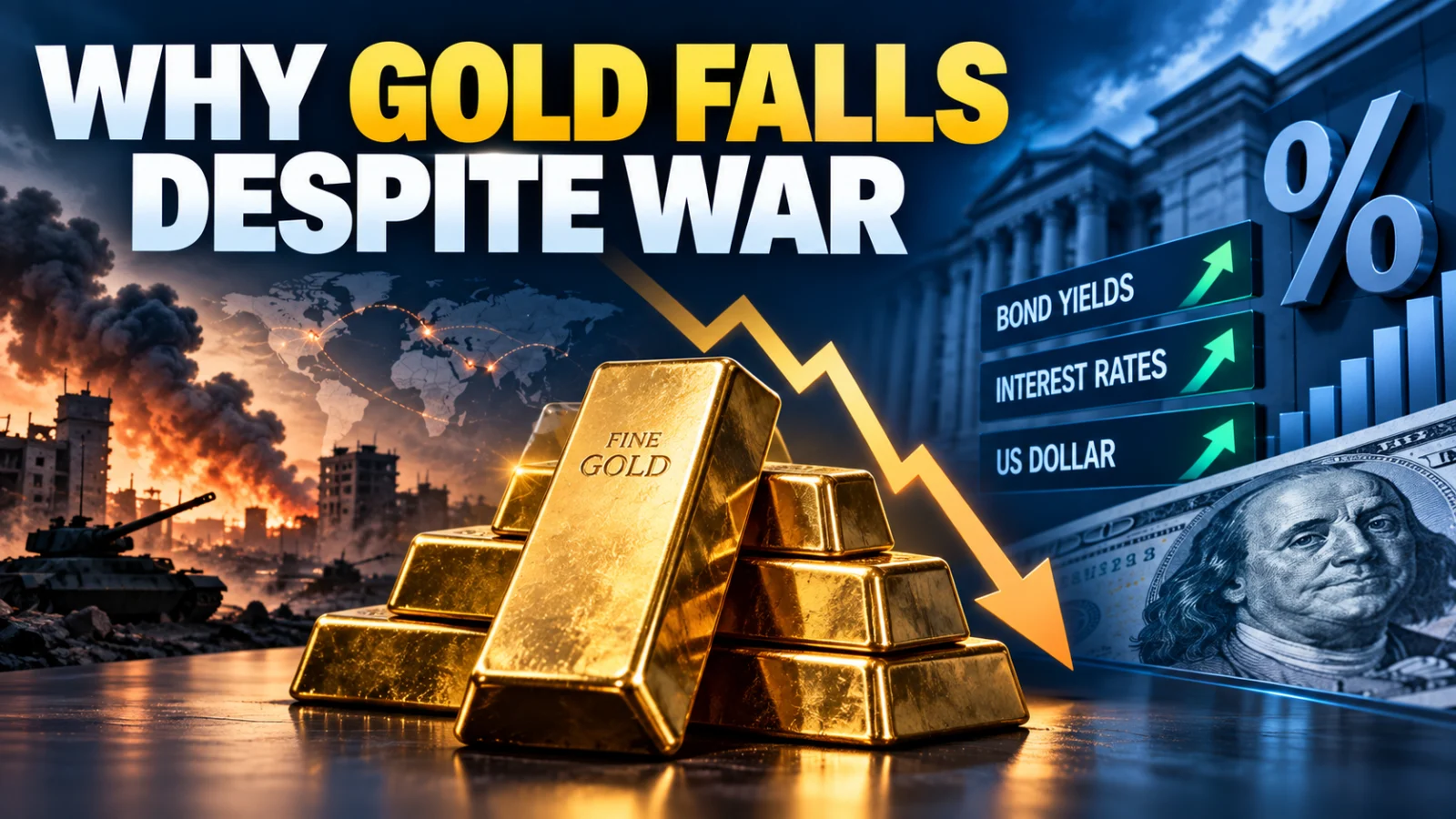
Why gold price falling despite war is a reasonable question because gold is widely described as a safe-haven asset. But war is only one force acting on the gold market. Gold can fall when the pressure from higher real interest rates, rising bond yields, a stronger US dollar, investor selling or profit-taking is stronger than the new safe-haven demand created by geopolitical fear.
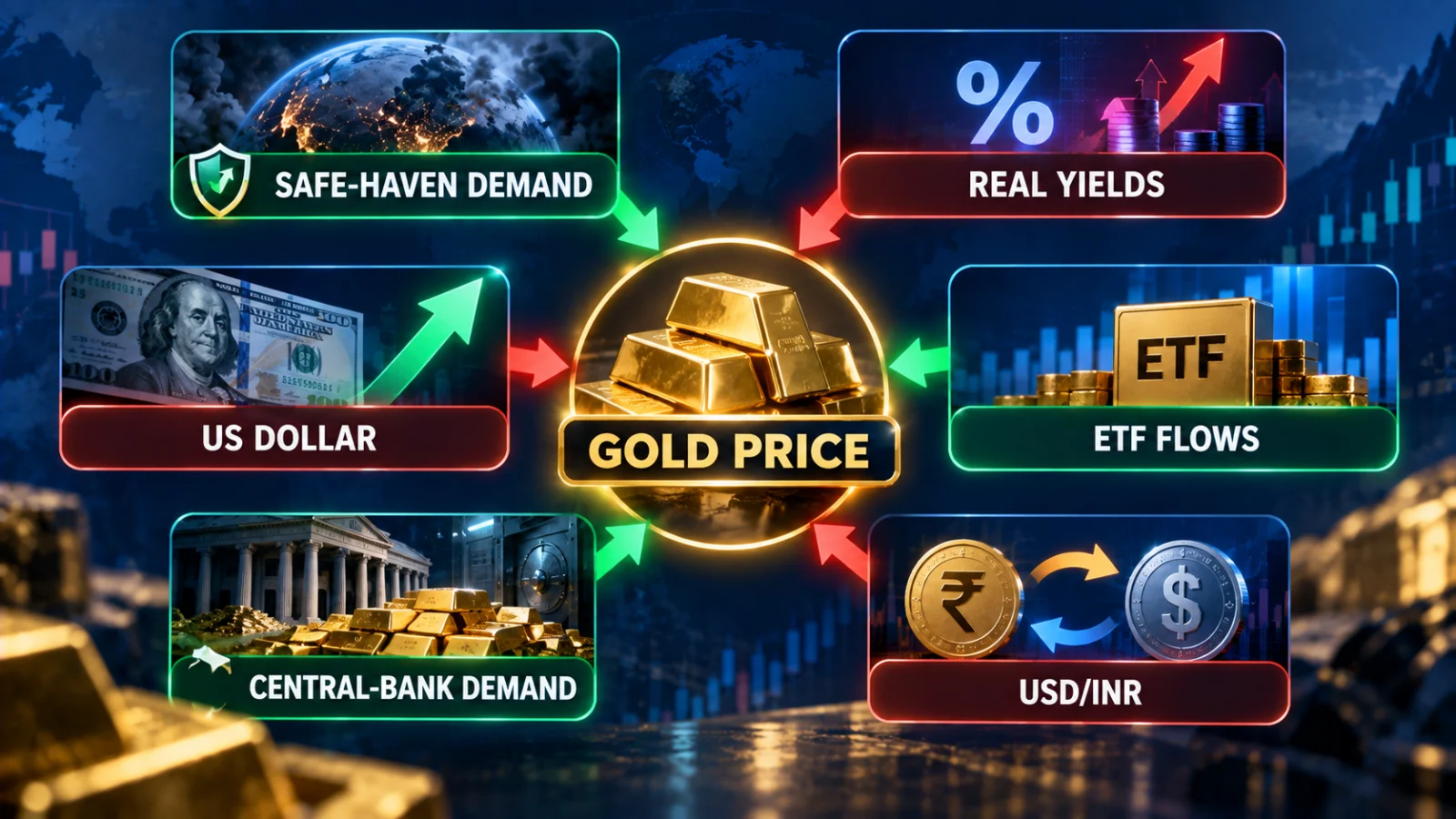
The important point is that gold does not follow a rule such as war equals higher gold or higher interest rates equal lower gold. Its price reflects several forces operating at the same time. World Gold Council research groups the major drivers broadly into economic expansion, risk and uncertainty, opportunity cost and momentum. Central-bank purchases, ETF flows, physical demand and currency movements can add further pressure in either direction.
War, financial stress and recession fears can increase demand for gold as a defensive asset.
Higher real yields and attractive interest-bearing assets can make non-yielding gold relatively less attractive.
A stronger dollar often creates a headwind for dollar-priced gold, although the relationship is not permanent.
ETF inflows, ETF outflows, profit-taking and positioning can amplify short-term moves.
Why gold price falling despite war: the short answer
A geopolitical shock can create two opposing forces at once. Fear and uncertainty may encourage investors to buy gold. At the same time, the same conflict can disrupt energy or supply chains, increase inflation concerns and cause markets to expect tighter monetary policy or higher-for-longer interest rates. If real yields rise and the dollar strengthens, the opportunity cost of holding gold can increase.
The result depends on which force dominates. Safe-haven demand can win, pushing gold higher. Monetary-policy and currency pressures can win, pushing gold lower. Sometimes they largely cancel each other out.
This is why it is misleading to explain a gold move from a single headline such as a war, an inflation number or one central-bank decision.
1. War does not automatically make gold rise
Gold often benefits from geopolitical uncertainty because investors may seek assets perceived as stores of value or portfolio diversifiers. But the initial reaction to a crisis is not guaranteed to continue.
A market may have already priced in part of the risk before a conflict escalates. Investors may also sell profitable gold positions to raise cash, meet margin calls or reduce portfolio risk. If the conflict then changes expectations for inflation, monetary policy, economic growth or the dollar, those macroeconomic effects can become more important than the original safe-haven impulse.
That distinction matters. Gold is a safe-haven asset, but it is also a globally traded financial asset affected by interest rates, currencies, positioning, central-bank activity and physical demand.
2. Real interest rates matter more than the simple ‘rates up, gold down’ rule
One of the most important concepts is the real interest rate: the return on an interest-bearing asset after accounting for inflation or expected inflation.
A simplified relationship is:
Real yield ≈ nominal bond yield − expected inflation.
Gold itself does not pay a coupon or regular interest. When investors can earn an increasingly attractive inflation-adjusted return from high-quality bonds, the opportunity cost of holding gold can rise. That can pressure investment demand for gold.
But nominal interest rates alone are not enough. A 5% nominal yield when expected inflation is 2% produces a very different real-return environment from a 5% yield when expected inflation is also near 5%.
This is also why saying that a central bank has raised rates does not automatically tell you what gold must do next. Markets care about the size of the move, what was already expected, inflation expectations, future policy, economic growth, financial stability and the dollar.
3. Why rising Treasury yields can pressure gold
US Treasury securities are important competing assets for global investors. When Treasury yields rise, investors may be offered a larger income return from an asset backed by the US government. Gold, in contrast, provides no contractual coupon.
That can encourage some portfolios to move toward bonds and away from gold, particularly when real yields are rising and investors are confident that inflation will be controlled.
However, Treasury yields and gold can occasionally rise together. For example, yields may rise because markets are worried about inflation, fiscal risk or bond supply rather than because economic conditions have become reassuring. At the same time, investors may still want gold as a hedge against uncertainty. The reason behind the yield move therefore matters as much as the yield itself.
4. Why a stronger US dollar can hurt gold
International gold is commonly quoted in US dollars. When the dollar strengthens against other currencies, the same dollar price of gold becomes more expensive for many non-US buyers. That can restrain demand at the margin.
A stronger dollar can also reflect the same forces that are pressuring gold: higher relative US yields, tighter expected Federal Reserve policy, strong US growth or global demand for dollar liquidity.
This helps explain why gold and the dollar often move in opposite directions. But the inverse relationship is not a law. World Gold Council research has documented periods when gold, the dollar and real yields moved in the same direction. A crisis severe enough to create demand for both dollar liquidity and gold can produce precisely that result.
5. Inflation can support gold and still contribute to a short-term gold fall
This is one of the most confusing parts of the relationship.
Persistent inflation can support demand for gold as investors look for ways to preserve purchasing power. But an inflation shock can also cause investors to expect tighter monetary policy. If those expectations push real yields and the dollar higher, gold can face an immediate headwind.
So the chain is not simply:
inflation rises → gold rises.
A more realistic sequence can be:
inflation rises → markets reassess central-bank policy → bond yields, real yields and currencies move → gold reacts to the combined result.
If inflation persists while real rates fall, the dollar weakens or recession risks increase, the environment may become much more supportive for gold. If policy credibility improves and real yields rise materially, inflation itself may not be enough to push gold higher.
6. Why a prolonged conflict can create a paradox for gold
A prolonged conflict can disrupt energy, shipping, commodities or industrial supply chains. The first-order reaction may be greater geopolitical fear, which can support gold.
But the second-order effects can point the other way. Higher transport, energy or input costs can increase inflation risk. That can change expectations for central-bank policy and bond yields. A more hawkish rate outlook can then increase gold’s opportunity cost.
The sequence is therefore conditional rather than automatic. A war does not directly command bond yields to rise or central banks to increase policy rates. Policymakers also consider labour markets, growth, financial conditions, inflation expectations and whether the shock is temporary or persistent.
7. ETF flows, profit-taking and positioning can overpower the headline
Gold-backed exchange-traded funds allow institutional and individual investors to change gold exposure quickly. Large ETF inflows can add demand; large outflows can add selling pressure.
World Gold Council data during 2026 showed how significant these flows can become. It also documented episodes of de-risking, rebalancing and profit-taking even while geopolitical risks remained elevated.
This is important after a large previous rally. An investor who still believes in gold’s long-term case may nevertheless reduce a position because it has grown above a target portfolio weight or because the investor wants to lock in gains. That selling can occur at the same time another investor is buying gold for safe-haven protection.
Central-bank buying is another reason simple gold models can fail
Central banks have become an important structural source of gold demand. Their motives can differ from those of short-term investors: reserve diversification, liquidity, geopolitical considerations and long-term portfolio strategy can matter more than whether a bond yield moved by a few basis points this week.
World Gold Council data for the second quarter of 2026 showed a renewed increase in reported central-bank net buying after a weaker first quarter. Its annual central-bank survey also found strong expectations among reserve managers for continued growth in official gold holdings.
That structural demand is one reason a simple two-variable model based only on the dollar and real yields can fail. Higher real yields may create a headwind while central-bank purchases or other investment demand create support.
Why gold can rise even when interest rates are high
If high interest rates automatically caused gold to fall, gold analysis would be easy. In reality, several other forces can offset the rate effect.
- Central banks may continue accumulating gold.
- Geopolitical or financial-system risk may increase.
- Investors may expect future rate cuts even while current rates remain high.
- The US dollar may weaken.
- Inflation expectations may rise faster than nominal yields, reducing real yields.
- ETF or physical investment demand may strengthen.
- Fiscal or sovereign-risk concerns may make investors want an asset outside another party’s liability structure.
The relationship between gold and real rates is therefore useful, but it should be treated as one major driver rather than an infallible forecasting formula.
Can gold and the US dollar rise together?
Yes. Although gold and the dollar have often been negatively correlated, both can benefit from defensive demand during periods of severe uncertainty.
Correlation describes how assets have moved together over a particular period; it does not create a permanent economic rule. The relationship can weaken or reverse when the underlying reasons for buying the assets change.
The same warning applies to gold and bond yields. Instead of asking only whether yields rose, ask why they rose.
Why international gold can fall while gold in India does not
Indian investors have an additional variable to watch: the rupee.
A simplified starting point for translating international gold into rupees is:
Indian currency value of gold ∝ international USD gold price × USD/INR exchange rate.
Suppose international gold falls from US$4,000 per ounce to US$3,900, a decline of 2.5%. If the rupee simultaneously weakens from ₹90 per US dollar to ₹94, the currency conversion changes from:
US$4,000 × ₹90 = ₹360,000
to:
US$3,900 × ₹94 = ₹366,600.
That simplified illustration shows why a weaker rupee can offset a fall in the international dollar gold price. It is not a retail-price calculation.
Actual Indian gold prices can also reflect import duties and other applicable taxes, domestic premiums or discounts, logistics, futures-market pricing, local supply and demand, dealer spreads and, for jewellery, making charges.
Why MCX or Indian retail gold prices can differ from international spot gold
An international headline may quote spot gold in US dollars per troy ounce. An Indian investor may be looking at an MCX futures contract, a bullion dealer’s rupee quote or a jewellery-store price per gram. Those are not identical instruments or price surfaces.
Currency conversion is one reason for the difference. Futures basis, contract timing, taxes, duties, local premiums or discounts and retail charges can create further differences.
That means a statement such as “global gold fell 2% today” does not guarantee that the rupee-denominated price visible to an Indian buyer will also be exactly 2% lower.
Gold, bonds and the dollar: how to read the signals together
| Market force | Often supportive for gold | Often a headwind for gold |
|---|---|---|
| Geopolitical risk | Escalating uncertainty and defensive demand | De-escalation and declining risk premium |
| Real yields | Falling real yields | Rising real yields |
| US dollar | Dollar weakness | Dollar strength |
| Monetary-policy expectations | Easier future policy | Tighter or higher-for-longer expectations |
| ETF flows | Net inflows | Net outflows |
| Central-bank demand | Strong accumulation | Slower buying or net selling |
| Investor positioning | Fresh allocations or dip buying | Profit-taking, rebalancing or liquidation |
| Indian rupee | Rupee weakness can lift INR gold | Rupee strength can soften INR gold |
The words often and can are deliberate. None of these relationships should be treated as a guaranteed trading signal.
Four ways gold can behave during a war
| Dominant market interpretation | Possible accompanying conditions | Potential effect on gold |
|---|---|---|
| Safe-haven fear dominates | Risk aversion rises and investors seek protection | Supportive |
| Inflation and tighter-policy expectations dominate | Real yields and the dollar rise | Potentially negative |
| Recession or financial stress dominates | Growth expectations weaken and future easing becomes more likely | Potentially supportive |
| Liquidity stress dominates initially | Investors sell assets to raise cash or reduce leverage | Gold can fall first even during severe fear |
This framework is more useful than assuming that every conflict must generate the same price reaction.
What actually moves gold prices?
A useful way to think about gold is as the result of several competing channels:
Gold price pressure = risk demand + inflation/hedging demand + central-bank and investment demand − opportunity-cost pressure ± dollar effects ± positioning and momentum ± physical-market forces.
This is a conceptual framework, not a mathematical pricing formula. Its purpose is to prevent a common analytical mistake: assigning the entire move in gold to whichever headline happened most recently.
World Gold Council’s 2026 mid-year research similarly describes gold through interacting forces rather than one variable. It identified risk and uncertainty, opportunity cost, economic expansion and momentum as major drivers, while noting additional effects from central-bank demand and regional markets.
Why ‘bonds pay interest and gold does not’ is only half the explanation
The statement is directionally useful but incomplete.
Yes, an investor choosing between a yielding bond and non-yielding gold may find bonds more attractive when inflation-adjusted yields rise. But gold performs other portfolio roles. It has no issuer promising repayment, is held as a reserve asset, trades globally and can be sought during financial or geopolitical stress.
An investor’s decision therefore depends not only on the bond coupon but also on inflation, currency risk, credit or sovereign concerns, portfolio diversification needs and expectations about future policy.
Why gold may fall during a stock-market crash before recovering
Another apparent contradiction occurs during acute market stress. Investors may sell gold even though the crisis appears favourable for safe-haven assets.
One explanation is liquidity demand. Funds or traders facing losses elsewhere may need cash to meet redemptions, margin requirements or risk limits. Assets that are liquid and profitable can be sold precisely because they are easy to sell.
Once that forced-liquidity phase changes, the underlying reasons for owning gold may reassert themselves. This is another example of why the direction of the first market move should not be turned into a permanent rule.
Does inflation always increase gold prices?
No. Inflation can be supportive for gold, especially when it is persistent and undermines confidence in purchasing power. But the policy response matters.
If higher inflation causes markets to expect materially higher real rates and a stronger dollar, gold can face pressure. If inflation rises while real rates remain low or fall, or if investors doubt the ability of policy to control inflation without damaging growth, gold may respond differently.
The better question is therefore not simply “Is inflation rising?” but “What is inflation doing to real yields, policy expectations, the dollar and investor demand?”
Does a Federal Reserve rate hike mean gold must fall?
No. Financial markets continuously price expectations before official decisions. If investors have already expected a rate hike, much of the effect may already be reflected in bonds, currencies and gold.
A hike can even be followed by higher gold if the accompanying message is less hawkish than expected, if real yields fall, if the dollar weakens or if another source of risk dominates.
For the same reason, a rate cut does not guarantee an immediate gold rally. Context and expectations matter.
What to check when gold falls despite bad geopolitical news
Did inflation-adjusted US Treasury yields rise or fall?
Did the dollar strengthen against major currencies?
Did markets move toward tighter policy or delay expected rate cuts?
Are gold-backed funds seeing large inflows, outflows or liquidation?
Is the move partly profit-taking or portfolio rebalancing after a previous rally?
Is official-sector buying providing a structural counterweight?
Is the conflict genuinely new information, or had markets already priced much of it?
Is rupee weakness offsetting the international decline?
Which signal should investors watch first?
There is no single signal that works in every market regime. For short-term macro interpretation, real yields and the US dollar are useful starting points because they directly affect gold’s opportunity cost and international pricing environment.
But stopping there can produce the wrong conclusion. ETF flows, central-bank demand, investor positioning, recession risk, geopolitical uncertainty and physical demand can become dominant at different times.
For Indian readers, USD/INR deserves a separate check because a weakening rupee can materially change the domestic outcome even when the international gold price is falling.
The 2026 episode is a useful example, not a permanent formula
Gold’s behaviour during 2026 illustrates why these competing forces matter. World Gold Council’s mid-year analysis documented a sharp gold pullback despite elevated geopolitical risk and highlighted changing investor sentiment, the dollar, interest-rate expectations, profit-taking and other forces affecting performance.
Its July commentary also stressed that high inflation on its own does not guarantee a major gold rally. The effect depends on real rates, the dollar, growth expectations, Asian demand, central-bank activity and other market responses.
That makes 2026 a useful case study for the evergreen principle: geopolitical risk can support gold without being powerful enough to determine its price by itself.
Frequently asked questions
Does gold always go up during war?
No. War can increase safe-haven demand, but gold can still fall if rising real yields, a stronger dollar, liquidity selling, ETF outflows or profit-taking exert greater pressure.
Why does gold fall when interest rates rise?
Higher real interest rates can increase the opportunity cost of holding a non-yielding asset such as gold. The effect is not automatic because other sources of demand can offset it.
Why do bond yields affect gold?
Higher inflation-adjusted bond yields can make interest-bearing assets relatively more attractive. Investors also interpret Treasury yields as signals about monetary policy, inflation, growth and risk.
Why does a strong dollar affect gold?
Gold is internationally quoted in US dollars. Dollar strength can increase its cost in other currencies and frequently appears alongside higher US yields or tighter policy expectations.
Can gold and the dollar rise at the same time?
Yes. Their correlation changes over time. Severe uncertainty can create demand for both dollar liquidity and gold, while other market forces may also override the usual inverse relationship.
Can gold rise when interest rates are high?
Yes. Central-bank buying, geopolitical risk, declining expected future rates, a weaker dollar, strong ETF demand or other factors can outweigh the opportunity-cost headwind.
Why can gold fall when inflation is rising?
If higher inflation causes markets to expect tighter monetary policy, rising real yields or a stronger dollar, those effects can temporarily outweigh gold’s inflation-hedge demand.
Why can international gold fall while Indian gold stays high?
A weaker rupee can offset part or all of a fall in dollar gold. Domestic duties, taxes, premiums, discounts and local market conditions can create additional differences.
Is gold a guaranteed safe haven?
No asset has a guaranteed short-term price reaction. Gold has historically been used as a defensive and diversifying asset, but it can fall during periods of stress, especially when investors need liquidity or when other macro forces dominate.
What is more important for gold: war or interest rates?
Neither is always more important. The answer changes with the market regime. The useful task is to evaluate geopolitical risk together with real yields, the dollar, investor flows, central-bank demand and growth expectations.
Verification note
ThePulseSignal reviewed World Gold Council research on 2026 gold-market performance, its framework for gold-price drivers, real-rate and dollar relationships, central-bank demand, ETF flows and Indian market conditions. The evidence supports a multi-driver explanation rather than a deterministic rule linking war, interest rates or inflation to gold.
Limitations and unresolved facts
No single model can identify one universal cause for every daily gold-price move. Correlations between gold, real yields and the US dollar change over time, and market positioning or flows may not be fully observable in real time. The numerical USD/INR example in this article is an explanatory illustration rather than a reconstruction of a specific retail gold quote. This article explains mechanisms and should not be read as a forecast of future gold prices.