






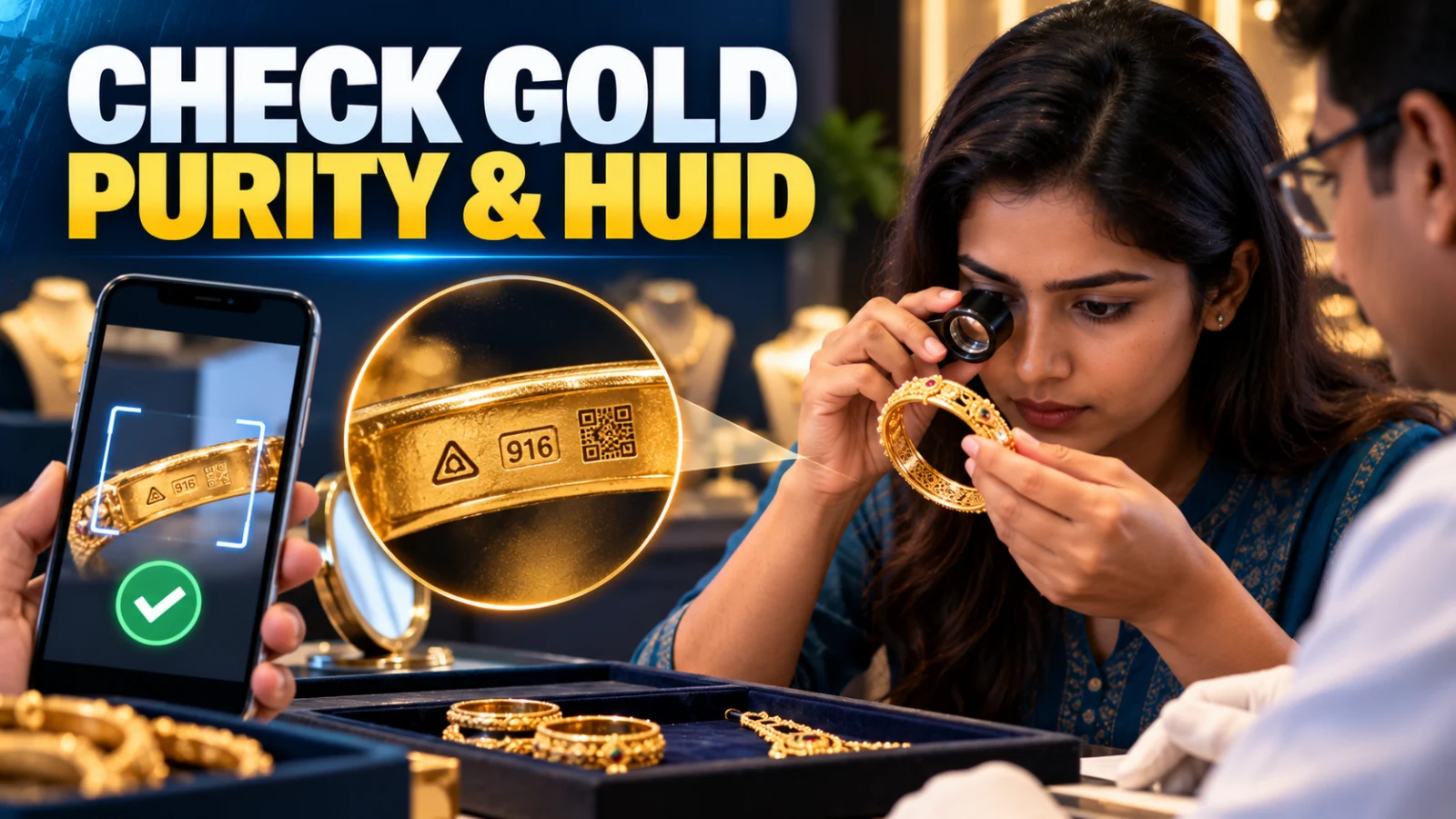
How to check gold purity and HUID in India starts with separating three different questions: what purity the jewellery is marked as, whether the HUID corresponds to a BIS hallmark record, and whether the metal itself actually meets that declared purity. Those are related checks, but they are not identical.
For current HUID-based hallmarked gold jewellery, BIS says the hallmark contains the BIS Standard Mark, the purity in carat and fineness, and a six-character HUID. A buyer can use the BIS Care app to verify the HUID and compare the returned details with the item being offered. If there is still doubt about the actual metal purity, BIS also provides a separate route for independent testing through a recognised Assaying & Hallmarking Centre.
Gold verification decision path
1. Read the marks on the jewellery
Look for the BIS mark, the purity or fineness mark such as 22K916 or 18K750, and the six-character HUID.
2. Verify the HUID
Enter the HUID in BIS Care and compare the returned purity and item-related details with the jewellery and the seller’s information.
3. Check the invoice
Make sure the bill records the hallmarked article and its relevant weight and purity information rather than relying only on a verbal assurance.
4. Stop if the evidence does not reconcile
If the HUID cannot be found, the returned details do not match, or you still doubt the actual fineness, ask the seller to resolve the discrepancy before relying on the item as verified.
5. Use independent testing when purity itself is disputed
A BIS-recognised Assaying & Hallmarking Centre can test jewellery and provide an assay report. That is a different evidence layer from an app lookup.

What should be present on a current BIS hallmark?
BIS describes the current HUID-based hallmark using three key components: the BIS Standard Mark, the purity of the article expressed in carat and fineness, and the HUID. The HUID is a unique six-character alphanumeric identifier associated with the hallmarked article.
That means a buyer should not treat a lone “916” stamp or a shop tag as the whole verification process. The useful check is whether the complete hallmark information is present and whether its HUID can be reconciled with the BIS record for the item.
What do 22K916 and 18K750 mean?
The carat and fineness markings describe the declared purity of the gold. BIS uses combinations such as 22K916 and 18K750.
- 22K916 identifies 22-carat gold with a fineness marking of 916.
- 18K750 identifies 18-carat gold with a fineness marking of 750.
- Other BIS-recognised grades should be interpreted from the exact carat and fineness marking shown on the article and current BIS guidance.
The important point is that these markings state the certified or declared purity grade. They are not a substitute for an independent physical assay if there is a genuine dispute about the metal in the particular item.
What does HUID mean?
HUID stands for Hallmark Unique Identification. BIS describes it as a unique six-character alphanumeric identifier for the hallmarked article.
Its practical value to a buyer is traceability. Rather than accepting only a generic hallmark impression, the consumer has an item-specific code that can be checked against BIS information.
How to verify HUID in BIS Care
Use the BIS Care application and open the Verify HUID function. Enter the six-character code exactly as it appears on the jewellery. Then compare the returned information with the article being offered and the transaction in front of you.
The useful question is not merely, “Did the app return something?” The stronger check is, “Does the result correspond to this jewellery’s declared purity and other relevant item details?”
What does a valid HUID verification prove?
A successful HUID lookup provides BIS-linked hallmark information associated with that identifier. It is therefore useful evidence for checking the hallmark identity and declared details of the jewellery.
But TPS does not treat that database check as the same thing as independently assaying the metal in your hand. BIS separately provides consumer testing through recognised Assaying & Hallmarking Centres and a remedy when hallmarked jewellery is found below its marked purity. That separate process matters when the dispute is about the article’s actual physical fineness rather than whether a HUID record exists.
What if HUID says record not found?
First recheck the code carefully because the characters are small and a transcription mistake can produce a failed lookup. If the result still cannot be resolved, do not jump directly to a fraud conclusion, but also do not treat the article as fully verified simply because the seller says it is hallmarked.
Ask the seller to explain the discrepancy and provide the correct item and invoice evidence. If the purchase is consequential and the uncertainty remains, use the recognised BIS testing route rather than relying on guesswork.
What if the HUID details do not match the jewellery?
A mismatch in article details, purity information or seller-related information deserves resolution before the buyer relies on the hallmark evidence.
A mismatch does not by itself prove fraud. There can be factual or record-specific explanations that need to be checked. The safe buyer action is to pause, compare the code again, ask the seller to reconcile the result with the actual article and invoice, and obtain independent testing when the remaining question is physical purity.
Check the invoice, not only the jewellery
BIS consumer guidance says the invoice for a hallmarked precious-metal article should contain the description of the article, the net weight of the precious metal, purity in carat and fineness, and hallmarking charges.
The invoice matters because it creates transaction evidence connecting the seller’s written description and purity claim to the item for which you paid.
Before you pay: accept, question or test?
Accept the verification evidence
The hallmark components are present, the purity mark matches what is being sold, the HUID resolves consistently, and the invoice reflects the transaction.
Question the seller
The HUID does not resolve, the returned information conflicts with the item, the purity marking differs from the sales claim, or the invoice does not document the purchase clearly.
Seek independent assay evidence
The hallmark identity appears valid but you still have a substantive reason to doubt the metal’s actual purity, or a post-purchase dispute requires physical evidence.
How can a consumer independently test gold purity?
BIS says consumers can get jewellery tested at a BIS-recognised Assaying & Hallmarking Centre on a chargeable basis and obtain an assay report.
This is the appropriate evidence layer when the real question is no longer “Is there a HUID record?” but “Does this physical article actually meet the purity marked on it?”
Home tests such as magnet checks, colour observations or household chemical tricks should not be treated as substitutes for recognised assay evidence when exact fineness or a consumer dispute matters.
What if the jewellery tests below the hallmarked purity?
BIS provides a consumer compensation mechanism where hallmarked jewellery is found to have lower purity than the purity marked on the article. BIS states that the buyer is entitled to compensation based on twice the amount of the purity shortfall calculated for the weight of the article, together with the testing charges.
A compensation claim should therefore be based on recognised testing evidence and the transaction documentation rather than an informal home test or suspicion alone.
Does every gold item sold in India have to carry HUID?
No blanket statement should be made that every gold object sold by every seller everywhere in India is covered identically. BIS mandatory hallmarking has notified geographic scope and recognised exemptions, and those rules can change.
For a specific transaction, check the current BIS hallmarking rules if the seller claims that the article or business falls outside mandatory hallmarking requirements.
Gold purity verification is different from gold-price verification
This page answers whether the evidence attached to a specific jewellery item supports its stated hallmark and purity. It does not explain how the rupee gold rate was calculated, why a jeweller’s price differs from MCX, or why international gold prices move.
Those are separate reader jobs. A jewellery item can be correctly priced but poorly verified, or correctly hallmarked while still carrying retailer charges that need a different price comparison. Keeping those questions separate prevents the buyer from treating price evidence as purity evidence.
Bottom line
Before buying hallmarked gold jewellery, verify the complete evidence chain rather than trusting a single stamp. Read the BIS mark and purity code, verify the HUID in BIS Care, compare the result with the item, and keep an invoice that records the transaction and purity details.
If those records do not reconcile, pause and resolve the discrepancy. If the unresolved question is the actual metal purity, use a BIS-recognised Assaying & Hallmarking Centre. A HUID lookup and a physical assay answer different questions, and a careful buyer should know when each one is needed.