





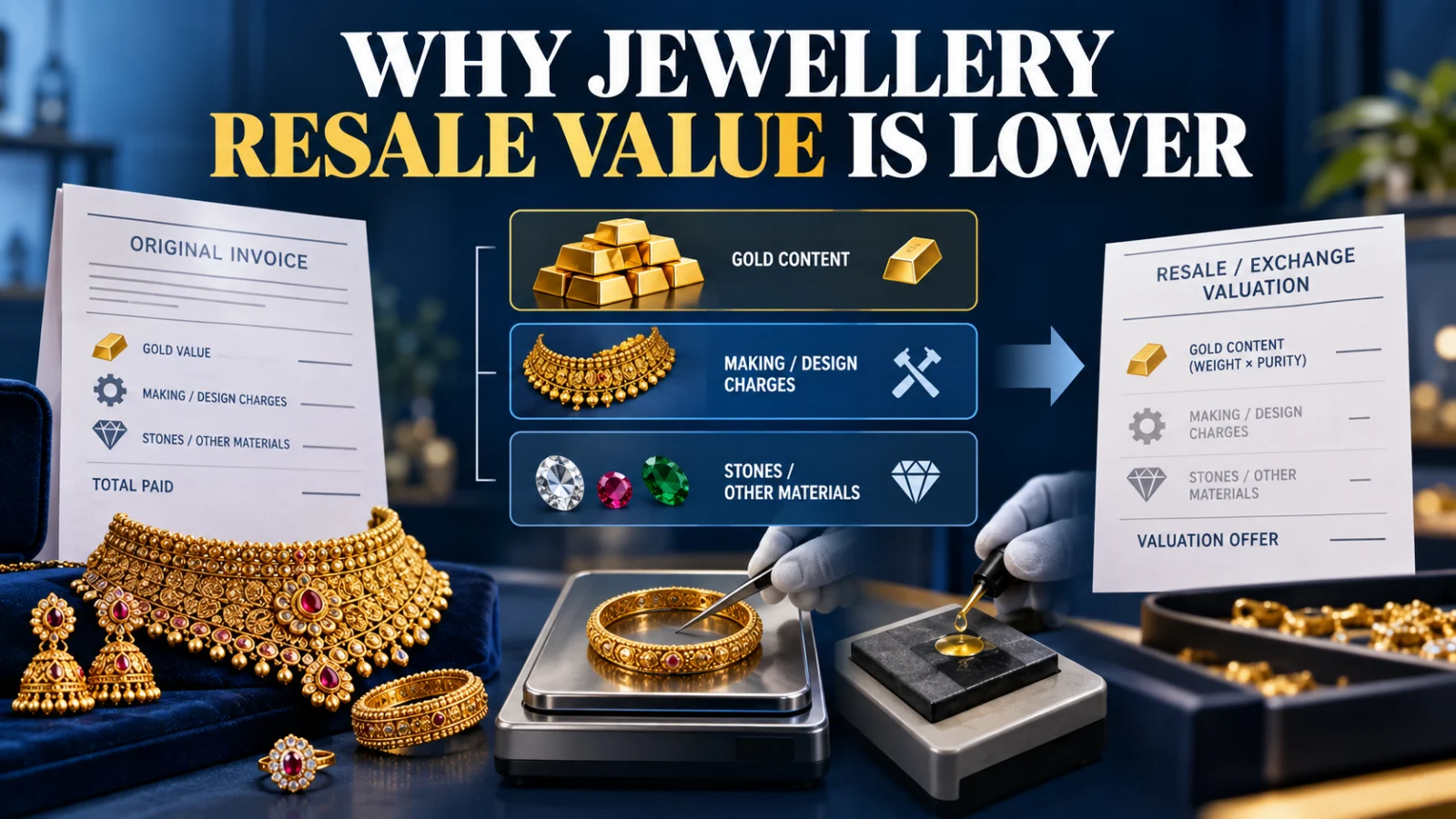
Gold jewellery resale value can be lower than the purchase price because the amount you originally paid was not only the value of recoverable gold. The purchase bill can also include making or design charges, taxes and, depending on the piece, stones or other non-gold components. When you later sell or exchange the jewellery, the buyer usually starts from the recoverable gold content and then applies the current buyback or exchange policy.
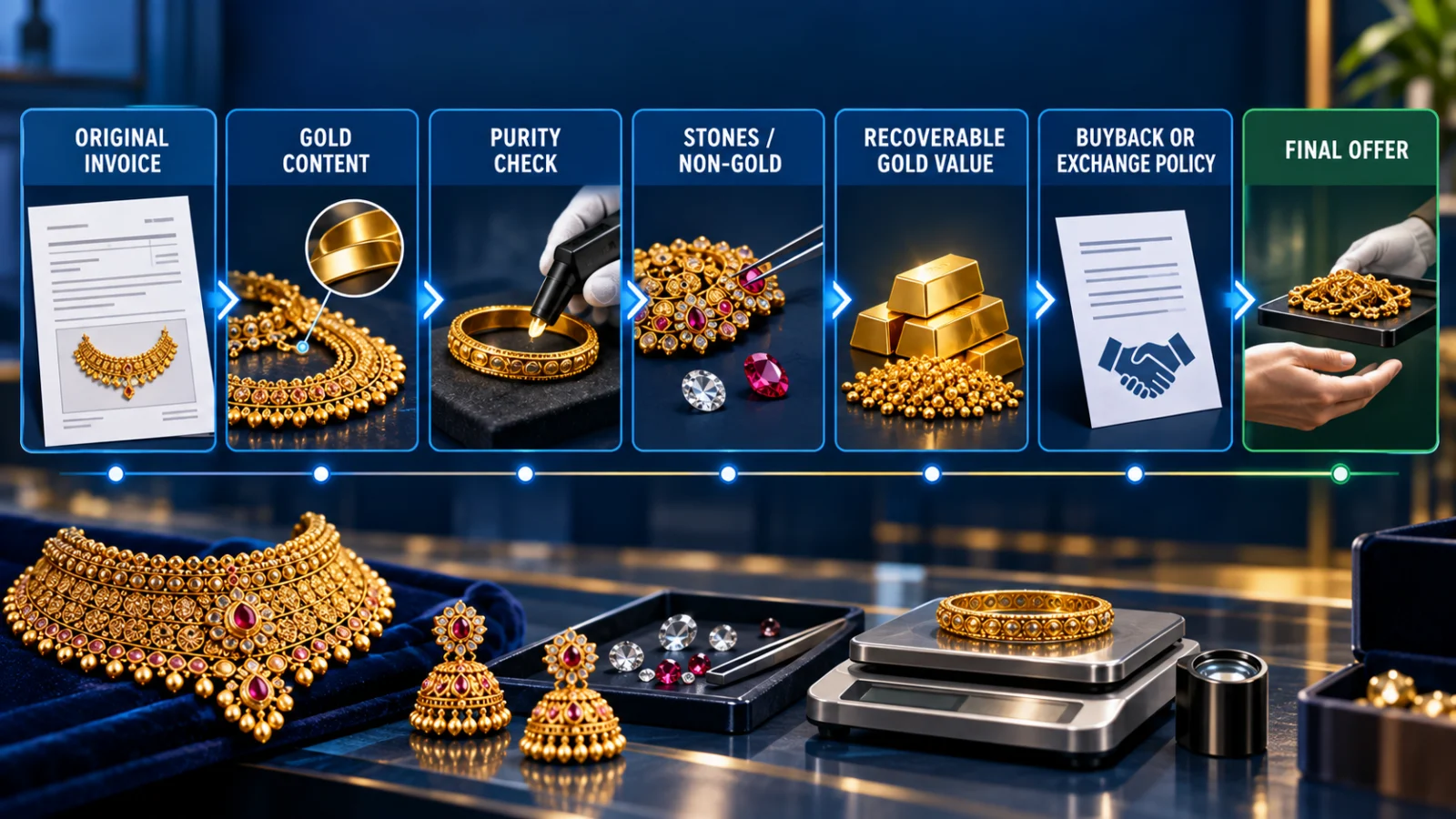
What you paid when buying the jewellery, including the gold component and other bill components.
Separate the actual gold from stones, clasps or other non-gold material where applicable.
Confirm the fineness or karat that determines how much pure gold the item contains.
Establish the gold weight that can actually be valued at the applicable current gold rate.
Apply the jeweller’s current cash-buyback or exchange terms, which may not be identical.
The amount offered after the valuation method and current policy have been applied.
Purchase price, recoverable gold value and buyback offer are three different numbers
The easiest way to understand a disappointing resale quote is to stop treating the original invoice as if it were entirely gold. The invoice tells you what the jewellery cost to purchase. Recoverable gold value estimates what the usable gold content is worth now. The final buyback or exchange offer is a commercial amount determined after the buyer applies its current policy.
Those numbers can be different even when the market gold price has increased sharply.
Why higher gold prices do not guarantee the resale gain you expect
A higher gold price raises the value of the gold content, but it does not automatically make every component of the original invoice appreciate. If part of the purchase price consisted of making charges, taxes, design work or stones, those amounts should not automatically be treated as additional grams of gold that rise with the metal price.
A sufficiently large increase in the gold price can still produce a strong resale value and may even push the recoverable metal value above the original total invoice in some cases. The important point is that the comparison must be made using the recoverable gold content and current policy rather than assuming the complete historic invoice rises one-for-one with gold.
Why making charges are usually not the same as recoverable gold value
Making charges compensate for manufacturing, craftsmanship, design and the work involved in producing and selling the jewellery. They are not additional gold content.
That distinction is visible in current jeweller policies. For example, reviewed Tanishq exchange terms explicitly separate the metal value from making charges and other original-bill components. Other retailers may offer promotional or exchange benefits that reduce deductions, so TPS does not treat one company’s terms as an industry-wide rule.
The related TPS explainer on gold making and wastage charges covers the purchase-side question in more detail. This article stays focused on what happens when the jewellery exits through resale or exchange.
Purity changes how much gold value is actually recoverable
The buyer needs to establish how much pure gold is present in the article. A heavier piece does not automatically mean all of that weight is pure gold, and two items of the same gross weight can have different recoverable gold values if their purity differs.
The Bureau of Indian Standards allows consumers to have hallmarked or unhallmarked jewellery tested at a BIS-recognised Assaying and Hallmarking Centre. The centre can issue an assay report showing the tested purity. This gives consumers an independent verification route when purity itself is in doubt.
What happens to stones and non-gold components?
Stones and non-gold components cannot simply be valued as gold weight. Their treatment depends on the product and the buyer’s policy.
Some exchange programmes accept only plain gold as incoming jewellery. Other policies may remove or separately assess stones, and some branded products may have special exchange rules. This is why the gross weight shown on a jewellery item should not automatically be multiplied by a gold rate to estimate the final offer.
There is no universal jewellery resale deduction percentage
TPS did not find a single verified percentage that all Indian jewellers deduct. Current published policies differ materially.
Tanishq distinguishes between its own products and general old-gold exchange and applies its published valuation rules. CaratLane currently advertises a zero standard deduction under its old-gold exchange programme subject to its eligibility and testing conditions, while that programme is an exchange route rather than a cash payout. Malabar separately publishes exchange benefits and states that cash buyback can involve regional standard deductions. Kalyan has also advertised zero-deduction old-gold exchange offers under specific promotional conditions.
Those differences are exactly why a consumer should not accept a generic claim such as “jewellers deduct 10%” or “you always get 90% of gold value.” The applicable number depends on the buyer, the transaction type, the jewellery and the current policy.
Cash buyback and exchange value are not necessarily the same
A jeweller may offer a better commercial value when old jewellery is exchanged for a new purchase than when the customer asks for cash. Promotions can also temporarily change exchange deductions or benefits.
| Question | Why it matters |
|---|---|
| Is this cash buyback or exchange? | The applicable terms and deductions may differ. |
| Is the jewellery the buyer’s own brand? | Some brands apply different rules to their own products and outside jewellery. |
| Is it plain or studded jewellery? | Stones and non-gold components may be excluded or separately valued. |
| What purity was tested? | Recoverable pure-gold value depends on actual fineness. |
| What gold rate is being used? | The valuation should identify the current rate or metal basis applied. |
What to check before accepting a resale or exchange offer
Confirm the karat or fineness used in the calculation.
Ask which weight is actually being valued as gold after stones or other components are handled.
Confirm the rate and valuation basis applied to the recoverable gold.
Ask whether stones are returned, removed, separately valued or excluded.
Confirm whether the quote is for cash buyback, exchange or another programme.
Ask the buyer to identify each deduction, promotional benefit or policy adjustment affecting the final offer.
What if hallmarked jewellery tests below the declared purity?
BIS provides a specific consumer-protection route for hallmarked jewellery that tests below the declared purity. Its current consumer-protection guidance says the consumer is entitled to compensation based on twice the amount of the purity shortfall plus the testing charges, subject to the BIS framework.
That remedy concerns purity compliance. It should not be confused with a commercial guarantee that a jeweller must pay a fixed resale percentage.
Does hallmarking guarantee a better resale price?
No. Hallmarking provides evidence about purity and gives consumers a standards-based protection route. It does not create a universal commercial buyback rate.
A hallmarked item can still receive different offers from different buyers because their current exchange and cash-buyback policies may differ. Hallmarking can strengthen confidence about what metal is present; it does not standardise every commercial offer.
Why two jewellers can quote different resale values for the same jewellery
Two buyers can start with the same gold item yet reach different final offers if they use different policies for outside jewellery, stones, melting or testing, cash buyback, exchange incentives or other commercial adjustments.
That does not mean purity and metal value are arbitrary. It means the metal-value calculation and the commercial offer are separate layers. A useful resale comparison therefore asks both: what is the recoverable gold worth? and what policy is this buyer applying?
Bottom line
Gold jewellery resale value is not simply today’s gold price applied to the amount on the original bill. Start with the recoverable gold content, verify purity and weight, separate stones or other non-gold components where necessary, then examine the current cash-buyback or exchange policy.
The key distinction is simple: purchase price ≠ recoverable gold value ≠ final buyback or exchange offer. Once those three numbers are separated, a lower-than-expected quote becomes much easier to diagnose.
Verification note
TPS reviewed BIS consumer-protection guidance on purity testing and compensation together with current published exchange or buyback terms from major jewellers including Tanishq, CaratLane, Malabar and Kalyan. The policies were compared to separate universal gold-content logic from retailer-specific commercial terms.
Limitations and unresolved facts
No universal jewellery resale deduction percentage was established. Retailer policies, branch conditions, promotions, product eligibility, treatment of stones and cash-versus-exchange terms can change. A specific resale decision should therefore use the buyer’s current written terms and the tested characteristics of the actual jewellery rather than a generic percentage from another retailer or older article.