






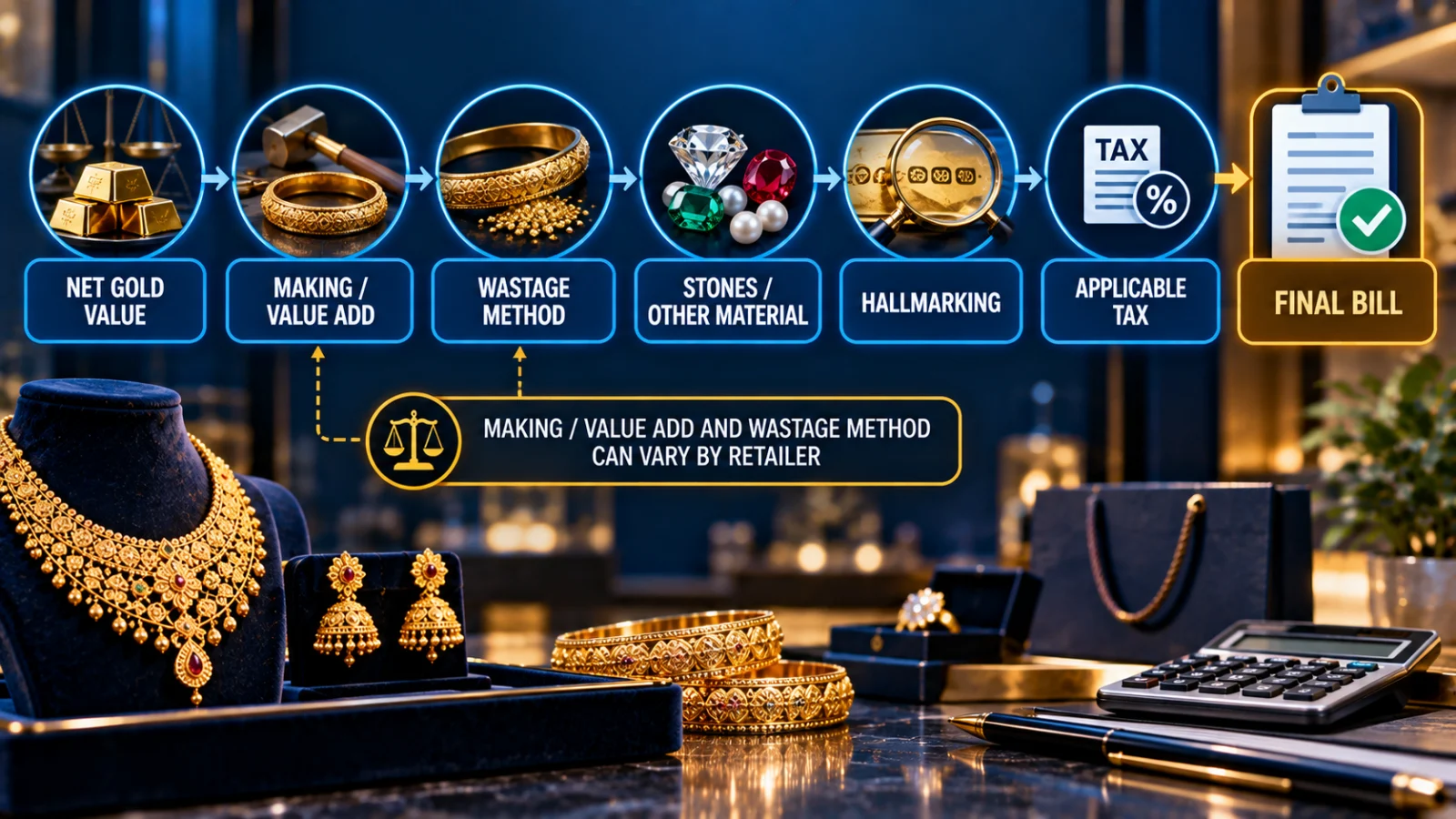
A quoted gold rate is only one part of a jewellery bill. When you buy a chain, ring, bangle or other gold jewellery, the final amount can also reflect the amount of precious metal actually used, the jeweller’s making or value-add methodology, any separately disclosed wastage treatment, stones or other non-gold components, hallmarking charges and applicable tax.
The practical question is therefore not simply, “What is today’s gold rate?” It is: “What exactly is this jeweller charging me for, and am I comparing the same things across two quotes?”
Check purity and the net precious-metal weight rather than assuming the jewellery’s gross weight is all gold.
Ask whether making or value addition is charged per gram, as a percentage, as a fixed amount, or through another disclosed method.
Check wastage/value-add terminology, stones, non-gold material, hallmarking and any other disclosed charge.
Compare like with like after discounts and applicable tax, not just one advertised making-charge number.
Why is the jewellery bill higher than the quoted gold rate?
The displayed gold rate normally tells you the price basis for gold of a particular purity and unit. Jewellery is a finished retail product, so the invoice can contain more than the underlying precious-metal value.
A useful bill-audit framework is:
Gold-content value + retailer making/wastage or value-add methodology + stones or other separately priced components + hallmarking and other disclosed charges + applicable tax = final jewellery bill.
This is a framework for checking a quote, not a universal mathematical formula. Retailers can use different commercial methods, and TPS does not assume that every jeweller calculates making or wastage on the same base.
If your question instead is how the Indian gold rate itself is formed before these retail bill additions, see How Is Gold Price Determined in India?
What are gold making charges?
Making charges are the jeweller’s charge for converting precious metal into a finished jewellery article. The commercial charge may reflect design, labour, craftsmanship, production complexity and the retailer’s pricing model.
There is no single BIS-prescribed making-charge percentage that TPS can apply to every jewellery purchase. The important consumer task is to identify exactly how the jeweller calculates the charge on the article you are considering.
Percentage making charge vs per-gram making charge
| Method | What the buyer must ask | Comparison risk |
|---|---|---|
| Percentage making charge | What value is the percentage applied to? | A lower percentage is not automatically cheaper if the underlying gold value, weight or other charges differ. |
| Per-gram making charge | Which weight is being used and what is the charge per gram? | The quoted ₹/gram number cannot be compared fairly unless the weight basis is also known. |
| Fixed or bundled value-add | What does the amount include and exclude? | It may be difficult to compare against another quote unless the jeweller provides a clear breakup. |
Percentage and per-gram methods can both be legitimate pricing approaches. The trap is comparing only the headline rate without checking the calculation base.
Does a percentage making charge apply to gross weight or gold value?
Do not assume one universal rule. If a jeweller quotes a percentage making charge, ask what the percentage is being applied to: the gold-content value, another stated value, or a retailer-specific value-add base.
Likewise, if the charge is quoted per gram, ask which weight is used. This is especially important for stone-set jewellery because the article’s gross weight may include material that is not gold.
What do jewellers mean by wastage charges?
“Wastage” is commonly used in jewellery pricing to describe a retailer’s allowance or charge associated with material loss or value addition during manufacturing processes such as cutting, shaping, soldering, polishing or finishing.
But consumers should not assume that there is one standard wastage percentage across India. BIS does not prescribe a universal wastage rate in the hallmarking guidance reviewed by TPS. Jeweller, manufacturing process and design can affect how the retailer describes and prices this component.
Some retailers may use terms such as wastage, value addition or another commercial label. Ask what the charge represents, how it is calculated and whether it overlaps with the separately quoted making charge.
Hallmarking charge is not the same as making or wastage
This distinction is authoritative. BIS explicitly states that hallmarking charges do not include making charges or wastage charges.
BIS also says hallmarking charges are applied per article rather than according to the jewellery’s weight. Its current hallmarking FAQ lists ₹45 per gold article. That figure should be treated as the current BIS-listed hallmarking charge and rechecked if BIS updates its schedule.
So a jeweller should not describe the BIS hallmarking charge itself as a percentage of the jewellery’s weight or gold value.
Gross weight is not always the same as gold weight
This matters most when jewellery contains diamonds, gemstones, enamel, lac, beads or other non-gold material.
BIS says the bill or invoice for hallmarked precious-metal articles should state the net weight of precious metal. That means a buyer should not automatically multiply the entire gross article weight by the gold rate when trying to reconstruct the gold-content value.
For stone-set jewellery, ask for a clear breakup showing the precious-metal weight and how stones or other components are priced.
What should appear on the invoice for hallmarked jewellery?
BIS says an authentic bill or invoice is necessary for hallmarked jewellery and for dispute, misuse or complaint redressal. Its consumer and jeweller guidance says the invoice should include:
Enough information to identify what was sold.
The precious-metal weight should be distinguishable from total gross weight where relevant.
Purity in carat and fineness should be stated.
The hallmarking charge should be shown on the invoice.
Those BIS-required hallmarked-article details are the minimum evidence base for auditing the precious-metal component. A retailer may disclose additional commercial components such as making charges, value addition, wastage, stones, discounts or other charges according to its billing structure.
How does GST apply when making charges are shown separately?
CBIC’s jewellery-sector FAQ gives a specific answer for a jeweller selling finished gold, diamond or silver jewellery to the end consumer. It states that GST is payable at 3% of the total transaction value of the jewellery, whether the making charge is shown separately or not.
This is important because consumers may encounter online explanations that split a retail jewellery sale into 3% GST on gold and 5% GST on separately shown making charges. CBIC’s published sectoral FAQ distinguishes the end-consumer jewellery sale from job-work treatment and says the finished jewellery transaction is taxed at 3% of the total transaction value.
Tax rules can change, so buyers making a consequential purchase should verify the current invoice treatment and controlling CBIC guidance rather than relying on an old calculator or article.
Do discounts on making charges always make the jewellery cheaper?
No. A making-charge discount reduces only the component to which the discount actually applies. Two jewellers can quote very different final totals even when one advertises a much larger making-charge discount.
The underlying gold rate used, net gold weight, purity, wastage or value addition, stone pricing, other charges and final tax treatment can all affect the amount payable.
That is why a “50% off making charges” promotion cannot be evaluated in isolation. Compare the final like-for-like invoice.
Does “zero making charges” mean the cheapest jewellery?
Not necessarily. “Zero making charges” only tells you what happened to one pricing component. It does not prove that the total invoice is lower than a competing quote.
A retailer may still have a different gold rate, different value-add or wastage methodology, different stone pricing, different discounts or other disclosed components. The useful comparison is therefore the complete bill for an equivalent article, not the promotional label.
How to compare two gold jewellery quotes properly
Do not compare a 22K quote directly with an 18K quote as though the underlying gold content were identical.
Separate gold weight from stones and other non-gold content where applicable.
Check the per-gram rate and purity used by each jeweller.
Percentage, per gram, fixed amount or another disclosed value-add method.
Ask whether it is separate from making charges and how the amount is calculated.
For stone-set jewellery, compare the stone value and non-gold weight separately.
Check which component the promotion actually reduces.
Use the complete post-discount, post-tax invoice rather than one headline charge.
A simple quote-audit example
Suppose Jeweller A offers a lower making-charge percentage while Jeweller B offers a higher percentage. You still cannot conclude that A is cheaper until you compare the purity, net precious-metal weight, gold rate used, calculation base, wastage/value-add treatment, stones, discounts and total transaction value.
The same rule applies when comparing a percentage making charge with a per-gram making charge. Convert both quotes into actual rupee amounts using each jeweller’s stated calculation method, then compare the final payable total.
What should you ask before paying?
Ask the jeweller to show you the complete calculation in writing. You should be able to identify the jewellery’s purity, net precious-metal weight, the gold rate used, how making/value-add and any wastage charge are calculated, stone or non-gold charges where relevant, hallmarking charge, discounts, applicable tax and the final payable amount.
If one of those components cannot be explained, do not fill the gap with an assumed “industry standard” percentage. Ask for the retailer’s actual calculation.
Bottom line
The quoted gold rate is only the starting point of a jewellery purchase. The buyer’s real task is to audit the finished invoice.
Making charges may be percentage-based, per gram, fixed or otherwise structured. Wastage/value-add methods are retailer and design dependent. BIS hallmarking is a separate per-article charge and does not include making or wastage. For hallmarked jewellery, BIS also requires important invoice details including the net precious-metal weight and purity. And for a finished jewellery sale to the end consumer, CBIC’s sectoral FAQ states that GST applies at 3% of the total transaction value whether making charges are separately shown or not.
The best comparison between two jewellery offers is therefore not “Who has the lowest making charge?” It is: “For the same purity and comparable article, what exactly am I paying for, and what is the final amount?”
Verification note
TPS reviewed BIS consumer and jeweller hallmarking guidance for hallmarking charges and invoice requirements, and CBIC’s jewellery-sector GST FAQ for the treatment of finished jewellery sold to end consumers. TPS also reviewed current consumer explanations of common percentage and per-gram making-charge methods. No universal making or wastage percentage has been assumed.