






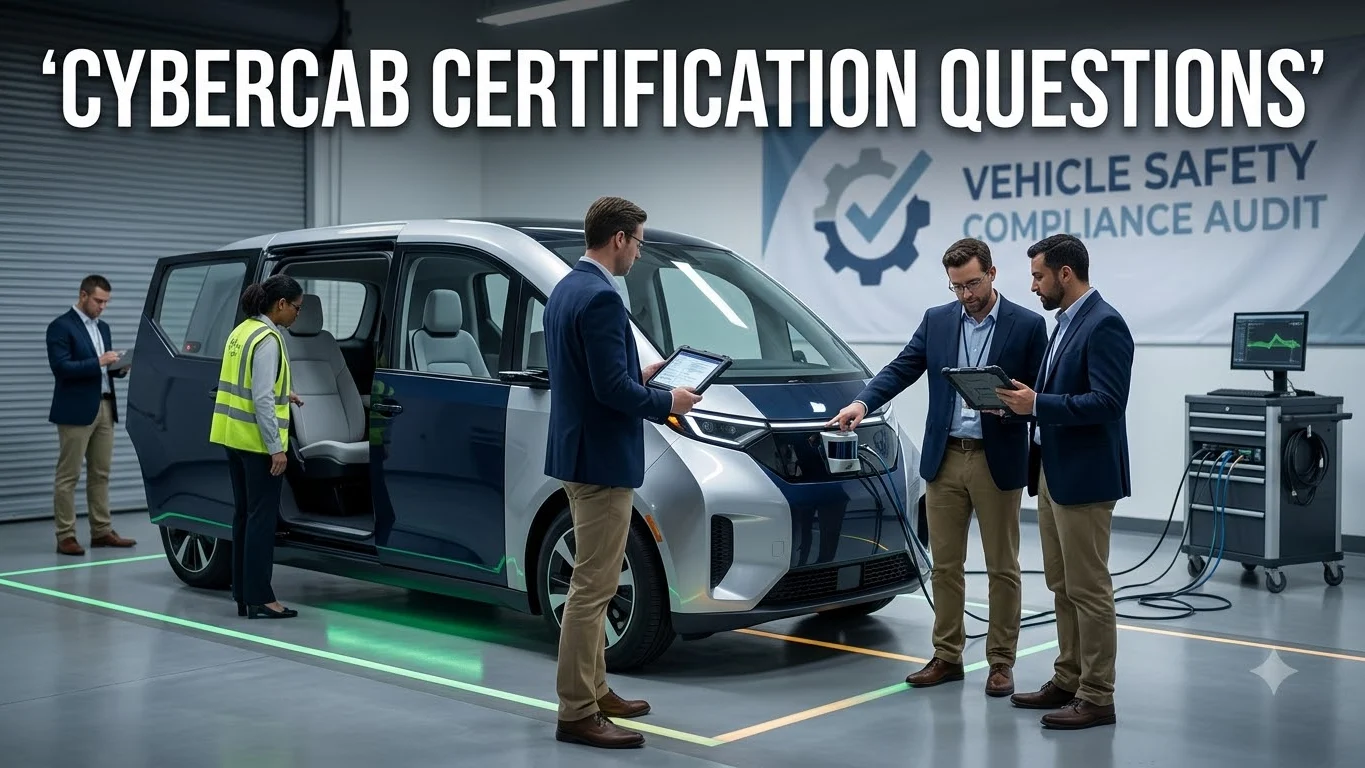
Tesla must answer a new set of questions about its Cybercab certification by September 30, according to Reuters reporting on the National Highway Traffic Safety Administration’s ongoing investigation. The questions sharpen an Audit Query that NHTSA officially opened earlier in September to examine how Tesla concluded that its steering-wheel-free and pedal-free Cybercab complies with applicable US Federal Motor Vehicle Safety Standards.
What is NHTSA asking Tesla about the Cybercab?
NHTSA’s official investigation examines the process and technical data Tesla used to self-certify Cybercab compliance. Reuters reports that the newer questions ask, among other things, whether temporarily installed human-driver controls or other equipment were part of Tesla’s certification basis, whether the vehicle can be driven by a human, whether occupants can move it through touchscreen controls, and what speed, geographic, time-of-day or other operating restrictions apply. Those are regulatory questions, not findings that Tesla used temporary controls improperly or violated a safety standard.
What changed on September 15?
NHTSA had already publicly announced Audit Query AQ26002 on September 4 after Tesla began commercial Cybercab deployment in Austin, Texas.
The new information is the reported September 30 response deadline and the more detailed set of questions about the certification basis and vehicle-control configuration.
That moves the investigation from a broad review of Tesla’s self-certification process toward a more specific evidence-gathering stage.
What does NHTSA officially confirm about the investigation?
NHTSA says the Audit Query is examining Tesla’s certification that the Cybercab complies with all applicable Federal Motor Vehicle Safety Standards, or FMVSS.
The agency says it will evaluate the technical data and processes Tesla relied on when certifying a vehicle that lacks traditional human controls. NHTSA specifically said the review would consider whether Tesla’s certification depended on determinations that some FMVSS requirements do not apply to the Cybercab.
NHTSA also says existing federal safety standards remain in force while the agency works on rule changes intended to modernise requirements for automated vehicles.
What is vehicle self-certification in the United States?
US vehicle regulation generally does not work like a pre-market approval system in which NHTSA signs off on every model before sale or deployment.
Manufacturers certify that their vehicles comply with applicable federal motor vehicle safety standards. NHTSA then has authority to oversee compliance, request technical evidence and investigate whether a manufacturer’s certification is supported.
That distinction matters in the Cybercab case. Tesla’s certification allowed it to represent the deployed vehicles as compliant, but NHTSA can still audit the reasoning, testing and data behind that certification.
Why is a vehicle without a steering wheel or pedals a regulatory question?
Many existing federal vehicle standards were written around vehicles designed for human drivers. They can contain requirements involving equipment such as brake pedals, mirrors, windshield systems and other driver-oriented controls.
The Cybercab is designed around automated driving and lacks permanently attached conventional controls including a steering wheel and brake and accelerator pedals.
NHTSA is separately working to update some federal standards for vehicles designed to be driven exclusively by automated driving systems. For example, the agency began rulemaking in June 2026 that would remove the requirement for a manual brake pedal in vehicles designed exclusively for automated operation while retaining braking-performance requirements.
But proposed or unfinished rule changes do not automatically replace the standards currently in force.
Did Tesla use temporary human controls to certify the Cybercab?
That has not been established by the evidence reviewed by ThePulseSignal.
Reuters reports that NHTSA is asking Tesla whether temporarily installed human-driver controls or other equipment were part of the company’s basis for certifying compliance.
A regulator asking that question is not evidence that the answer is yes.
Until Tesla’s response or a directly reviewable NHTSA document establishes what equipment was actually used for certification testing, TPS treats that point as unresolved.
Can the Cybercab be driven by a human?
The deployed Cybercab does not have permanently attached conventional steering and pedal controls. Reuters reports that NHTSA is asking Tesla whether the vehicles can nevertheless be driven by a human and whether occupants have touchscreen controls capable of moving the vehicle.
Those questions are also unresolved in the current regulatory record reviewed for this article. They should not be converted into claims that passenger touchscreen driving or temporary manual driving capability definitely exists in the deployed fleet.
Why is NHTSA asking about speed and geographic restrictions?
Reuters reports that the agency is seeking information about maximum speed, geographic limits, time-of-day restrictions and other operating constraints.
Those details can matter because the conditions under which a vehicle operates may affect the technical assumptions and evidence used to demonstrate compliance or safety performance.
The existence of operational restrictions would not by itself establish that the Cybercab is noncompliant. NHTSA is collecting information to understand the actual deployed configuration and the basis of Tesla’s certification.
Has NHTSA found the Cybercab illegal or noncompliant?
No such finding is established by the current evidence.
AQ26002 is an open Audit Query. NHTSA is examining Tesla’s self-certification and requesting evidence. An investigation is not the same as a determination that a vehicle violates federal standards.
No reviewed NHTSA source establishes a Cybercab recall, certification revocation or final noncompliance determination arising from this audit.
Does the September 30 deadline stop Cybercab service?
The September 30 date is a response deadline, not a shutdown date in the evidence reviewed by TPS.
Reuters reports that Tesla must provide answers by that date. The reviewed evidence does not establish that commercial Cybercab operations must automatically stop on September 30.
A later NHTSA decision could change the operational or compliance state, but that would require new evidence.
What happens after Tesla responds?
The next stage depends on what Tesla provides and how NHTSA evaluates it.
The agency could determine that the information resolves some questions, seek additional technical material, expand its inquiry or take further compliance action if the evidence supports it.
TPS is not treating any of those outcomes as predetermined. The important next factual state is Tesla’s response and any subsequent NHTSA finding or request.
Why does this matter beyond Tesla?
The Cybercab investigation sits inside a broader regulatory problem for the autonomous-vehicle industry: how safety standards written around human-operated vehicles should apply when a vehicle is designed without a human driver.
NHTSA is already rewriting several standards to address automated vehicles, but existing requirements continue to apply until those changes become effective.
That makes the Cybercab audit useful beyond one Tesla product. It may show how NHTSA evaluates self-certification arguments when automated-vehicle design moves faster than the regulatory text.
What should readers watch on September 30?
- Whether Tesla’s response becomes publicly available.
- How Tesla explains the standards it considered applicable or inapplicable.
- Whether temporary controls or test equipment were used in certification and, if so, how Tesla says that relates to the production configuration.
- Whether Tesla identifies operating limits for deployed Cybercabs.
- Whether NHTSA accepts the response, requests more information or changes the investigation status.
- Any separate NHTSA compliance finding, recall, enforcement action or regulatory interpretation.
What remains unproven right now?
- That Tesla improperly used temporary human controls during certification.
- That an occupant can conventionally drive a deployed Cybercab.
- That the Cybercab violates a specific FMVSS requirement.
- That NHTSA will order a recall or halt deployment.
- That September 30 is anything other than the reported response deadline.
Verification method
ThePulseSignal reviewed NHTSA’s September 4 announcement opening Audit Query AQ26002 and current NHTSA material on automated-vehicle standards, then reconciled those primary sources with Reuters reporting on the September 30 deadline and detailed questions. The newer request itself was not recovered from a directly reviewable public NHTSA page during this research.
Limitations & unresolved facts
The detailed September 15 NHTSA request and Tesla’s response were not publicly recovered by TPS from a primary NHTSA or Tesla source. The exact answers to questions about temporary controls, human drivability, touchscreen movement controls and operating restrictions therefore remain unresolved. No final noncompliance finding, recall or certification revocation is established.
Bottom line
The Tesla Cybercab certification inquiry is now more specific, but it is still an investigation rather than a finding against Tesla. NHTSA officially confirms that it is auditing the technical basis for Cybercab self-certification. Reuters reports that Tesla must answer more detailed questions by September 30. The next meaningful change will be Tesla’s response or a subsequent NHTSA conclusion—not the existence of the questions themselves.