






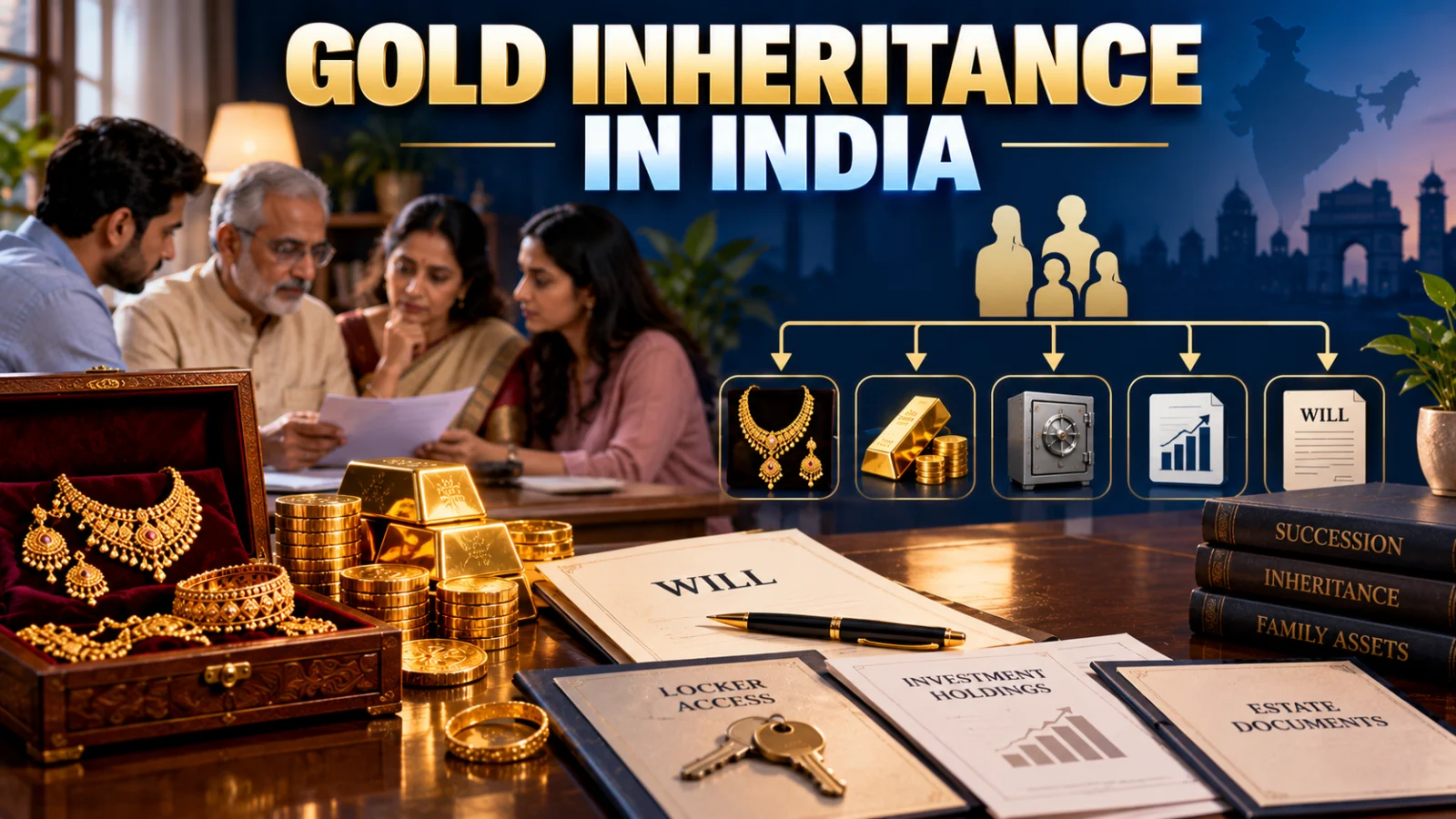
Gold inheritance in India does not follow one universal rule such as “the nominee gets the gold” or “the locker holder’s family automatically owns everything inside.” What happens after death depends first on what the deceased actually owned, whether there is a valid will, which succession law applies and how the gold is held.
The practical process also changes by asset form. Jewellery or bullion kept at home, jewellery stored in a bank locker, Gold ETF units in a demat account, mutual-fund units and legacy Sovereign Gold Bonds do not use one identical transfer procedure.
The most important distinction is this: access, nomination, institutional transmission and ultimate beneficial ownership are related but they are not automatically the same thing.
Gold inheritance: five questions to separate first
| Question | Why it matters |
|---|---|
| What did the deceased legally own? | Succession can operate only over assets or interests that actually belonged to the deceased. |
| Is there a valid will? | A valid testamentary disposition can change the result that would otherwise follow on intestacy. |
| Which succession law applies? | Indian succession is not governed by one universal heir formula for every person and family. |
| Is there a nominee or surviving joint holder? | This can affect who the institution initially gives access or transmission to. |
| Who is the ultimate beneficial successor? | Institutional access or transmission should not automatically be treated as final ownership under succession law. |

1. Start with ownership, not possession
Before asking who inherits gold, establish whether the gold actually belonged to the deceased.
This matters especially for family jewellery. A person may physically possess jewellery that was gifted to someone else, jointly owned, held for another family member or disputed within the family. A bank locker can also contain property belonging to more than one person.
Possession, a locker key or an institution’s record can therefore be evidence, but it does not by itself resolve every beneficial-ownership dispute.
Useful records can include purchase invoices, gift records, valuation reports, photographs, insurance schedules, wealth or tax records, family settlement documents and earlier estate documents. Where ownership itself is disputed, the article cannot determine title from possession alone.
2. A valid will can change the succession route
If the deceased left a valid will covering the gold or the relevant estate, the first succession question is what that will provides, subject to the law governing its validity and operation.
For Hindus, Buddhists, Jains and Sikhs within the statutory scope of the Hindu Succession Act, section 30 recognises testamentary disposition of property capable of being disposed of by will.
The Indian Succession Act also contains a broad framework concerning wills and testamentary succession, but its provisions do not apply identically to every person or every personal-law situation.
That means TPS should not give a universal answer such as “a will always settles everything.” A will can itself be challenged, may not cover the disputed property, may require probate or other estate formalities in circumstances where the law requires them, or may coexist with jointly held assets that pass through a separate mechanism.
3. If there is no controlling will, intestate succession law matters
When a person dies without a controlling will for the asset, the relevant intestate succession framework determines who is entitled to the deceased person’s estate.
There is no single heir chart that safely applies to every Indian family.
For example, the Hindu Succession Act contains separate intestate succession provisions for male and female Hindus. Section 8 addresses succession to the property of a male Hindu dying intestate, while section 15 contains the general rules for succession to the property of a female Hindu dying intestate.
Other individuals may be governed by different succession or personal-law frameworks. The Indian Succession Act contains important intestate and testamentary rules, but it should not be presented as a one-size-fits-all personal-law code for every Indian estate.
The safe editorial rule is therefore: identify the deceased person’s applicable succession framework before calculating who inherits.
4. Nominee does not automatically mean ultimate owner
Nomination is extremely useful because it can help an institution identify who should initially receive or access an asset after the holder’s death. But the word “nominee” should not automatically be translated into “final beneficial owner.”
The Supreme Court has examined this issue in the securities context and held that nomination does not displace ordinary succession law or automatically exclude legal heirs merely because the securities were transmitted to the nominee.
RBI’s locker framework reflects a similar practical distinction. A bank can give a nominee access to a deceased customer’s locker after prescribed checks, but that institutional access is not intended to prejudice the rights of people who may ultimately be entitled under succession law.
The exact legal effect of nomination can still depend on the asset and governing law. The key reader lesson is not to generalise one nominee rule across every form of gold.
5. Physical jewellery or bullion kept at home
If jewellery, coins or bullion were physically held by the deceased, the estate first needs to identify the property and establish that it belonged to the deceased.
Where ownership is clear, the asset becomes part of the succession process governed by the will or applicable intestate law.
Where ownership is unclear, physical possession alone may not settle the matter. Families should avoid distributing or selling disputed jewellery before entitlement is sufficiently established.
Creating an inventory can help. Record the item, approximate description, weight where available, photographs, existing purchase documentation and any available valuation record. The inventory is not a substitute for legal title, but it creates a useful evidence trail.
6. What happens to gold in a bank locker?
A bank locker adds an access problem before the succession problem is fully resolved.
Under RBI’s locker directions, a bank can give access to a nominee after verifying the death and the nominee’s identity and following the applicable procedure. An inventory of the locker contents is prepared before the contents are removed.
If the locker was jointly held with an operating mandate, the surviving-holder rules can also affect access.
If there is no nomination or survivorship mandate, the bank follows its Board-approved process for legal heirs or legal representatives.
Crucially, bank access should not be confused with a judicial determination that the nominee owns every item removed from the locker. RBI’s framework treats the nominee or survivor as receiving access without prejudicing claims under succession law.
A family should preserve the bank’s inventory and acknowledgement because those records can become important when the estate is later divided or disputed.
7. A locker can contain property that was not owned by the deceased
The bank generally knows who rented the locker. It does not necessarily know who beneficially owned each necklace, coin, bar or document inside it.
This is why “the deceased had the locker” and “the deceased owned every item in the locker” are different statements.
If another person claims ownership of a specific item, that is an ownership dispute that may need documentary evidence, family settlement or legal determination. The bank’s act of giving access does not by itself resolve that private title dispute.
8. What happens to Gold ETF units after death?
Gold ETF units are securities rather than physical gold held by the investor. When they are held in demat form, the relevant process is securities transmission through the depository and participant framework.
SEBI describes transmission as the transfer of securities of a deceased holder to a surviving joint holder, nominee or legal heir, depending on the holding pattern and circumstances.
If there is a surviving joint holder, the operational sequence can differ from a sole-holder account. If there is a nominee, the nominee can use the prescribed transmission process. Where there is no usable nomination, legal heirs or legal representatives may need additional succession documentation.
Transmission to a nominee should not automatically be described as the final answer to beneficial succession. In the securities context, the Supreme Court has expressly distinguished nomination from the operation of succession law.
9. Demat transmission is not the same as inheriting physical gold
A Gold ETF holder owns units of a regulated fund structure, not identified bars stored personally for that investor.
That means heirs do not normally approach a jeweller or bullion dealer to obtain the underlying metal. They first complete the securities transmission process for the ETF units.
Once units have been validly transmitted and any succession claims are resolved, the successor can generally continue holding or later sell the units subject to the applicable account, market and tax rules.
10. What happens to mutual-fund units after death?
Mutual funds have their own transmission process. The correct route depends on factors including whether the deceased was a sole holder or joint holder, whether a valid nomination exists and whether the units are held in statement-of-account form or demat form.
For ordinary mutual-fund folios, the asset-management-company or registrar-and-transfer-agent transmission framework applies. Current industry procedures provide separate routes for surviving holders, nominees and legal heirs.
If mutual-fund units are held in demat form, the depository-side transmission and nomination framework becomes relevant.
A nominee receiving mutual-fund units through the institution’s process should not automatically be assumed to have defeated every succession claim. The estate should still reconcile institutional transmission with the will and applicable succession law.
11. What happens to legacy Sovereign Gold Bonds?
Legacy Sovereign Gold Bonds are government securities linked to gold rather than physical coins or jewellery.
RBI’s SGB framework provides for nomination under the Government Securities Act and Government Securities Regulations. After the holder’s death, the operational transmission route can depend on the form in which the SGB is held and the receiving office or depository records.
Families should locate the SGB certificate, investor identification details, nomination records and demat or receiving-office information before starting transmission.
Do not assume that an old SGB follows the same paperwork as a Gold ETF or an ordinary mutual-fund folio merely because all three are financial ways to obtain gold exposure.
12. Joint holding can change the first operational step
Before using a nominee or legal-heir process, check whether the asset had multiple holders.
A surviving joint holder may have an immediate operational role under the bank, depository or fund’s rules. That operational survivorship step can be different from a sole-holder transmission claim.
The exact beneficial rights can still depend on the governing ownership and succession facts. Joint account operation should therefore not be used as a shortcut for analysing ultimate title where a dispute exists.
13. Is inherited gold taxable when the heir receives it?
Under the current Income Tax Department framework reviewed for this article, property received under a will or by inheritance is excluded from the receipt-based deemed-income or gift-tax provision that can otherwise apply to property received without consideration.
That means the act of receiving inherited gold is not automatically treated as taxable income merely because the heir received valuable property.
Tax becomes a different question if the inherited gold or financial gold is later sold, redeemed or otherwise transferred.
14. Preserve the previous owner’s cost and holding records
For a later sale of an inherited capital asset, the previous owner’s acquisition history can matter to the capital-gain calculation.
Current capital-gains rules can require the previous owner’s acquisition cost to be carried into the heir’s tax computation, and the previous owner’s holding period can also be relevant to determining the character of the gain.
This makes old records valuable even when the heir did not personally pay for the asset.
Keep purchase invoices, contract notes, demat statements, mutual-fund statements, SGB records, valuation reports and any evidence showing when and how the previous owner acquired the asset. If exact historic records are missing, obtain professional tax guidance before inventing a cost figure.
15. Can an heir sell inherited jewellery immediately?
There is no useful universal “yes” or “no.” The practical question is whether the person’s entitlement to the asset is sufficiently established.
If a valid will clearly transfers the item, the estate administration is complete and no competing claim exists, sale may be straightforward. If ownership, heirship or the will is disputed, selling the item can create additional legal and evidentiary problems.
Similarly, receiving locker access as nominee should not be treated as permission to disregard competing succession claims.
16. Probate, succession certificate and other court documents are not one universal checklist
Families often search for one document that supposedly proves inheritance in every situation. Indian estate administration does not work that simply.
Whether probate, letters of administration, a succession certificate, legal-heir documentation, indemnities, affidavits or other evidence is required can depend on the asset, governing law, jurisdiction, existence of a will, value, nomination status, institutional rules and whether the estate is disputed.
The article therefore does not tell every reader to obtain the same court document. Use the requirements applicable to the actual asset and estate.
17. What if the nominee and legal heirs disagree?
This is the point where an institutional transmission process should not be mistaken for a final adjudication of title.
If a nominee receives access to a locker or securities but another person asserts rights under a will or succession law, the dispute may require legal advice, settlement or a court process.
TPS cannot determine which claimant is legally entitled without the controlling documents and family facts.
The safe action is to preserve the asset and records, avoid irreversible transfer or sale where ownership is genuinely contested and obtain case-specific legal advice.
Practical gold inheritance workflow
1. Identify every gold asset
Separate jewellery and bullion from locker-held property, Gold ETF units, mutual funds and legacy SGBs.
2. Establish the deceased’s ownership
Collect invoices, statements, certificates, photographs, valuation records and other evidence showing what actually belonged to the deceased.
3. Locate the will and estate documents
Determine whether a valid testamentary document covers the asset. If not, identify the applicable intestate succession framework.
4. Check joint-holder and nomination records
These records can determine the institution’s initial access or transmission path, but they do not automatically answer every beneficial-ownership question.
5. Follow the asset-specific transmission process
Use the bank process for lockers, depository process for demat securities, AMC/RTA process for mutual funds and the applicable RBI/Government Securities route for SGBs.
6. Preserve the institution’s evidence
Keep locker inventories, transmission acknowledgements, new account statements, transfer records and correspondence.
7. Resolve succession before irreversible action
If heirship, ownership or will validity is disputed, obtain legal advice before selling or permanently transferring the asset.
8. Preserve historic cost records
Old acquisition evidence can matter when inherited gold or financial-gold assets are later sold and capital gains must be calculated.
What gold owners can do before death
The simplest estate is usually one in which the records agree with each other.
Keep an updated asset inventory, preserve purchase and valuation records, record where financial gold is held, review nominations and make sure the will does not unintentionally conflict with the intended estate plan.
For locker-held jewellery, a private inventory with photographs and ownership notes can reduce later confusion, although it does not replace formal legal ownership evidence.
For demat, mutual-fund and SGB holdings, keep folio, depository, certificate and nomination information discoverable by the executor or family.
Bottom line
After a gold owner’s death, do not begin with the assumption that the nominee owns everything.
Begin with five questions: What did the deceased own? Is there a valid will? Which succession law applies? Who is recorded as joint holder or nominee? What asset-specific transmission process must be completed?
Physical jewellery, bank-locker contents, Gold ETF units, mutual funds and legacy Sovereign Gold Bonds can all require different operational steps.
The institution may determine who can initially access or receive an asset. Ultimate beneficial entitlement, however, can still depend on the will, applicable succession law and any unresolved ownership claim.