






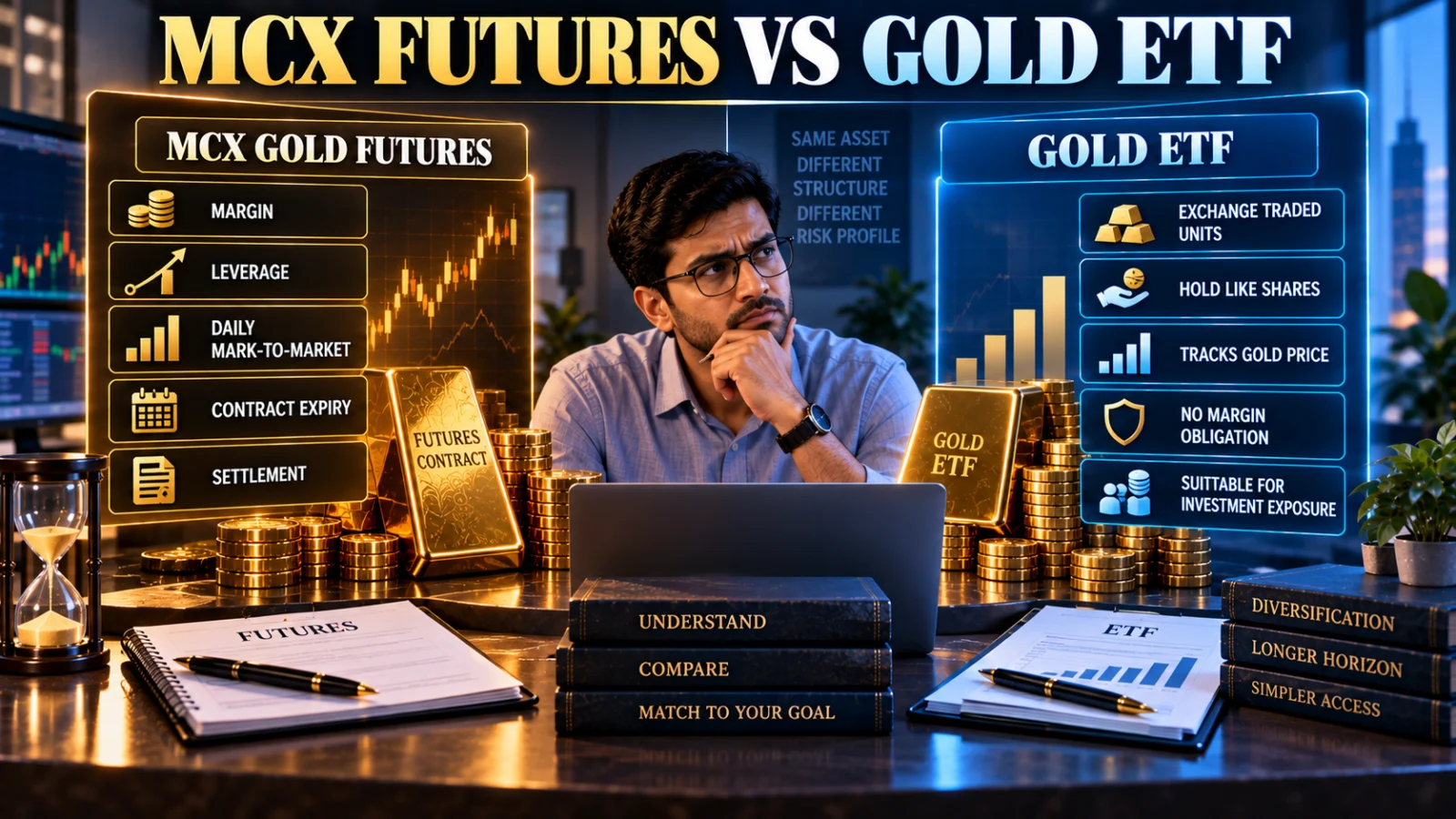
MCX gold futures vs gold ETF can look like a simple comparison between two ways to get exposure to gold. The important difference is not just where each product trades or which one recently delivered a higher return. The structures create very different obligations for the person holding them.
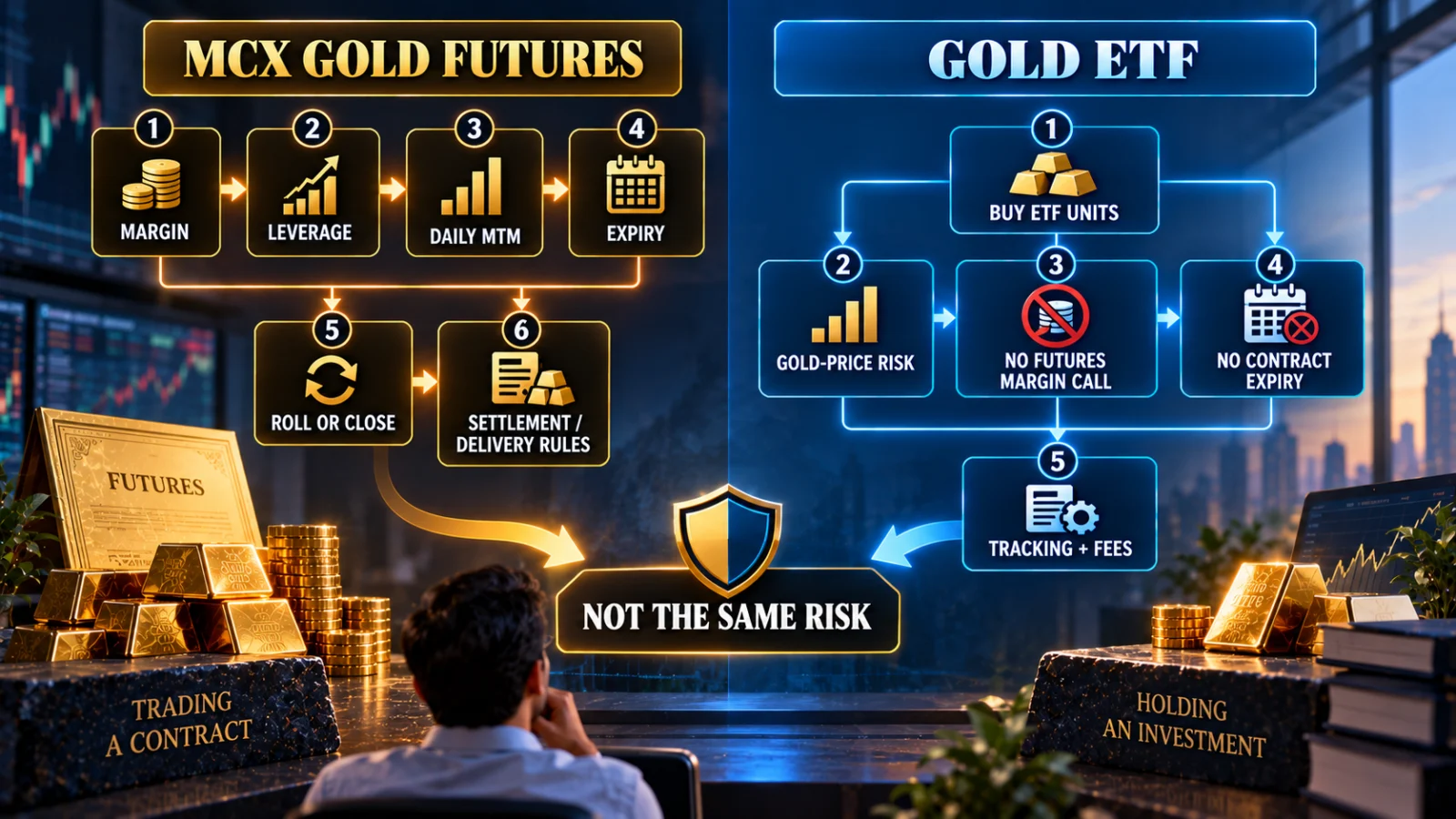
An MCX Gold futures position is a dated derivative contract. The trader posts margin, receives economic exposure larger than the cash initially deposited, is subject to daily mark-to-market gains and losses, and must manage the contract as expiry approaches. A Gold ETF investor buys exchange-traded fund units instead. The units can rise or fall with gold, but ordinary ETF ownership does not by itself place the holder into the same direct futures margin, daily MTM and expiry cycle.
| Dimension | MCX Gold futures | Gold ETF |
|---|---|---|
| What the investor holds | A standardized, dated derivative contract | Units of an exchange-traded fund |
| Upfront cash | Margin rather than the full economic value of the contract | Investor pays for the ETF units purchased, subject to normal brokerage and market costs |
| Leverage | Yes, because contract exposure can exceed margin posted | No direct futures leverage merely from buying ordinary ETF units |
| Daily mark-to-market | Yes; gains and losses affect the futures account | No direct futures MTM debit or credit to the unit holder |
| Expiry | Yes; each futures series has an expiry | ETF units do not expire like futures contracts |
| Rollover | Relevant when continuing exposure beyond one contract | Not required simply to continue holding ETF units |
| Settlement / delivery mechanics | Can become relevant under the applicable MCX contract and settlement rules | Investor normally buys or sells ETF units on exchange; scheme-level operations are separate |
| Main investor-level risk distinction | Gold-price risk plus leverage, margin liquidity and contract-lifecycle risk | Gold-price, tracking, fee and market-liquidity risk without direct futures margin obligations |
What you actually hold is different
SEBI describes futures as standardized exchange-traded contracts to buy or sell an underlying product at a predetermined price on a future date. That future date is fundamental to the product. A futures contract is not a perpetual gold holding.
A Gold ETF is structured differently. The investor buys units of a fund that are listed and traded on an exchange. The value of those units is linked to the scheme’s gold exposure and can fluctuate, but the investor is holding fund units rather than personally entering an MCX Gold futures contract.
This distinction matters because the obligations after taking the position are different even when both products respond to movements in gold.
Why futures can require much less cash upfront
Futures use margin. MCX describes margin as funds deposited as security for fulfilment of contractual obligations. The holder therefore does not normally pay the entire economic value of the futures contract upfront.
That smaller initial cash requirement should not be confused with smaller economic exposure. If a contract represents a much larger value of gold than the margin deposited, changes in the futures price apply to that larger contractual exposure.
This is leverage. It can magnify both gains and losses relative to the cash initially posted.
Lower upfront cash does not mean lower risk
A reader may see a futures margin requirement and conclude that futures are simply a cheaper route to the same gold exposure. That interpretation misses the main risk.
The margin is not a discounted purchase price for gold. It is collateral supporting a derivative obligation. If the futures position moves against the holder, losses can consume part of that margin and additional funds may be required under the applicable margin framework and broker risk controls.
Exact margin levels should never be treated as permanent. MCX recognises multiple forms of margin, including initial and additional margins, and requirements can change with the contract and market conditions.
What mark-to-market means in MCX Gold futures
MCX describes mark-to-market, or MTM, as the process through which gains or losses arising from changes in futures prices are credited or debited on a daily basis.
This creates an important cash-flow difference from an ordinary ETF holding. An ETF investor can see the market value of the units fall without receiving a direct futures MTM debit merely because the ETF price declined. A direct futures holder can face daily account-level gains or losses tied to the futures position.
If available funds become insufficient, the holder may need to provide additional funds or face risk-control action under the applicable exchange and broker rules. Exact broker liquidation thresholds or procedures vary and should be verified from current account terms rather than assumed.
Futures have an expiry date
A futures contract is dated. MCX lists separate Gold futures contract series that expire according to the applicable contract specification.
This means a futures position cannot simply be held indefinitely in the same contract. As expiry approaches, the holder must understand the relevant current rules and decide whether the position is being closed, replaced with a later-dated contract or allowed to proceed under the applicable settlement process.
A Gold ETF unit does not have the same contract-expiry problem. The unit can generally remain in the investor’s account until it is sold or otherwise dealt with under the scheme and exchange rules.
What rollover means
If someone wants to maintain futures exposure beyond an expiring contract, the existing position is ordinarily closed or replaced and exposure is established in a later-dated contract. This is commonly called rolling the position.
Rollover is not the same as simply continuing to hold one perpetual asset. The expiring and later-dated contracts can trade at different prices, so moving between them can affect the economic result.
This article does not provide a rollover strategy or tell traders when or how to roll. The relevant point is that expiry management is an additional obligation that ordinary ETF ownership does not create for the unit holder.
Settlement and physical delivery can matter
Commodity futures also have exchange-defined settlement and delivery procedures. MCX publishes delivery and settlement information for its commodity contracts, including gold.
A reader should not assume every futures position can be ignored until expiry or that every position automatically becomes physical gold. The applicable outcome depends on the specific contract, the position and current MCX rules.
Before holding any commodity futures position close to expiry, the current contract specification, delivery provisions, tender period and settlement rules should be checked directly.
Current MCX Gold contract size shows why margin can create large exposure
MCX currently describes its main Gold futures contract as a 1 kg contract and Gold Mini as a 100 gram contract. Other smaller gold contracts also exist.
These examples help explain leverage: the contractual gold exposure can be substantial even though the cash posted as margin is only a fraction of the economic contract value.
Contract sizes and specifications can change, so TPS does not treat these figures as permanent product rules. Current MCX specifications control.
A Gold ETF avoids direct futures margin mechanics for the unit holder
When an investor buys ordinary Gold ETF units, the investor pays for the units purchased and their value then moves in the market. The investor is not personally required to maintain an MCX futures margin account merely because those ETF units are held.
There is no direct futures-style expiry date on the ETF units and no requirement for the retail holder to roll an expiring futures contract to keep owning those units.
That makes the investor-level operating experience very different from direct futures exposure.
But a Gold ETF is not risk-free
A Gold ETF can still fall when gold prices fall. It can also have scheme expenses, tracking difference and market-price or liquidity effects.
The correct distinction is therefore not “futures are risky, ETF is safe.” It is that the risks are different. Futures add leverage, margin liquidity, daily MTM and contract-lifecycle obligations to the underlying gold-price exposure. ETF ownership generally removes those direct futures obligations but still leaves the investor exposed to the ETF’s market value and scheme structure.
Does every Gold ETF hold only physical gold?
That should not be stated universally. Current Indian fund rules and scheme disclosures can permit certain gold-related instruments, including exchange-traded commodity derivatives where allowed.
This does not erase the investor-level distinction. Even if an ETF scheme itself uses permitted derivatives within its portfolio, a retail investor who buys ETF units is not thereby personally entering the scheme’s underlying futures contracts or taking on their direct margin and expiry obligations.
Gold-price exposure does not make the products economically identical
Both instruments can respond to changes in the gold market. That shared underlying exposure is why they can look similar on a price screen.
But the path from price movement to investor outcome is different. Futures can create immediate cash-flow requirements through MTM and margin. ETFs generally translate market movement into changes in the value of the fund units.
This is why comparing only percentage returns can hide the most important difference.
A simple decision path before comparing returns
1. Are you trying to hold gold exposure or enter a dated derivative contract?
If the objective is a normal investment holding, understand why direct futures introduce obligations that a fund unit does not.
2. Can you tolerate leverage?
A futures contract can create exposure larger than the margin deposited, magnifying both gains and losses relative to that cash.
3. Can you fund daily losses or higher margin requirements?
MTM and margin are cash-flow obligations, not merely changes in an unrealised investment value.
4. Do you understand expiry?
Direct futures exposure must be managed as the contract approaches expiry.
5. Do you understand rollover and settlement?
Continuing exposure can require moving into a later contract, while positions near expiry can become subject to the current settlement and delivery process.
6. If choosing an ETF, have you checked its costs and tracking?
An ETF avoids direct futures margin mechanics for the unit holder but still has gold-price, fee, tracking and market-liquidity risk.
Who might use futures and who might use ETFs?
SEBI describes derivatives as instruments used for purposes including hedging, speculation and arbitrage. That means it would be wrong to describe every futures user as a short-term speculator.
Futures can serve legitimate hedging and market-risk-management purposes. But that does not make them a simple substitute for an investment holding.
A Gold ETF is structurally more straightforward for an investor whose objective is to hold exchange-traded gold exposure without personally managing futures margin, MTM, expiry and rollover. Whether that structure is suitable for a particular person still depends on their objective, risk capacity, time horizon and understanding of the product.
Bottom line
MCX gold futures vs gold ETF is fundamentally a comparison between a leveraged, dated derivative contract and an exchange-traded fund holding. Futures add margin, leverage, daily mark-to-market, expiry and settlement obligations. Gold ETF units can still rise or fall and carry costs and tracking risk, but ordinary ownership does not place the unit holder into that direct futures contract lifecycle.
Do not choose futures simply because the initial cash requirement appears smaller. The lower upfront amount reflects margin-backed leverage, not a discounted way to buy the same investment.
Verification note
TPS reviewed SEBI investor education on derivatives and ETFs and cross-checked current MCX material covering Gold contracts, margin, mark-to-market and delivery or settlement mechanics. Current SEBI-filed Gold ETF disclosures were also reviewed to preserve the distinction between direct retail futures exposure and permitted scheme-level derivative use.
Limitations and unresolved facts
Future gold prices, MCX margin requirements, contract specifications, broker liquidation rules, rollover economics and ETF tracking outcomes are unknown. Contract and scheme rules can change. This article explains structure and risk only and does not provide futures trading strategies, leverage recommendations, entry or exit levels, rollover tactics or personalised investment advice.