







Gold loan default auction India rules are easy to misunderstand when a payment has just been missed. A missed due date does not mean the lender immediately owns your pledged jewellery or can automatically auction it the next day. The exact overdue or default timeline depends on the loan agreement and applicable lender rules, but the current RBI framework requires borrower protections before an auction can proceed.
The useful way to understand the process is as a sequence: payment due → payment missed → overdue/default under the applicable terms → lender communication and notice → opportunity to repay or settle → auction process if unresolved → dues adjusted from sale proceeds → surplus returned or shortfall handled under the agreement → grievance route if the process is disputed.
One missed payment does not mean immediate auction
A gold loan can have different repayment structures. Some require periodic interest payments, some use instalments and some may have a bullet repayment structure. That means TPS cannot safely say that one missed EMI, one missed interest payment or one missed due date creates the same legal or operational state for every borrower.
The first thing to establish is the actual contractual state of the account: what payment was due, what remains unpaid, what charges have accrued and what amount the lender says is required to regularise or settle the loan.
Do not automatically treat one missed payment as identical to an auction-ready account or assume that every lender follows the same number of recovery days.
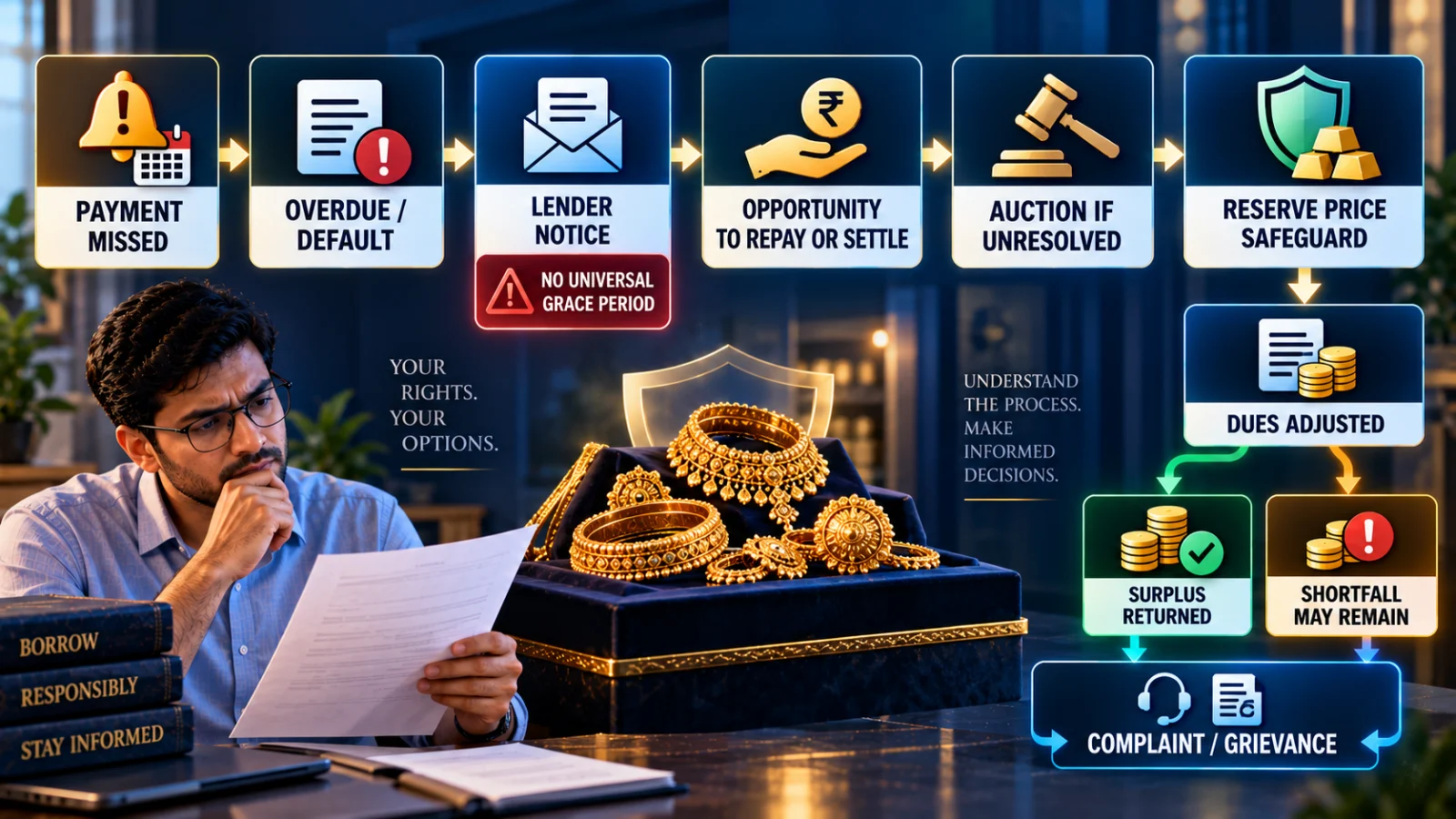
There is no universal RBI grace period before every gold-loan auction
This is one of the most important borrower protections to understand correctly.
The RBI framework requires the lender to give the borrower or legal heir adequate notice and an opportunity to repay or settle the dues before initiating auction. The reviewed Directions do not establish one universal 7-day, 14-day or 30-day grace period that applies to every reachable borrower and every loan.
The exact timeline can depend on the loan agreement, lender policy, applicable regulatory regime and the stage of recovery. If a lender notice gives a specific payment or auction date, that notice and the controlling loan terms should be checked directly rather than replaced with a generic internet timeline.
The one-month rule applies to a specific untraceable-borrower situation
The current framework contains a separate safeguard when the borrower or legal heir cannot be located despite the lender’s efforts. In that situation, after the required public notice is issued, the lender must wait the prescribed period before proceeding with auction.
This special rule should not be presented as the general grace period for every gold-loan borrower. A reachable borrower who has received direct communication can be governed by a different contractual and recovery timeline.
What should you do as soon as you miss a payment?
1. Ask for the current outstanding amount.
Request the principal, interest, penal charges if applicable, and the amount required to regularise or settle the account.
2. Ask for the current account status.
Confirm whether the account is merely overdue, has entered a lender-defined default stage, or has already reached a formal auction-notice stage.
3. Check the loan agreement and Key Facts Statement.
Repayment frequency, charges, maturity, renewal conditions and recovery steps can differ by lender and loan structure.
4. Keep every notice and communication.
Preserve SMS messages, emails, letters, branch acknowledgements, payment receipts and copies of any auction notice.
5. Ask what amount will stop the recovery process at the current stage.
If you can repay or settle, obtain the lender’s current written amount and payment instructions. Do not assume that a partial payment automatically stops an auction unless the lender confirms the account status.
6. If you dispute the process, complain in writing.
Raise the issue with the lender first and preserve the complaint reference before considering further escalation.
What must happen before the lender auctions the jewellery?
Under the current RBI framework, auction is not supposed to be an invisible recovery step. The borrower or legal heir must be given adequate notice through available means and an opportunity to repay or settle before auction is initiated.
If the dues remain unresolved and the lender progresses to auction, the process is also subject to transparency and valuation protections.
How the auction must be announced
The current regulatory framework requires public announcement of the auction through newspapers, including a regional-language newspaper and a national daily.
This public-notice requirement is separate from the lender’s obligation to communicate with the borrower. It helps make the sale process transparent rather than allowing pledged collateral to be disposed of privately without a documented auction process.
What reserve price can the lender use?
The reserve price is the minimum price below which the collateral should not ordinarily be sold at that auction stage.
Under the reviewed RBI framework, the reserve price is ordinarily set at not less than 90% of the current value of the pledged collateral. If two auctions fail, the reserve price may be reduced, but not below 85% of the current value.
These percentages are auction protections, not guarantees of the final sale price or the amount left after the borrower’s dues are adjusted.
Where can the auction take place?
The first auction is generally required to be conducted physically in the same district as the lending branch under the reviewed framework. If the first auction fails, the permitted process can broaden, including use of an adjoining district or online auction subject to the applicable rules.
The borrower should verify the location, date and auction terms in the actual notice because later auction stages can differ from the first attempt.
Can the lender buy the pledged gold itself?
The regulatory framework includes conflict-of-interest protections intended to prevent the lender and related parties from participating in the auction as buyers.
This matters because the lender is already the creditor controlling the recovery process. The auction is supposed to establish a transparent sale process rather than allowing the lender to acquire the collateral for itself through the same recovery procedure.
Can you still repay after the account becomes overdue?
The RBI framework requires the borrower to receive an opportunity to repay or settle before auction. However, TPS cannot state that every borrower has an unlimited right to cure the account at any moment under identical terms.
Whether the loan can be regularised, renewed, closed or settled, and the exact amount required, depend on the current stage, the loan agreement and lender rules. A borrower facing an auction warning should therefore obtain the lender’s written current dues rather than relying on an old statement or original loan amount.
What happens when the jewellery is actually auctioned?
Once the collateral is sold, the auction proceeds are applied against the borrower’s outstanding dues according to the applicable rules and loan agreement.
The borrower or legal heir should receive details showing the auction value and how the proceeds were adjusted against the loan dues. That accounting is important because the lender cannot simply treat the full sale proceeds as its own money when the sale produces more than the amount owed.
If the auction raises more than you owe, the surplus must be returned
If the lender receives more from the auction than the amount required to satisfy the dues, the remaining surplus belongs to the borrower or legal heir.
Under the reviewed framework, that surplus must be refunded within a maximum of seven working days from receipt of the full auction proceeds.
Keep the lender’s auction statement, dues-adjustment details and proof of the amount refunded. If the surplus is not returned or the calculation appears wrong, those records become important evidence for a complaint.
What if the auction raises less than the loan dues?
An auction does not automatically wipe out every outstanding amount. If the sale proceeds are insufficient to cover the dues, the lender may recover the remaining shortfall according to the applicable loan agreement and law.
The exact amount should be supported by a clear post-auction accounting showing the sale proceeds, dues adjusted and balance claimed.
What if you repay the loan before the collateral is sold?
If the borrower fully repays or settles the loan before the collateral is sold, the pledged collateral should be released under the applicable RBI and lender framework rather than proceeding to auction merely because recovery action had previously begun.
The exact release process and timing should be confirmed from the current lender terms and RBI framework. Keep proof of final payment and obtain written confirmation that the account has been closed and the auction process, if started, has been stopped.
What if you dispute the notice, valuation or auction?
Start with a documented complaint to the lender. State exactly what is disputed: the outstanding amount, notice, valuation, reserve price, auction procedure, post-auction adjustment, collateral release or surplus refund.
Keep the complaint number and copies of supporting records. This is important because RBI’s Ombudsman framework generally expects the customer to first approach the regulated entity.
If the complaint concerns an eligible deficiency in service and the lender does not provide a satisfactory resolution within the applicable RBI Ombudsman timeline, escalation through the RBI grievance framework may be available. Not every contractual, commercial or legal dispute is automatically covered by the Ombudsman scheme, so TPS does not treat it as a universal substitute for every legal remedy.
Older gold loans may need a transition check
The RBI’s unified Lending Against Gold and Silver Collateral Directions were issued in 2025 and regulated entities were required to comply within the prescribed implementation period.
However, the Directions also preserve a transition distinction for loans sanctioned before a regulated entity adopted the new framework. Those loans can remain governed by the earlier applicable guidelines.
If the loan is older, the borrower should therefore confirm which regulatory framework the lender says applies rather than assuming every clause of the 2025 Directions automatically governed the loan from its original sanction date.
A practical gold-loan default path
Payment missed
Check the exact due amount and contractual repayment structure.
Account becomes overdue or enters the lender’s default process
Do not assume this is automatically the same as NPA classification or immediate auction eligibility.
Lender communicates and seeks recovery
Request a written current dues figure and account status.
Pre-auction notice and repayment opportunity
RBI requires adequate notice before auction, but there is no single universal grace period for every borrower.
Auction if the dues remain unresolved
Transparency, reserve-price, location and conflict safeguards apply.
Auction proceeds adjusted
The lender applies the proceeds to dues and provides the relevant accounting.
Surplus or shortfall
Surplus must be returned within the prescribed period; a shortfall may remain recoverable under the agreement.
Complaint or escalation if disputed
Complain to the lender first, then use an eligible RBI grievance route where applicable.
Bottom line
A gold-loan payment default does not mean immediate loss of your pledged jewellery. The borrower can move through several states before auction, and the current RBI framework requires notice, an opportunity to repay or settle, transparent auction safeguards and proper accounting of the sale proceeds.
The most important practical rule is not to rely on a generic internet grace period. Ask the lender for the current dues, account status and controlling notice in writing. If an auction has been announced, verify the notice and act on the actual lender deadline rather than assuming that every borrower receives the same number of days.
Verification note
TPS reviewed the RBI’s Lending Against Gold and Silver Collateral Directions, 2025, current material on the auction framework and RBI’s grievance/Ombudsman process. The article separates regulator-wide protections from lender-specific repayment, charge and cure timelines.
Limitations and unresolved facts
The exact repayment schedule, overdue/default classification, penal charges, cure period, renewal option, settlement amount and auction timing can vary by lender, loan structure and sanction date. Older loans may remain under earlier applicable guidelines. Individual disputes may also require remedies outside the RBI Ombudsman framework. TPS therefore does not state a universal grace period or promise that every auction dispute follows the same legal route.