







If you are comparing a bank locker nominee vs legal heir after someone dies, the most important distinction is simple: the person whom the bank allows to access the locker is not automatically the person who beneficially owns every item inside it.
RBI’s locker framework separates the bank’s operational job from the family’s succession and ownership questions. A valid nominee or eligible survivor may be allowed to access the locker and remove its contents after the prescribed verification and inventory process. But RBI also makes clear that the nominee or survivor receives that access in a trustee capacity and that release by the bank does not extinguish other valid claims.
That means two different questions must be answered after a locker hirer dies: who may the bank deal with? and who is legally entitled to keep the gold, jewellery or other valuables?
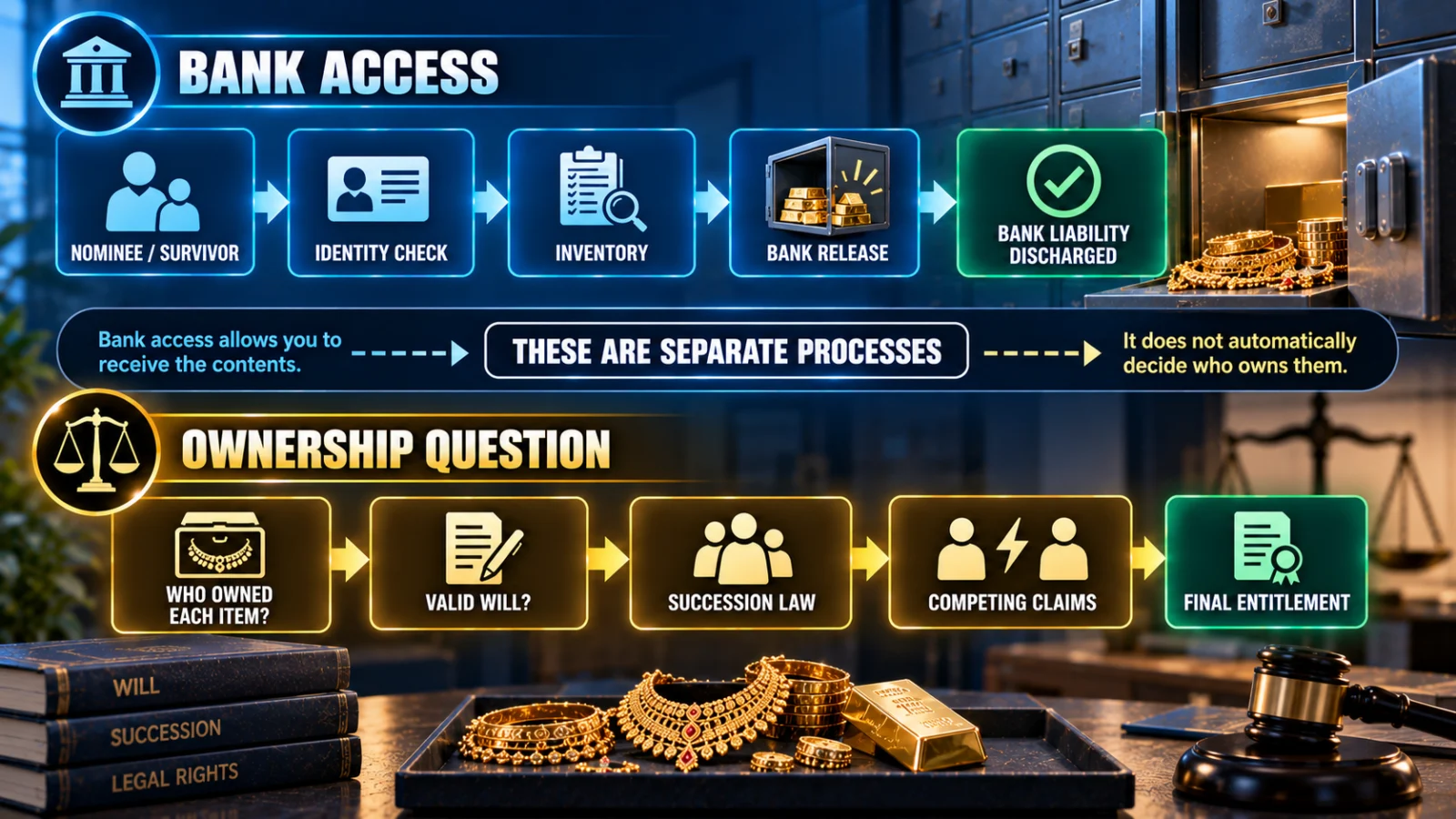
Bank access and ownership are two separate decisions
1. Check the locker mandate
Confirm whether the locker was held singly or jointly and whether the bank has a valid nominee or survivorship instruction.
2. Complete the bank’s death-claim process
The bank verifies the death, claimant identity, nomination or survivorship mandate and any relevant restraint before permitting access.
3. Prepare the inventory
The locker contents are recorded through the prescribed inventory process before the nominee, survivor or authorised claimant removes them.
4. Do not treat handover as title
Bank release can discharge the bank’s responsibility without deciding who beneficially owns each item.
5. Resolve the ownership layer separately
Check who actually owned the jewellery, whether a valid will exists and which succession law applies to property that belonged to the deceased.
6. Preserve disputed contents
If another heir or claimant asserts ownership, avoid irreversible sale or distribution until the entitlement issue is resolved.
Does the bank locker nominee own the gold?
Not merely because of the nomination.
A locker nomination primarily tells the bank whom it may recognise for access after the hirer’s death. RBI’s framework says that the nominee or survivor receives access to the locker and its contents in a trustee capacity for the legal heirs and that giving access does not affect another person’s right or claim against that nominee or survivor.
This is why the bank can validly hand the contents to a nominee while an inheritance or ownership dispute can still continue outside the bank.
Why does the bank release the locker if ownership is unresolved?
The bank is not expected to act as a succession court.
Its job is to identify the person it may safely deal with under the banking mandate, follow the required verification and inventory process, and release the contents in accordance with the applicable banking rules.
The Banking Regulation Act provides a statutory framework under which a valid nominee can receive access and remove locker contents after death. When the bank follows that framework correctly, its liability in relation to the locker contents can be discharged.
That bank-side discharge should not be confused with a judicial determination that the nominee owns every article.
What does ‘trustee of the legal heirs’ mean?
In this context, it means the nominee’s receipt of the locker contents does not automatically wipe out the rights of people who may be legally entitled to those contents.
The nominee may be the person who physically receives the jewellery from the bank, but the nominee can still have obligations toward the persons who are ultimately entitled under ownership evidence, a valid will or the applicable succession law.
This does not mean a nominee can never also be the ultimate owner. The same person may, for example, also be the sole beneficiary or sole person legally entitled to the property. The important point is that the ownership result comes from those separate legal facts, not from the nomination alone.
Does the bank inventory prove who owns the jewellery?
No.
The inventory is important evidence of what was present in the locker and what was removed during the bank’s claim process. It can reduce later disagreement over the contents.
But an inventory normally records possession and description; it does not by itself prove who originally purchased an item, who gifted it, whether it belonged to a spouse or child, or who ultimately inherits it.
Families should therefore preserve the inventory together with relevant invoices, valuation records, gift records, wills, family-settlement documents and other ownership evidence where available.
Does everything inside the locker belong to the deceased?
Not necessarily.
A bank locker is a storage facility. The fact that an item was found inside a deceased person’s locker does not automatically prove that the deceased beneficially owned it.
For example, jewellery stored in the locker may have belonged to a spouse, daughter, parent or another family member. There may also be jointly owned valuables or items placed there only for safekeeping.
That is why the ownership analysis should begin with the article itself, not merely with the name on the locker agreement.
What if there is a valid will?
A valid will can be highly relevant to who is entitled to property that actually belonged to the deceased.
The bank’s nomination process and the will answer different questions. Nomination can determine whom the bank may recognise for operational access, while the will may determine who beneficially receives property from the deceased’s estate, subject to the applicable legal framework.
TPS’s broader guide on gold inheritance and nomination in India covers the wider inheritance distinction. This page remains focused on the special bank-locker access-versus-ownership problem.
What if there is no will?
If the deceased beneficially owned the gold and there is no controlling valid will, the applicable intestate succession law may determine who inherits it.
There is no single universal share formula that can safely be applied to every Indian family. The answer can depend on the deceased’s personal law, family relationships and other facts.
For that reason, the bank locker article should not be used to calculate individual heir shares.
Can the legal heirs challenge the nominee after the bank releases the contents?
Yes, a valid competing claim is not extinguished merely because the bank completed the nominee-access process.
RBI’s framework specifically preserves other rights and claims against the nominee or survivor. If the dispute is about beneficial ownership rather than bank procedure, the parties may need to resolve it through agreement, documentary evidence or appropriate legal proceedings.
This is also why a nominee should be cautious about immediately selling, melting, gifting or distributing disputed gold after removing it from the locker.
Does a nominee need a succession certificate just to open the locker?
A bank should not automatically demand probate, a succession certificate or similar court documentation from a valid nominee merely because the locker hirer has died, where the nomination is clear and there is no relevant discrepancy or legal restraint.
The bank’s clean-nomination process is designed to avoid forcing an undisputed nominee through unnecessary succession formalities for basic access.
That does not prevent additional documentation becoming necessary when the nomination is disputed, invalid, unclear, subject to a court order or part of a broader legal conflict.
What if there is no nominee?
The bank then follows its applicable deceased-claim procedure for legal heirs, legal representatives or other authorised claimants.
The documents required can differ depending on whether the claim is disputed, whether there is a will, the bank’s approved procedure and whether probate, letters of administration, succession documentation, indemnity or other legal evidence is required in the particular case.
This is a different procedural state from a clean, valid nomination.
What if the locker is jointly held?
Joint lockers can include operating instructions or survivorship mandates that affect whom the bank may allow to access the locker after one hirer dies.
But survivorship at the bank level should not automatically be read as proof that the survivor beneficially owns every article in the locker.
The same access-versus-ownership distinction still matters: the bank follows the mandate for operational release, while private title to the contents can depend on separate evidence and succession rules.
Can a bank locker have more than one nominee now?
Yes. The banking-law nomination framework changed from 1 November 2025.
Locker customers can now nominate up to four persons successively. This is different from some deposit-account nomination structures because locker nominations are successive rather than simultaneous.
That means the nominations operate in priority order. The existence of four nominated names does not mean all four automatically receive equal portions of the locker contents.
It also does not convert nomination into inheritance. The successive nominee structure determines the bank-access mechanism; beneficial ownership remains a separate question.
What if the first nominee dies before making the claim?
The current successive-nomination framework is designed so that a lower-priority valid nominee can become operative when the earlier nominee is no longer effective under the statutory sequence.
The bank should check its current nomination records and the applicable legal rules before granting access.
How quickly should the bank process the claim?
Current RBI deceased-customer directions establish a 15-calendar-day processing framework after the bank receives the required documents, including communication with the claimant to fix the date for inventory in locker and safe-custody claims.
This does not mean every inheritance dispute must be resolved within 15 days.
The RBI timeline governs the bank’s claim-processing responsibility. A separate dispute over beneficial ownership, a will, title to particular jewellery or competing heirs can continue beyond the bank-access process.
What if a court has restrained release?
A competent court order can change what the bank is permitted to do.
If the bank has notice of a valid restraint affecting access or release, the ordinary clean-nomination route cannot simply be treated as if no dispute exists.
A family member seeking to stop release should use the appropriate legal process rather than relying only on an informal objection to the branch.
What should the nominee do after receiving the contents?
A prudent nominee should preserve the evidence trail before making irreversible decisions.
- Keep the bank’s locker inventory and acknowledgement.
- Keep the death certificate and claim documents submitted to the bank.
- Preserve nomination and survivorship records.
- Check whether a valid will exists.
- Identify whether every item actually belonged to the deceased.
- Preserve purchase invoices, gift records, valuations and other ownership evidence where available.
- Do not assume nomination alone defeats another person’s documented ownership claim.
- Avoid selling, melting or distributing genuinely disputed gold until entitlement is resolved.
What should legal heirs check?
Legal heirs should first separate disagreement with the bank’s access process from disagreement with the nominee’s ownership claim.
If the bank followed a valid nomination and inventory process, the bank may have correctly completed its role even though a legal heir still disputes who should ultimately keep the jewellery.
The next evidence may therefore be a will, succession records, invoices, ownership documents, family settlement or court material rather than another bank form.
Bank locker nominee vs legal heir: the practical rule
The safest way to understand a bank locker nominee vs legal heir dispute is to keep the two layers separate.
Bank layer: nomination or survivorship can determine who gets operational access, the bank prepares an inventory and valid release can discharge the bank’s responsibility.
Ownership layer: the person entitled to keep each item can depend on who actually owned it, a valid will, applicable succession law and any competing ownership claim.
The same person can ultimately succeed at both layers, but one does not automatically prove the other.
Verification note
TPS reviewed the RBI deceased-locker framework, the Banking Regulation Act provisions governing locker nomination and release, current government material on the post-November-2025 multiple-nomination rules and current bank deceased-claim procedures. The legal boundary is clear at the general level, but individual ownership and succession outcomes remain fact-specific.
Bottom line
A bank locker nominee may be the person the bank is legally permitted to give access to after the hirer’s death. That does not automatically make the nominee the beneficial owner of every piece of gold or jewellery inside.
The bank’s decision is primarily about safe operational release and discharge of its responsibility. Ownership is a separate question that can depend on the actual title to each item, a valid will, applicable succession law and other competing claims.
For families, the most important practical step is to preserve the inventory and ownership evidence and avoid treating bank handover as the final inheritance judgment.