






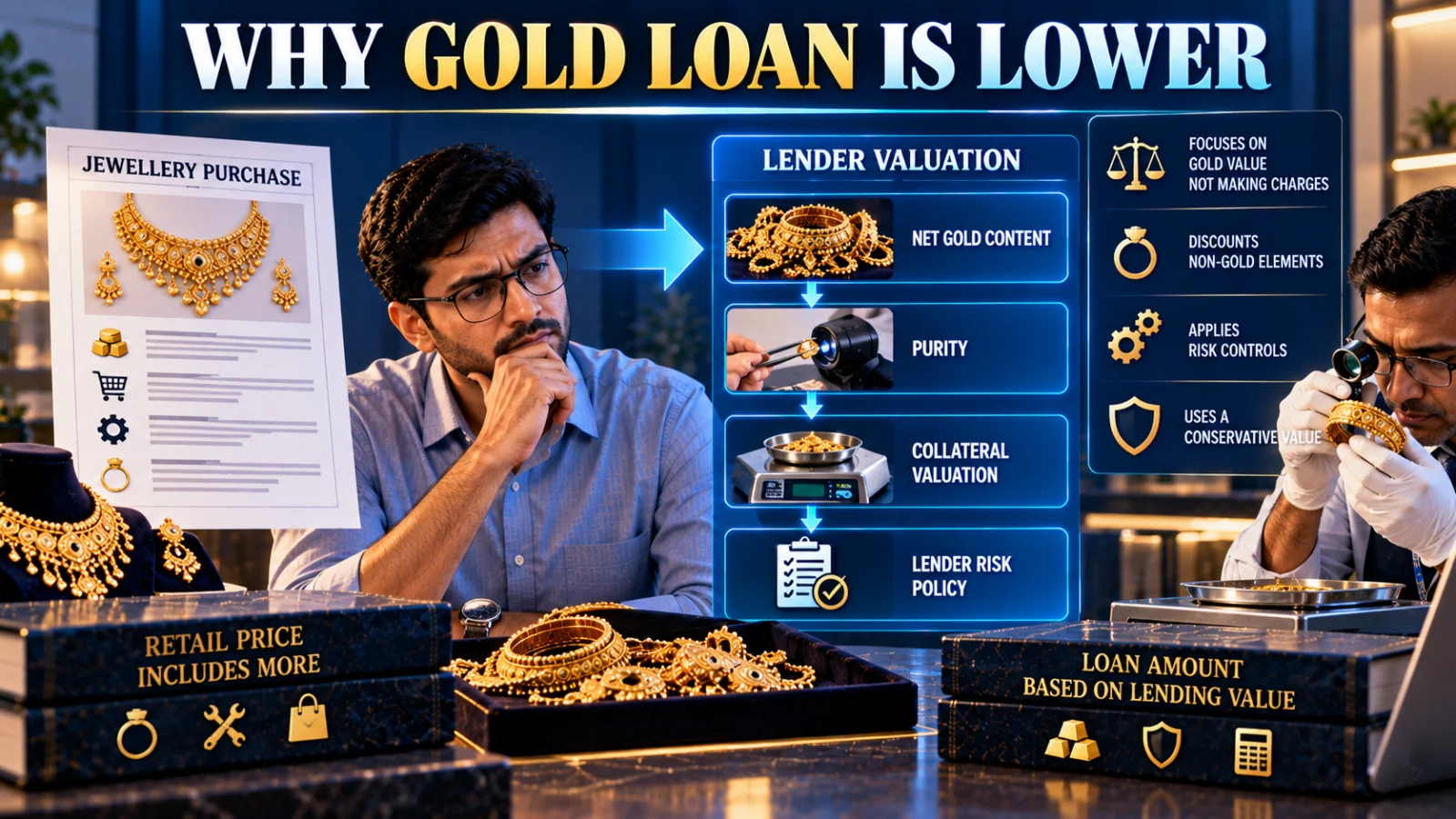
A gold loan amount can be much lower than your jewellery’s purchase value because the lender is not lending against the retail bill. Under the current RBI gold-and-silver collateral framework, the lender values the eligible gold content based on its actual purity and net weight, uses the prescribed reference-price method, excludes non-gold value such as stones or gems, and then applies the applicable loan-to-value or LTV limit.
That means a jewellery invoice can contain several amounts that do not become loan collateral. Making charges, design or retail margin, and the value of stones or other non-gold components can contribute to what you paid, but the RBI valuation framework focuses on the intrinsic value of the gold contained in the eligible collateral.
Retail jewellery value is not the same as gold-loan collateral value
| Part of jewellery value | What happens in gold-loan valuation? |
|---|---|
| Gold content | Eligible gold content is valued after weight and purity are established. |
| Making charges | They are not part of the intrinsic gold value used as collateral. |
| Precious stones or gems | RBI directions say these are not added to the collateral value. |
| Fastenings and other deductions | The lender’s assaying process identifies net gold weight and explains applicable deductions. |
| Retail markup | The retail selling price is not the RBI collateral-valuation basis. |
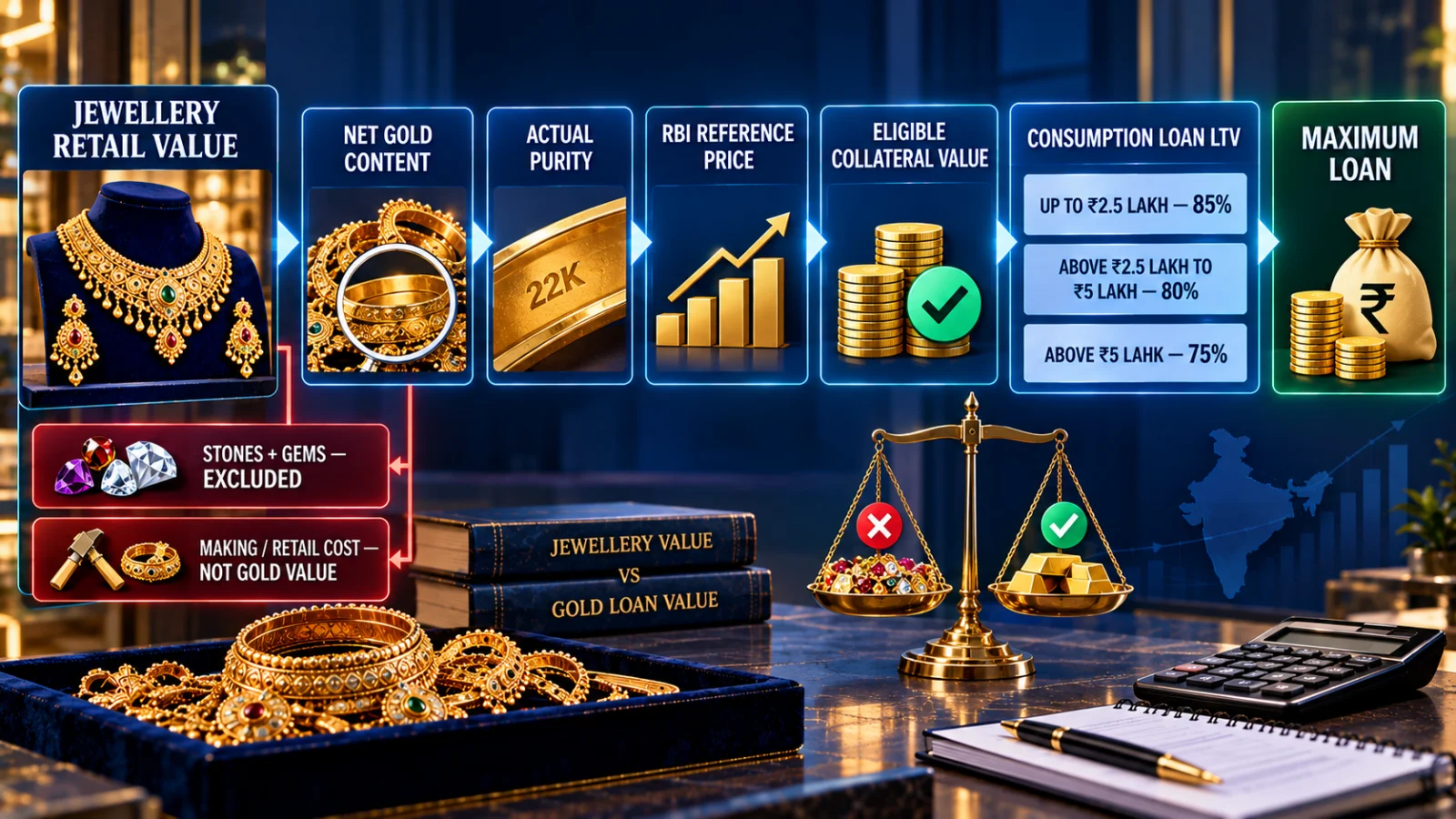
Gold loan amount lower than jewellery value: the calculation starts with net gold, not your invoice
The Reserve Bank of India’s Lending Against Gold and Silver Collateral Directions, 2025 require lenders to use a standardised process for assaying purity and determining gross and net weight.
The borrower must be present while the collateral is assayed at sanction. Deductions relating to stone weight, fastenings and similar non-gold portions must be explained, and the details are to be incorporated in the certificate issued as part of the process.
This is why two ornaments with the same gross weight can produce different collateral values. Their actual gold content and purity may be different even if their retail prices looked similar.
Purity changes the eligible gold value
RBI’s current framework values gold collateral according to its actual purity or caratage. A lower-purity ornament contains less fine gold for the same gross weight, so its collateral value will generally be lower than an otherwise comparable higher-purity ornament.
If a published price for the exact purity is unavailable, the lender must use the nearest available published purity and proportionately adjust the weight based on the collateral’s actual purity.
The lender’s website must disclose its methodology for determining the net weight of gold or silver content and the price it uses for determining the LTV ratio.
The lender cannot simply use today’s jewellery-shop price
The current RBI directions prescribe a reference-price method rather than allowing the jewellery’s retail ticket price to become the collateral value.
For the relevant purity, the lender uses the lower of:
- the average closing price over the preceding 30 days; or
- the closing price on the preceding day.
The price must come from the India Bullion and Jewellers Association Ltd. or a commodity exchange regulated by SEBI, as specified in the RBI directions.
Because the lower of those two reference prices is used, the collateral valuation can also be below a spot or retail gold price that a borrower sees elsewhere on the day of the loan.
Only the intrinsic gold value is counted
RBI’s current directions state that only the intrinsic value of the gold or silver contained in the eligible collateral is to be reckoned for valuation. Other cost elements, including precious stones or gems, are not added.
This continues the regulatory principle seen in earlier RBI gold-loan rules: the lender is financing against the underlying gold value, not against everything that contributed to the jewellery-shop invoice.
So a ₹5 lakh jewellery bill does not establish ₹5 lakh of eligible collateral. Before any LTV is applied, the lender first has to determine how much eligible gold is actually present and what that gold is worth under the regulatory valuation method.
Then the LTV limit reduces the maximum loan further
LTV means the outstanding loan amount divided by the value of the pledged eligible collateral. Even after the lender establishes the gold collateral value, the borrower is not automatically entitled to borrow 100% of that value.
Under the current RBI Directions, the maximum LTV for consumption loans is tiered by the total consumption-loan amount per borrower:
| Total consumption loan amount per borrower | Maximum RBI LTV |
|---|---|
| Up to ₹2.5 lakh | 85% |
| Above ₹2.5 lakh and up to ₹5 lakh | 80% |
| Above ₹5 lakh | 75% |
The prescribed LTV must be maintained on an ongoing basis through the loan tenor.
Important: these numerical tiers are specifically prescribed for consumption loans. The RBI Directions also cover loans for income-generating purposes, including farm, business and commercial activity, but readers should not automatically apply the consumption-loan table to every business or farm gold loan. The lender’s applicable policy and the relevant RBI framework should be checked for that loan type.
Why the gap between jewellery price and loan amount can be large
The gap is usually produced in layers:
- Retail value is stripped back to eligible collateral. Decorative, making and other non-gold value does not become intrinsic gold value.
- Gross weight becomes net eligible gold weight. Stones, gems, fastenings and other non-gold portions can reduce the weight used for valuation.
- Purity is applied. The lender values the actual gold content, not merely the ornament’s gross grams.
- The RBI reference-price method is applied. The lower of the prescribed 30-day average and previous-day closing price is used for the relevant purity.
- The applicable LTV is applied. For consumption loans, even the resulting eligible collateral value is subject to the RBI maximum LTV tier.
Each stage can reduce the amount compared with the original jewellery invoice. That does not by itself mean the lender has undervalued the ornament.
What should you ask the lender to show you?
If the offered loan looks unexpectedly low, ask for the figures behind the valuation rather than comparing only the loan amount with your purchase invoice.
- What gross weight did the lender record?
- What net gold weight was used after deductions?
- What purity or caratage was determined?
- What deductions were made for stones, fastenings or other non-gold material?
- Which reference price was used?
- What collateral value did the lender calculate?
- What LTV was applied to your particular loan?
The RBI framework requires standardised assaying and valuation procedures and requires lenders to disclose their net-weight methodology and valuation-price method on their websites.
Does a hallmark guarantee a particular loan amount?
No. Hallmark information can help establish jewellery purity, but the final loan calculation still depends on eligible net gold content, the applicable reference price, the nature and amount of the loan, the permitted LTV and the lender’s credit policy.
A high jewellery purchase price or a high current retail gold price therefore does not guarantee a proportionately high loan sanction.
Does the highest RBI LTV mean the lender must offer that much?
No. An RBI maximum is a ceiling, not a promise that every borrower will receive the maximum percentage. The lender’s credit policy, repayment-capacity assessment where applicable, product terms and other lawful underwriting conditions can result in a lower sanctioned amount.
The 2025 Directions specifically require a detailed credit assessment, including repayment-capacity assessment, where the total loan amount against eligible collateral exceeds ₹2.5 lakh.
Bottom line
Your gold loan amount is based on eligible collateral value, not on what the jewellery cost at the shop. The current RBI framework moves from net gold content and actual purity to a prescribed reference price, excludes non-gold value, and then applies the relevant LTV framework.
That is why an expensive ornament can support a much smaller loan than its invoice value suggests. To check whether the lender’s figure makes sense, compare the lender’s net gold weight, purity, reference price, collateral value and applied LTV rather than comparing the loan directly with the jewellery bill.
Verification note
TPS reviewed the Reserve Bank of India (Lending Against Gold and Silver Collateral) Directions, 2025, including the current valuation, assaying and consumption-loan LTV provisions, and checked earlier RBI gold-loan guidance for the longstanding intrinsic-gold-value principle.
Limitations and unresolved facts
The exact sanctioned amount is lender- and borrower-specific. The RBI’s 85%, 80% and 75% maximum LTV tiers cited here apply specifically to consumption loans. Income-generating loans, lender-specific credit policy, repayment-capacity assessment, product conditions and changes to regulatory guidance can produce a different result. TPS has not calculated any reader’s individual eligible loan amount.