






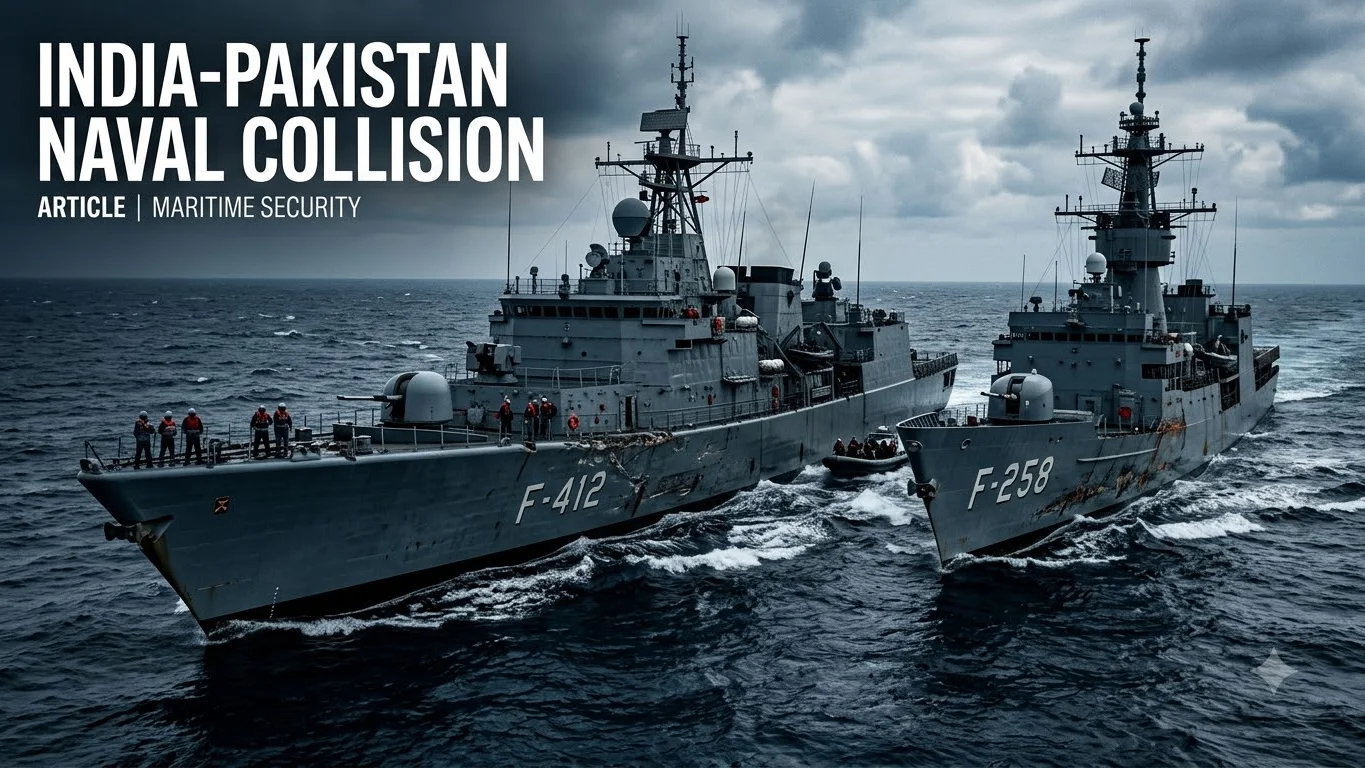
The India Pakistan naval collision has triggered a formal diplomatic protest from New Delhi, but the evidence reviewed so far does not establish deliberate ramming, combat or a wider naval escalation.
Indian and Pakistani naval units collided in international waters in the northern Arabian Sea. India subsequently summoned Pakistan’s Charge d’Affaires and protested what its foreign ministry described as unacceptable and unprofessional conduct by the Pakistani side.
India also says the Pakistani naval unit’s conduct contravened Article 10 of a 1991 bilateral military agreement. That allegation is India’s official position. It is not, by itself, an independently adjudicated finding of fault.
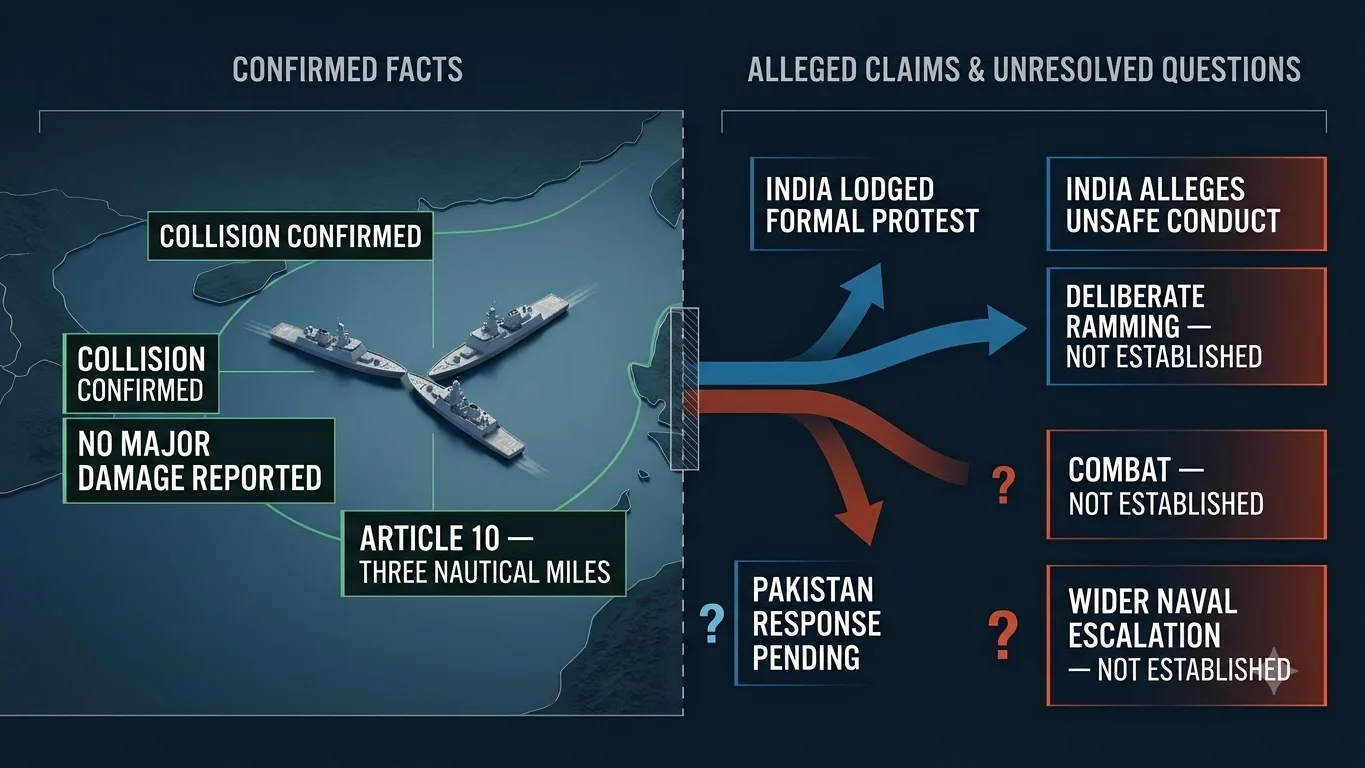
What is confirmed so far: a collision occurred, India lodged a formal protest, and India says the incident involved a breach of the bilateral three-nautical-mile naval-separation rule. No major damage was reported in the current India-attributed account. Pakistan’s public version, precise fault, intent and wider operational consequences remained unresolved when TPS completed its review.
What happened in the India-Pakistan naval collision?
Current Reuters, AP and Indian reporting directly attribute the incident and diplomatic protest to India’s Ministry of External Affairs.
AP reports that the collision took place on September 15 in the northern Arabian Sea in international waters. The exact coordinates were not established in the evidence reviewed by TPS.
After the incident, India summoned Pakistan’s senior diplomat in New Delhi and lodged a strong protest. India also instructed its diplomatic mission in Islamabad to raise the issue with Pakistani authorities.
Was there major damage or were there casualties?
The current India-attributed account says there was no major damage from the collision.
TPS did not recover a standalone Indian Navy damage assessment or a complete primary casualty statement during this research pass. That means the safest current wording is that no major damage has been reported, while the complete damage and casualty picture remains subject to further official clarification.
What does India say caused the collision?
India has blamed what it described as unacceptable and unprofessional conduct by the Pakistani naval unit.
That wording should remain attributed to India. The reviewed evidence does not independently establish the full navigational sequence immediately before impact, which vessel had the right of way, whether either side manoeuvred incorrectly, or whether any formal investigation has assigned responsibility.
There is also no evidence in the reviewed material establishing that the collision was intentional.
What is Article 10 of the 1991 India-Pakistan agreement?
The dispute matters because India has specifically invoked Article 10 of a bilateral agreement dealing with military exercises, manoeuvres and related military conduct.
Article 10 says naval ships and submarines of India and Pakistan should not close within three nautical miles of one another while operating in international waters. The provision is intended to reduce the risk of accidents and dangerous close approaches.
India says the Pakistani unit’s conduct during this incident contravened that rule. Whether an investigation ultimately confirms that assessment is still unresolved.
Did Pakistan deliberately ram the Indian vessel?
There is no evidence reviewed by TPS that establishes deliberate ramming.
A collision between military vessels can be serious without automatically being an intentional attack. The current evidence supports describing this as a naval collision followed by an Indian diplomatic protest. It does not support upgrading the event to deliberate ramming, an armed clash or combat.
Was this a naval battle or armed confrontation?
No weapons use or armed engagement was established in the reviewed evidence.
India’s diplomatic protest increases the political significance of the incident, but a formal protest is not the same thing as evidence that the two navies entered combat or that either government has changed its rules of engagement.
What has Pakistan said?
No immediate Pakistani government or naval response to the collision was identified in the material reviewed by TPS.
That is an important current limitation. India’s version is therefore the principal government account available in the evidence set, but it should not be treated as Pakistan’s agreed version of events or as an independent determination of fault.
If Pakistan’s Foreign Office or Navy issues a materially different account, this article should be updated on the same URL.
Which ships were involved?
Some current reports have named vessels, but TPS did not recover direct primary naval documentation establishing the exact vessel identities during this research pass.
For that reason, the core article does not depend on a specific ship identification. Vessel names, classes or manoeuvres should be added only when supported by a direct naval or government source or sufficiently reconciled evidence.
Does the collision change naval activity in the Arabian Sea?
There is currently no verified evidence that the incident has changed Indian or Pakistani naval deployments, patrol patterns, navigation restrictions or operational posture.
That could change if either government announces a new maritime instruction, investigation, deployment change or deconfliction measure. None was established in the evidence reviewed for this first publication.
Does this affect commercial shipping?
TPS found no evidence that the collision has disrupted merchant shipping, closed a maritime route or created new navigation restrictions for commercial vessels.
The northern Arabian Sea is strategically important and military incidents can matter to maritime-risk monitoring, but readers should not infer a commercial-shipping disruption from the naval collision alone.
Why this incident matters even without major damage
The significance comes from the combination of three facts: naval units from two rival states physically collided, India formally protested, and New Delhi invoked an existing bilateral collision-prevention rule.
That creates a deconfliction and diplomatic issue even if the vessels suffered no major damage. It also creates a need to distinguish what is already established from what remains allegation, interpretation or speculation.
What could change the assessment next?
The most important next evidence would be a public Pakistani response, an Indian Navy or additional MEA statement, confirmed vessel identities, a detailed damage or casualty assessment, navigational evidence, an investigation finding or a concrete change in naval operations.
A Pakistani response could either corroborate parts of India’s account, dispute responsibility or introduce a different description of the encounter. An investigation could also clarify whether Article 10 was breached and whether fault can be assigned.
Until then, the strongest evidence-backed description remains: a naval collision occurred in international waters, India lodged a formal protest and accused the Pakistani side of unsafe conduct, while intent, final responsibility and broader operational consequences remain unresolved.
Verification method
ThePulseSignal reviewed current Reuters and AP reporting with direct attribution to India’s Ministry of External Affairs, corroborating Indian coverage, and the text of Article 10 in the 1991 bilateral military agreement. TPS also checked for a current Pakistani government response and did not identify one in the material reviewed.
Limitations and unresolved facts
A standalone current MEA or Indian Navy incident statement was not recovered in this research pass. Pakistan’s account was still unavailable. Exact vessel identities, precise coordinates, full casualty and damage details, navigational sequence, fault, intent, investigation status and any change in naval or commercial maritime activity remain unresolved.