







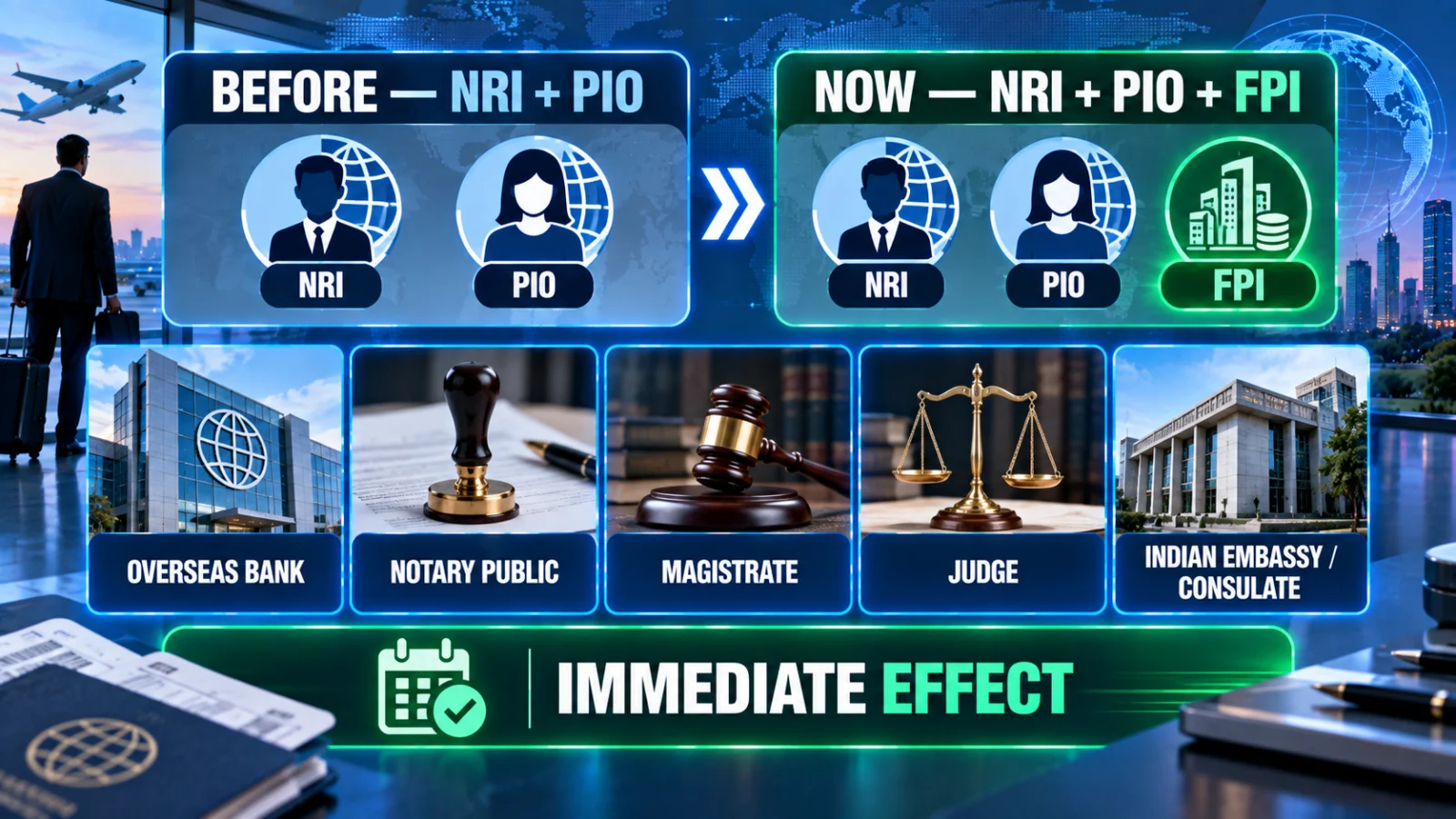
The RBI RRB KYC Amendment 2026 changes one narrow but important part of Regional Rural Bank KYC: Foreign Portfolio Investors can now use the alternative overseas certified-copy route that was already available to NRIs and PIOs. The September 18 amendment is reproduced as RBI/2026-27/260 and says the change takes effect immediately.
Direct answer: the newly added category is the Foreign Portfolio Investor. The amendment does not establish that all FPI KYC requirements have been relaxed or removed. It extends the existing alternative original-certified-copy facility in the RRB KYC Directions to FPIs.
What changed in the RBI RRB KYC Amendment 2026?
The amendment substitutes paragraph 4(1)(v) of the Regional Rural Banks Know Your Customer Directions. Before this change, the alternative original-certified-copy route applied to NRIs and PIOs. The September 18 text adds Foreign Portfolio Investors to that group.
That distinction matters because an article saying RBI has introduced a new NRI or PIO facility would be misleading. The practical addition is FPI eligibility for the same alternative certification route.
What did not change?
The evidence reviewed does not show that RBI removed the broader customer due-diligence obligations applicable to FPIs. It also does not establish that uncertified copies may now be accepted or that every FPI document can bypass ordinary verification.
The amendment is therefore best understood as a change to the permitted certification route for documents when the relevant provision applies, not as a wholesale rewrite of FPI KYC.
Who can certify the documents abroad?
The substituted provision retains the specified overseas certification authorities. The reproduced amendment lists the following routes:
- overseas branches of Indian Scheduled Commercial Banks;
- overseas banks having relationships with Indian banks;
- a notary public abroad;
- a court magistrate;
- a judge; and
- the Indian Embassy or Consulate General in the country where the non-resident customer resides.
Compliance teams should use the controlling RBI text and their institution’s approved procedure when deciding whether a particular certification satisfies the rule.
Does the amendment apply immediately?
Yes. The reproduced September 18 notification says the amendment comes into force with immediate effect.
That means RRB compliance and operations teams handling an eligible FPI case should not continue relying on an older version of paragraph 4(1)(v) that limits the alternative facility to NRIs and PIOs.
Does this change all FPI KYC requirements?
No evidence reviewed by TPS supports that conclusion. The amendment changes the certified-copy provision. Separate FPI customer-identification, due-diligence, beneficial-ownership, regulatory and record requirements remain outside the scope of this narrow amendment unless another controlling rule says otherwise.
Teams should therefore avoid treating the September 18 change as a general relaxation of FPI onboarding or anti-money-laundering requirements.
Is this the same as RBI’s September money-mule KYC proposal?
No. The September 18 RRB amendment is a separate regulatory instrument from the September 2026 draft KYC changes dealing with suspected money-mule accounts and temporary debit restrictions.
The two measures belong to the broader KYC framework but address different reader and compliance problems.
What should an RRB or FPI compliance team check now?
Verify that the customer is being handled as a Foreign Portfolio Investor for the relevant KYC process.
Determine which KYC documents are required under the applicable RRB and FPI framework before considering certification.
Use one of the permitted overseas certification routes where paragraph 4(1)(v) applies.
Retain the certified-copy evidence and the current regulatory basis used to accept it.
Continue applying other KYC and due-diligence requirements unless the controlling rules expressly modify them.
Confirm the live RBI notification or consolidated directions before making consequential compliance decisions.
Why the before-and-after distinction matters
The key compliance question is not whether RBI created an entirely new overseas certification system. It is whether the existing system now covers another customer class.
The answer is yes: the September 18 amendment extends the relevant facility to FPIs. NRIs and PIOs were already covered under the earlier RRB KYC wording.
What remains unresolved?
The controlling RBI notification URL has been identified, and multiple current regulatory sources reproduce the same notification number and substituted clause. However, TPS was not able to directly retrieve the RBI-hosted artifact during the research pass.
The evidence reviewed also does not establish how quickly every RRB will update internal manuals, onboarding checklists or operational systems to reflect the amendment.
Verification note
ThePulseSignal reconciled two current reproductions of RBI/2026-27/260 with the pre-amendment Regional Rural Banks KYC wording. The comparison supports the central conclusion that FPIs are the newly added category in the alternative certified-copy provision. Direct access to the identified RBI-hosted artifact remained unavailable during this review.
Bottom line
The September 18 RBI RRB KYC amendment adds Foreign Portfolio Investors to an overseas certified-copy facility that already covered NRIs and PIOs. RRB and FPI compliance teams should update the relevant documentation workflow, but they should not interpret this narrow amendment as removing other KYC or due-diligence requirements.