




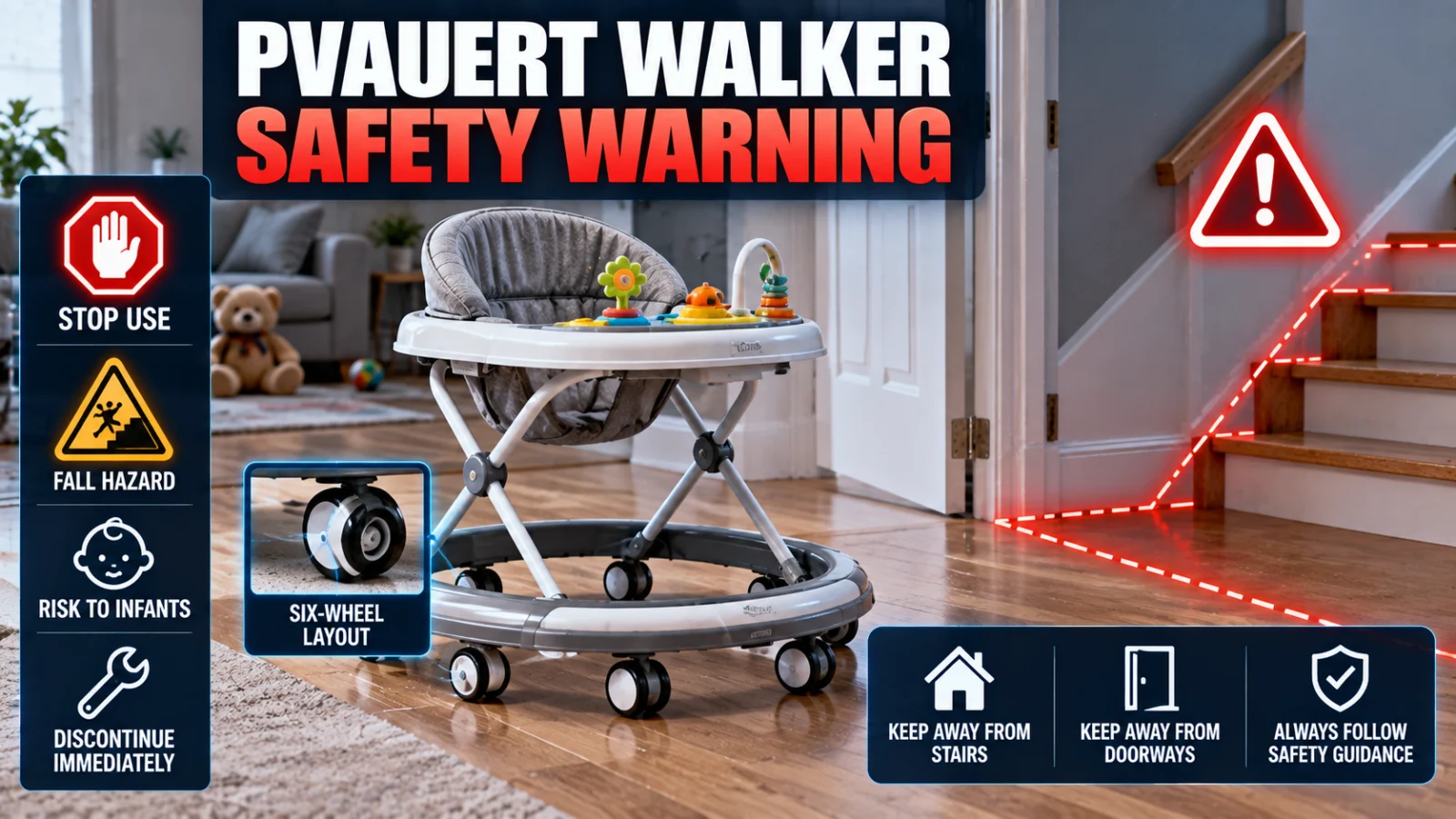
The Pvauert infant walker warning applies to model CT02. The U.S. Consumer Product Safety Commission says consumers should stop using the affected walkers immediately because they can fit through a standard doorway and fail to stop at the edge of a step, creating a fall hazard that can cause serious injury or death.
Direct answer: If your walker is a Pvauert model CT02, CPSC says stop using it immediately, dispose of it, and do not sell or give it away. CPSC says it is aware of six incidents, including three head injuries. This is currently a product safety warning, not an agreed recall with a refund, repair or replacement remedy.
Which Pvauert infant walker is affected?
CPSC identifies the affected product as the Pvauert infant baby walker, model CT02. The product name and model number are printed on a label on the underside of the seat.
The warning describes a foldable walker with nine adjustable height settings, a tray, a round base and six wheel assemblies. The walkers were sold in black, green, pink and white.
What is the safety problem?
CPSC says the walkers violate the mandatory federal safety standard for infant walkers because they can fit through a standard doorway and fail to stop at the edge of a step.
That creates a fall hazard. A child in the walker could move through a doorway or reach an elevated edge and fall, creating a risk of serious injury or death.
Have children been injured?
Yes. CPSC says it is aware of six incidents involving the walkers. Three of those incidents resulted in head injuries.
The reported incident count is the number known to CPSC in the current warning. It should not be treated as a prediction of how many additional incidents may exist or occur.
How many walkers are involved?
CPSC says about 5,451 Pvauert CT02 infant walkers are involved in the warning.
The agency says the walkers were sold on Amazon.com from October 2025 through June 2026 for about $65. CPSC also says the products may have been sold by other sellers and on other websites, so an owner should verify the model number rather than relying only on purchase history.
What should owners do now?
Look on the underside of the seat for the product label and confirm whether the model number is CT02.
If it is CT02, follow CPSC’s instruction to stop using it immediately.
Do not allow another child to use the walker while deciding how to dispose of it.
CPSC specifically warns consumers not to sell or give away the affected walkers.
CPSC’s current instruction is to dispose of the product because the seller has not agreed to a recall remedy.
If an injury or product-safety incident occurred, consumers can report it through SaferProducts.gov.
Is this a recall?
Not in the current CPSC notice. CPSC issued a product safety warning and says the retailer has not agreed to recall the walkers or offer a remedy.
That distinction matters. A formal recall often provides a defined consumer remedy such as a refund, repair or replacement. The current Pvauert warning does not establish any such remedy.
Can owners get a refund, repair or replacement?
No refund, repair or replacement programme is established in the current CPSC warning. The agency says the firm has not agreed to a recall or consumer remedy.
Owners should therefore not assume that a reimbursement or replacement is available unless CPSC, the seller or a marketplace later publishes a new remedy.
What if the walker was not bought on Amazon?
The product can still be relevant to the warning if it is model CT02. CPSC says the walkers were sold on Amazon during the identified period and may also have been sold by other sellers and on other websites.
The model label is therefore more reliable than assuming the warning only applies to Amazon purchases.
Can the walker be sold second-hand or given to another family?
No. CPSC tells consumers not to sell or give away the affected walkers.
Passing the product to another family would transfer the same fall hazard rather than resolve it.
What if the model number is missing or unreadable?
The current CPSC warning specifically identifies model CT02. If the label is missing or cannot be read, do not guess that a visually similar walker is covered or excluded.
Compare the product with the identifying information and photographs in the current CPSC warning. If uncertainty remains, use the current CPSC information before allowing further use.
Why does the doorway and step-edge test matter?
The federal infant-walker safety standard is intended to reduce hazards including falls down steps. CPSC says these Pvauert walkers can pass through a standard doorway and do not reliably stop at the edge of a step.
That failure is central to the agency’s stop-use instruction and is more important for owner action than whether a particular walker has previously appeared to work normally in the home.
What could change next?
The current state could change if the seller agrees to a formal recall or remedy, CPSC publishes updated injury information, a marketplace announces a consumer programme, or the warning is revised.
If that happens, the safest action path may change from disposal-only guidance to a defined refund, replacement, repair or other remedy. Until then, the current CPSC instruction is to stop use, dispose of the walker and not resell or give it away.
What remains unknown?
- Whether the seller will later agree to a formal recall.
- Whether a refund, repair or replacement programme will be created.
- How many units remain in homes or second-hand circulation.
- Whether additional sellers or websites distributed material quantities.
- Whether CPSC will report additional incidents or injuries.
Verification note
ThePulseSignal reviewed CPSC’s September 17, 2026 product safety warning for Pvauert CT02 infant walkers, including the product-identification details, unit count, sales information, reported incidents, injury count, hazard description and current consumer action. Current secondary coverage was also checked for consistency with the agency notice.
Bottom line
If you own a Pvauert CT02 infant walker, CPSC says to stop using it immediately, dispose of it, and do not sell or give it away. About 5,451 units are covered by the warning, and CPSC reports six incidents including three head injuries. The seller has not agreed to a recall or consumer remedy, so owners should not assume a refund, repair or replacement is currently available.