






A blank sailing replacement vessel is not always obvious from a carrier notice that says your cargo will move on the “next available sailing.” The original voyage may be cancelled, one port call may be skipped, cargo may be redistributed onto another service, or a replacement vessel may still be only provisional.
The practical question is not simply whether the sailing was blanked. It is: which vessel and voyage now own your booking, when will they depart, and is your container actually protected or loaded on that replacement?
Direct answer
How do you find the replacement vessel after a blank sailing?
Start with the carrier’s blank-sailing advisory to confirm what was cancelled. Then check the current booking record for a replacement vessel and voyage, compare the revised port-of-loading departure date, verify any changed cut-offs and determine whether the carrier has actually reassigned or protected your cargo on that sailing.
For cargo already handed to the carrier, the strongest evidence is the updated booking plus later container-specific loading and vessel-departure milestones.
First thing to check
“Next available sailing” is not the same as a confirmed replacement
A carrier can intend to move cargo on the next available sailing before the final vessel, voyage, capacity or routing has been assigned to your individual booking.
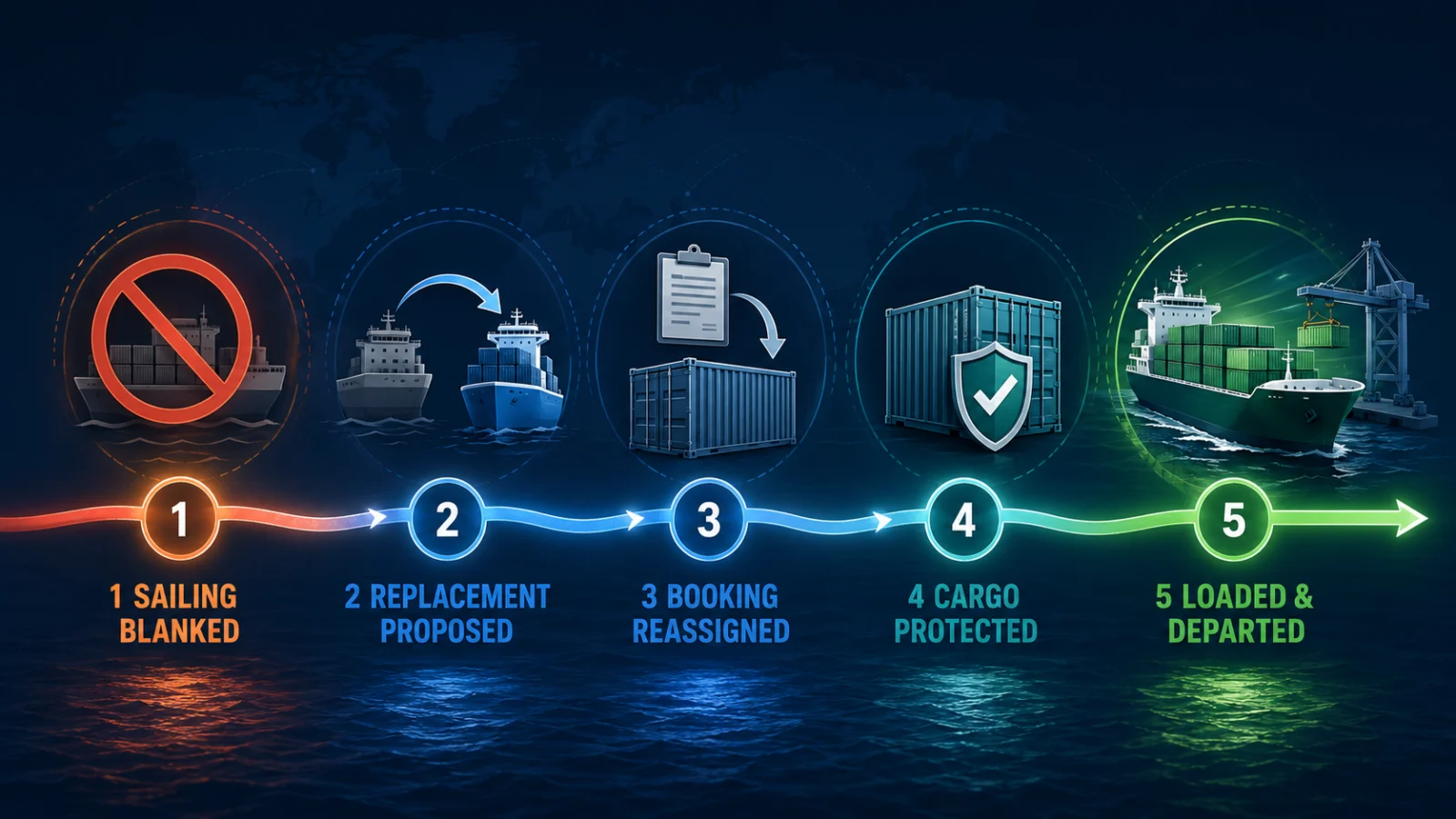
State 1
Original sailing blanked
The booked vessel position or port call will not operate as originally scheduled.
State 2
Replacement proposed
A carrier identifies a likely later voyage, alternative vessel or network option.
State 3
Booking reassigned
The replacement vessel and voyage now appear against the shipment booking.
State 4
Replacement movement confirmed
The cargo is accepted or protected and later shipment evidence shows loading or departure on the revised plan.
In this guide
- What a blank sailing actually means
- Full sailing vs skipped port call
- Blank sailing vs rollover vs omission
- Replacement-vessel evidence chain
- Start with the carrier advisory
- Check the booking, not only the schedule
- Cargo protection and space
- Check revised ETD and cut-offs
- Cargo gated vs not yet handed over
- When the replacement changes again
- Why the next sailing may also be full
- Watch, verify or act
- Worked example
- Related TPS shipment diagnostics
- Verification boundaries
- Limitations
- FAQs
A blank sailing replacement vessel begins with understanding what was actually cancelled
A blank sailing generally means a scheduled container-shipping sailing or service position will not operate as originally planned. Depending on the carrier and context, the term can describe an entire cancelled sailing or a skipped port call within an otherwise operating voyage.
That distinction matters because the replacement path changes.
Entire sailing blanked
The scheduled service position disappears and affected bookings need another sailing or network plan.
One port call skipped
The vessel may continue sailing but not call your load or discharge port.
Service reset
A carrier may remove one voyage position to restore schedule reliability and redistribute cargo through remaining services.
Flexport’s blank-sailing guidance notes that a blank sailing can involve a skipped port or the cancellation of an entire sailing, while cargo is generally moved to another available option.
Do not infer the replacement from the word “blanked” alone. First identify whether your entire booked voyage disappeared, one relevant port was omitted or the carrier is restructuring the service.
Full sailing cancellation and port-call cancellation produce different next steps
Full sailing blank
The vessel position itself is cancelled. Your booking may be shifted to the same vessel on a later voyage, a different vessel, another service or a wider network alternative.
Port-call blank or omission
The vessel may continue its voyage while skipping one port. The carrier then needs another plan for cargo associated with that omitted call.
Carrier terminology is not perfectly uniform. Therefore the operational facts are more useful than the label: Did the voyage disappear, or did the vessel sail while skipping your port?
Blank sailing, rollover and port omission should not be treated as synonyms
| Event | What happened | Main reader question |
|---|---|---|
| Blank sailing | The planned sailing or service position did not operate as booked | Which sailing replaces it? |
| Rollover | A sailing operated, but your cargo was moved to a later sailing | Why did my box stay behind and where was it rebooked? |
| Port omission | The vessel operated but skipped a particular port | Where will my cargo now load or discharge? |
| Missed transshipment connection | The box reached a hub but failed to make the intended onward vessel | Did it miss the connection or get rebooked? |
TPS interpretation: the quickest diagnostic is to ask whether the planned vessel/call itself disappeared or whether it operated without your container.
Use an evidence chain to find the real replacement vessel
Replacement-vessel verification path
The evidence becomes stronger as it becomes more shipment-specific. A public schedule can show that a vessel exists. It cannot by itself prove your booking moved onto that vessel.
| Evidence | What it proves | Strength |
|---|---|---|
| Carrier blank-sailing advisory | The original sailing or call changed | Strong event evidence |
| Public carrier schedule | A later vessel or service is scheduled | Planning evidence only |
| Updated booking record | Your shipment is assigned to a replacement vessel/voyage | Strong shipment-specific evidence |
| Carrier cargo-protection confirmation | The carrier intends or confirms that the cargo has space on the alternative | Stronger operational evidence |
| Container load event | The box was reported loaded on the replacement vessel | Very strong shipment evidence |
| Replacement-vessel departure | The revised sailing actually departed | Strong transport evidence |
Start with the carrier’s blank-sailing advisory
A carrier advisory can establish several facts before your individual booking catches up:
- which vessel and voyage were blanked;
- which ports are affected;
- whether the entire service position or only selected calls are affected;
- whether cargo will be protected on another sailing;
- whether a named alternative vessel or voyage is proposed;
- whether revised cargo or documentation dates will follow.
Maersk’s August 10, 2026 SLI advisory is a useful example. It blanked AS Sara voyage 633N and stated that cargo would be protected on the next available sailing, while identifying AS Sara 634N as the alternative voyage then under consideration.
“Under consideration” or “next available sailing” is still weaker than seeing the replacement vessel and voyage confirmed against your own booking.
Check the booking record — not only the next vessel on the schedule
Suppose the service normally sails every Tuesday and the carrier’s public schedule shows another vessel next Tuesday.
That tells you the next service exists. It does not automatically tell you your container has space on it.
Schedule evidence
Vessel C, voyage 634N, is currently planned to call the port on the revised date.
Booking evidence
Your shipment reference now identifies Vessel C, voyage 634N, as the revised booked movement.
Carrier support material also treats vessel availability and booking amendment as separate steps, reinforcing the distinction between a sailing existing and an individual booking being moved onto it.
“Cargo protected” is useful — but understand what it confirms
Carriers often use language such as:
- cargo will be protected;
- cargo will be rebooked;
- bookings will be moved to the next available sailing;
- alternative routing will be arranged.
This can be meaningful operational evidence, but the strongest answer still includes a named vessel, voyage and current booking state.
Weak
“Next available sailing”
No specific replacement has been confirmed yet.
Better
Named alternative
A vessel and voyage are proposed in carrier guidance.
Strong
Booking reassigned
Your shipment record now carries the replacement vessel/voyage.
Strongest
Loaded and departed
Shipment evidence shows the container actually moved on the replacement.
Check the revised ETD, cargo window and documentation cut-offs
A replacement sailing can create new operational dates. Depending on the carrier and port, these may include revised:
- port-of-loading ETD;
- cargo receiving or gate-in window;
- shipping-instruction cut-off;
- VGM cut-off;
- documentation deadlines;
- transshipment connection timing.
Do not assume every cut-off changes. Check what the carrier has actually revised for the replacement movement.
Maersk’s August 2026 AS Sara advisory specifically said revised cargo-receiving dates and documentation cut-offs would be communicated for the affected cargo.
Operational rule: identifying the replacement vessel is only part of the job. Missing the replacement sailing’s revised cargo or documentation deadline can turn a carrier-induced schedule change into a second shipment delay.
Your options depend partly on whether the cargo has already been handed over
Not yet gated
The shipper may still be able to accept the new sailing, amend the booking or evaluate another commercial option, subject to the booking terms and carrier availability.
Already gated
The container is already within the carrier-terminal operating chain and the practical alternatives may be narrower.
Already moving
If the cargo is already on an earlier leg, a downstream blank sailing can become a transshipment-connection problem instead.
If your container has already reached an intermediate hub and the issue is now whether it made the next connection, use ThePulseSignal’s transshipment-port container guide.
A replacement vessel can change again before departure
Shipping schedules remain operational plans until the movement actually occurs. A proposed replacement can later be:
- changed to another vessel;
- shifted to another voyage;
- moved to another service;
- rerouted through another hub;
- affected by another schedule reset.
That is why a screenshot taken immediately after the blank-sailing notice should not be treated as permanent proof.
TPS interpretation: freeze your decision on the latest shipment-specific booking and carrier evidence, not on the first replacement mentioned after the cancellation.
Why the next sailing may not automatically take your container
A blank sailing removes capacity from a network position. Cargo that would have moved on the cancelled sailing can accumulate into the following departures.
Marine Insight and Trackberry both describe the practical consequence: cargo from the blanked position can compete for space on later sailings, which means the next scheduled vessel may itself become capacity-constrained.
What “next sailing” means
The next vessel position exists in the service schedule.
What still needs verification
Your cargo is actually accepted, protected or assigned to that sailing.
Watch, verify or act
1
WATCH
The original sailing is blanked, the carrier has announced cargo protection and your replacement booking details are expected but not yet final.
2
VERIFY
A replacement vessel appears in a schedule or advisory, but your booking, revised ETD, cargo protection or cut-offs are still unclear.
3
ACT
Your booking has not been reassigned, the replacement no longer meets your delivery requirement, revised cut-offs require immediate action or the cargo has missed the proposed alternative.
Worked example: from blanked voyage to confirmed replacement
Assume your original booking is:
| Evidence | What you can conclude |
|---|---|
| Booking shows Vessel A / Voyage 633N | This is the original transport plan. |
| Carrier advisory says Voyage 633N is blanked | The original sailing is no longer valid. |
| Advisory says cargo will be protected on the next available sailing | The carrier intends to re-accommodate the cargo, but the final replacement may not yet be shipment-specific. |
| Carrier identifies Vessel A / Voyage 634N as the alternative | A specific replacement is proposed. |
| Your booking updates to Vessel A / Voyage 634N | The replacement is now tied to your shipment. |
| New ETD and documentation cut-offs appear | The revised operating plan is actionable. |
| Container tracking later shows loaded on 634N | Strong evidence that the box actually made the replacement sailing. |
| Vessel 634N departs | The replacement transport movement has occurred. |
This is materially stronger than assuming:
“The original vessel was cancelled, so my container will automatically leave one week later.”
Where blank sailing fits in the TPS shipment-diagnostics cluster
Related TPS shipping guides
Port disruption: is your container actually affected?
Use this when the starting signal is congestion, closure, disruption, schedule reset or a wider port/service problem and you need to establish whether your shipment intersects with it.
Container stuck at a transshipment port
Use this when the container has reached an intermediate hub and you need to determine whether the onward connection is still normal, missed or rebooked.
Verification notes: confirmed, carrier plan, interpretation and unresolved
Confirmed
- Blank sailings can remove scheduled service positions or port calls.
- Affected cargo can be moved to later or alternative sailings.
- Carriers can identify specific replacement vessels, voyages or alternative network arrangements.
- Blank sailings and individual-container rollovers are not the same operational event.
Carrier plan
- “Cargo protected” or “next available sailing” expresses the carrier’s current movement plan.
- A proposed replacement vessel can precede the final shipment-specific booking update.
TPS interpretation
- The booking record is stronger evidence than a generic public schedule for determining which vessel owns your shipment.
- Container loading and replacement-vessel departure provide stronger confirmation than a proposed alternative alone.
Not established by a blank-sailing notice
- that one specific replacement is final;
- that your cargo definitely has space;
- that all cut-offs are unchanged;
- that the replacement will depart exactly as currently scheduled;
- that your box has loaded.
Verification method
ThePulseSignal reviewed current Maersk 2026 blank-sailing advisories covering named replacement voyages, schedule resets and alternative service coverage; Maersk booking and vessel-availability support guidance; Hapag-Lloyd operational material showing blank weeks, vessel phase-ins and replacement patterns; and Flexport, Trackberry and Marine Insight material explaining blank-sailing behaviour and the distinction from rollover.
The article treats carrier advisory, public schedule, booking reassignment, cargo protection, container loading and vessel departure as separate evidence layers rather than treating “next available sailing” as final confirmation.
Limitations and unresolved facts
No general guide can identify the live replacement vessel for an individual booking without current carrier and booking data.
- Carrier terminology for blank sailing, void sailing, omitted call and cancelled voyage can vary.
- A public carrier schedule does not prove an individual booking has space.
- A proposed replacement vessel can change before departure.
- “Cargo protected” may not expose every operational condition or commercial term.
- Revised ETDs remain schedules rather than guarantees.
- Blank sailings can create capacity pressure on later departures.
- Already-gated, already-loaded and transshipment cargo can follow different operational paths.
- Booking amendments, cancellation rights, charges and commercial alternatives depend on the applicable carrier and contract terms.
- This article does not replace carrier confirmation for time-critical cargo.
Blank sailing replacement vessel: frequently asked questions
What happens to my container after a blank sailing?
The carrier will normally need to move the affected booking to another sailing or network option. The exact replacement can be the same vessel on a later voyage, a different vessel, another service or an alternative routing.
How do I find the replacement vessel after a blank sailing?
Check the carrier advisory first, then the current booking record. A named vessel and voyage against your booking are stronger evidence than simply seeing the next vessel in the public schedule.
Does “next available sailing” mean my container definitely has space?
Not necessarily. It describes the intended next movement, but shipment-specific booking or cargo-protection confirmation provides stronger evidence that your cargo has been accommodated.
Is a blank sailing the same as a rollover?
No. In a blank sailing, the scheduled sailing or call itself does not operate as planned. In a rollover, the sailing operates but your individual cargo moves to a later departure.
Can the replacement vessel change again?
Yes. Vessel assignments, services and routing can change before actual departure. Recheck the latest booking and carrier information if the shipment is time-sensitive.
Will my cargo leave exactly one week later?
Not necessarily. Even on a weekly service, the next departure may face capacity pressure, another schedule change or alternative routing.
Do I need to check new documentation cut-offs?
Yes, when the carrier revises them. A blank sailing can produce a new ETD, cargo-receiving window or documentation deadline, but which cut-offs change depends on the actual replacement plan.
What if my container is already at a transshipment port?
If the box is already at an intermediate hub, the problem may now be whether it made the replacement connection. In that case, verify discharge, the new connecting vessel, load event and departure.
Bottom line
When a sailing is cancelled, finding the blank sailing replacement vessel requires more than looking at the next ship in the timetable.
Best evidence chain: original sailing blanked → replacement proposed → booking reassigned → revised ETD and cut-offs checked → cargo protected → container loaded → replacement vessel departed.
Until the replacement vessel and voyage are tied to your booking, treat “next available sailing” as a plan rather than final proof.
Last verified: August 22, 2026. This guide reflects current carrier examples showing that blank sailings can lead to later voyages, different vessels, alternative services or wider network rebooking rather than one automatic replacement pattern.