




BRICS leaders adopted the 2026 New Delhi Declaration, giving political backing to cooperation on trade, payments, development finance, technology and global governance. For India, the declaration creates channels for cooperation rather than guaranteed economic gains. That distinction is important because FY2025-26 merchandise data show India exported about $95.7 billion of goods to its BRICS partners while importing about $321.8 billion, leaving a deficit of roughly $226.1 billion.
What did the BRICS Summit 2026 actually decide?
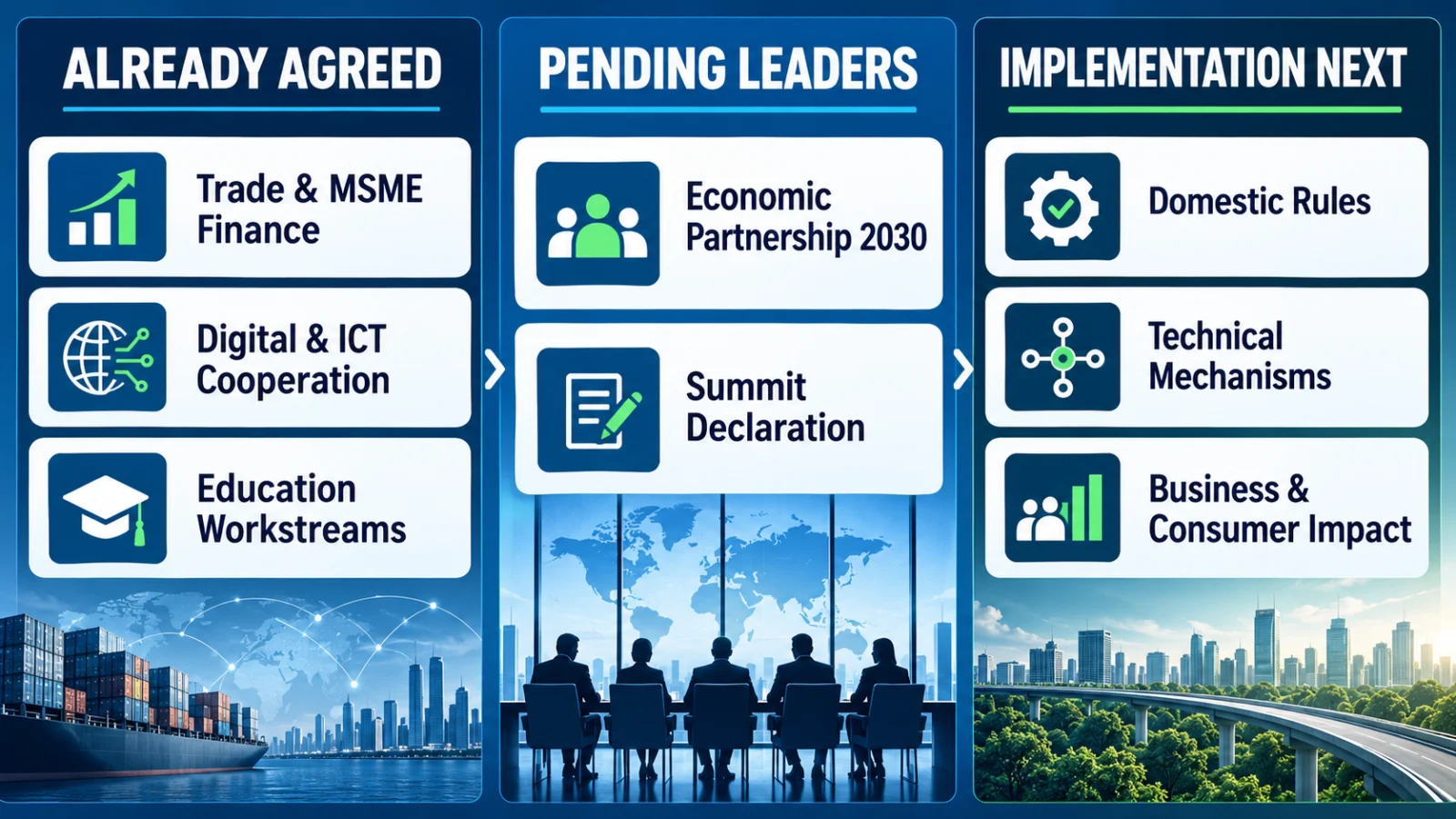
The New Delhi Declaration gives leader-level political backing to a broad set of BRICS cooperation tracks. It recognises continuing work on the Strategy for BRICS Economic Partnership 2030, directs further work on faster and more efficient cross-border payments, supports discussion of trade and investment settlement in local currencies, strengthens the role of the New Development Bank and advances cooperation in digital infrastructure, innovation, health, education, resilient supply chains and global-governance reform. On the Middle East, leaders expressed deep concern over escalating tensions, called for maximum restraint and reiterated that disputes should be addressed through dialogue, consultation and diplomacy. The declaration does not create a single BRICS currency, an instantly available consumer BRICS payment network, automatic tariff reductions or automatic cross-BRICS qualification recognition.
Why does BRICS still matter to India after the summit?
India’s interest in BRICS is broader than hosting one summit. The grouping gives India a large multilateral platform covering economic cooperation, development finance, trade, technology, diplomacy and Global South representation.
The 2026 declaration therefore matters less as a one-day announcement and more as a map of which cooperation tracks have collective political support and may move into technical, regulatory or institutional implementation.
For Indian businesses, banks, students and consumers, the key distinction is between BRICS-level political agreement and an operational mechanism available in India. The first can exist long before the second.
Is India economically benefiting from BRICS trade?
The current merchandise-trade data show a large and widening imbalance, but the trade deficit is not by itself a complete scorecard of whether BRICS is beneficial or harmful to India.
For FY2025-26, India’s merchandise exports to its ten BRICS partner countries were about $95.7 billion, while imports were about $321.8 billion. That produced a merchandise trade deficit of approximately $226.1 billion. Total goods trade with the grouping was about $417.5 billion.
For comparison, the deficit was about $74.5 billion in FY2020-21. Over the same period, exports to BRICS partners rose from about $64.3 billion to $95.7 billion, while imports increased from about $138.8 billion to $321.8 billion.
The imbalance is also concentrated rather than evenly distributed across every BRICS relationship. China, Russia and the UAE account for a substantial part of India’s import exposure and the overall deficit. That makes country-level composition important when interpreting the bloc-wide figure.
BRICS partners accounted for roughly 41.5% of India’s merchandise imports in FY2025-26 but about 21.7% of its merchandise exports. This supports a narrower conclusion: India’s merchandise relationship with BRICS is currently much more import-heavy than export-heavy.
It does not prove that India receives no value from BRICS. Trade balances do not measure development-bank financing, energy security, investment, diplomatic coordination, technology cooperation, payment infrastructure, supply-chain access or geopolitical influence. The relevant test is whether BRICS initiatives produce identifiable gains in areas such as Indian exports, market access, financing, investment, logistics, services trade, technology or institutional influence.
What happened to the BRICS Economic Partnership Strategy 2030?
Before the summit, BRICS Trade Ministers had advanced the Strategy for BRICS Economic Partnership 2030 for leader-level consideration. The New Delhi Declaration recognises the Strategy for BRICS Economic Partnership as the overarching framework for economic cooperation and commends progress made under India’s 2026 chairship toward the 2030 strategy.
That gives the economic-cooperation programme stronger leader-level political standing, but it is not one self-executing trade agreement. Individual programmes, sectoral roadmaps and national implementation still depend on follow-up work.
India’s own Commerce Ministry has also called for deeper and more balanced intra-BRICS trade, wider market access, simpler regulatory procedures and stronger cooperation in sectors including agriculture, pharmaceuticals, engineering, electronics, automobiles, services, startups and emerging technologies. Those priorities are significant precisely because the current trade relationship remains heavily import-skewed.
Did BRICS approve a new common currency?
No common BRICS currency was launched by the New Delhi Declaration.
The financial language is more practical and incremental. BRICS leaders acknowledged work by the BRICS Payment Task Force on cross-border payment mechanisms and interoperability between payment and messaging channels. They also recognised discussions on using BRICS local currencies for trade settlement and investment while respecting national priorities.
This is materially different from replacing the rupee, dollar or other national currencies with one BRICS currency.
Could BRICS payment cooperation affect India or UPI?
Potentially, but not as an immediate universal consumer service.
The declaration supports continued work toward cross-border payments that are faster, lower-cost, more accessible, efficient, transparent and safe. That creates a policy framework within which member countries can explore interoperability and bilateral or multilateral payment links.
For an Indian user, however, a BRICS declaration by itself does not mean that every BRICS country’s payment network is now connected to UPI or that a new BRICS payment button is available. Any live service would still require participating institutions, technical integration, commercial arrangements and regulatory approval.
What does local-currency trade mean for India?
Local-currency settlement can allow some cross-border trade or investment to be invoiced or settled without routing every transaction through a third-country currency. BRICS leaders have supported continued discussion of such arrangements, and the New Development Bank is also encouraged to expand local-currency financing.
For Indian businesses, this could eventually reduce currency-conversion friction or create additional financing options in specific corridors. It does not mean every exporter or importer can automatically demand settlement in rupees, because actual availability depends on counterparties, banks, regulations, liquidity and country-specific arrangements.
Local-currency settlement also does not by itself correct a trade imbalance. Changing the currency used to settle an invoice is different from changing how much India exports or imports. Expanding Indian exports would require improvements in competitiveness, market access, standards, financing, logistics, services access or other underlying trade conditions.
What did the summit say about trade and supply chains?
The declaration supports deeper economic cooperation, resilient and stable supply chains and greater participation by developing economies in higher-value manufacturing and production.
It calls for work on trade facilitation, connectivity, industrial capacity, technology access and global value chains, while the Economic Partnership Strategy provides a framework for additional sectoral programmes and roadmaps.
For India, the practical upside would come from specific programmes that improve financing, market access, logistics, services trade, standards cooperation, manufacturing participation or investment. The declaration itself does not create an automatic tariff reduction or new export entitlement.
What does the declaration mean for the New Development Bank?
BRICS leaders reaffirmed the New Development Bank’s role in infrastructure and sustainable development and encouraged it to expand resource mobilisation, local-currency financing and support for projects in emerging and developing economies.
This can matter to India through infrastructure finance, development projects and knowledge-sharing mechanisms, but individual Indian projects still require normal project selection, financing and institutional processes.
What changed on digital infrastructure, AI and innovation?
The declaration treats digital and ICT systems as important infrastructure for economic growth and public-service delivery. It supports cooperation around resilient, secure and interoperable digital public infrastructure and notes proposals for a BRICS digital-public-infrastructure repository and pilot projects.
It also advances science, technology and innovation cooperation and recognises work in emerging areas including advanced technologies.
For India, this creates room to share digital-public-infrastructure experience and participate in joint innovation programmes. It does not automatically change India’s AI, telecom, data-protection or cybersecurity rules.
Did BRICS create automatic qualification recognition for Indian students?
No. Education cooperation has advanced, including continued work on mutual recognition of qualifications and academic mobility, but that should not be read as automatic recognition of every Indian qualification in every BRICS country.
Recognition still depends on the eventual framework, participating jurisdictions, professional rules, accreditation requirements and any national implementation.
What did BRICS say about the Middle East, Iran and the UAE?
The New Delhi Declaration expresses deep concern over the continued escalation of tensions in the Middle East. It calls on parties to exercise maximum restraint, avoid actions that could further aggravate the situation and pursue peaceful resolution through dialogue, consultation and diplomacy.
The consensus itself was diplomatically significant because BRICS includes both Iran and the UAE. Reuters reported that both countries backed the joint statement despite their opposing positions in the regional conflict. BRICS was therefore able to produce common language on de-escalation among members with sharply different positions.
Reuters also reported that Iranian President Masoud Pezeshkian met Abu Dhabi Crown Prince Sheikh Khaled bin Mohamed bin Zayed Al Nahyan on the sidelines of the summit in their highest-level bilateral engagement since the conflict began. According to the Abu Dhabi media office account cited by Reuters, the discussion covered regional and international issues, de-escalation, stability, peace and development; it did not announce a negotiated settlement to the conflict.
Indian Express reported that India facilitated the Iran-UAE consensus around the declaration. That is relevant to India’s BRICS chairship because it shows a diplomatic function beyond economic agenda-setting: creating language that members with sharply different security positions could jointly accept.
The stronger claim should still be kept narrow. The declaration itself establishes the collective BRICS position on restraint and diplomacy. Details about how negotiations were conducted are reporting about the diplomatic process rather than declaration text.
What geopolitical value does BRICS give India?
BRICS gives India a forum that includes major emerging economies across Asia, Africa, the Middle East and Latin America. It allows India to coordinate on global-governance reform, development priorities, trade and finance while preserving its own positions on issues where members disagree.
The Iran-UAE consensus provides one example of that diplomatic function. India hosted a summit at which two members divided by an active regional conflict still endorsed common language urging restraint and peaceful resolution, while their senior leaders also held a bilateral meeting.
The New Delhi Declaration again places emphasis on greater representation for emerging and developing countries in international institutions and on reform of the multilateral system.
For India, that supports its broader position that developing economies should have a larger role in institutions created for an earlier global balance of power.
What was actually confirmed versus what still needs implementation?
| Issue | Current state | What still has to happen |
|---|---|---|
| New Delhi Declaration | Adopted by BRICS leaders | Sector-by-sector follow-up and implementation |
| India-BRICS merchandise trade | FY2025-26 exports about $95.7B; imports about $321.8B; deficit about $226.1B | Future export, market-access, investment and trade-facilitation outcomes must be measured separately |
| Middle East escalation | BRICS collectively called for maximum restraint and diplomatic resolution | De-escalation depends on the parties and subsequent diplomacy |
| Iran-UAE BRICS consensus | Both countries backed the joint declaration | The consensus does not by itself establish a wider bilateral settlement |
| Economic Partnership Strategy 2030 | Recognised as the continuing economic-cooperation framework | Further programmes, roadmaps and member implementation |
| Cross-border payments | Further practical interoperability work supported | Technical, regulatory and institutional arrangements |
| Trade and investment in local currencies | Continuing discussions supported | Country, bank and transaction-specific arrangements |
| Single BRICS currency | Not launched | No common-currency implementation established |
| New Development Bank | Role and local-currency financing direction reinforced | Individual financing decisions and projects |
| Digital public infrastructure | Cooperation and proposed repository/pilots recognised | Specific pilots and national implementation |
| Qualification recognition | Cooperation continues | Framework details, participating jurisdictions and domestic recognition processes |
How should India’s BRICS gains be measured from here?
The strongest test is not summit optics or the trade deficit in isolation. It is whether cooperation produces measurable India-facing outcomes.
- Does India gain better market access or stronger export growth in major BRICS economies?
- Do Indian businesses receive usable trade-finance, logistics, standards or customs advantages?
- Do payment and local-currency initiatives reduce transaction costs in real corridors?
- Does the New Development Bank finance identifiable Indian infrastructure or development projects?
- Do investment and technology arrangements result in capital, manufacturing, research or technology flows?
- Does BRICS improve India’s ability to shape multilateral rules or build diplomatic consensus on issues important to it?
Those measures can move in different directions at the same time. A large merchandise deficit can coexist with gains in energy imports, financing or diplomacy; conversely, political declarations do not prove that Indian exporters have gained meaningful market access.
What should Indian businesses watch next?
- Specific trade-finance or MSME programmes created under BRICS economic-cooperation work.
- Any measurable market-access or regulatory changes for Indian exports.
- Any India-specific cross-border payment link or settlement arrangement announced by the RBI, banks or payment operators.
- New Development Bank financing or local-currency initiatives available to Indian projects.
- Supply-chain, standards, digital-services or investment programmes with defined eligibility and operating rules.
- Implementation documents connected to the BRICS Economic Partnership Strategy 2030.
What should Indian consumers and students watch next?
- Do not assume a BRICS payment system is already available simply because leaders support payment interoperability.
- Do not treat local-currency settlement language as a replacement of national currencies.
- Do not assume qualifications are automatically recognised throughout BRICS countries.
- Check the relevant Indian regulator, ministry, university, payment operator or other controlling authority when a BRICS initiative becomes operational.
What remains uncertain?
The declaration establishes collective direction but leaves many implementation details to later work. The timing, participating institutions, technical architecture, legal requirements, funding mechanisms and country-level adoption of individual initiatives can differ substantially.
The FY2025-26 trade figures describe merchandise flows and should not be treated as a complete measure of India’s overall relationship with BRICS. They do not directly capture services trade, investment returns, development finance, energy-security value, technology cooperation or diplomatic outcomes. Bloc-wide figures also mask substantial differences between India’s individual relationships with China, Russia, the UAE and other BRICS partners.
The Iran-UAE consensus is narrower than a peace agreement or full bilateral reconciliation. The declaration confirms a common BRICS call for restraint and diplomacy, while Reuters and other reporting establish the bilateral meeting and India’s reported role in facilitating consensus.
The practical value of BRICS cooperation to a specific Indian business, student, bank customer or consumer therefore depends on whether broad commitments turn into an identifiable programme, service, financing route, recognition framework, market-access gain, regulatory action or sustained diplomatic result.
Verification method
ThePulseSignal checked the 2026 New Delhi Declaration, Government of India BRICS trade-policy material, the Commerce Ministry’s TradeStat system and current reporting that aggregates FY2025-26 India-BRICS merchandise flows. The trade figures were treated as merchandise data rather than a complete measure of BRICS benefits. Declaration text remains separated from attributed reporting about summit diplomacy.
Limitations & unresolved facts
The New Delhi Declaration does not by itself establish operating rules for every initiative it supports. The FY2025-26 merchandise deficit does not establish whether BRICS as a whole is beneficial or harmful to India because it excludes other economic, financial and strategic channels and is concentrated in particular bilateral relationships. Cross-border payment interoperability, local-currency settlement, qualification recognition, digital infrastructure projects, development-finance programmes and market-access gains require separate implementation and outcome evidence.
Bottom line
BRICS gives India a large political, economic and diplomatic platform, but the measurable economic picture is mixed rather than automatically positive. The 2026 declaration supports trade, payment, finance, technology and institutional cooperation, while FY2025-26 merchandise data show India still imports far more goods from its BRICS partners than it exports to them. The key test from here is implementation: whether the bloc’s commitments translate into stronger Indian exports, market access, investment, financing, lower transaction costs, technology cooperation or durable diplomatic outcomes.