





The BRICS payment system is not one live UPI-style network and it is not a new common BRICS currency. The confirmed direction is narrower: BRICS members are discussing ways to make their national fast-payment systems work together across borders, and they are also examining whether central-bank digital currencies, or CBDCs, could eventually be connected. India is pushing for UPI to become a standard within BRICS, but that does not mean every BRICS country has adopted India’s UPI system.
Direct answer: what is BRICS actually building?
BRICS is working on cross-border payment interoperability rather than monetary union. The current official work includes the BRICS Cross-Border Payments Initiative and technical discussion on greater interoperability between national payment systems. RBI Governor Sanjay Malhotra said in August 2026 that linking fast-payment systems and linking CBDCs are among the options being discussed, but the work remains at the discussion stage.
This distinction matters because several ideas are often bundled together in headlines: UPI, BRICS Pay, CBDCs, local-currency settlement, de-dollarisation and a new BRICS currency. They are not the same thing.
The broader BRICS Summit 2026 implications for India are covered separately in ThePulseSignal’s BRICS Summit 2026 India-impact analysis. This page focuses only on the payment-system question: what could be linked, what is actually live, and whether any of this amounts to a new currency.
What is the BRICS payment system?
There is not yet one consumer-facing BRICS payment system comparable to a domestic instant-payment network such as UPI. Instead, BRICS governments and central banks are examining ways to make existing national payment infrastructures more interoperable.
The 2025 BRICS leaders’ declaration continued work under the BRICS Cross-Border Payments Initiative and noted work by the BRICS Payment Task Force on possible pathways toward greater interoperability between payment systems.
That means the near-term model is more likely to involve countries connecting or coordinating systems they already operate rather than replacing all of them with one central BRICS-owned retail network.
Is UPI becoming the BRICS payment network?
India is pushing for UPI to become a standard within BRICS, but bloc-wide adoption of UPI itself has not been established.
This is an important wording distinction. A standard can influence technical design, interoperability principles, QR compatibility, message formats or settlement architecture without requiring every participating country to operate India’s domestic UPI infrastructure.
India’s experience with instant payments gives it a strong policy and technology case to influence BRICS discussions. But readers should not translate an Indian proposal into a completed BRICS decision.
| Claim | Current evidence state |
|---|---|
| India wants UPI to play a role in BRICS payments | Confirmed |
| UPI has already become the official payment system of all BRICS members | Not established |
| A BRICS-wide UPI consumer network is already live | Not established |
What did the RBI Governor say about BRICS payments?
RBI Governor Sanjay Malhotra said in August 2026 that BRICS countries are discussing potential links between their fast-payment systems and their central-bank digital currencies.
The stated purpose is practical: faster and cheaper cross-border payments.
But he also made the current state clear. These are still options under discussion. That means there is no basis yet for saying BRICS has launched one unified retail payment network.
How would fast-payment interoperability work?
The basic idea is that a user or business should not necessarily need one new BRICS app or one new BRICS currency. Instead, national payment systems could eventually be connected so that a payment initiated through one country’s system can reach another country’s participating infrastructure.
A simplified example would be an Indian payment rail communicating with another country’s instant-payment system while financial institutions handle currency conversion, compliance, messaging and final settlement behind the scenes.
That is conceptually different from every BRICS country replacing its domestic system with UPI.
Are CBDCs part of the plan?
Yes, but at the discussion level.
CBDCs are digital forms of sovereign currency issued or backed by central banks. India’s digital rupee is one example of a national CBDC project.
The BRICS discussion is about whether national CBDCs could eventually interoperate for cross-border transactions. Such a model could potentially shorten settlement chains or reduce some cross-border payment costs, but the technical architecture, participating countries, consumer availability and rollout dates remain unresolved.
A linked CBDC system would still not automatically create one common BRICS currency. Each country could continue issuing and controlling its own sovereign digital currency.
Is the digital rupee becoming a BRICS currency?
No evidence supports that interpretation.
The digital rupee is India’s sovereign CBDC. A future cross-border bridge involving the digital rupee would mean India’s currency can potentially interact with another country’s digital currency or settlement system. It would not transform the rupee into a shared BRICS currency.
Is BRICS creating a new common currency?
No current common BRICS currency launch has been established.
Brazil’s 2025 BRICS presidency explicitly pushed back on the idea that a shared BRICS currency was being created, saying the common-currency issue was not under discussion. The practical focus was instead on reducing payment costs, greater use of national currencies and improving financial connections between member economies.
This does not mean BRICS countries have abandoned efforts to reduce dependence on the US dollar in some transactions. It means that using more local currencies is different from creating one new currency.
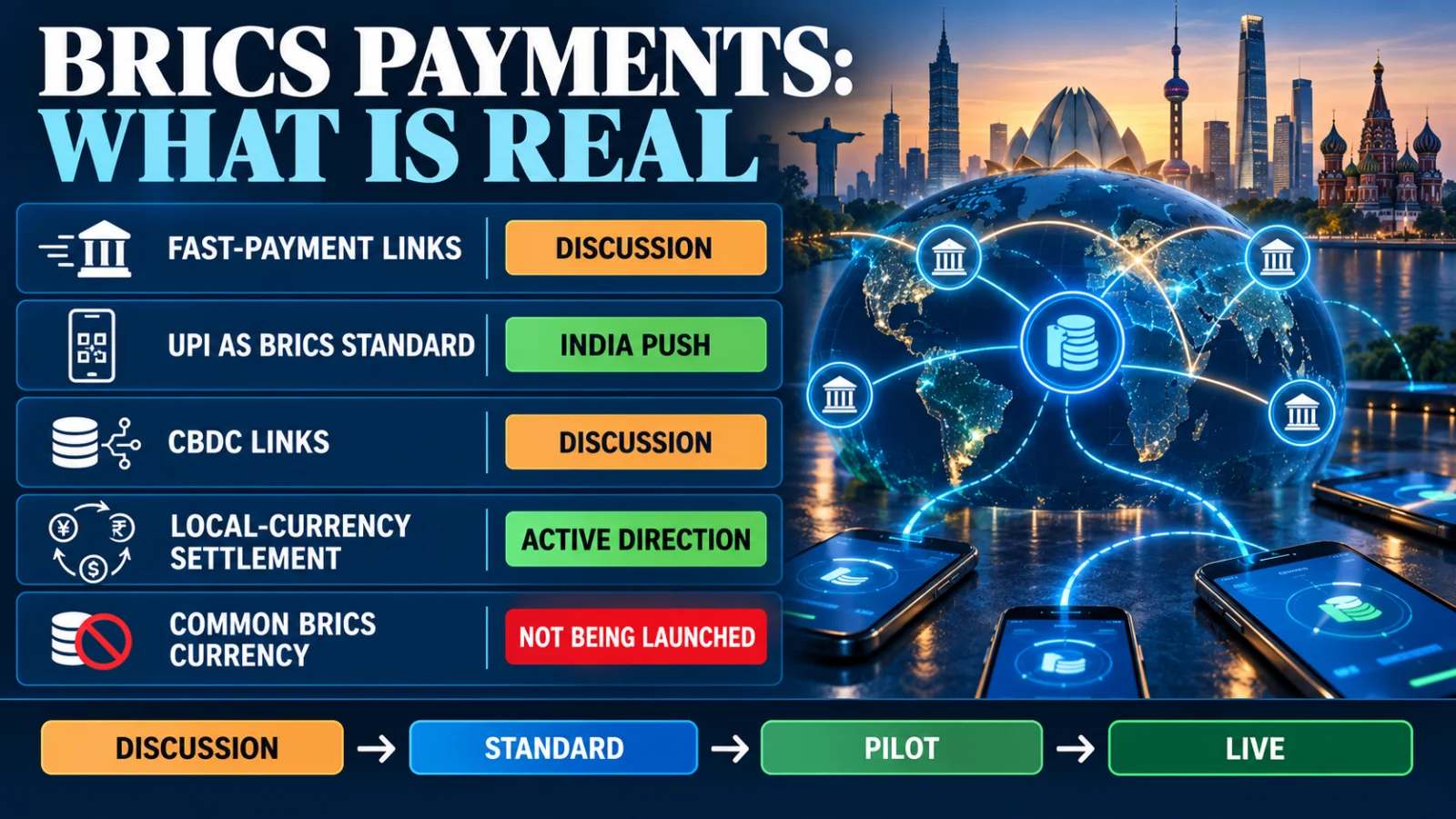
| Concept | What it means | Current state |
|---|---|---|
| Fast-payment interoperability | National instant-payment systems communicate across borders | Being discussed |
| UPI as a BRICS standard | India wants UPI’s model or standards to influence BRICS payment design | Confirmed Indian push |
| CBDC interoperability | National central-bank digital currencies connect for cross-border transactions | Being discussed |
| Local-currency settlement | Transactions use national currencies such as rupee, real or yuan instead of always using the dollar | Active policy direction |
| Common BRICS currency | One shared currency issued or used across the bloc | Not currently being launched |
Why use local currencies if there is no new BRICS currency?
A country does not need to create a new multinational currency to reduce its reliance on the dollar for some cross-border transactions.
Two countries can invoice, settle or clear more trade in their own national currencies. Payment systems can also be connected so that businesses or financial institutions have more direct settlement options.
This may reduce the number of intermediaries or dollar-conversion steps in selected transactions, although the actual savings depend on liquidity, foreign-exchange pricing, compliance costs, settlement design and participation by banks and other institutions.
Would a BRICS payment system replace SWIFT?
Current evidence does not establish that BRICS is launching a system that simply replaces SWIFT.
SWIFT, fast-payment systems, settlement currencies and CBDCs operate at different layers of financial infrastructure. SWIFT primarily provides secure financial messaging between institutions. Retail instant-payment networks move customer payments. CBDCs represent sovereign digital money. Currency settlement determines which assets finally discharge the obligation.
Future BRICS arrangements could reduce dependence on some existing cross-border channels for particular transactions, but saying that BRICS has already replaced SWIFT would outrun the available evidence.
What is BRICS Pay?
The term BRICS Pay has appeared in separate pilot, business-council and industry material around cross-border payment technology.
That should not automatically be treated as identical to the official intergovernmental BRICS Cross-Border Payments Initiative or the BRICS Payment Task Force.
For readers, the safe rule is simple: whenever a BRICS Pay claim appears, check who operates it, which governments or central banks formally participate, whether it is a demonstration or pilot, and whether ordinary users can actually transact through it.
Can an Indian user make a BRICS-wide UPI payment today?
No single BRICS-wide UPI-style retail payment capability has been established as live.
UPI already has international linkages and acceptance arrangements outside the BRICS framework, but those should not be confused with a completed BRICS-wide network.
The BRICS project is currently better understood as an interoperability policy and technical workstream than as a live product for consumers.
What could this eventually mean for remittances and trade?
If BRICS members successfully connect fast-payment systems or CBDCs, the practical benefits could include faster cross-border transfers, fewer payment intermediaries and potentially lower transaction costs.
Exporters and importers could also gain more settlement choices, particularly where national currencies are supported directly.
But these are potential outcomes, not guaranteed benefits. Actual fees and speed would depend on how foreign exchange, compliance, fraud controls, liquidity and final settlement are designed.
Security and data rules could still slow payment links
Cross-border payment connectivity is not only a technology problem.
Countries also need to agree on cybersecurity, fraud controls, data handling, sanctions and compliance screening, dispute resolution and who can access transaction information.
A current India example shows how important those constraints can become. A proposed UPI-Alipay+ linkage was reportedly stalled over security and data concerns. That case is separate from BRICS payment-system negotiations, but it demonstrates that technical interoperability does not automatically produce regulatory approval.
What would count as a real breakthrough at the BRICS Summit 2026?
The September 12–13 leaders’ summit could move the payment project into a materially different state if it produces any of the following:
- a formal leaders’ endorsement of a specific interoperability roadmap;
- named national fast-payment systems that will be linked;
- a CBDC pilot involving identified central banks;
- a technical standard or implementation timetable from the BRICS Payment Task Force;
- clear rules for cross-border settlement in national currencies;
- a confirmed consumer or business pilot with defined participating countries.
Generic language supporting cheaper or more efficient cross-border payments would be less significant than a named implementation mechanism.
How to read the next BRICS payment announcement
The most useful test is to classify the announcement by evidence state.
| State | What it tells you |
|---|---|
| Discussion | Governments or central banks are considering an option |
| Standard proposal | A country or institution is recommending technical rules or architecture |
| Pilot | Named participants are testing a defined connection |
| Implemented linkage | Infrastructure has been formally connected |
| Live consumer availability | Eligible users can actually make transactions through the system |
Moving from one state to the next requires evidence. A political statement or summit declaration should not automatically be described as a live payment product.
Verification method
ThePulseSignal compared the official BRICS Cross-Border Payments Initiative and Payment Task Force language with India’s UPI-standard push, the RBI Governor’s August 2026 remarks on fast-payment and CBDC links, and official BRICS statements on the common-currency question. Current reporting was used to clarify implementation and security issues without treating proposals as live systems.
Limitations & unresolved facts
The final September 12–13, 2026 BRICS summit declaration is not yet available. No single BRICS-wide retail payment network, consumer launch date, member-by-member technical architecture or confirmed CBDC bridge has been established as live. The exact implementation meaning of UPI becoming a BRICS standard remains unresolved, and separate BRICS Pay pilots should not be conflated with official government or central-bank infrastructure.
Bottom line
The BRICS payment system story is about interoperability, not a new common currency. India wants UPI’s model to influence BRICS payment standards, BRICS central banks are discussing links between fast-payment systems and CBDCs, and members are interested in greater use of national currencies for cross-border settlement.
What is not established is equally important: there is no confirmed common BRICS currency launch, no single BRICS-wide UPI network operating for consumers and no evidence that the digital rupee is becoming a shared BRICS currency.
The next meaningful change will come only if the September summit or later central-bank work moves the project from discussion to a defined pilot, technical standard or live linkage.