






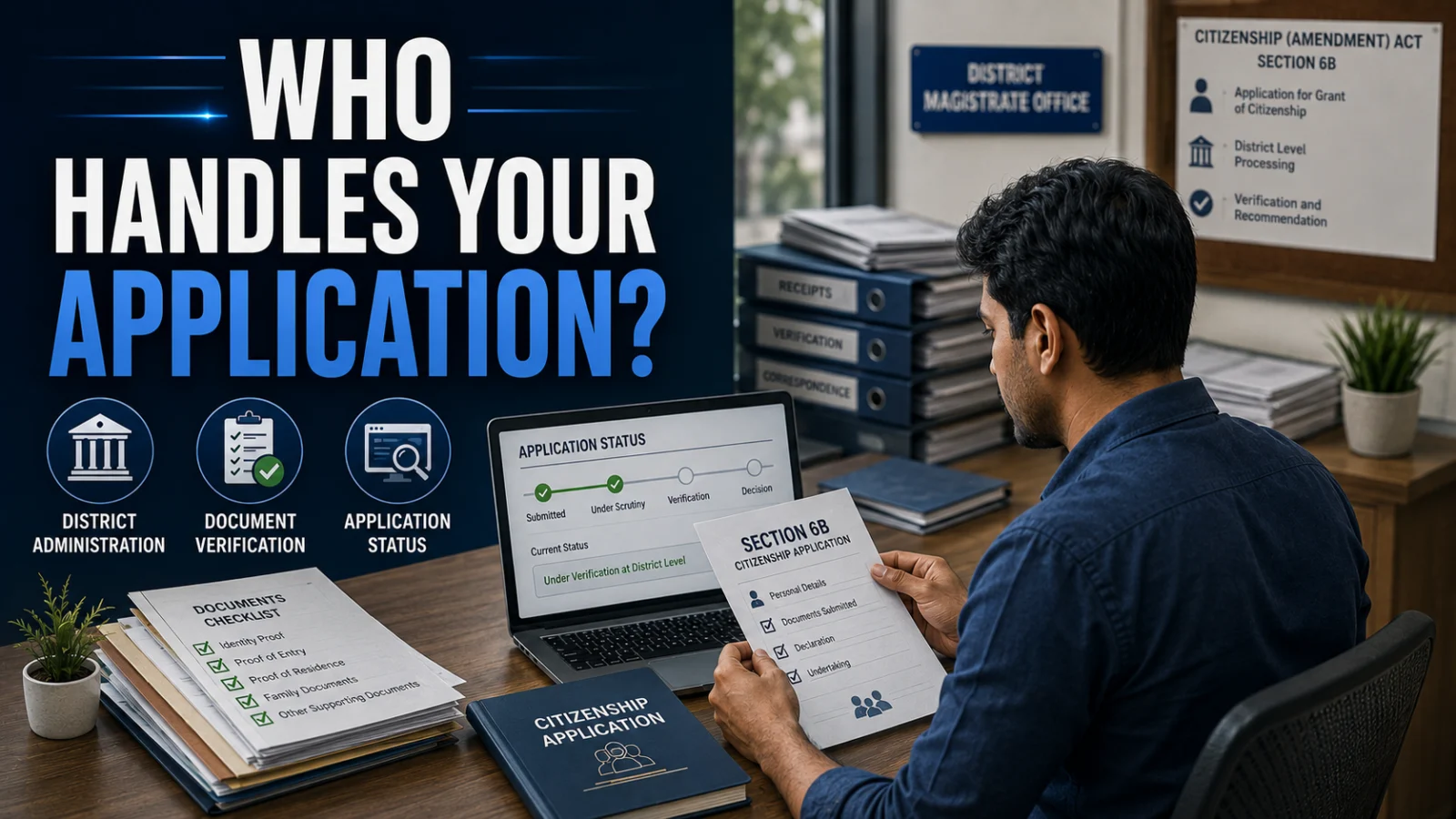
The CAA application process changed in August 2026 for Section 6B applicants ordinarily residing in specified states and Union Territories. The jurisdictional Collector is now the competent authority to receive, scrutinise and dispose of these applications in the covered areas.
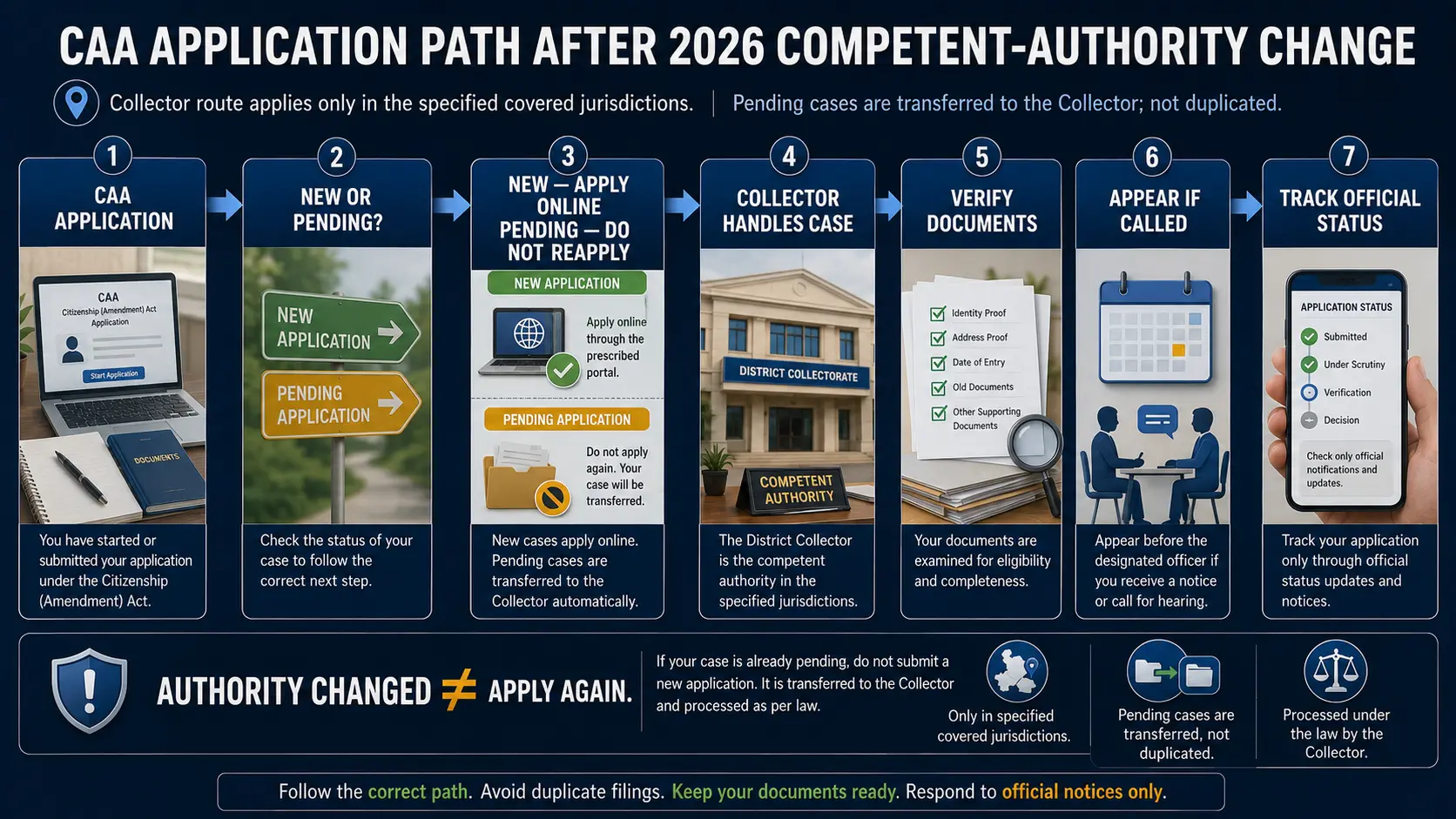
The practical distinction is important for both new and pending applicants. A new application remains an electronic application, while an already-pending application in a covered jurisdiction is to be transferred to the concerned Collector. The reviewed rules and transfer order do not instruct applicants to submit a duplicate application merely because the competent authority changed.
CAA application decision path after the 2026 rule change
New application
Use the official electronic citizenship application route, confirm that your ordinary residence falls within a jurisdiction covered by the new Collector-led process, and follow official instructions for document verification and personal appearance.
Pending application
Do not create a duplicate application solely because the authority changed. The pending case is to be transferred to the concerned Collector in the specified jurisdictions. Continue tracking the official portal and official communication.
If asked to appear
Follow the competent authority’s instructions for document verification, enquiry and the Oath of Allegiance. The rules allow rejection when an applicant fails to appear despite reasonable opportunities.
If the portal wording looks different from the new rules
Distinguish current legal authority from older FAQ language. The August 2026 amendment controls the competent-authority question in the covered jurisdictions.
Who handles CAA applications now?
For Section 6B applicants ordinarily residing in the jurisdictions covered by the 2026 amendment, the Collector having jurisdiction is now the competent authority.
The covered jurisdictions are:
- Gujarat
- Rajasthan
- Punjab
- West Bengal
- Assam, excluding tribal areas
- Tripura, excluding tribal areas
- Jammu & Kashmir
- Ladakh
This does not mean that every citizenship application in every state is now handled by a District Collector. The change discussed here applies to the specified Section 6B CAA application route and the jurisdictions named in the amendment.
What changed from the earlier CAA application process?
The earlier official process described applications moving through the District Level Committee and Empowered Committee structure. The August 2026 amendment changes the competent authority for the covered Section 6B cases to the jurisdictional Collector.
This creates a temporary source-reading problem for applicants because the current Indian Citizenship Online portal still exposes some FAQ language describing the earlier committee process. Applicants should therefore separate two questions:
- Where do I access the application and status system? The official online citizenship portal remains the public application and tracking surface.
- Which authority now receives, scrutinises and disposes of my covered Section 6B application? The later 2026 rule assigns that role to the jurisdictional Collector in the specified areas.
Do new CAA applicants still apply online?
Yes. The amended Rule 11A framework continues to provide for electronic submission. The authority receiving and processing the application has changed in the covered jurisdictions; the amendment does not convert the CAA application process into a purely offline district-office application.
Applicants should use the official Indian Citizenship Online portal for the current application and status surfaces and follow any official instructions issued after submission.
What happens to a CAA application that was already pending?
Pending Section 6B applications before the earlier Empowered Committee or District Level Committee structure in the specified jurisdictions are to be transferred to the concerned Collector.
The transfer is an administrative change in the competent authority. TPS did not find an instruction in the reviewed rule and transfer framework requiring applicants to abandon the existing application and submit a second application merely because the file is moving to the Collector.
That distinction matters because submitting a duplicate application without an official requirement could create additional confusion rather than speed up the existing case.
Do pending applicants need to apply again?
Do not reapply solely because the processing authority changed unless MHA or the competent authority specifically instructs you to do so.
The reviewed government framework provides for transfer of pending applications. It does not establish a general requirement that every transferred applicant create a fresh online application.
If your case is pending, preserve your application or acknowledgement details and continue checking the official status and communication channels for instructions specific to your case.
What can the Collector do under the new process?
The Collector’s role is broader than simply receiving documents. Under the amended process, the competent authority can receive and scrutinise the application, verify the supporting documents, conduct necessary enquiry, administer the Oath of Allegiance, assess whether the statutory requirements are satisfied and dispose of the application.
The exact sequence experienced by an individual applicant can depend on the case and the competent authority’s instructions. TPS has not established a universal district-by-district appointment timetable.
Will applicants need to appear in person?
Personal appearance can form part of the process, including for document verification, enquiry and subscription to the Oath of Allegiance where required.
The amended rules also provide an important consequence: if an applicant fails to appear personally despite being given reasonable opportunities, the application can be rejected.
Applicants should therefore treat an official appearance notice, appointment communication or verification instruction as consequential and should not rely only on a generic portal-status label.
How can you check CAA application status?
Continue using the official Indian Citizenship Online portal and the official communication channels associated with your application. Keep your application details, acknowledgement information and registered contact details available so you can identify genuine status or appearance instructions.
The supplied search evidence shows that readers commonly search for terms such as CAA application status, CAA application check and CAA application status check online. The important current distinction is that the status surface may remain familiar even though the competent authority behind the application has changed.
Why does the official portal still mention the District Level Committee and Empowered Committee?
The current portal exposes older FAQ wording that describes the previous committee-led workflow. That wording should not be treated as stronger than the later August 2026 amendment when deciding who is now the competent authority for covered Section 6B applications.
This does not mean the entire portal is invalid. The portal can still be the correct online application and status surface while some explanatory FAQ text lags behind a later legal amendment.
The safe way to read the two official surfaces together is:
- use the current portal for the electronic application and status functions;
- use the later controlling MHA/Gazette rule for the competent-authority question;
- follow case-specific official communication for appearance, verification and oath instructions.
Are Assam and Tripura fully covered by the Collector-led route?
No. The amendment excludes the tribal areas of Assam and Tripura from this specific Rule 11A(6) Collector route.
Applicants should not generalise a state-level headline into an assumption that every district or protected area follows the same Section 6B processing route.
Does the change guarantee faster CAA application processing?
No guaranteed processing-time improvement was established in the reviewed evidence. Moving authority to the Collector changes who processes and disposes of the covered application, but TPS has not found a universal service-level deadline guaranteeing that an individual application will be decided within a specific number of days.
Processing speed can also depend on document verification, enquiry, appearance, jurisdictional implementation and the state of an already-pending case.
When will a pending application actually reach the Collector?
The transfer order establishes that pending applications are to move to the concerned Collector, but TPS did not establish an applicant-specific transfer timetable or a universal notification schedule.
That means a pending applicant should not infer that silence on a particular day proves the file has not transferred. Conversely, the existence of the transfer order does not prove that every district has already completed every administrative handover.
What should new applicants do now?
- Confirm that you are using the Section 6B CAA application route.
- Check whether your ordinary residence falls within one of the jurisdictions covered by the Collector-led process.
- Use the official electronic citizenship application portal.
- Keep submitted documents and acknowledgement details available.
- Watch official communication for verification, enquiry or Oath of Allegiance instructions.
What should applicants with pending cases do now?
- Do not submit a duplicate application merely because the competent authority changed.
- Keep your existing application and acknowledgement details.
- Continue checking the official status surface and registered communication channels.
- Follow any Collector or official portal instruction requiring document verification or personal appearance.
- If your portal status or communication appears inconsistent, verify against the current MHA rules rather than relying only on older FAQ wording.
What remains unresolved?
Three implementation details remain uncertain from the reviewed evidence: the exact date on which each already-pending file reaches the concerned Collector, district-specific appointment or hearing schedules, and when the older committee references on the official portal will be fully updated.
Those uncertainties do not change the central current rule: for the specified Section 6B jurisdictions, the Collector is now the competent authority, while pending cases are to be transferred rather than automatically refiled by applicants.