




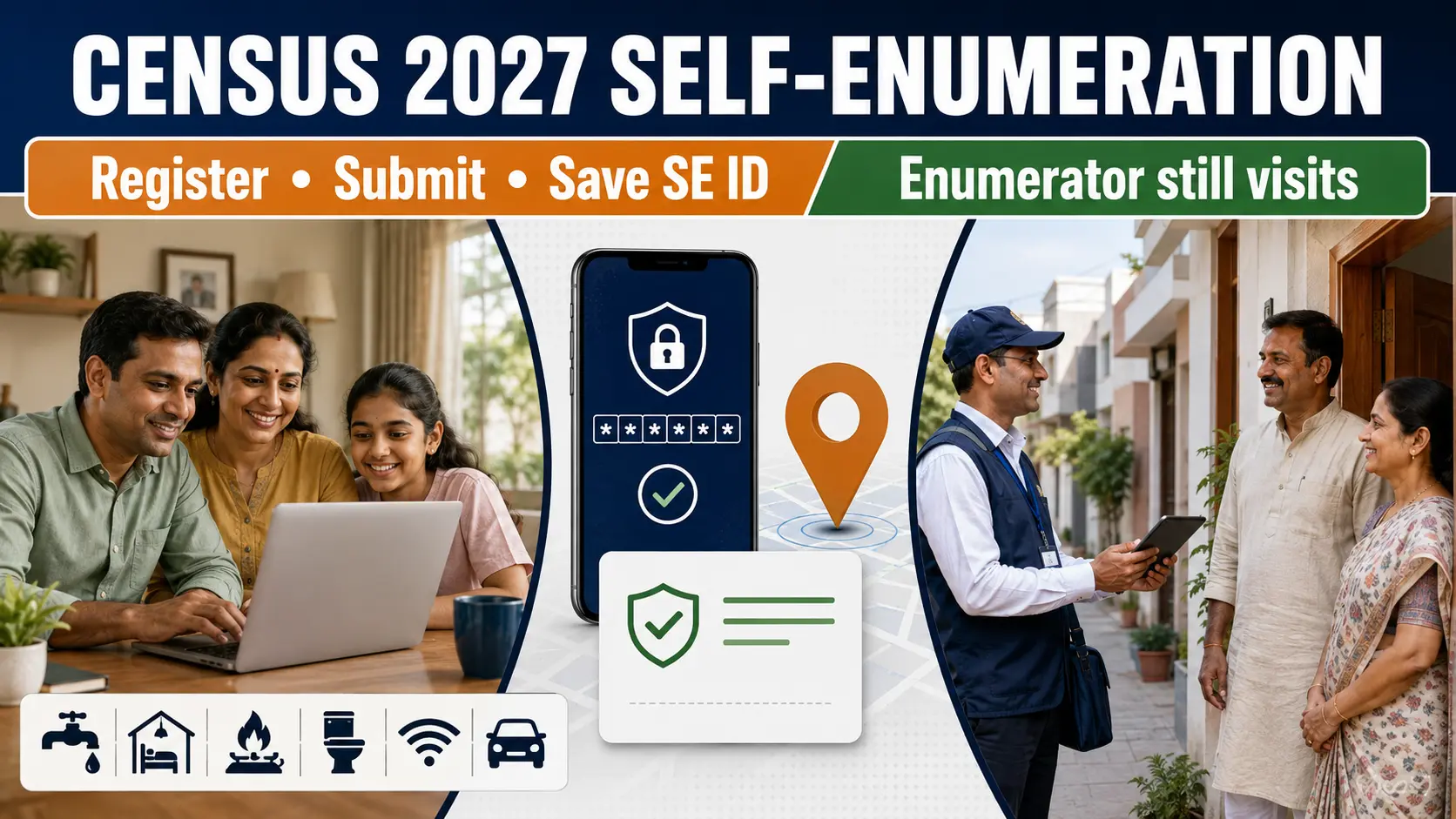
The Census 2027 self enumeration guide now needs one important distinction: Census 2027 has separate self-enumeration windows for Phase I Houselisting and Housing Census and Phase II Population Enumeration. The questions, dates and operational guidance are not interchangeable.
Direct answer: self-enumeration is optional. Use only the official Census self-enumeration portal and check which Census phase and geographic window applies to you. A household that does not complete an available online window remains covered through the notified field-enumeration process.
Phase I and Phase II self-enumeration are different
Phase I records housing and household information. Phase II records population information under a separately notified questionnaire. A date or question list from one phase should not automatically be applied to the other.
| Stage | What it covers | Current schedule position |
|---|---|---|
| Phase I: Houselisting and Housing Census | House, amenities, rooms, water, sanitation, cooking arrangements, connectivity and selected household assets. | State and UT operations were scheduled in rolling windows from April to September 2026. Most Phase I operations were already complete by August, with remaining operations scheduled into September. |
| Phase II: Population Enumeration | A separate population questionnaire covering individual and demographic information. | Population Enumeration has its own geographic timetable and separate self-enumeration windows. |
Do not reuse an old Phase I deadline for Phase II. Census 2027 now has different self-enumeration windows depending on both geography and phase.
What is the next confirmed Phase II self-enumeration window?
The Office of the Registrar General and Census Commissioner published new September 2026 notifications for Goa, Uttar Pradesh, Punjab and the non-snow-bound areas of Uttarakhand.
- Self-enumeration: November 16 to November 30, 2026.
- Population Enumeration: December 1, 2026 to January 4, 2027.
- Revisional round: January 5 to January 9, 2027.
- Reference date: 00:00 hours on January 5, 2027.
These dates do not apply to every part of India. Residents should use the schedule for their own State, Union Territory or notified area.
What happened in the snow-bound areas?
For Ladakh and notified snow-bound or non-synchronous areas of Jammu and Kashmir, Himachal Pradesh and Uttarakhand, Phase II was scheduled earlier. The self-enumeration window ran from August 17 to August 31, 2026, followed by Population Enumeration from September 1 to September 30, 2026.
This is another reason not to assume that one national self-enumeration deadline applies everywhere.
Is the Phase II questionnaire the same as the Phase I form?
No. The Office of the Registrar General and Census Commissioner separately notified the Population Enumeration questionnaire in August 2026.
The Phase I Houselisting and Housing Census form focuses on the house and household facilities. Phase II collects population information under a different schedule. Readers preparing for a Phase II window should not use the Phase I question list as a complete preview of what will be asked.
How does the Phase I online process work?
The step-by-step portal mechanics below were verified for the Houselisting and Housing Census self-enumeration workflow. Phase II operational screens should be rechecked against official guidance when the applicable Population Enumeration window opens.
- Open the official portal. Use se.census.gov.in.
- Select the applicable State or Union Territory. Confirm that the relevant self-enumeration window is active.
- Enter the household head’s name.
- Enter one active mobile number. Email was optional in the Phase I workflow.
- Complete captcha and OTP verification. Never share the login OTP with a caller or visitor.
- Select the available language.
- Enter the address and locate the residence.
- Complete the applicable questionnaire.
- Review before final submission.
- Preserve the generated Self-Enumeration ID. It is used during later field verification.
What is Census 2027 self-enumeration?
Self-enumeration lets an eligible respondent submit Census information digitally before the corresponding field-enumeration visit. It is an optional route rather than a requirement for inclusion in the Census.
Confirmed principle: households that do not use an available self-enumeration facility remain covered through the official field-enumeration process.
Who can use the Phase I self-enumeration workflow?
The Houselisting and Housing Census guidance describes self-enumeration for a normal household. A normal household generally means one person or a group of people who normally live together and share meals from a common kitchen, subject to ordinary temporary absences.
Institutional arrangements such as hostels, hotels, boarding establishments and similar institutions are handled differently.
What information was required for Phase I registration?
Required in the verified Phase I workflow
State or Union Territory, household head’s name, active mobile number, captcha and OTP.
Optional
Email address.
Not shown as a registration requirement
Aadhaar number or identity-document upload.
The official Houselisting instructions also stated that documents did not need to be uploaded. Readers should verify any later Phase II registration requirements when that window opens rather than assuming every Phase I screen remains identical.
Can one mobile number be used for several households?
The Phase I portal instructions stated that one mobile number should be used for one household. This matters when separate families or tenants share a building or when one person is helping relatives at another address.
Separate households should not be merged simply because they share a phone or because one person is assisting them.
Why does the household location matter?
The Houselisting workflow asks the respondent to identify the residence so the online record can be associated with the correct field area and later matched during enumeration.
Location caution: do not deliberately place the location marker at a district centre, post office or approximate landmark when the correct residence can be identified.
What questions are asked in Phase I?
The notified Houselisting and Housing Census schedule covers subjects such as:
- building materials and condition;
- use of the Census house;
- household head and household size;
- rooms and occupancy arrangements;
- drinking water and sanitation;
- kitchen arrangements and cooking fuel;
- lighting, internet and computer access;
- selected household assets; and
- the principal cereal normally consumed by the household.
The separate Phase II Population Enumeration questionnaire has now been officially notified. Readers should use that document for Phase II question preparation rather than treating this Phase I list as the later population questionnaire.
Can a Phase I form be saved and edited later?
Saved as draft
The respondent could return through the registered mobile number and continue the Phase I form while the window remained open.
Before final submission
Answers could be reviewed and revised.
After final submission
Direct online editing was no longer available.
During field verification
The household could report mistakes to the enumerator for correction under the field process.
What is the Census Self-Enumeration ID?
For the verified Phase I workflow, official Census material describes a unique 11-digit Self-Enumeration ID beginning with the letter “H” after successful submission.
Do not rely on third-party code-length claims. The Houselisting guidance reviewed by ThePulseSignal describes an 11-digit SE ID prefixed with “H”.
Keep the ID securely because it is used to help match the online submission during the later enumerator visit.
The exact identifier format used in later Phase II operational guidance should be checked when that self-enumeration window opens rather than assumed from Phase I.
Will an enumerator still visit after online submission?
Yes, field verification remains part of the Census process. Self-enumeration is not the same as removing the household from field operations.
During the verified Houselisting workflow, the enumerator could match the online submission, verify information, add field-only identifiers and resolve corrections or unmatched records.
What happens if you do not self-enumerate?
A household that does not complete an available online window should not use an unofficial form or assume it has been excluded. It remains covered through the notified field-enumeration process.
What should you do if the portal is slow or does not work?
- Confirm the official address is se.census.gov.in.
- Confirm that the correct self-enumeration window is actually open for your phase and area.
- Use a stable internet connection and an updated browser.
- Avoid repeatedly requesting OTPs within a very short period.
- Save a draft when the applicable workflow permits it.
- Use the official Census support route shown on the portal if the problem continues.
Fallback: inability to complete optional self-enumeration does not itself remove the household from Census coverage.
How to avoid fake Census links and OTP scams
- Use only the official se.census.gov.in portal.
- Do not submit Census details through an unknown Google Form or messaging link.
- Do not share the portal OTP with callers or visitors.
- Do not pay a registration or processing fee to unlock self-enumeration.
- Do not provide a UPI PIN, card PIN or internet-banking password.
- Ask a visiting enumerator to show official identification when identity is uncertain.
Security rule: an OTP used to sign in to the Census portal is for the household’s own authentication and should not be disclosed to someone claiming that they need it to activate or approve the form.
Frequently asked questions
Is Census 2027 self-enumeration compulsory?
No. It is an optional digital route. People who do not use it remain covered through field enumeration.
Is there one self-enumeration deadline for all of India?
No. Dates vary by phase and geography. Phase I used rolling State and UT windows, and Phase II also has separate notified schedules.
When is the next confirmed Phase II self-enumeration window?
Goa, Uttar Pradesh, Punjab and non-snow-bound Uttarakhand are scheduled for self-enumeration from November 16 to November 30, 2026, followed by Population Enumeration from December 1, 2026 to January 4, 2027.
Is Aadhaar mandatory for Phase I self-enumeration registration?
The verified Phase I portal workflow did not show Aadhaar as a registration requirement and official instructions stated that documents did not need to be uploaded.
How many digits are in the Phase I SE ID?
Official Houselisting material describes an 11-digit Self-Enumeration ID beginning with “H”.
Will an enumerator visit after online submission?
Yes. Self-enumeration is followed by the applicable field-verification or enumeration process.
Are the Phase I and Phase II question lists the same?
No. The Population Enumeration questionnaire has been separately notified and should be used for Phase II preparation.
Verification method
ThePulseSignal checked the Census of India portal, the official Houselisting and Housing Census schedule and questionnaire, the August 2026 Population Enumeration questionnaire notification, the August Ministry of Home Affairs Census status release and the September 2026 Gazette notifications covering the advanced Population Enumeration schedule for Goa, Uttar Pradesh, Punjab and non-snow-bound Uttarakhand.
The current guide separates Phase I process details from Phase II dates so that Houselisting instructions are not incorrectly presented as universal Population Enumeration instructions.
Limitations and unresolved facts
- Exact portal screens, help text and authentication details may change before a future Phase II self-enumeration window opens.
- The Phase I 11-digit SE ID format and registration workflow should not be assumed to apply unchanged to every later Phase II implementation without current official confirmation.
- State-specific support arrangements and temporary notices can change.
- Portal performance can vary by time, network and active window.
- No comprehensive official national dataset of OTP failures, captcha failures, map errors or abandoned drafts was identified.
- Readers should use the current official Census portal and Gazette schedule for consequential date or submission decisions.