






Energy drinks banned in India? The current evidence still does not establish a nationwide ban on Sting, Red Bull, Monster Energy or Campa Energy. FSSAI’s 2026 enforcement is centred on the use of “energy drink” terminology, product claims and labelling compliance for high-caffeine beverages.
There is now stronger evidence about the compliance timetable. Reuters reported that affected companies were given 90 days and that FSSAI rejected requests for a one-year extension. FoodNavigator reported on August 27 that PepsiCo, Red Bull and Monster face a September 29, 2026 deadline to remove the disputed “energy drink” descriptor. The underlying company-specific FSSAI directions still have not been located as publicly posted primary documents, so September 29 is treated here as a reported deadline rather than an independently inspected FSSAI order.
Direct answer
No nationwide product ban established
The evidence does not establish that Sting, Red Bull, Monster or Campa Energy have been prohibited from sale across India as products.
Current regulatory issue
Labelling and claims compliance
FSSAI enforcement concerns how caffeinated beverages are described, labelled and marketed, including use of “energy drink” terminology and related claims.
Confirmed from public FSSAI material
Caffeinated-beverage standards exist
FSSAI standards recognise carbonated and non-carbonated caffeinated beverages and specify compositional and labelling requirements.
Reported compliance deadline
September 29 reported for major brands
FoodNavigator reported that PepsiCo, Red Bull and Monster have until September 29 to remove the disputed “energy drink” descriptor.
Reported state enforcement
Stock seizures have occurred
Reuters reported seizures involving Sting, Campa Energy and Red Bull in Rajasthan and seizure-based inspections in Ladakh.
Not established
Nationwide product ban or one universal old-stock rule
No public evidence reviewed establishes a nationwide product prohibition or a single sell-through rule applying to every retailer and affected product across India.
1. Are Sting, Red Bull, Monster or Campa Energy banned in India?
No nationwide product ban has been established by the evidence reviewed.
Reuters reported that FSSAI’s enforcement focuses on the way targeted high-caffeine beverages are labelled and described. Removing or changing a descriptor is different from publishing a nationwide order prohibiting the underlying beverage from sale.
| Claim | Status | What the evidence supports |
|---|---|---|
| Sting nationwide ban | Not established | Sting is part of the labelling dispute and Rajasthan seizure reporting, but that does not establish a nationwide product ban. |
| Red Bull nationwide ban | Not established | Red Bull is among affected companies and was reportedly involved in Rajasthan enforcement, but no nationwide product prohibition was identified. |
| Monster Energy nationwide ban | Not established | Monster is affected by the labelling dispute, but the available evidence does not establish a nationwide product ban. |
| Campa Energy nationwide ban | Not established | Campa Energy stock was reportedly seized in Rajasthan enforcement, which is different from a nationwide prohibition. |
| 90-day compliance period | Reported | Reuters reported a private 90-day direction. FoodNavigator later reported September 29 as the compliance deadline for major affected brands. |
For the broader distinction between different regulatory actions, see ThePulseSignal’s guide to FSSAI ban vs recall.
2. What exactly is FSSAI objecting to?
The dispute concerns more than the presence of caffeine. FSSAI’s public standards recognise caffeinated beverages, while the 2026 enforcement reported by Reuters challenges targeted companies’ use of “energy drink” or similar terminology and allegedly misleading functional claims.
Regulatory nuance: a 2024 PIB/FSSAI clarification said the term “Energy Drinks” could be used for products properly licensed under specified caffeinated-beverage categories. The 2026 enforcement reported against targeted products is more restrictive. Because the company-specific 2026 directions are not publicly available, the precise legal reasoning and scope cannot be fully reconstructed from primary documents alone.
3. What are these beverages classified as?
FSSAI standards recognise Carbonated Caffeinated Beverage and Non-Carbonated Caffeinated Beverage categories. Current FSSAI material also prescribes a caffeine range for standardised caffeinated beverages and associated label requirements.
The existence of those categories is why the regulatory dispute should not be described as India banning caffeinated beverages themselves.
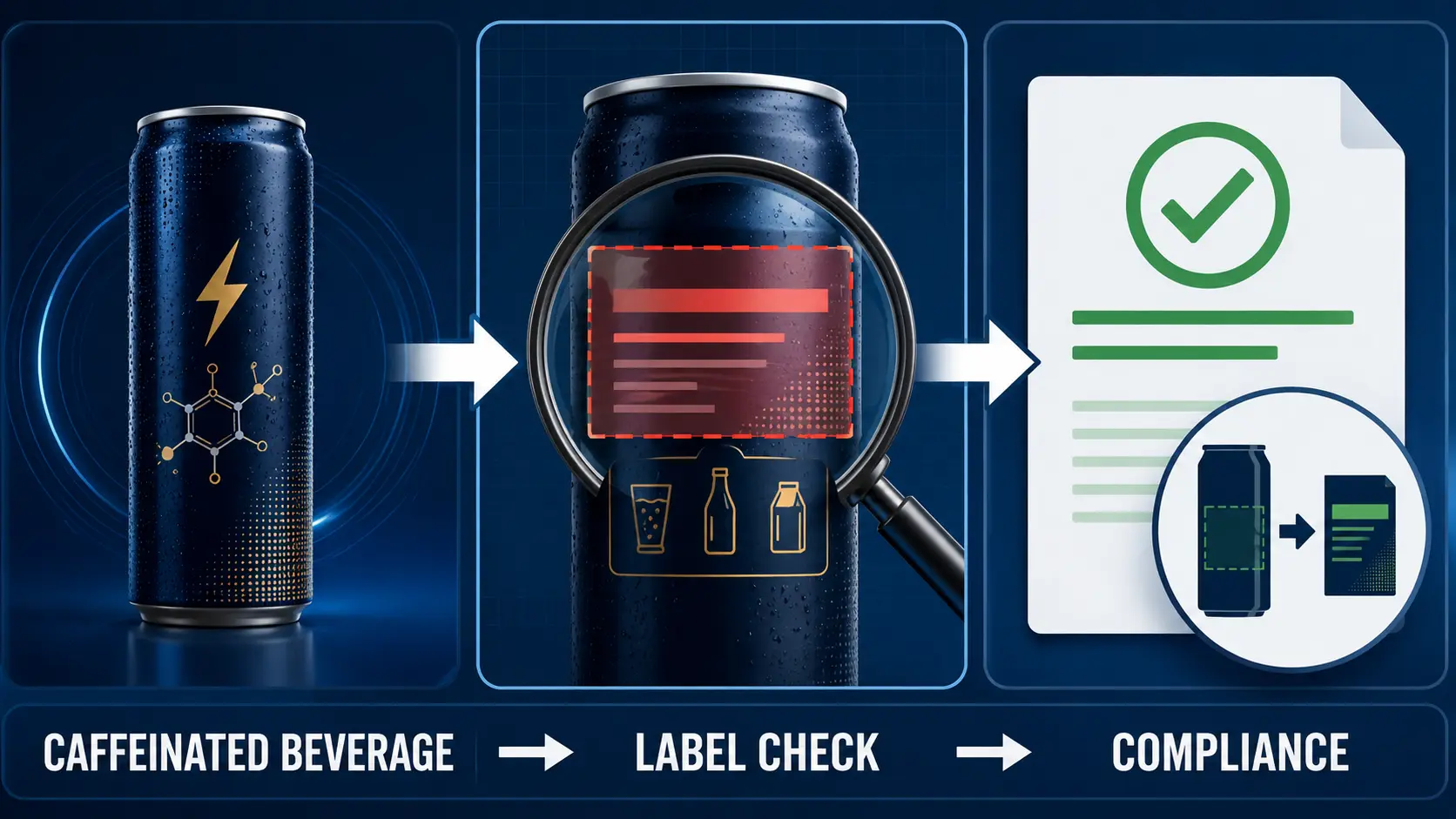
Formulation
The drink contains caffeine and other permitted ingredients.
Classification
The product must fit the applicable food category and standard.
Labelling
The name, descriptor and claims must comply with applicable rules.
Enforcement
Authorities may act against products they consider misbranded or non-compliant.
4. What is the current 90-day deadline?
September 29, 2026 is now reported as the compliance deadline for major affected brands, but it has not been independently verified from a publicly posted company-specific FSSAI order.
Reuters reported that FSSAI had privately given companies 90 days and would not grant the requested one-year extension. FoodNavigator reported on August 27 that PepsiCo, Red Bull and Monster face a September 29 deadline to remove the “energy drink” descriptor.
For consequential compliance decisions, use the actual notice issued to the company or controlling FSSAI communication. A reported September 29 date is stronger evidence than simply calculating 90 days from a news date, but the underlying private order remains the best source for the operative deadline.
5. If there is no nationwide ban, why was stock seized?
Local enforcement against stock considered mislabelled is not the same as a nationwide prohibition on the beverage itself.
Reuters reported that Rajasthan seized thousands of units involving Sting, Campa Energy and Red Bull. It also reported that Ladakh’s food-safety office was conducting inspections where seizure was part of the enforcement process.
Seizure is still consequential. Retailers and distributors in jurisdictions actively enforcing the directions may face action against stock considered non-compliant even though that does not establish a nationwide product ban.
6. Can old-labelled stock still be sold?
No single publicly posted national sell-through rule covering every affected product and retailer was identified.
Reuters reported that many states believed existing stocks could be sold within 60 to 90 days. Companies had sought more time because substantial inventory was already in the market or on order. State seizure activity shows that actual enforcement can differ by jurisdiction.
A separate FSSAI enforcement case involving Amway’s XS caffeinated beverage adds another useful signal: reporting on FSSAI’s August corrective-action update said Amway agreed to remove “Energy Drink” from its product artwork and marketing and requested permission to sell existing stock carrying the earlier artwork until exhausted. That request should not be treated as a general permission applicable to Sting, Red Bull, Monster, Campa or every retailer.
Retailer caution: do not rely on a general media estimate for old stock if a company-specific notice, state instruction or food-safety officer has imposed a different requirement.
7. Is FSSAI’s action broader than Sting, Red Bull, Monster and Campa?
Yes, there is evidence that FSSAI’s scrutiny of the “Energy Drink” descriptor is not limited to the original group of widely reported beverage brands.
Reporting on FSSAI’s August 25 corrective-action disclosure says Amway India accepted directions to discontinue “Energy Drink” from its XS caffeinated beverage range and revise its packaging and promotional material.
This supports a broader interpretation: FSSAI is actively scrutinising energy-related descriptors and claims across caffeinated beverages. It still does not prove that every product marketed with the phrase “energy drink” has received an identical notice or is subject to the exact same deadline.
Does FSSAI’s action mean the drinks are unsafe?
No blanket unsafe-product finding has been established for Sting, Red Bull, Monster or Campa Energy by the evidence reviewed.
The current dispute concerns labelling, classification and marketing claims. Separate public-health concerns around caffeine, sugar or other ingredients do not turn a labelling action into proof that the named products failed laboratory safety tests.
What about Bindu B-Hot Energy Drink?
Bindu’s own beverage catalogue continues to list “B-Hot (Energy Drink – Blazing Berry)”.
That makes B-Hot relevant to monitor as FSSAI scrutinises the descriptor more broadly. However, no reliable evidence reviewed establishes that Bindu or B-Hot received the same company-specific 2026 direction issued to the major brands discussed above.
Do not infer a notice from the product name alone. The product’s current marketing wording is verified from Bindu’s own site; receipt of a specific FSSAI enforcement notice remains unverified.
Verification notes: confirmed, reported and unresolved
Confirmed from official sources
Caffeinated-beverage regulation exists
FSSAI standards recognise caffeinated beverages and prescribe relevant compositional and labelling requirements.
Reported by Reuters
90-day direction and rejected extension
Reuters reported that affected companies were privately given 90 days and that FSSAI would not extend that period to one year.
New deadline evidence
September 29 reported
FoodNavigator reported September 29 as the deadline for PepsiCo, Red Bull and Monster to remove the disputed descriptor.
Broader enforcement evidence
Amway changed its XS wording
Reporting on FSSAI’s corrective-action disclosure says Amway accepted directions to remove “Energy Drink” from its XS range.
Verification method: ThePulseSignal separates public FSSAI standards and government guidance from company-specific enforcement that remains private. Reuters is used for the original 90-day direction, rejected extension and local seizures; FoodNavigator is used for the reported September 29 deadline; reporting on FSSAI’s August corrective-action disclosure is used for the Amway example; Bindu’s own site is used only to verify its current product description.
Sources checked
FSSAI primary
FSSAI Standards
Used to verify that caffeinated-beverage standards continue to exist.
Government primary
PIB/FSSAI 2024 clarification
Used for the official distinction around appropriate categorisation and “Energy Drinks” terminology.
Reliable secondary
Reuters — August 7
Used for the private 90-day direction, rejected extension and state enforcement.
Industry source
FoodNavigator — August 27
Used for the newly reported September 29 compliance deadline.
Company primary
Bindu beverage catalogue
Used only to verify B-Hot’s current product wording.
Limitations and unresolved facts
The company-specific FSSAI directions behind the original 90-day compliance action were not found as publicly posted documents.
September 29 is now reported as the deadline for major affected brands, but the exact company-specific FSSAI order establishing that date was not independently inspected.
No universal publicly posted nationwide sell-through instruction for old-labelled stock was identified.
State and Union Territory enforcement can differ, so Rajasthan or Ladakh seizures should not automatically be generalised to every state.
No nationwide product ban on Sting, Red Bull, Monster or Campa Energy was established.
No blanket laboratory finding that the named products are unsafe was established.
Amway’s corrective action shows broader scrutiny of the “Energy Drink” descriptor but does not prove every caffeinated beverage has received an identical notice.
Bindu currently markets B-Hot as an energy drink, but no evidence reviewed establishes that Bindu received the same enforcement notice.
Energy drinks banned in India: FAQs
Is Sting banned in India?
No nationwide Sting ban has been established. Sting is involved in the labelling dispute and has been reported in Rajasthan seizure enforcement.
Is Red Bull banned in India?
No nationwide Red Bull ban has been established. Red Bull is affected by the labelling dispute, and September 29 is reported as a compliance deadline for the descriptor change.
Is Monster Energy banned in India?
No nationwide Monster Energy ban has been established. Monster is among companies affected by the labelling action.
Is Campa Energy banned?
No nationwide Campa Energy ban has been established. Campa Energy stock was reportedly involved in Rajasthan enforcement.
When does the 90-day deadline end?
September 29, 2026 is now reported as the deadline for major affected brands. The underlying company-specific FSSAI order has not been publicly inspected, so businesses should verify their own controlling notice.
Does FSSAI still recognise caffeinated beverages?
Yes. Public FSSAI standards continue to recognise carbonated and non-carbonated caffeinated beverages.
Did Amway also remove “Energy Drink” wording?
Yes. Reporting on FSSAI’s August corrective-action disclosure says Amway accepted directions to remove the term from its XS caffeinated beverage range.
Is Bindu B-Hot affected?
Bindu’s website currently describes B-Hot as an energy drink, but no evidence reviewed establishes that Bindu received the same 2026 company-specific notice.