






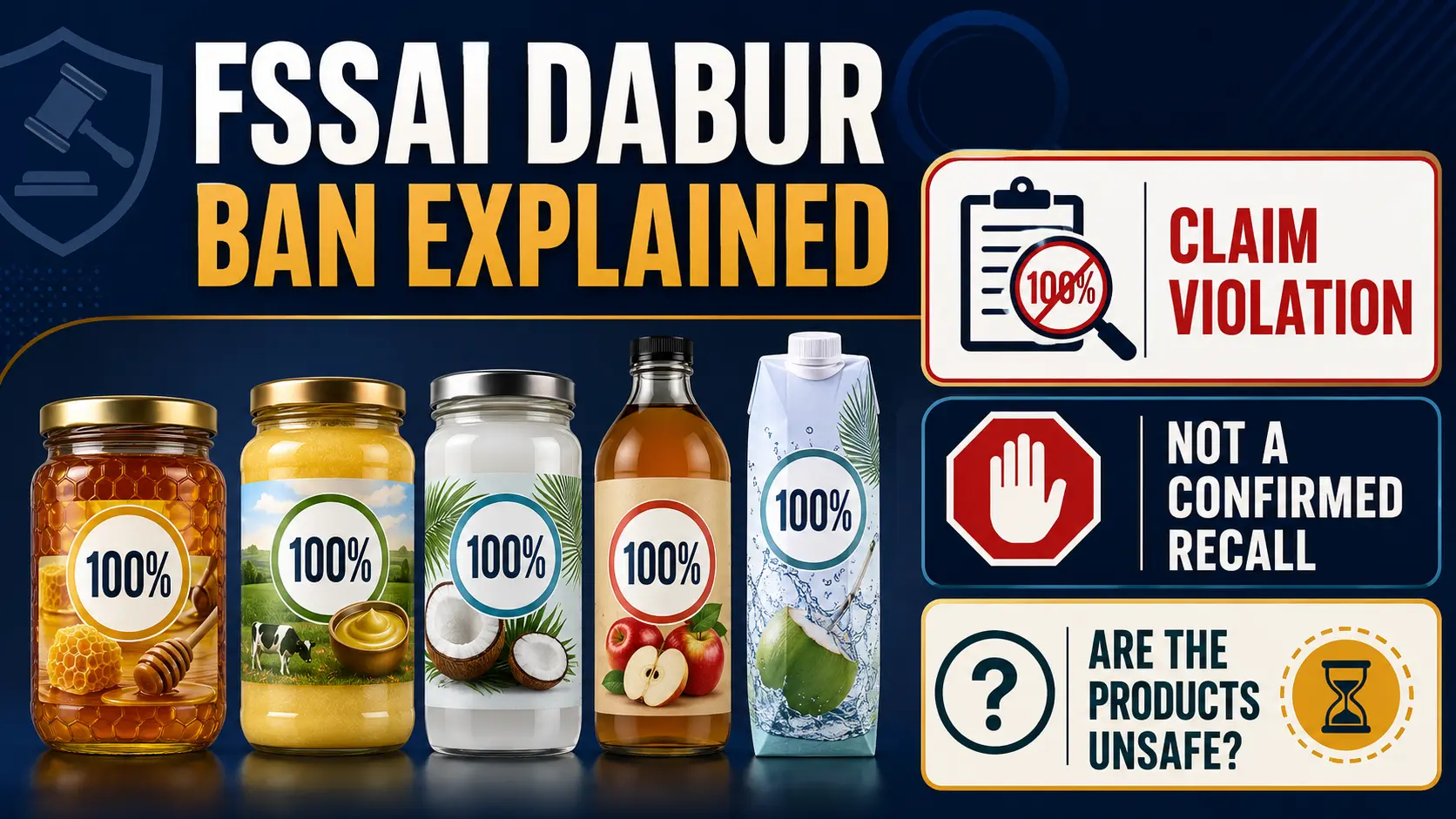
The FSSAI order that prohibited Dabur from selling identified food products carrying disputed “100%” claims is currently stayed by the Delhi High Court.
The court first stayed the August 3 prohibition order on August 7. At the August 24 hearing, the matter was listed for December 16, 2026, and Dabur disclosed that the stay will continue until then.
This does not mean the Delhi High Court has ruled that Dabur’s “100% Pure,” “100% Natural” or similar claims are legally valid. The underlying dispute remains pending.
Current legal status: FSSAI’s August 3 prohibition order is stayed.
Next listed hearing: December 16, 2026.
Not established: a consumer recall, a general unsafe-food finding, laboratory-confirmed adulteration or an instruction for consumers to discard Dabur honey, ghee or the other identified foods.
- What is the current status?
- What did FSSAI originally order?
- What does the Delhi High Court stay mean?
- Which products were identified?
- Were the foods declared unsafe?
- Is there a consumer recall?
- What should consumers do?
- What does this mean for retailers?
- What about Jaivik Bharat?
- What happens next?
- Limitations
What is the current FSSAI Dabur ban status?
As of September 1, the August 3 FSSAI prohibition order is not currently operating as an active stop-sale direction because the Delhi High Court has stayed it.
On August 7, the court granted Dabur interim relief after observing at a preliminary stage that the prohibitory order ought not to have been issued without giving the company an opportunity to be heard.
The initial stay was linked to the August 24 hearing. Dabur subsequently informed the stock exchanges that the matter was re-notified for December 16 and that the stay would continue in force until that date.
A stay is not a final judgment on the labels. The court has paused the operation of FSSAI’s order while the challenge continues. It has not finally decided whether every disputed “100%” representation complies with food-claims law.
What did FSSAI originally order?
FSSAI’s August 3 action concerned food products carrying absolute representations such as “100% Natural,” “100% Pure,” “100% Purity Guaranteed” and “100% Organic.”
The regulator said such claims could be ambiguous, unverifiable and misleading under the Food Safety and Standards advertising-and-claims framework.
The original order directed Dabur to stop selling identified products carrying the disputed claims and called for an Action Taken Report within 15 days.
Because the prohibition order is now stayed, that original direction should not be described as the current enforceable status without also stating the court order.
What does the Delhi High Court stay mean?
| Question | Current answer |
|---|---|
| Is FSSAI’s August 3 stop-sale order currently in force? | No. Its operation is stayed while the court case continues. |
| Did the court declare the “100%” claims lawful? | No final ruling on that issue has been reported. |
| Did the court declare the products safe or pure? | No. The interim order concerns the regulatory action and procedure, not a laboratory safety certification. |
| Has the FSSAI case disappeared? | No. The underlying dispute remains pending. |
| When is the next listed hearing? | December 16, 2026, according to Dabur’s August 24 exchange update. |
Which Dabur products were identified in the FSSAI action?
Public reports on the August 3 order identified products or categories including:
- honey;
- organic honey;
- apple cider vinegar;
- virgin coconut oil;
- sesame oil;
- cow ghee;
- coconut water; and
- coconut milk.
The publicly accessible material reviewed still does not establish a complete consumer SKU, batch and pack-size list that should be treated as a recall list.
Do not convert the product examples into an “all Dabur products banned” claim. The original action concerned identified food products and disputed claims, and the prohibition order itself is now stayed.
Did FSSAI find Dabur honey or ghee unsafe?
The evidence reviewed for this dispute does not establish a general unsafe-food finding.
FSSAI’s reported objection concerned advertising and labelling claims. A misleading or inadequately substantiated claim is legally different from a laboratory finding that a food is contaminated, adulterated or unsafe.
No public-health warning tied to this specific order, batch-specific safety recall or instruction not to consume the identified products was found in the material reviewed.
Claim dispute: whether a label or marketing statement complies with the applicable advertising-and-claims rules.
Food-safety finding: evidence that composition, contamination, adulteration or another safety parameter failed a required standard.
Has Dabur honey or ghee been recalled?
No consumer-level recall connected to this FSSAI “100%” claims dispute was identified in the current evidence reviewed.
A consumer recall normally provides identifying information such as product name, batch or lot number, manufacturing or expiry dates, the reason for recall and consumer return, refund or disposal instructions.
The August 3 dispute was a claim-related prohibition order, and that order is now stayed. Consumers should therefore not treat the event as proof of a batch recall unless FSSAI or Dabur publishes a separate recall notice.
What should consumers do if they already bought Dabur honey, ghee or another named product?
- Do not discard a product solely because of the August 3 headline. No general consumer discard instruction was identified for this claims dispute.
- Keep the packaging. Preserve the product name, variant, pack size, batch number, manufacturing date and expiry date.
- Keep proof of purchase where possible. This may help if a later product-specific return or recall instruction is issued.
- Check current official notices. Look for a specific FSSAI, Dabur or retailer notice rather than relying on an old stop-sale headline.
- Follow ordinary food-safety precautions. Do not consume food that is expired, damaged, leaking, swollen, smells abnormal or otherwise appears unsafe.
- Seek medical advice for concerning symptoms. The court stay does not replace normal health precautions for any suspected food reaction.
What does the court stay mean for retailers and marketplaces?
The specific August 3 prohibition order is stayed. That changes the position from the original immediate stop-sale direction.
Retailers and marketplaces should nevertheless follow current instructions from the regulator, Dabur, their authorised distributor and any later court or regulatory order. The stay should not be treated as permission to ignore unrelated food-safety, labelling or certification obligations.
What happened to the Jaivik Bharat issue?
FSSAI’s August action also reportedly questioned use of the Jaivik Bharat organic mark or endorsement on identified Dabur organic products.
The court stay does not establish that those organic representations are valid. Nor does the allegation itself establish that the food is unsafe. The certification and claims questions remain part of the unresolved regulatory dispute unless separately decided by the relevant authority or court.
What happens next in the Dabur-FSSAI case?
Dabur’s August 24 stock-exchange update states that the Delhi High Court has listed the matter for December 16, 2026 and that the existing stay will continue until then.
Before that date, the position could still change if the court passes another order, FSSAI issues a new legally operative direction, the parties resolve part of the dispute or Dabur changes the disputed labels voluntarily.
Until there is such evidence, the safest current description is: FSSAI issued the August 3 prohibition order, but the Delhi High Court has stayed its operation and the legal dispute remains pending.
Verification method
The current status was checked against Reuters reporting on the original FSSAI action and the August 7 Delhi High Court interim relief, legal reporting describing the basis of the stay, and Dabur’s August 24 stock-exchange update reporting that the matter was moved to December 16 with the stay continuing.
FSSAI’s regulations and Jaivik Bharat portals remain relevant for the underlying claims, labelling and organic-certification framework.
Sources reviewed
Limitations and unresolved facts
The legal dispute is still pending. The stay is interim relief and should not be represented as a final judgment validating or rejecting the disputed “100%” claims.
- The final merits of Dabur’s challenge remain unresolved.
- The complete signed FSSAI order and annexed consumer-level SKU list were not located in the official indexed material reviewed.
- No consumer recall tied to this claims order was identified.
- No general refund or disposal instruction was identified.
- No laboratory-confirmed adulteration finding tied to the order was identified.
- The final regulatory treatment of the disputed “100%” claims remains unresolved.
- The final status of the Jaivik Bharat endorsement allegations remains unresolved.
- The stay can be modified by a later court order before the currently listed December 16 hearing.
Frequently asked questions
Is the FSSAI Dabur ban still in force?
The August 3 prohibition order is currently stayed by the Delhi High Court. Dabur says the stay will continue until the next listed hearing on December 16, 2026.
Can Dabur currently sell honey and ghee with the disputed claims?
The specific FSSAI prohibition order stopping those sales is stayed. This does not amount to a final court ruling that every disputed claim is lawful.
Did the Delhi High Court say Dabur honey is safe?
No. The interim relief concerns the FSSAI prohibition order and the process by which it was issued. It is not a laboratory or food-safety certification.
Has Dabur honey been recalled?
No consumer-level recall related to this “100%” claims dispute was identified in the current evidence reviewed.
Should consumers throw away Dabur honey or ghee?
No general disposal instruction linked to this claims dispute was identified. Consumers should follow any later product- or batch-specific official instruction if one is issued.
When is the next court hearing?
Dabur’s exchange update states that the Delhi High Court listed the matter for December 16, 2026.
Last verified: September 1, 2026.
