






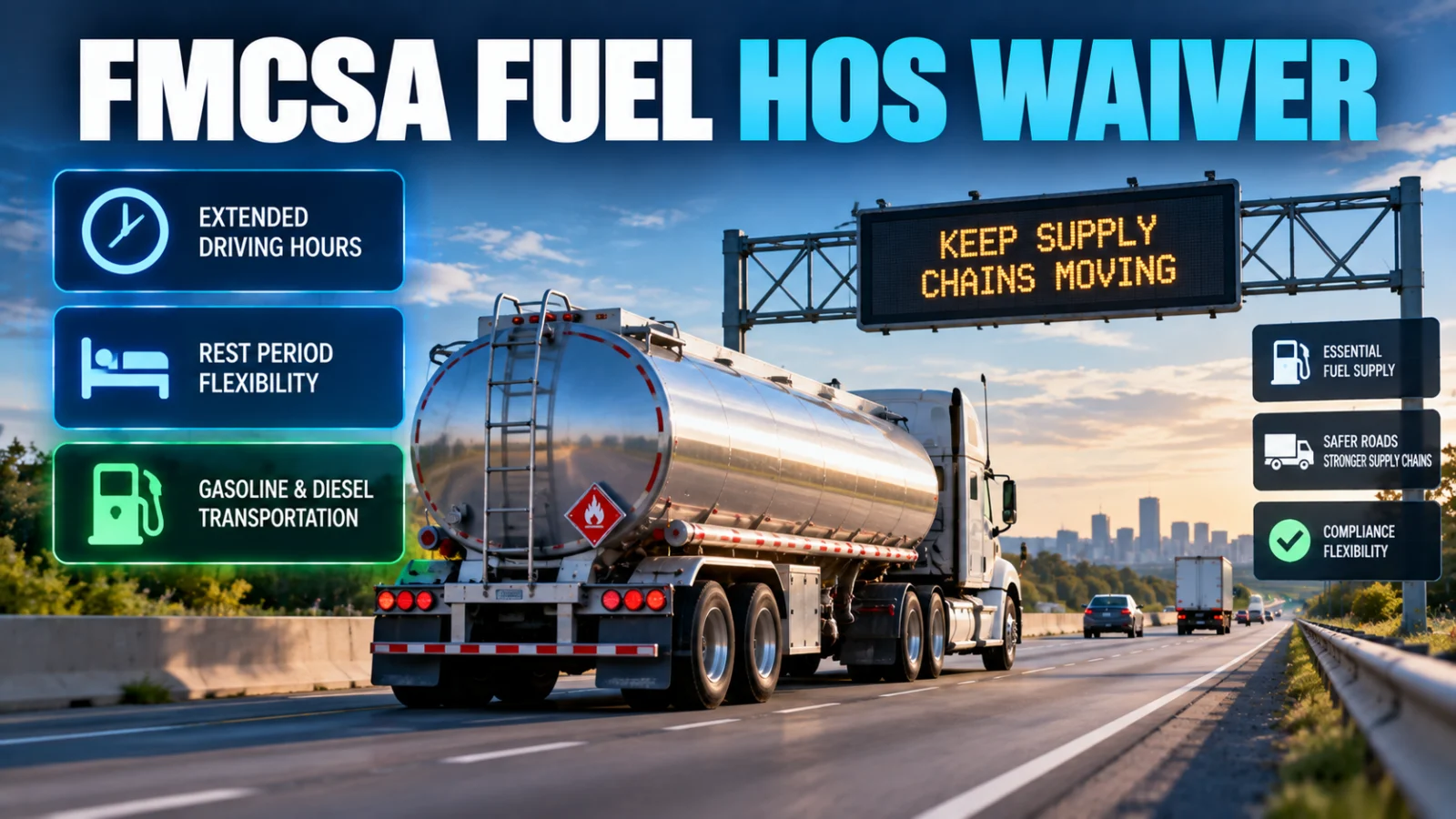
The FMCSA fuel HOS waiver temporarily changes the hours-of-service rules for qualifying interstate gasoline and diesel transportation through December 16, 2026. It does not suspend trucking safety rules generally. Instead, FMCSA waived the ordinary limits in 49 CFR 395.3 for eligible fuel-hauling operations while imposing a separate set of driving, rest, eligibility, documentation and reporting conditions.
Who can use the FMCSA fuel HOS waiver
The waiver applies to motor carriers and drivers transporting gasoline or diesel fuel in interstate commerce. It is not a blanket exemption for every commercial truck, every fuel-related trip or every intrastate movement.
Drivers using the waiver must hold a valid commercial driver’s license and any required endorsements. Carriers with a conditional safety rating are not eligible, and drivers or carriers subject to an active out-of-service order cannot use the relief until that restriction is lifted.
What the 16-hour limit actually means
The waiver permits qualifying drivers to drive for up to 16 hours in any 24-hour period. That is a maximum operating limit under the waiver, not permission to drive continuously for 16 hours without rest.
Drivers must receive at least six consecutive hours in a sleeper berth during each 24-hour period. If the vehicle does not have a sleeper berth, the driver must receive at least eight consecutive hours off duty.
If a driver requests immediate rest because of fatigue or another safety concern, the carrier must allow the driver to stop safely and take at least 10 consecutive hours off duty before driving again.
What rules were not waived
The FMCSA action is narrow. Other requirements continue unless the waiver specifically says otherwise. That includes commercial-driver licensing, required endorsements, hazardous-material rules, drug and alcohol requirements, insurance requirements, size and weight limits, route restrictions and other applicable federal or state safety rules.
The waiver should therefore not be described as a general suspension of hours-of-service or trucking safety regulation.
Drivers must carry the waiver
A driver operating under the waiver must carry a physical or digital copy of it. That makes the waiver itself part of the driver’s compliance documentation while using the temporary relief.
Does the empty return trip count?
Yes. The relief also covers the driver’s empty return to the motor carrier’s terminal or the driver’s normal work reporting location after transporting gasoline or diesel under the waiver.
However, transition back to normal operations still carries a rest requirement. If operations under the waiver, or waiver operations combined with normal operations, total at least 14 hours, the driver must take a 10-hour break before resuming normal regulated driving.
Interstate and intrastate fuel hauling are different
For qualifying interstate transportation, FMCSA says states may not enforce laws or regulations that conflict with or are inconsistent with the federal waiver. That does not mean every intrastate fuel movement is automatically covered.
States may choose to adopt the same policy for intrastate operations, but carriers should verify the current state rule before assuming the federal waiver applies to an entirely intrastate trip.
This is not a nationwide fuel emergency declaration
FMCSA issued the action as a waiver tied to a nonemergency and unique event. The agency cited global supply disruptions, anticipated fuel demand and acute fuel-supply issues as reasons for providing temporary transportation flexibility.
That rationale should not be converted into a broader claim that every U.S. market is experiencing a gasoline or diesel shortage.
Crash reporting still applies
If a qualifying crash occurs while a driver is operating under the waiver, the motor carrier must report it to FMCSA within two business days and provide the information required by the waiver.
When does the waiver end?
The waiver is effective from September 16, 2026 through 11:59 p.m. on December 16, 2026, unless FMCSA changes, revokes or replaces it earlier.
The waiver may increase fuel-hauling flexibility during supply stress, but completed evidence does not establish how much it will change regional fuel availability, carrier utilization or pump prices. Those outcomes should remain separate from the confirmed regulatory change.
What carriers and drivers should verify now
- Confirm that the load is gasoline or diesel covered by the waiver.
- Confirm that the transportation is interstate or that any applicable intrastate relief has separately been adopted.
- Check carrier and driver eligibility before relying on the waiver.
- Follow the 16-hour driving ceiling and the applicable sleeper-berth or off-duty rest requirement.
- Carry a physical or digital copy of the waiver.
- Continue complying with CDL, hazmat, drug and alcohol, insurance, vehicle and other rules that were not waived.
- Apply the required 10-hour break before returning to normal operations when the waiver’s transition condition is met.
What could change next
This article should be updated if FMCSA amends or revokes the waiver, changes the covered transportation or eligibility rules, issues a material interpretation, publishes significant safety information, or extends or replaces the waiver at or before its December 16 expiration.